 27°C

Dominican Republic to Track Larimar From Mine to Market by 2027
A new digital platform will assign unique identifiers to Larimar stones and record their journey from extraction in Barahona through processing and sale, strengthening safeguards against counterfeit products and supporting the gemstone’s international market position.


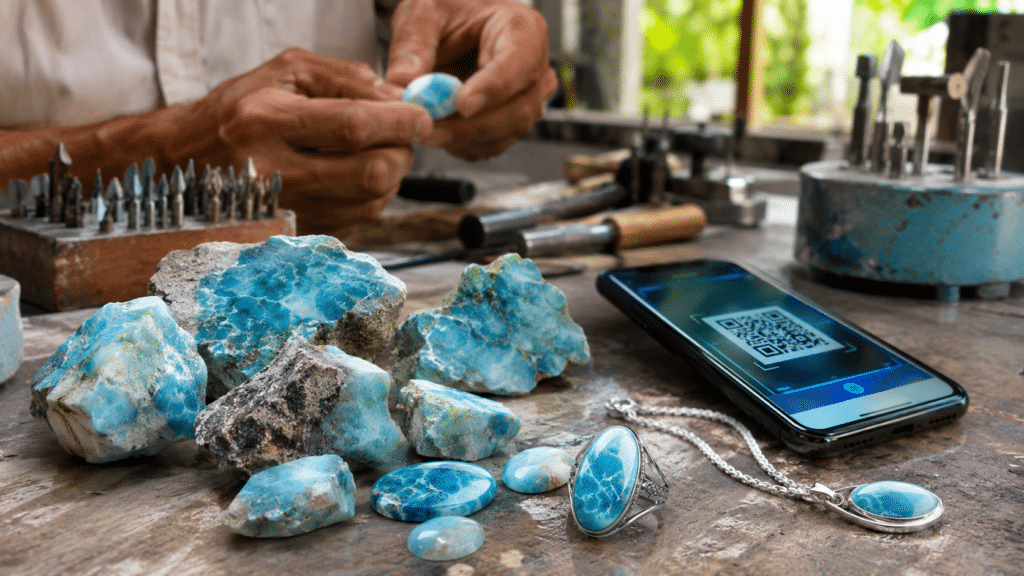
The Dominican Republic is preparing a digital traceability system for Larimar, the distinctive blue gemstone found exclusively in the country. The platform, scheduled for launch in 2027, is designed to document each stone’s origin and follow its movement through the supply chain, from mining to its final sale as jewelry or artwork.
The initiative is being developed by the Ministry of Energy and Mines (MEM), the National Office of Industrial Property (Onapi) and other members of the Regulatory Council for the Larimar Barahona Designation of Origin.
Golye Latoufe, the MEM’s director of Mining Promotion and president of the regulatory council, said the system will use unique codes assigned to extracted batches. Information will be added at successive stages of production, allowing the origin and handling history of individual pieces to be checked.
Digital identification will follow each stone
The process is expected to begin at the mine, where Larimar will be identified according to the specific extraction well from which it originated. Additional registered characters or images will then be incorporated as the material moves through cutting, processing and commercialization.
Latoufe said each stone will also receive an engraved identifier designed to last more than 100 years. That marking will be connected to the digital platform, creating a record of the people and businesses involved in its journey.
The system is intended to give buyers and businesses a more reliable way to distinguish authenticated Dominican Larimar from stones or products whose stated origin cannot be verified. It could also provide greater visibility into the supply chain for miners, artisans, jewelers and exporters.
Designation of origin supports international protection
The traceability project builds on the existing legal protection of the Larimar Barahona designation of origin. The designation links the gemstone’s name to its geographic origin and establishes conditions for authorized use in commercial products.
The World Intellectual Property Organization (WIPO) records Larimar Barahona as an appellation of origin from the Dominican Republic. Its documented geographical area covers the Larimar mine in the Sierra de Bahoruco, in Barahona province, including the communities of Los Checheses and La Filipina.
According to the Ministry of Energy and Mines, the designation is currently registered in 29 countries. Applications are also being pursued in China, India, the United States and Ecuador. Authorities are considering a further step in 2027 involving Germany, which Latoufe said could extend protection across the European Union.
The international registration was formally presented to Energy and Mines Minister Joel Santos on July 24, 2025, by Onapi Director General Salvador Ramos.
Onapi certification and QR verification
Onapi plays a central role in the system because it manages trademarks, industrial designs and other intellectual property rights associated with Larimar products.
Latoufe explained that businesses and producers seeking authorization to use the designation of origin must first be registered with Onapi. Certificates issued through the process include QR codes that can be checked through the agency’s institutional portal.
The protection effort also includes collective trademark registration for Larimar miners, a measure intended to support the formalization of the sector. The new digital record would add a product-level tracking mechanism to those existing legal and certification tools.
Consumers and exporters can also consult the government’s Larimar and amber verification and classification service, which explains the technical certification process required for mineral exports.
Strengthening the value of a Dominican gemstone
Beyond authentication, the authorities say the initiative is intended to improve Larimar’s commercial value and provide buyers with greater assurance about its origin and the standards applied during extraction and processing. These include environmental, sustainability and occupational safety requirements.
The Regulatory Council oversees the authenticity, quality and commercial standards associated with the designation in domestic and international markets. It is chaired by the Ministry of Energy and Mines and includes Onapi, the Ministry of Industry, Commerce and MSMEs, the General Directorate of Customs, the National Geological Survey and ProDominicana, among other institutions.
For the Dominican gemstone industry, the planned platform would connect geographic-origin protection with a digital record of each product’s supply chain. Its effectiveness will ultimately depend on how consistently miners, processors, artisans and sellers adopt the identification and verification procedures once the system becomes operational.