 26°C
26°C

Disaster Risk Perception in Santo Domingo’s Informal Settlements
A 2026 study of nine informal settlements in Greater Santo Domingo found a broad pattern of moderate underestimation of disaster risk, despite residents living with recurring exposure to floods, hurricanes and other hazards. Based on 198 surveys across four municipalities, the research suggests that how communities understand risk is shaped not only by physical exposure but also by poverty, memory of past disasters, institutional trust, personal involvement and perceptions of whether the consequences of a disaster can be reversed. The findings provide a detailed picture of selected communities in the capital region, but the researchers caution that they should not be generalized to all informal settlements in the Dominican Republic.


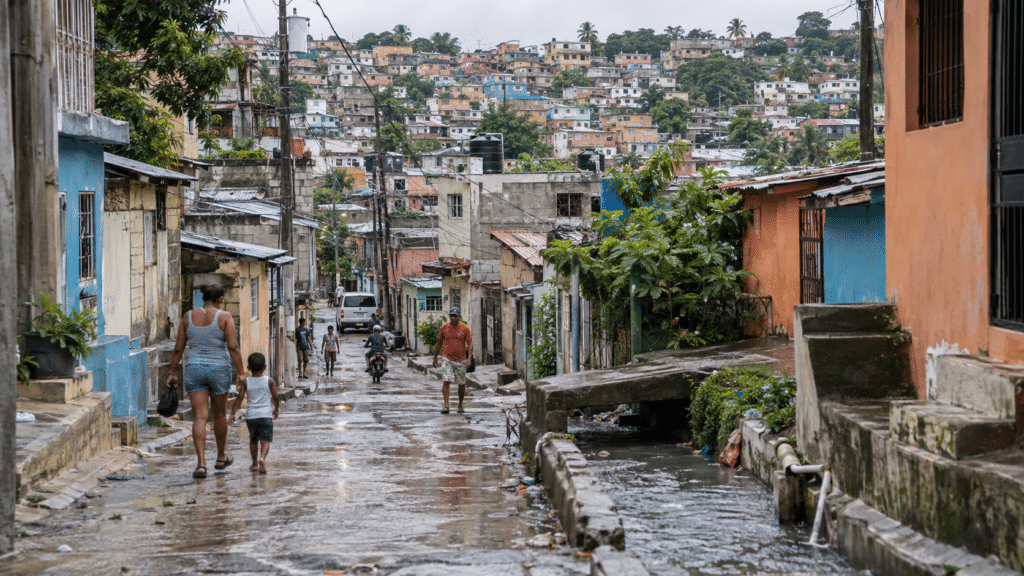
The risk of a disaster is not determined only by the hazard itself. Two communities exposed to similar flooding, heavy rainfall or hurricanes may respond differently depending on whether residents understand the threat, remember previous events, trust institutions, feel personally involved in preparedness and believe they have the resources to recover. A study published in Urban Science in 2026 examines this less visible dimension of disaster risk in nine informal settlements in Greater Santo Domingo, offering a detailed look at how residents perceive danger and how poverty and living conditions interact with that perception.
What the Santo Domingo Study Investigated
The research by Yanelba E. Abreu-Rojas, Juan C. Sala-Rosario, Antonio Torres-Valle, Antonio Jurado-Málaga and Ulises J. Jauregui-Haza focused on the relationship between subjective disaster risk, poverty and socio-environmental vulnerability. Rather than measuring only physical exposure to hazards, the researchers asked how residents themselves understand and evaluate the risks around them.
This distinction matters. Objective risk assessment can use information such as records of floods, rainfall, infrastructure conditions or the location of hazard-prone areas. Risk perception, by contrast, concerns the way people interpret those threats. The study treats perception as a multidimensional phenomenon influenced by knowledge, experience, emotions, social conditions and institutional factors.
The research was designed as a case study rather than a national survey. Its findings therefore describe the selected communities in Greater Santo Domingo and should not be interpreted as a statistical portrait of every informal settlement in the Dominican Republic. The authors themselves identify broader generalization as a subject for future research.
The Nine Settlements Examined
The fieldwork covered nine informal settlements distributed across the National District and the municipalities of Santo Domingo Este, Santo Domingo Norte and Santo Domingo Oeste. The communities were selected using criteria including climate vulnerability, poverty, infrastructure conditions, population characteristics, potential hazards and disaster history.
| Settlement | Municipal area represented in the study |
|---|---|
| La Yuca | Greater Santo Domingo |
| La 800ta | Greater Santo Domingo |
| Capotillo | Greater Santo Domingo |
| Los Mina | Greater Santo Domingo |
| Los Tres Brazos | Greater Santo Domingo |
| Los Coordinadores | Greater Santo Domingo |
| Villa Mella | Greater Santo Domingo |
| Pueblo Chico | Greater Santo Domingo |
| Juan Guzmán | Greater Santo Domingo |
The companion 2026 resilience research conducted with the same nine communities identifies the geographic scope as Santo Domingo Norte, Santo Domingo Este, Santo Domingo Oeste and the National District. It also confirms the nine-community sample used for the broader resilience assessment.
The study design deliberately included communities with different levels of vulnerability and resilience. That allowed the researchers to examine whether risk perception varied according to living conditions rather than assuming that all informal settlements experience risk in exactly the same way.
How Researchers Measured Disaster Risk Perception
The study used a mixed-methods approach centered on the RISKPERCEP algorithm and a structured questionnaire containing 98 questions grouped into variables related to risk perception. A total of 198 valid surveys were collected across the four municipal areas.
The sample was calculated using a probabilistic formula based on the population of the selected settlements. Survey administrators received training before fieldwork, and the research team used a digital questionnaire system that allowed information to be compiled during data collection. Participation required informed consent, and eight people who declined to participate were excluded from the results.
The researchers also consulted experts and applied statistical techniques including Pearson’s chi-square tests and Cramér’s V coefficients to examine relationships among categorical variables. The purpose was not simply to produce a single perception score, but to identify the variables associated with departures from what the methodology defined as an adequate level of perceived risk.
Within the RISKPERCEP framework, a value of 2 represents adequate risk perception. Values between 1 and 2 indicate underestimation, while values between 2 and 3 indicate overestimation. The distinction is important because underestimating risk and overestimating it can have different implications for preparedness and adaptation.
The Central Finding: Risk Was Generally Underestimated
The communities displayed a general tendency toward moderate underestimation of disaster risk, with average results between approximately 1.5 and 1.7 on the study’s perception scale. The differences between the municipal groups were relatively small, leading the researchers to concentrate on the factors behind the perception gap rather than treating one municipality as fundamentally different from the others.
The study links the underestimation pattern primarily to several interconnected factors: limited understanding of hazards, a weak sense of personal involvement, limited perception of the catastrophic potential of events, poor knowledge or memory of previous impacts, limited concern about consequences, and perceptions of insufficient institutional attention.
In practical terms, the finding does not mean that residents believe disasters are impossible. Rather, the research indicates that the perceived level of risk does not consistently match the combination of hazards and vulnerabilities documented in the selected communities.
That distinction is important. A household can recognize that flooding occurs while still underestimating how severe the consequences could be, how quickly conditions can deteriorate or how difficult recovery may become. Risk perception therefore involves more than simply knowing that a hazard exists.
Floods and Hurricanes Were the Most Frequently Reported Hazards
Among the hazards considered in the survey, respondents most frequently identified riverine and rainfall-related flooding and hurricanes. Landslides followed them in reported frequency. Earthquakes and tsunamis were included in the assessment but received substantially fewer positive responses from participants.
The prominence of flooding is consistent with the physical geography and urban conditions examined by the researchers. Informal settlements in Greater Santo Domingo can face combinations of intense rainfall, inadequate drainage, occupation of environmentally exposed areas and infrastructure limitations. The study therefore treats disaster risk as a product of interacting environmental and social conditions rather than as the consequence of a single hazard.
Anthropogenic hazards were also considered. Domestic fires, particularly those associated with electrical systems, were identified as the most frequently reported human-caused disaster risk in the survey.
The study’s findings should nevertheless be kept within their geographic and methodological boundaries. They describe perceptions among respondents in the nine selected settlements; they do not establish that the same ranking of hazards applies to every neighborhood in Santo Domingo or elsewhere in the country.
Why Poverty Changes the Meaning of Disaster Risk
One of the most important findings is the relationship between socioeconomic conditions and the way residents perceive disasters. The researchers found that poverty can influence risk perception in apparently contradictory ways.
On one side, repeated exposure to difficult living conditions may normalize danger. When flooding, poor infrastructure or other hazards become part of everyday life, residents may become accustomed to them. That can contribute to lower concern about prevention or reduce the perceived urgency of adaptation.
On the other side, severe poverty can increase the perceived consequences of a disaster. A household with little or no financial reserve may understand that losing a roof, appliances, documents, employment or basic household assets could be extremely difficult to recover from.
The researchers therefore distinguish between the perception of prevention and the perception of consequences. Poverty may weaken the sense that preventive action is achievable while simultaneously increasing concern about what would happen if a major event occurred.
This is one reason the study does not treat risk perception as a simple measure of awareness. People’s judgments are shaped by their ability to act on what they know. Knowledge of a hazard does not automatically translate into the ability to reinforce a home, relocate temporarily, purchase insurance, miss work for preparedness activities or replace possessions after a disaster.
Which Groups Reported Greater Vulnerability?
The research found that socioeconomic deprivation was strongly associated with perceived vulnerability. The study specifically highlights women, retirees and lower-income groups as groups in which vulnerability and perceptions of socioeconomic disadvantage were particularly evident.
The researchers also report substantial material deprivation within the survey population. Their analysis found that 42.9% of respondents lived in conditions classified as severe material deprivation, while 88.2% of households reported having no financial margin for unexpected expenses.
These figures come from the study’s surveyed population and should not be interpreted as estimates for all residents of Greater Santo Domingo or all Dominican households. They are important precisely because they show how the social and economic characteristics of the selected communities interact with disaster preparedness.
For a family without financial reserves, disaster preparedness is not simply a matter of receiving better information. The practical barriers may include housing quality, access to credit, employment insecurity, transportation, health conditions and the ability to absorb a temporary loss of income.
Institutional Trust and Personal Involvement Matter
The study identifies perceived institutional attention and organizational climate among the factors associated with risk underestimation. That finding points to an important distinction between receiving a warning and having confidence that institutions, community organizations and households can act effectively on that warning.
The Dominican Republic has a formal national disaster-management system. The Centro de Operaciones de Emergencias (COE) coordinates preparedness and response among institutions within the national disaster-management system, while Defensa Civil Dominicana is responsible for coordinating and carrying out prevention, mitigation, emergency response and disaster-protection activities.
The COE also publishes preparedness material covering hurricane alerts, evacuation maps, family emergency plans and emergency kits. Its alert system distinguishes among green, yellow and red levels, with progressively stronger precautions as the expected danger increases. The COE’s hurricane preparedness resources provide these materials for public use.
These institutional mechanisms provide an important context for interpreting the study. The research does not conclude that emergency institutions are absent. Instead, it identifies perceived institutional attention and trust as components of the social environment that can influence whether residents recognize and act on disaster risks.
The Broader Dominican Context
The study is focused on nine communities, but those communities exist within a country exposed to multiple natural hazards. International disaster-risk assessments have repeatedly identified the Dominican Republic as vulnerable to hurricanes, floods, droughts, earthquakes and other hazards. The World Bank has also emphasized that vulnerable households can face greater difficulty coping with and recovering from climate-related shocks.
The United Nations Office for Disaster Risk Reduction has documented the country’s efforts to strengthen disaster-risk governance, while noting the importance of hazard and vulnerability information, planning and institutional capacity. More recent regional work has also focused on disaster-risk financing and resilience in the Dominican Republic and neighboring countries.
For the Dominican Republic, the significance of the Santo Domingo study therefore extends beyond the question of whether residents know about floods or hurricanes. It raises a broader policy issue: risk reduction depends partly on whether people can translate information into practical action.
That can require more than public warnings. It can involve safer housing, drainage and infrastructure, community organization, social protection, evacuation planning, accessible information and confidence that assistance will be available when a household is affected.
What the Study Says About Preparedness
The researchers’ interpretation is that low risk perception can become a barrier to adaptation. If residents underestimate a threat, they may be less likely to participate in preparedness activities or support measures intended to reduce exposure and vulnerability.
But the study also points to an important limitation of purely educational approaches. If vulnerability is rooted partly in poverty and deficient infrastructure, telling residents that they face danger does not by itself remove the underlying conditions that produce the risk.
The authors therefore call for an integrated approach combining social protection, climate education, urban resilience and community-based adaptation. They also discuss incentives and emergency support mechanisms as potential ways to connect household assistance with risk-management and community-resilience activities.
Those proposals should be understood as recommendations from the researchers, rather than as established government policy or as evidence that a particular program has already been demonstrated to work in these communities.
A Second Study Helps Put the Findings in Context
A companion study published in Sustainability in 2026 examined climate resilience in the same nine Greater Santo Domingo settlements using the IRECLIVA index. That research combined expert assessments with community-perception information and evaluated dimensions including housing and infrastructure, the natural environment, community and governance, economy and insurance, and health and well-being.
The IRECLIVA assessment classified four of the nine settlements as low resilience and five as medium resilience. Its objective scores ranged from 15.75 for Los Coordinadores to 53.375 for Juan Guzmán on the study’s 0-to-100 scale. La Yuca, La 800ta and Los Mina also fell in the low-resilience category, while Capotillo, Los Tres Brazos, Villa Mella, Pueblo Chico and Juan Guzmán were classified as medium.
| Settlement | Objective IRECLIVA score | Resilience classification |
|---|---|---|
| La Yuca | 33.25 | Low |
| La 800ta | 28.875 | Low |
| Capotillo | 40.25 | Medium |
| Los Mina | 28.875 | Low |
| Los Tres Brazos | 45.50 | Medium |
| Los Coordinadores | 15.75 | Low |
| Villa Mella | 44.625 | Medium |
| Pueblo Chico | 50.75 | Medium |
| Juan Guzmán | 53.375 | Medium |
The two studies measure different things and should not be treated as interchangeable. The disaster-risk perception study examines how residents understand and evaluate risk. IRECLIVA assesses resilience through objective expert-based criteria alongside community information. Their value lies partly in showing that physical resilience and perceived risk are related dimensions but are not the same measurement.
The companion study also identified housing, infrastructure and environmental conditions as major contributors to differences in resilience among the nine communities. That provides a useful physical counterpart to the perception study’s findings about knowledge, institutional trust, socioeconomic conditions and personal involvement.
Why the Nine Communities Should Not Be Treated as One
It would be misleading to describe the study as evidence that all informal settlements in Santo Domingo have the same level of preparedness or risk awareness. The researchers deliberately selected communities with different characteristics, and the results show that vulnerability is multidimensional.
Even within the nine-community study area, conditions differ in housing, infrastructure, environment, socioeconomic circumstances and resilience. The perception study found relatively small differences in overall municipal perception while identifying substantial differences in the variables behind those perceptions.
This is important for policymakers because a single citywide intervention may not address the reasons why risk is underestimated in a particular community. One settlement may need stronger flood preparedness, another may face severe housing deficiencies, while another may require stronger community organization or improved access to emergency information.
The study therefore supports a more localized approach to risk diagnosis. Its proposed methodology is intended to identify the variables that contribute to a perception gap so that adaptation measures can be designed around specific conditions rather than relying solely on broad assumptions about vulnerable populations.
What the Findings Mean for Disaster Policy
The central policy implication is that preparedness cannot be separated from social vulnerability. A warning system can identify a dangerous event, but its effectiveness ultimately depends on whether people understand the warning, trust the information, know what action to take and have a realistic ability to carry it out.
This makes community-level risk education potentially valuable, but the study suggests that education should operate alongside measures addressing the conditions that make disasters more damaging. Housing quality, infrastructure, poverty, access to services and community organization all influence the practical capacity to prepare and recover.

This approach is broadly consistent with the direction of disaster-risk policy in the Dominican Republic. The country’s disaster-management institutions have emphasized prevention, preparedness, community training, contingency planning and early warning, while international partners have supported improvements in risk information, land-use planning, safer construction, social protection and disaster-risk financing.
The challenge is therefore not simply to make communities more aware of hazards. It is to connect awareness with the resources, infrastructure, institutions and social protections that allow people to act on that awareness.
What the Study Does Not Prove
The research provides important evidence, but its conclusions have clear boundaries. It is a case study of nine informal settlements in Greater Santo Domingo, not a national survey. The authors explicitly identify the need for additional research before the methodology and findings can be generalized to other communities across the Dominican Republic.
The study also identifies associations between socioeconomic and perception variables. These relationships should not automatically be interpreted as proof that one variable directly causes another. Risk perception is shaped by multiple interconnected factors, and the statistical associations reported by the researchers are part of that broader multidimensional picture.
The results should also not be interpreted as a judgment on the attitudes or abilities of residents. Underestimating risk can arise from structural conditions, repeated exposure, limited resources, institutional relationships and other circumstances. The research is ultimately concerned with diagnosing those conditions, not assigning responsibility to individual households.
The Larger Lesson for Santo Domingo
The research offers a useful reminder that disaster risk is partly a social problem. Flooding, hurricanes and heavy rainfall are physical hazards, but the damage they cause depends on where people live, the quality of their homes and infrastructure, their economic resources, their access to information and their ability to act before and after an emergency.
For the nine settlements studied, the research identifies a recurring perception gap that exists alongside socioeconomic and physical vulnerability. That does not mean residents are unaware of disasters. Instead, it suggests that awareness, perceived severity, personal involvement, institutional trust and the ability to prepare do not always align.
That distinction is particularly relevant for a rapidly urbanizing metropolitan area such as Greater Santo Domingo. Risk reduction cannot be reduced to emergency response after a flood or hurricane has already occurred. It also involves understanding how communities experience risk before an event, why some threats become normalized and what prevents households from turning knowledge into practical preparedness.
The study’s most important contribution is therefore methodological as well as substantive: it demonstrates how community-level measurement of risk perception can reveal factors that conventional hazard assessments may miss. Its evidence comes from nine selected settlements, not from the country as a whole. But within those boundaries, the findings show why disaster resilience requires attention not only to hazards and infrastructure, but also to the social and economic conditions that shape how people perceive, prepare for and recover from them.
For official information on emergency preparedness and alerts, readers can consult the Centro de Operaciones de Emergencias and Defensa Civil Dominicana. The original research is available through Urban Science and MDPI. International context on disaster-risk management in the Dominican Republic is also available from the United Nations Office for Disaster Risk Reduction and the World Bank.