 27°C
27°C

Dominican Republic Employment Reaches 5.27 Million in Q2
Employment in the Dominican Republic rose 2.9% year over year to 5,271,005 workers in the second quarter of 2026, while women accounted for most of the net jobs created over the past 12 months.


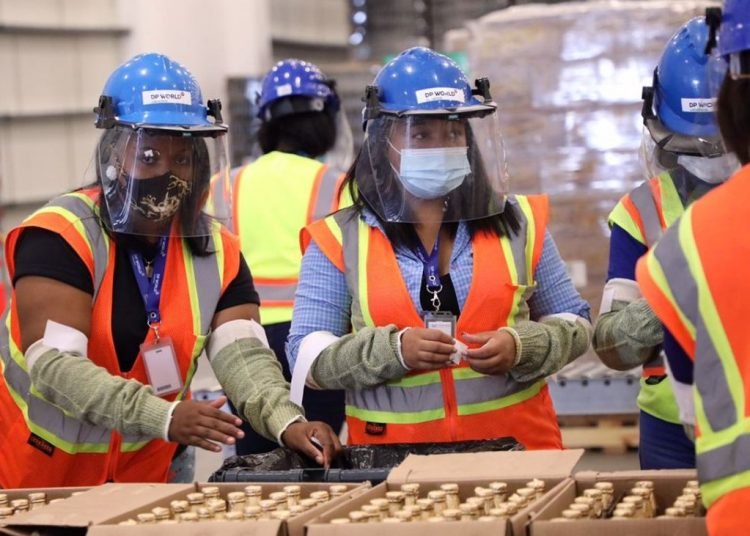
The Dominican Republic’s labor market added 147,456 net jobs between April-June 2025 and the same period of 2026, bringing total employment to 5,271,005 workers, according to the Central Bank of the Dominican Republic (BCRD).
The 2.9% year-over-year increase kept the country’s employment rate at 63.2% and the global labor force participation rate at 66.8%. Both indicators remained close to their historical highs, pointing to continued high labor-force participation and employment in the Dominican economy.
Formal Jobs Accounted for Half of the Increase
Formal employment represented slightly more than half of the jobs created over the 12-month period. Formal workers increased by 74,794, or 50.7% of the net employment gain, while informal employment contributed another 72,663 workers, equivalent to 49.3%.
The total informality rate stood at 53.8% in the second quarter. That was below the 56.7% historical average recorded in the BCRD’s labor-force survey series since 2014, indicating that the share of informal employment remained below its long-term average even as informal jobs continued to account for a substantial portion of new employment.
The previous year’s data provide a reference point for the change. In the second quarter of 2025, the BCRD reported 5,123,548 employed people and an informality rate of 54.0%, while the employment rate stood at 62.8%.
Women Drove Most of the Net Employment Growth
Women accounted for the largest share of the increase in employment. The number of employed women rose by 127,742 over the year, representing 86.6% of the net jobs added. Men accounted for the remaining 19,714 additional workers.
Despite that increase, men continued to represent the larger share of total employment. Of the 5.27 million employed people recorded in the second quarter, 57.0% were men and 43.0% were women.
Unemployment and Labor Underutilization Edged Higher
The labor market expansion was accompanied by a modest increase in unemployment measures. The open unemployment rate, known as SU1, reached 5.3% in April-June 2026, up 0.3 percentage points from 5.0% a year earlier.
The broader SU3 underutilization rate, which includes both people actively seeking work and those available to work but not actively searching, also increased by 0.3 percentage points to 8.7%.
These measures provide a broader view of labor-market conditions than employment growth alone. The combination of higher employment and slightly higher unemployment reflects continued movement into and within the Dominican labor force during the period.
Labor-Market Transitions Show Continued Mobility
The BCRD’s analysis of labor-market transitions shows that 92.6% of people who were employed in April-June 2025 remained employed a year later. Another 5.9% moved out of the labor force into inactivity, while 1.5% moved from employment into unemployment.
Among people who were unemployed a year earlier, 44.0% had moved into employment by the second quarter of 2026. A further 28.3% remained unemployed and 27.7% moved into inactivity.
The survey also found that 15.9% of people who had been outside the labor force moved into employment during the 12-month period, while 2.8% entered the labor force through active job searching. The remaining 81.3% stayed outside the labor force.
How the BCRD Measures Employment
The figures come from the Continuous National Labor Force Survey (ENCFT), the BCRD’s probability-based survey for measuring the relationship between working-age people and the labor market. It is also used as a source for monitoring the evolution of monetary poverty.
The survey is designed to produce nationally representative results as well as separate estimates for the country’s four major regions: Ozama or Metropolitan, North or Cibao, South and East. Data are collected continuously from a sample of 8,480 households on a quarterly basis, with a 90% confidence level for estimates of labor-market indicators.
The second-quarter results show an economy continuing to generate employment at a moderate pace while maintaining high labor-force participation. At the same time, the increase in both SU1 and SU3 indicates that employment growth has not eliminated broader measures of labor-market underutilization.