 26°C
26°C

ENHOGAR-MICS 2025 Reveals Progress and Persistent Gaps in the Dominican Republic
The Dominican Republic has made measurable progress in several areas affecting children, women and households, but the country’s latest national household survey also exposes major gaps in health, education and early childhood development. The ENHOGAR-MICS 2025, produced by the National Statistics Office (ONE) with technical and financial support from UNICEF and support from the Superintendency of Health and Occupational Risks (SISALRIL), found that 97.2% of people ages 15 to 24 can read and write and 97.6% of women who had a child in the previous two years received prenatal care from qualified health personnel, while only 19.2% of infants were exclusively breastfed for the first six months and 68.2% of women reported having had a cesarean delivery.


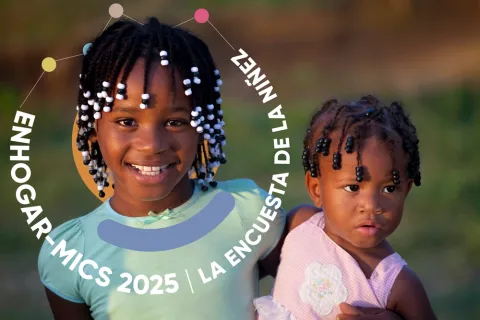
The ENHOGAR-MICS 2025 provides one of the clearest recent statistical portraits of living conditions among households, women, children and adolescents in the Dominican Republic. Rather than focusing on a single social issue, the survey combines the national reach of the Dominican Republic’s Multipurpose Household Survey, known as ENHOGAR, with UNICEF’s internationally standardized Multiple Indicator Cluster Surveys methodology, or MICS.
The result is a large-scale dataset covering health, education, birth registration, nutrition, maternal and reproductive health, health insurance, early childhood development, child functioning, protection and other indicators linked to the Sustainable Development Goals. The National Statistics Office, known as ONE, published the basic results in June 2026. The survey selected 35,238 households and obtained an effective sample of 29,676, producing a reported response rate of 98.6%. ONE’s official publication and UNICEF’s official ENHOGAR-MICS 2025 page provide the primary documentation for the results.
What ENHOGAR-MICS 2025 Actually Measured
For international readers, the survey is important because it goes beyond a conventional opinion poll. Its purpose is to measure specific social and demographic conditions across the population and among defined groups. The 2025 round covered household and housing characteristics, information and communications technology, education, environmental conditions, health insurance, maternal and reproductive health, fertility and family planning, early unions, nutrition, early childhood development, child protection and functioning among children and adolescents.
The population covered by individual indicators varies. For example, literacy indicators refer to defined age groups rather than the entire population, maternal-health indicators concern women of reproductive age or women who recently gave birth, and child-functioning indicators concern children ages 5 to 17. That distinction matters: a percentage in the report should not be interpreted as representing every Dominican resident.
The survey was conducted as a probability sample rather than a census. Fieldwork took place nationwide in 2025, and the final basic report was prepared and published in 2026. The design means the results are intended to describe the relevant population groups at the national level, while individual indicators have their own denominators and definitions.
A Strong Literacy Rate, But a Significant Economic Gap
One of the clearest positive findings is the level of literacy among young people. The survey reports that 97.2% of people ages 15 to 24 can read and write. At first glance, that suggests a relatively strong foundation for the country’s younger generation.
But the national figure conceals an important socioeconomic difference. Reported literacy reaches 91.2% among young people in the lowest wealth quintile and 99.4% among those in the highest wealth quintile. The difference is therefore more than eight percentage points between the two ends of the distribution.
This is more than a statistical footnote. Literacy is a basic capability that affects access to education, employment, information and public services. A national rate close to universal literacy can therefore coexist with pockets of disadvantage that remain highly relevant to public policy.
The broader result should consequently be read in two parts: the Dominican Republic has achieved a high level of literacy among young people, but the distribution of that achievement is not uniform. The survey provides evidence of a socioeconomic divide that policymakers cannot see from the national average alone.
Health Insurance Coverage Is Broad, But Coverage Does Not Equal Access to Every Service
The survey found that 74.5% of the population reported having health insurance. This indicator provides an important measure of financial and institutional access to health care, but it should not be interpreted as proof that all insured people receive the same services or experience the same quality of care.
Health insurance coverage is only one part of the health system. Actual access also depends on the availability of providers, geographic location, the services included in a person’s coverage, affordability of additional expenses and whether people can obtain care when they need it. ENHOGAR-MICS 2025 measures the insurance dimension; it does not by itself establish that insurance coverage has produced a particular health outcome.
This distinction is particularly important when comparing the insurance figure with maternal and child health indicators. A country can simultaneously expand coverage and continue to face problems involving the type, timing or quality of care.
Maternal Care Shows a Strong Access Indicator
One of the strongest health findings is related to prenatal care. Among women who had a child during the two years preceding the survey, 97.6% received prenatal care from qualified health personnel. The indicator suggests very broad contact with skilled prenatal services among the women covered by this definition.
That result is significant because prenatal care is a basic entry point into maternal and reproductive health services. It can provide opportunities to identify pregnancy-related risks, monitor maternal and fetal health and connect women with other services.
At the same time, the survey does not establish that a high percentage of women receiving qualified prenatal care automatically produces better outcomes in every other part of maternal or newborn health. The appropriate interpretation is narrower: access to qualified prenatal care was reported at a very high level among the relevant population.
The Cesarean Rate Is One of the Survey’s Most Important Health Findings
The most striking maternal-health figure in the initial results is the reported 68.2% cesarean-delivery rate. In other words, more than two-thirds of women covered by the survey’s delivery indicator reported having had a cesarean birth.
The figure deserves attention, but it also requires careful interpretation. A cesarean section can be medically necessary and lifesaving in situations involving complications during pregnancy or labor. The existence of a high population-level rate does not mean that every individual procedure was unnecessary.
The World Health Organization has historically cited a population-level range of 10% to 15% in discussions of cesarean rates, while also emphasizing that it does not recommend a specific national or hospital rate that every country or facility should achieve. WHO’s evidence review found that increasing cesarean rates up to around 10% at population level was associated with declining maternal and newborn mortality, but that higher rates were not associated with further reductions in mortality.
That distinction matters when reading the Dominican figure. The 68.2% result should be understood as a signal that warrants examination of how and why cesareans are being used, rather than as proof that a particular percentage of the procedures were medically unnecessary. The survey itself describes the prevalence; it does not establish the clinical indication for each operation.
For health-system analysis, the next questions are therefore more specific: How does the rate vary by age, parity, place of residence, socioeconomic status or type of facility? How many procedures occur before labor begins? How are deliveries distributed across the clinical categories used to assess obstetric risk? Those questions require more detailed analysis than a single national percentage can provide.
Exclusive Breastfeeding Remains a Major Challenge
The survey also found that 19.2% of infants were exclusively breastfed through the first six months of life. Exclusive breastfeeding means that an infant receives only breast milk during the first six months, apart from specific medical exceptions such as medicines or oral rehydration solution.
The finding is important because exclusive breastfeeding for the first six months is recommended by both WHO and UNICEF. International guidance recommends beginning breastfeeding within the first hour after birth, maintaining exclusive breastfeeding for six months, and introducing appropriate complementary foods at six months while continuing breastfeeding for up to two years or longer.
The Dominican result therefore identifies a substantial gap between recommended practice and reported population-level behavior. It does not, however, explain the reasons behind that gap. Breastfeeding decisions can be influenced by maternity-care practices, employment, family circumstances, social norms, access to professional support and other factors. Establishing which factors are responsible would require additional analysis rather than assuming causation from the survey percentage.
The contrast with prenatal care is particularly instructive. The Dominican Republic reports very high contact with qualified prenatal personnel while exclusive breastfeeding remains much less common. That suggests that access to one stage of maternal and child health care does not automatically translate into the same level of performance across the entire continuum of care.
Birth Registration Has Expanded, But It Is Not Yet Universal
The survey reports that 91.5% of children under age 5 have a birth certificate. Birth registration is more than an administrative formality: legal identity can affect a child’s ability to establish official documentation and access rights and services that depend on proof of identity.
The 91.5% figure represents substantial coverage, but it also means that the indicator is not universal. Roughly one in twelve children in the survey’s defined population did not have the document measured by this indicator. The precise circumstances behind missing documentation are not established by the percentage alone and may require administrative and qualitative follow-up.
For international readers, this is an example of why national social indicators should be read as distributions rather than simple pass-or-fail measures. A country can achieve broad coverage while a smaller group remains excluded, and that smaller group may be concentrated among populations facing other disadvantages.
One in Ten Children Ages 5 to 17 Has at Least One Functional Difficulty
ENHOGAR-MICS 2025 also expands the picture beyond conventional education and health statistics. Among children and adolescents ages 5 to 17, 10.5% were identified as having at least one difficulty in a domain of child functioning. The domains include areas such as anxiety, behavior, mood, learning, memory, communication, vision, hearing and mobility.
The most frequently reported difficulty was related to anxiety, nervousness or persistent worry, at 4.6%. Difficulties controlling behavior affected 2.4%, while 1.8% reported being very sad or depressed. The survey also identified difficulties involving memory and adaptation, learning and vision.
These figures should not be treated as a clinical prevalence estimate for diagnosed mental disorders. A survey-based functional indicator is designed to identify difficulties that affect functioning; it is not equivalent to a medical diagnosis. That distinction is especially important when interpreting terms such as anxiety or depression.
Nevertheless, the data give policymakers a reason to examine how schools, primary health services and child-protection systems identify children who may need additional support. The value of the survey is precisely that it makes these issues measurable at population level.
Early Childhood Development Shows a Large Difference in Parental Participation
The survey also found a marked difference in participation in early stimulation and responsive-care activities. 53.4% of children participated in such activities with their mothers, compared with 12.5% with their fathers, according to reporting based on the ENHOGAR-MICS 2025 results.
The socioeconomic gradient is also notable. Among children ages 2 to 4 in the lowest wealth quintile, 6.6% participated in early stimulation activities with their fathers, compared with 22.7% in the highest wealth quintile.
These figures describe participation patterns; they do not establish why those differences exist or demonstrate that one factor causes another. They nevertheless highlight an aspect of child development that can be overlooked when national education statistics focus primarily on school-age enrollment and literacy.
Early childhood is a period in which interaction with caregivers, language exposure, play and responsive care can shape children’s development. The survey’s contribution is to show how participation in these activities is distributed across households and between caregivers, providing a basis for further research and policy discussion.
What the Results Mean for the Dominican Republic
Taken together, the findings do not tell a simple story of either progress or crisis. They show a country in which several basic indicators have reached relatively high levels while important gaps remain in the quality, distribution or continuity of services and outcomes.
Education provides one example. A 97.2% literacy rate among 15- to 24-year-olds represents substantial progress, but the 91.2% rate among the lowest wealth quintile shows that national achievement does not eliminate socioeconomic inequality.
Health presents a similar contrast. The reported 97.6% rate of prenatal care from qualified personnel suggests broad access to an important maternal-health service, while the 68.2% cesarean rate and 19.2% exclusive-breastfeeding rate point to areas requiring closer examination. These indicators measure different parts of the health system, so they should not be treated as contradictory. They show that access, clinical practice and health behavior can move differently.
Child welfare presents another layer. Birth registration reaches 91.5% among children under 5, while 10.5% of children ages 5 to 17 have at least one reported functional difficulty. These findings reinforce the importance of looking beyond headline measures and examining which groups are still missing from universal coverage or require additional support.
Why the Methodology Matters
The credibility of a national survey depends not only on the numbers it produces but also on how those numbers are collected. ENHOGAR-MICS 2025 used a probability sample of 35,238 selected households and obtained an effective sample of 29,676, with a reported 98.6% response rate. UNICEF identifies the exercise as part of the global MICS program, which is designed to generate comparable social indicators across participating countries.
The Dominican Republic has participated in five MICS rounds integrated with ENHOGAR: 2006, 2009-2010, 2014, 2019 and 2025. This history is important because repeated surveys can help researchers and policymakers examine changes over time, provided that indicator definitions, questionnaires and sampling approaches are sufficiently comparable.
The survey’s broad coverage also explains why its results matter beyond child policy. It links household conditions with education, health, social protection, reproductive health and child development, allowing policymakers to see how different dimensions of living conditions intersect.
What the Survey Does Not Tell Us
There is a temptation with large surveys to treat every percentage as an explanation of why something happens. That would go beyond the evidence. ENHOGAR-MICS 2025 is primarily descriptive: it measures conditions and behaviors in defined populations. A high cesarean rate, for example, does not by itself establish the reasons for the procedures. A literacy gap by wealth does not prove which educational or economic mechanism created it. A difference in parental participation does not demonstrate why fathers and mothers participate at different rates.
Those questions require additional research, including administrative data, clinical records, longitudinal studies, qualitative research and analyses that can control for other variables. The survey is therefore best understood as a map of where the country stands and where deeper investigation is warranted.
This distinction is especially important for international readers. Statistical comparisons can make a country appear either better or worse than its neighbors depending on the indicator selected. A more useful reading is to examine the full pattern: where coverage is high, where inequality persists, where outcomes remain weak and which populations require closer attention.
Why International Readers Should Pay Attention
For travelers, expatriates, investors, researchers and international organizations, social indicators can provide a more meaningful understanding of the Dominican Republic than economic or tourism statistics alone. The country is not simply a destination or an economy; it is a society whose long-term prospects depend on the health, education and development of its population.
ENHOGAR-MICS 2025 offers evidence on those foundations. The combination of high youth literacy and high prenatal-care coverage with persistent inequalities, a very high cesarean-delivery prevalence, low exclusive breastfeeding and measurable child-functioning difficulties shows why national development cannot be assessed through a single headline indicator.
The findings are also relevant to anyone trying to understand public policy in the Dominican Republic. ONE and UNICEF have described the survey as an instrument for monitoring national development priorities and the Sustainable Development Goals. The data can help government agencies, researchers and international partners identify areas where broad national progress needs to be translated into more equitable outcomes.