 26°C
26°C

Farizon Showcases New Generation of Electric Commercial Vehicles at IAA Transportation 2026
The Geely-backed commercial vehicle brand presented three fully electric models in Hannover, highlighting its strategy around electrification, intelligent vehicle architecture and the changing demands of logistics and urban distribution.


HANNOVER, Germany. — More than a century after automobiles first began appearing on Dominican roads, the transportation industry is entering another major technological transition. Electrification, connectivity and advanced driver-assistance technologies are changing not only passenger vehicles but also the commercial vehicles that move goods across cities and supply chains.
That evolution is particularly relevant for a country such as the Dominican Republic, where commercial vehicles play an important role in distribution, logistics, tourism and business activity. The history of the automobile in the Dominican Republic provides a useful perspective on how dramatically transportation has evolved, from the first motor vehicles to today’s increasingly connected and electrified commercial fleets.
One company seeking to position itself at the forefront of that next phase is Farizon, the new-energy commercial vehicle brand backed by China’s Geely Holding Group.
The company used IAA Transportation 2026, held from September 14 to 20 at the Hannover Exhibition Grounds in Germany, to showcase three fully electric models aimed at different areas of professional transportation: the Homtruck, Farizon SV and V7E.
The appearance in Hannover was also an opportunity for Farizon to demonstrate its broader international strategy, as the relatively young brand seeks to expand beyond its home market with commercial vehicles designed around electrification, digital technologies and flexible vehicle architectures.
Farizon: a young brand built around new-energy transportation
Farizon was established in 2016 within the Geely ecosystem with a focus on developing new-energy commercial vehicles.
Unlike traditional manufacturers that have gradually added electric versions to established combustion-engine platforms, Farizon has positioned itself around the development of commercial vehicles specifically designed for new-energy propulsion.
The company’s technology strategy covers several areas, including battery-electric vehicles, battery-swapping systems, range-extender technologies and methanol-powered solutions.
Farizon says it has built extensive research and development capabilities around new-energy commercial transportation and has accumulated more than 2,800 patents related to its technologies. Its research activities cover areas ranging from energy systems and vehicle architecture to intelligent driving and digital connectivity.
The company is therefore not approaching electrification simply as a matter of replacing an internal-combustion engine with a battery. Instead, it is attempting to rethink the commercial vehicle around the requirements of electric propulsion and the operational needs of professional fleets.
An architecture designed specifically for electric commercial vehicles
One of Farizon’s central technological concepts is its GXA-M architecture, a modular platform developed specifically for new-energy commercial vehicles.
A purpose-built electric architecture can provide manufacturers with greater flexibility when determining battery placement, weight distribution, cargo space and vehicle configurations.
For commercial operators, those factors are particularly important because the vehicle is ultimately a business tool. A delivery van, for example, needs to maximize usable cargo volume while remaining easy to operate in dense urban environments. A heavy truck, meanwhile, must balance battery capacity, payload, range and charging requirements.
Farizon has also incorporated technologies such as drive-by-wire into its vehicle architecture. By replacing some traditional mechanical connections with electronic controls, the system can provide greater flexibility in vehicle design and create a foundation for more advanced driver-assistance and automated-driving functions.
The company has also developed different energy technologies rather than relying exclusively on battery-electric propulsion.
Farizon has worked on methanol-powered vehicles, battery swapping and range-extender systems, reflecting the different infrastructure and operating requirements found across global commercial vehicle markets.
Some of these technologies remain more closely associated with the Chinese market, while battery-electric vehicles are currently at the center of Farizon’s international expansion.
Homtruck brings Farizon into the heavy-duty electric truck segment
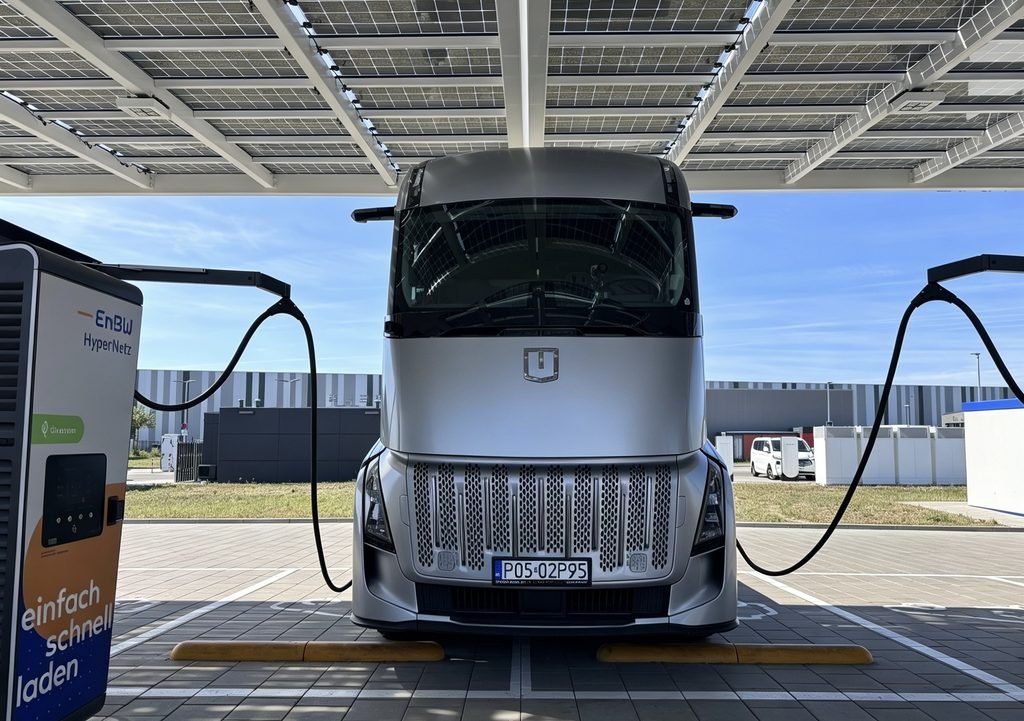
The Homtruck represents Farizon’s entry into the electric heavy-duty truck market and illustrates the scale of the company’s ambitions.
At IAA Transportation 2026, Farizon presented a European-oriented version of the truck equipped with a 600 kWh battery and a range of more than 500 kilometers, according to specifications released by the company.
Electrifying heavy trucks presents a different challenge from electrifying passenger cars or small vans.
Long-haul commercial vehicles operate for many hours each day and carry substantial loads. Battery capacity, charging infrastructure, charging times, payload, operating temperatures and route planning can all have a significant effect on the economics of an electric truck.
Farizon has therefore been exploring several approaches to the energy challenge, including battery-swapping technology and alternative energy systems.
The company has also established a strategic partnership with ZF, covering areas such as vehicle efficiency, electrification, braking, steering, safety and advanced driver-assistance systems.
The objective is to create a broader technological ecosystem around the commercial vehicle rather than treating the electric powertrain as an isolated component.
Farizon SV targets the commercial van market
The Farizon SV is a fully electric commercial van designed for businesses that need a combination of cargo capacity, operating efficiency and configuration flexibility.
The vehicle uses a modular architecture that allows different body lengths and configurations, enabling it to serve multiple professional applications.
One notable design feature in certain configurations is the absence of a conventional B-pillar, creating a wider side opening that can make loading and unloading goods easier.
That type of design can be particularly relevant for delivery operators, where drivers may make dozens of stops during a working day and spend considerable time moving between the cabin and cargo area.
The SV is also designed around digital technologies and driver-assistance systems, reflecting the broader shift toward software-defined commercial vehicles.
Farizon has increasingly emphasized the idea that commercial vehicles should be adaptable to different businesses rather than being developed around a single standardized configuration.
That approach is particularly relevant as logistics companies seek to tailor their fleets to different routes, cargo types and operating environments.
V7E focuses on urban distribution
The Farizon V7E takes a more specific approach, targeting urban delivery and distribution operations.
According to Farizon’s specifications presented for the model, the V7E provides 6.95 cubic meters of cargo space, a 1,373-kilogram payload capacity and a combined WLTP range of 328 kilometers.
The vehicle also comes with more than 14 advanced driver-assistance systems (ADAS) as standard equipment.
Those technologies are particularly relevant in urban environments, where commercial vehicles must operate around pedestrians, cyclists, parked vehicles and frequent traffic interruptions.
For fleet operators, however, range is only one part of the equation.
Cargo capacity, payload, charging availability, vehicle downtime, maintenance requirements and the ability to complete an entire working shift without unnecessary interruptions can be equally important.
The V7E therefore represents Farizon’s attempt to combine electric propulsion with the practical requirements of everyday commercial distribution.
Electrification is changing how businesses evaluate commercial vehicles
The emergence of vehicles such as those developed by Farizon comes at a time when businesses are reconsidering how they build and manage their fleets.
For a commercial operator, choosing an electric vehicle involves more than comparing purchase prices.
Daily mileage, charging infrastructure, energy costs, payload, maintenance, financing and vehicle utilization all influence the overall business case.
The expanding electric commercial vehicle market is also changing the wider vehicle buying and selling market, giving businesses and professional drivers more options as manufacturers introduce new electric vans, trucks and specialized vehicles.
This transition is particularly relevant to operators whose vehicles follow predictable daily routes and can return to a central facility where they can be recharged.
For longer-distance operations, however, charging infrastructure and vehicle range remain critical considerations.
Farizon’s “Born Global” strategy
The presentation in Hannover forms part of Farizon’s international expansion strategy, which the company describes as “Born Global.”
The concept reflects Farizon’s intention to develop products with international markets in mind rather than simply exporting vehicles originally designed exclusively for China.
That distinction matters because commercial vehicles operate under very different regulatory, infrastructure and business conditions around the world.
European markets, for example, impose specific requirements covering vehicle safety, emissions, dimensions and homologation. Commercial operators also have different expectations regarding charging infrastructure, after-sales service and vehicle financing.
Farizon has consequently been building relationships with distributors and technology partners in several international markets.
Europe has become an important part of that strategy, with the company expanding its distribution network and introducing models such as the SV and V7E in different European markets.

The international expansion also provides Farizon with an opportunity to establish its brand among fleet operators at a time when demand for lower-emission commercial transportation is increasing.
Farizon’s presence in the Dominican Republic
The brand’s international expansion also has a direct connection to the Dominican market.
Farizon Dominicana is represented by Grupo Viamar, which includes the brand among its automotive operations in the country.
That presence gives Dominican businesses access to a manufacturer whose product strategy is centered specifically on commercial electrification.
For the Dominican Republic, electric commercial vehicles could eventually have applications across several sectors, including urban deliveries, logistics, last-mile distribution and business fleets.
The suitability of any particular electric vehicle, however, will depend on factors such as daily mileage, load requirements, charging infrastructure and the type of operation involved.
Those considerations are especially important in commercial transportation because a vehicle’s financial value is closely connected to how efficiently it can perform its intended job.
Beyond the electric motor
Perhaps the most significant aspect of Farizon’s strategy is that its approach extends beyond simply replacing a diesel engine with an electric motor.
The company is developing vehicles around a combination of electrification, software, connectivity, modular architecture and advanced driver assistance.
That could eventually change how commercial vehicles are operated and maintained.
Software updates, digital fleet management, real-time vehicle information and increasingly sophisticated driver-assistance systems could become as important to fleet operators as traditional mechanical specifications.
At the same time, technologies such as battery swapping and alternative energy systems could provide additional options for operations where conventional battery charging is difficult.
Farizon’s strategy therefore reflects a broader transformation taking place throughout the commercial vehicle industry.
IAA Transportation as a showcase for the next generation
Farizon’s appearance at IAA Transportation 2026 provided a snapshot of how the commercial vehicle industry is evolving.
The Homtruck demonstrates the company’s ambitions in heavy-duty electric transportation. The SV focuses on flexible electric commercial mobility, while the V7E targets the increasingly important urban distribution segment.
Although the three vehicles serve different purposes, they share a common technological philosophy: electric propulsion combined with purpose-built architecture, digital technologies and advanced driver assistance.
For Farizon, the next challenge will be turning that technology into a sustainable international commercial operation supported by reliable distribution networks, after-sales service, charging infrastructure and products adapted to local markets.
For the Dominican Republic, the company’s presence is another indication that the global transition toward electric commercial transportation is gradually reaching the Caribbean market.
The shift will not happen overnight, and diesel-powered commercial vehicles are likely to remain an important part of transportation for years to come. But as manufacturers such as Farizon continue to develop electric vans and trucks specifically for professional use, the options available to Dominican businesses are likely to become increasingly diverse.
IAA Transportation 2026 offered a glimpse of that future: commercial vehicles increasingly designed not simply as machines for moving goods, but as electric, connected and adaptable platforms built around the operational needs of modern logistics.