 24°C
24°C

History of Automobiles in the Dominican Republic: Key Milestones
The history of automobiles in the Dominican Republic began at the start of the 20th century, but identifying the very first car is more complicated than often suggested. Historical research points to isolated vehicles appearing in Puerto Plata before the organized expansion of motoring, while 1907 marks the better-documented beginning of automobile transportation in Santo Domingo. Crucially, available historical evidence does not establish the brand of that earliest vehicle with sufficient certainty; Chevrolet's documented arrival in 1920 therefore represents an important milestone in the development of the Dominican automotive market, but not necessarily the first automobile to reach the country.


The automobile transformed the Dominican Republic far beyond the simple replacement of horses and carriages. It changed the way people moved between communities, accelerated the development of roads, created new commercial activities and eventually became deeply connected with urban growth, politics and everyday life. Yet the beginning of that transformation was gradual. The first motor vehicles appeared when roads were still rudimentary, public transportation depended largely on animal power and railways, and there was no established automobile industry in the country.
The historical record also contains an important distinction that is frequently lost in simplified accounts: the first automobile to reach the Dominican Republic was not necessarily the first automobile introduced as part of a commercial automotive market. Research by Dominican historian Santiago Castro Ventura, whose book El automóvil y las vías de comunicación en la historia dominicana examines the subject chronologically, points to several stages in the arrival and expansion of motor vehicles.
When Did the Automobile Arrive in the Dominican Republic?
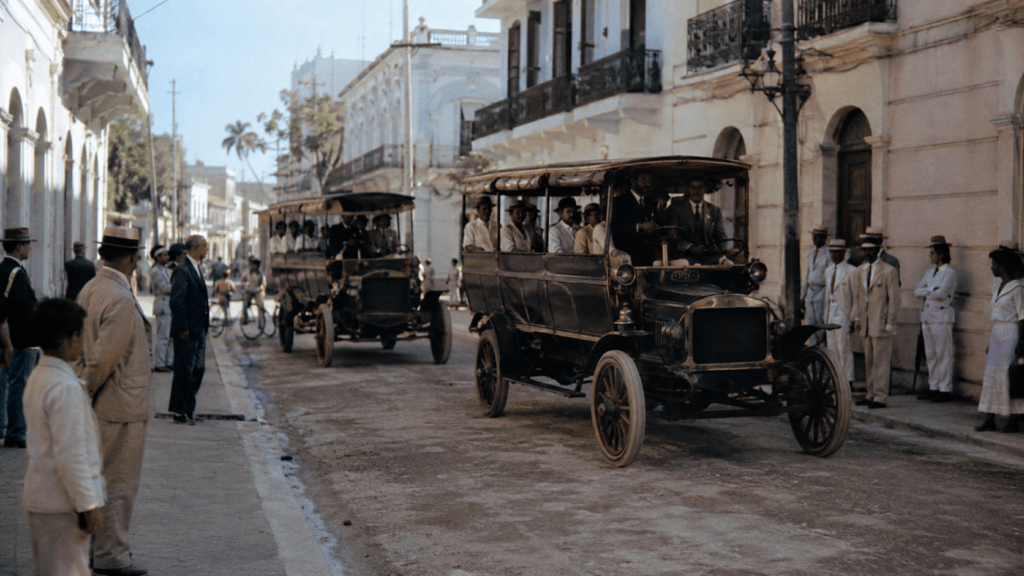
The most commonly cited date for the arrival of automobiles in the Dominican Republic is 1907. That year is particularly important because the first documented automobile transportation service in Santo Domingo began to attract considerable public attention. Historical accounts describe two early omnibus vehicles operating in the capital, producing what contemporary observers regarded as a remarkable spectacle.
However, 1907 should not automatically be interpreted as the date when the first automobile physically entered Dominican territory. Castro Ventura’s research, as reported by Dominican publications discussing his book, indicates that a vehicle had appeared in Puerto Plata sometime before the organized introduction of automobiles in Santo Domingo. The evidence describes that earlier vehicle as an isolated occurrence rather than the beginning of a sustained automotive business.
Puerto Plata’s role is historically plausible in this context. During the late 19th and early 20th centuries, the northern port was one of the country’s principal commercial gateways. Steamships connected it with international markets, while railways linked Puerto Plata with Santiago and the Cibao. The city was therefore particularly exposed to technological developments arriving from Europe, the United States and other Caribbean ports.
The First Automobile: What the Historical Evidence Actually Says
The question “What was the first car in the Dominican Republic?” sounds straightforward, but the surviving evidence does not provide a definitive answer regarding the make and model of the earliest vehicle.
According to accounts based on Castro Ventura’s research, the first automobile may have reached the country through Puerto Plata toward the end of the 19th century. The vehicle appears to have been an isolated arrival rather than part of an organized transportation network. The available published accounts do not identify its manufacturer with enough certainty to establish a particular brand as the undisputed first.
That distinction matters because several different milestones can be confused with one another:
- The first automobile physically brought into Dominican territory.
- The first automobile documented in a particular city.
- The first automobile used for public transportation.
- The first privately owned automobile.
- The first automobile brand officially distributed through an established dealer.
These were not necessarily the same vehicle or the same date. For that reason, claims that a particular brand was unquestionably “the first automobile in the Dominican Republic” should be treated cautiously unless they are supported by primary historical documentation.
Pedro Marín and the First Serious Automobile Initiative
One of the most interesting figures in the early history of Dominican motoring was Pedro Marín, a Cuban-born businessman living in Santo Domingo. According to the historical research summarized by Acento, Marín announced in the Listín Diario on May 28, 1906, that he intended to invest in importing several automobiles.
This announcement predates the better-known public arrival of automobiles in Santo Domingo in 1907. It suggests that the introduction of the automobile was not simply a spontaneous technological curiosity: entrepreneurs were already considering the commercial possibilities of motor vehicles and their use in transportation.
The significance of Marín’s initiative lies in the distinction between an isolated imported automobile and an attempt to establish automobiles as part of the country’s transportation system. The latter process was what ultimately changed Dominican society.
1907: The Automobile Becomes a Public Spectacle in Santo Domingo
In April 1907, Osvaldo Báez, son of former president Buenaventura Báez, announced through the newspaper El Diario in Santiago that an automobile would arrive to operate as public transportation between the Ozama area and San Gerónimo.
The arrival of the first two omnibus vehicles in Santo Domingo generated enormous public curiosity. For many residents, automobiles had previously been something known mainly through newspapers and reports from abroad. Seeing motor vehicles moving through the streets represented a visible sign of technological change.
The timing was also politically significant. The country was experiencing a serious political and financial crisis surrounding the 1907 Dominican-American Convention. According to Castro Ventura’s historical interpretation, authorization for automobile circulation had been pending since the previous year and was granted during a period in which the government was dealing with intense political controversy.
The early automobiles were not immediately welcomed without reservations. Their engines produced noise, smoke and unfamiliar smells, while horses and pedestrians had to adapt to vehicles that moved differently from traditional transportation. Some contemporary observers reportedly referred to automobiles as a “machine from hell”, illustrating how disruptive the new technology initially appeared.
The First Private Automobile
Another important milestone came in 1911. Historical accounts cited in discussions of Castro Ventura’s research state that a private automobile from the United States was announced as arriving at the port of Santo Domingo in February of that year. Three additional automobiles arrived in June for public transportation.
This distinction is important because public transportation and private automobile ownership developed along partially different paths. The early omnibus was intended to provide a service and demonstrate the practical value of motorized transportation. Private cars, by contrast, represented a new form of individual mobility associated with wealth, business and social status.
By 1911, therefore, the automobile was beginning to move from being an extraordinary novelty toward becoming a recognizable element of Dominican urban life.
From Curiosity to Transportation Network
The automobile could not expand simply by importing vehicles. The country also needed roads capable of handling them.
At the beginning of the automotive era, Dominican transportation infrastructure was extremely different from today’s road network. Horses, mules, carts, carriages and railways remained fundamental. Puerto Plata’s railway connection with Santiago and the Cibao was particularly important, while Santo Domingo had also relied on an animal-powered tramway.
The transition to automobiles therefore involved more than buying cars. Roads had to be improved, regulations created and fuel supplied. Castro Ventura’s work traces the emergence of vehicle taxes, disputes over gasoline prices, labor conflicts involving drivers and the gradual adaptation of public infrastructure to motorized transportation.
The automobile gradually spread beyond Santo Domingo. Historical accounts place the arrival of the first automobile in Baní in 1914 and the establishment of an automobile route between Moca and Santiago in 1915. By the following year, a motor vehicle had reached San José de las Matas after the construction of a rudimentary road connection with Santiago.
These developments illustrate a central feature of Dominican automotive history: the expansion of the automobile was closely tied to the expansion and improvement of roads. Motor vehicles encouraged investment in transportation infrastructure, while better roads made automobiles increasingly useful outside the major cities.
Which Car Brand Arrived First?
There is no sufficiently documented evidence to identify the brand of the very first automobile that entered the Dominican Republic. This is the most accurate answer based on the historical sources available.
The early vehicle associated with Puerto Plata is described in historical accounts as the first automobile to reach the country, but the published material does not establish its manufacturer. Similarly, the 1907 omnibus associated with the beginning of organized automobile transportation in Santo Domingo is not identified by make in the sources reviewed.
This means that naming Chevrolet, Ford, Buick or another manufacturer as the unequivocal maker of the country’s first automobile would go beyond what the available evidence establishes.
There is, however, a very important answer if the question is instead asking which automobile brand was first introduced through a major, formally established Dominican distributor. In that case, the answer is Chevrolet.
Chevrolet and the Beginning of the Modern Automotive Market
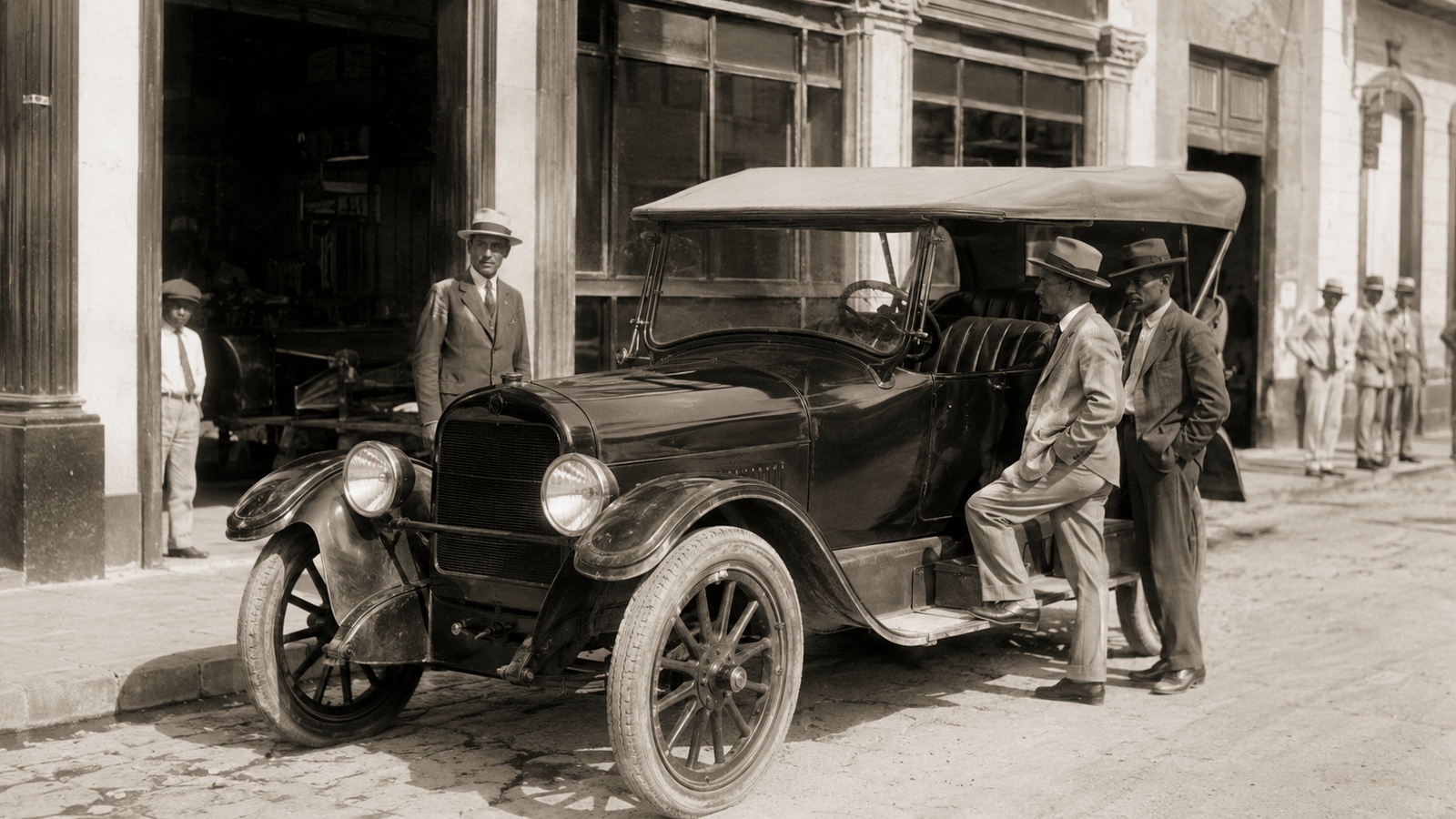
On September 12, 1920, Italian-born businessman Amadeo Barletta founded Santo Domingo Motors. The company began as a representative of Chevrolet, a General Motors brand, and became one of the foundational companies of the Dominican automotive distribution industry.
Santo Domingo Motors itself describes its 1920 establishment as a pioneering moment in the distribution and sale of automobiles in the country. Its first year was modest by later standards: the company sold only three vehicles. Within several years, however, sales had grown dramatically, illustrating how quickly the market could expand once a formal distribution network existed.
A company history published by Santo Domingo Motors identifies Chevrolet as the brand it represented when the company was established. A contemporary account of the company’s centenary further identifies the Chevrolet 490 as the first model it commercialized in 1920.
This is why Chevrolet occupies such an important place in the history of the Dominican automobile. It was not necessarily the brand of the first car ever seen on Dominican soil, but it was the brand associated with the establishment of one of the country’s earliest and most enduring formal automotive distribution operations.
The 1920s: Cars Become Part of Public Life
During the 1920s, the automobile became increasingly integrated into government, commerce and urban society. The growing number of vehicles created new demand for mechanics, fuel, spare parts, drivers and improved roads.
Government vehicles also became symbols of official authority and prestige. A document preserved by the Dominican government’s Instituto Geográfico Nacional contains a 1926 letter from Santo Domingo Motors to President Horacio Vásquez discussing the possible purchase of Cadillac vehicles and referring to Packard automobiles that the government was reportedly considering for its secretaries.
Another historical account based on contemporary newspaper reporting indicates that Packard vehicles began entering government service during the administration of Horacio Vásquez. This illustrates how quickly the automobile moved beyond basic transportation and became part of the country’s political and institutional culture.
The Automobile During the Trujillo Era
The expansion of automobile ownership continued during the dictatorship of Rafael Leónidas Trujillo, although the automobile also became closely associated with political power and repression.
Historical research on Dominican automobiles records vehicles being used both by the regime and by opponents of the dictatorship. Cars provided mobility, communication and logistical advantages, but they could also be used for surveillance, intimidation and political operations.
The political symbolism of the automobile became especially striking in the final years of the dictatorship. Vehicles were directly involved in the conspiracy that culminated in Trujillo’s assassination on May 30, 1961. Historical accounts based on Castro Ventura’s work describe several automobiles associated with the conspirators and the pursuit of Trujillo’s vehicle that night.
The episode demonstrates how deeply automobiles had become embedded in Dominican political and social life within only a few decades of their arrival.
From Imported Cars to Mass Motorization
By the middle of the 20th century, the automobile was no longer an unusual sight restricted to a small group of wealthy owners. Importers and distributors expanded their operations, more brands entered the market and roads increasingly connected major population centers.
The process accelerated as the country developed economically and urban areas expanded. Cars, trucks, buses and motorcycles became essential to commerce and daily mobility. At the same time, increased motorization created problems that would remain familiar throughout later Dominican history: traffic congestion, road safety, fuel costs, vehicle regulation and the need for better public transportation.
An interesting historical snapshot comes from a 1937 publication concerning automobile use in Latin America. It estimated that the Dominican Republic had approximately 2,880 motor vehicles, including about 2,000 automobiles, 80 buses and 800 trucks, as well as roughly 150 motorcycles. Almost half of the automobiles were concentrated in the capital, with the remainder distributed mainly between Santiago and San Pedro de Macorís.
The figures provide a useful sense of scale. The Dominican Republic had moved from a handful of pioneering vehicles in the early 1900s to thousands of motor vehicles within roughly three decades.
Regulation and the Modern Traffic System
As motorization expanded, regulation became increasingly important. The Dominican state gradually created institutions and laws dealing with vehicle registration, traffic, public transportation and road safety.
The Instituto Nacional de Tránsito y Transporte Terrestre (INTRANT), the country’s national authority for land transportation, explains that its institutional predecessors include the Dirección General de Tránsito Terrestre, created under Law 241-67 on Motor Vehicles. That legislation was eventually replaced by Law 63-17 on Mobility, Land Transportation, Traffic and Road Safety, which established INTRANT in 2017.
The development from the first automobile regulations to the modern INTRANT framework reflects a fundamental change. In the early 1900s, the challenge was simply adapting streets and society to the presence of motor vehicles. In the modern era, the challenge is managing a complex mobility system involving private cars, commercial vehicles, motorcycles, buses and other forms of transportation.
A Short Timeline of Automotive History in the Dominican Republic
| Period | Milestone |
|---|---|
| Late 19th century | Historical research points to an isolated automobile appearing in Puerto Plata, although the vehicle’s make has not been conclusively established. |
| 1906 | Businessman Pedro Marín announced plans to invest in importing several automobiles. |
| 1907 | The automobile became publicly established in Santo Domingo, with early omnibus vehicles attracting major public attention. |
| 1911 | A private automobile from the United States was announced as arriving in Santo Domingo, followed by additional vehicles for public transportation. |
| 1914 | Historical accounts place the arrival of the first automobile in Baní. |
| 1915 | An automobile route between Moca and Santiago was reported. |
| 1920 | Amadeo Barletta founded Santo Domingo Motors as a Chevrolet representative. |
| 1926 | Government correspondence documents the growing presence of brands such as Packard, Cadillac and Buick in official transportation. |
| 1937 | A published regional automotive report estimated nearly 2,900 motor vehicles in the Dominican Republic. |
| 1967 | Law 241-67 established the Dirección General de Tránsito Terrestre as the government body responsible for regulating vehicle traffic. |
| 2017 | Law 63-17 created INTRANT and established the current institutional framework for mobility, transportation and road safety. |
Why the First-Car Question Is More Complicated Than It Looks
Historical questions about the first automobile often produce a single date and a single brand. In the Dominican case, the surviving evidence suggests that such a simplified answer would be misleading.
The strongest historical distinction is between the first isolated automobile and the beginning of organized automobile transportation and commercial distribution. Puerto Plata appears in the historical record before 1907, while 1907 marks the best-documented public introduction of motor vehicles in Santo Domingo. Chevrolet’s documented entry through Santo Domingo Motors came later, in 1920.
Consequently, the most defensible answer is this: the first automobile in the Dominican Republic cannot currently be assigned with certainty to a particular brand based on the available published historical evidence; Chevrolet was the brand introduced by Santo Domingo Motors when the country’s organized automotive distribution industry took shape in 1920.

Frequently Asked Questions
What year did automobiles arrive in the Dominican Republic?
1907 is the key documented year for the public introduction and operation of automobiles in Santo Domingo. However, historical research indicates that an isolated automobile may have reached Puerto Plata before that date, possibly in the late 19th century.
What was the first car brand in the Dominican Republic?
The brand of the earliest automobile to reach the country has not been conclusively established by the published historical evidence reviewed. Chevrolet is the better-documented answer when referring to the beginning of formal automotive distribution, because Santo Domingo Motors was founded in 1920 as a Chevrolet representative.
Was Chevrolet the first automobile in the Dominican Republic?
Not necessarily. Chevrolet’s documented presence dates to 1920 through Santo Domingo Motors, whereas automobiles were already operating in the Dominican Republic in the first decade of the 20th century. Chevrolet was therefore an early and highly important commercial brand, but not demonstrably the maker of the country’s first automobile.
Who introduced automobiles to the Dominican Republic?
No single person can be credited without qualification. Pedro Marín announced plans to import automobiles in 1906, while Osvaldo Báez was associated with the introduction of an automobile transportation service in Santo Domingo in 1907. The broader process involved several entrepreneurs, importers, drivers and distributors.
When did Santo Domingo Motors begin operating?
Santo Domingo Motors was founded on September 12, 1920, by Amadeo Barletta. It began as a representative of Chevrolet from General Motors and became one of the most important institutions in the history of automobile distribution in the Dominican Republic.
What was the first Chevrolet model sold by Santo Domingo Motors?
According to a centenary account published about the company, the Chevrolet 490 was the first model Santo Domingo Motors commercialized in 1920.
Sources and Further Reading
The most useful modern reference for the subject is Santiago Castro Ventura’s El automóvil y las vías de comunicación en la historia dominicana, a historical study devoted specifically to the arrival and development of motor vehicles and roads in the country. Its publication was documented by Dominican media and the author is a member of the Academia Dominicana de la Historia.
For the institutional history of automobile distribution, Santo Domingo Motors provides its own historical account, while the Dominican government’s INTRANT website provides useful documentation on the evolution of traffic regulation and the country’s modern mobility framework.
Readers interested in primary and institutional material can also consult the Instituto Geográfico Nacional, whose digital historical publications include government-era documents containing references to automobiles and automobile suppliers, and the Instituto Nacional de Tránsito y Transporte Terrestre (INTRANT) for the legal and institutional history of Dominican transportation.
The Lasting Importance of the Automobile in Dominican History
The automobile arrived in the Dominican Republic as a technological novelty, but it quickly became something much more consequential. It altered the relationship between cities and rural communities, encouraged the development of roads, created new businesses and occupations, changed government transportation and eventually became part of the country’s political history.
The most important lesson from the early record is that there was no single moment when the Dominican Republic suddenly became an automobile country. The transition unfolded over several decades: an isolated early vehicle, public omnibuses in Santo Domingo, private ownership, the growth of intercity routes, the emergence of professional distributors and finally mass motorization.
That is also why the question of which brand arrived first deserves a precise answer rather than a convenient one. The evidence currently available does not conclusively identify the manufacturer of the very first automobile to reach Dominican territory. What can be established much more firmly is that 1907 marked the beginning of documented public automobile transportation in Santo Domingo and that Chevrolet, through Santo Domingo Motors, became a foundational brand in the country’s organized automotive market from 1920 onward.