 24°C
24°C

Fefita La Grande Honored With Street Named After Her in New Jersey
Dominican merengue típico icon Fefita La Grande has been honored with a street named after her in Union City, New Jersey, in recognition of a career spanning more than six decades and her contribution to Dominican music and cultural identity.


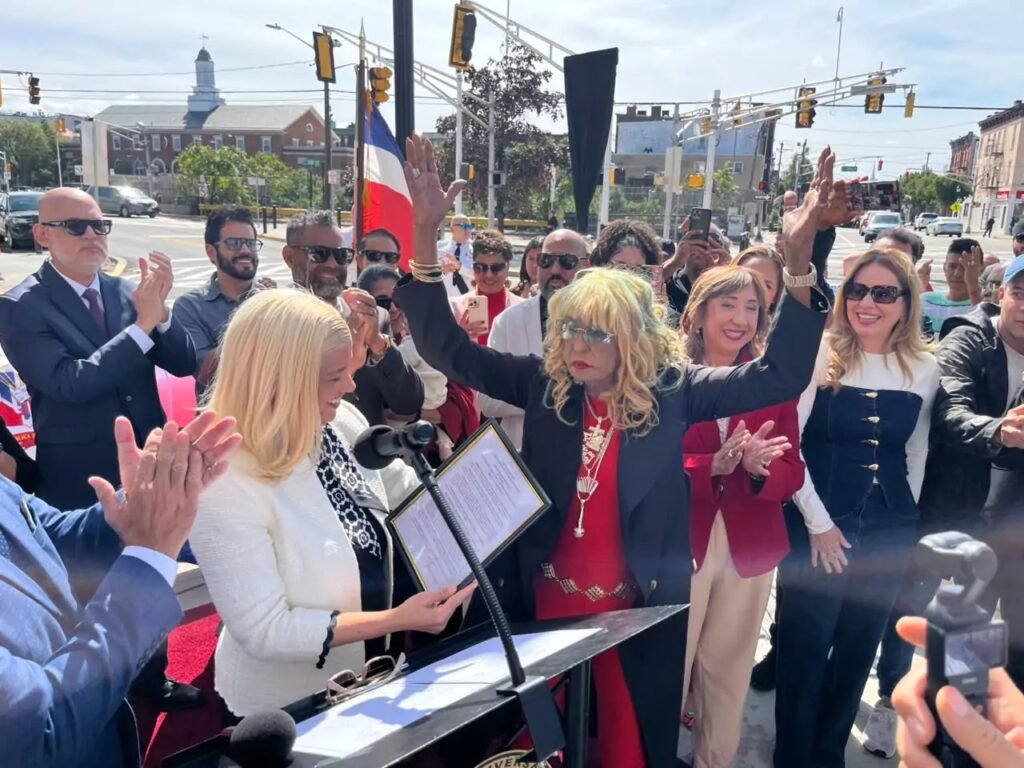
Union City, New Jersey, has permanently added the name of one of the Dominican Republic’s most recognizable traditional musicians to its streetscape. On September 24, city authorities officially dedicated a section of 32nd Street as Fefita La Grande Way, honoring the legendary accordionist and merengue típico performer.
The ceremony was led by Union City Mayor Brian P. Stack and members of the city’s Board of Commissioners and was attended by Fefita La Grande herself, along with fans and members of the Dominican community.
The designated section runs between Bergenline Avenue and New York Avenue, placing the artist’s name in a prominent part of a city with a long-standing Latino and Dominican presence. The dedication recognizes not only Fefita’s career but also her role in carrying Dominican musical traditions to audiences outside the country.
A six-decade career in Dominican music
Fefita La Grande, whose full name is Manuela Josefa Cabrera Taveras, was born on September 18, 1943, in San Ignacio de Sabaneta, Santiago Rodríguez, in the Dominican Republic. She developed an interest in music from childhood and learned to play the accordion, eventually becoming one of the best-known female figures in merengue típico.
Her official biography describes a career of more than six decades, during which she has performed Dominican merengue típico in the country and internationally. Her distinctive accordion playing, stage presence and repertoire helped establish her as a prominent figure in a genre historically associated with male performers.
The Dominican government has also recognized her contribution to national culture. The Ministry of Higher Education, Science and Technology previously highlighted her more than 50 years of artistic work, while noting her role in bringing merengue típico to audiences in Europe and other international destinations.
In 2016, Fefita received the Gran Soberano, the highest distinction awarded by the Dominican Association of Art Critics (Acroarte) and Cervecería Nacional Dominicana. Her career has also been recognized by Dominican institutions for her contribution to the preservation and international promotion of traditional music.
Why the Union City recognition matters
The street dedication gives Fefita La Grande a permanent physical presence in a U.S. city where Dominican culture is part of everyday community life.
For Dominican immigrants and their families, traditional music can serve as an important connection to the country’s cultural heritage. Merengue típico, with its characteristic combination of accordion, güira and tambora, is closely associated with the Dominican Cibao region and has become one of the country’s most recognizable musical traditions.
The recognition in Union City therefore goes beyond the career of an individual performer. It places the name of a Dominican cultural figure within the urban landscape of a community where generations of immigrants have established lives while maintaining connections with the Dominican Republic.
Local coverage of the ceremony described the dedication as a recognition of Fefita’s influence across generations and her contribution to the visibility of Dominican music in the United States.
Fefita and the international reach of merengue típico
Fefita’s importance to Dominican music is also connected to the international development of merengue típico.
The Dominican Senate previously recognized her as a pioneer who helped take the genre beyond the Dominican Republic, including performances in the United States and Europe. The Senate also noted her contribution to a musical tradition that was inscribed by UNESCO in 2016 on the Representative List of the Intangible Cultural Heritage of Humanity.
That UNESCO recognition applies to merengue as a Dominican cultural expression and reflects the broader importance of the genre within the country’s cultural heritage. Fefita’s career has developed within that tradition while giving it a particularly recognizable female voice.
Her career also illustrates the evolution of Dominican popular music from regional traditions into an international cultural export. For Dominican communities abroad, artists such as Fefita have helped keep familiar sounds, rhythms and expressions present far from the island.
A week of tributes in New Jersey
The street dedication was part of a broader series of activities celebrating Fefita La Grande in New Jersey.
According to local reports, the artist was also honored during a gala event in Moonachie and was selected as the central figure of the Dominican Parade of Hudson County. A biographical film about her life, La Grande, was also scheduled for a September 25 presentation at the Gilmore School in Union City.
The Hudson County Dominican parade is scheduled to travel along Bergenline Avenue on September 27, with Fefita La Grande serving as one of the central figures of the celebration.
The combination of public ceremonies, cultural events and the street dedication has turned the visit into a broader celebration of the artist’s career and of Dominican cultural heritage in New Jersey.
Fefita dedicates recognition to Dominicans
During the unveiling of the street sign, Fefita La Grande expressed her gratitude for the recognition and dedicated the honor to the Dominican people, according to reports from the ceremony. :contentReference[oaicite:8]{index=8}
The moment also offered a symbolic connection between the artist’s birthplace in Santiago Rodríguez and the Dominican diaspora in the United States. Her career began in the Dominican Republic, but much of her professional legacy has been built through performances for Dominican audiences both at home and abroad.
With the designation of Fefita La Grande Way, Union City has added a permanent reminder of that cultural connection to its streets. For the artist, it represents another recognition of a career that has carried Dominican merengue típico across generations and national borders.