 26°C
26°C

Dominican Inventions: Innovations and Dominican Inventors You Should Know
The Dominican Republic has produced inventions ranging from an unusual early aircraft to technologies for renewable energy, electric vehicles, accessibility and everyday products. Some are associated with individual inventors, while others appear in the records of the country’s National Office of Industrial Property (ONAPI). The history is not always straightforward: some inventions were patented decades after they were conceived, and historical accounts of early aviation sometimes differ on dates and technical details. Taken together, however, the documented record shows that Dominican innovation extends well beyond the country’s better-known cultural and sporting achievements.


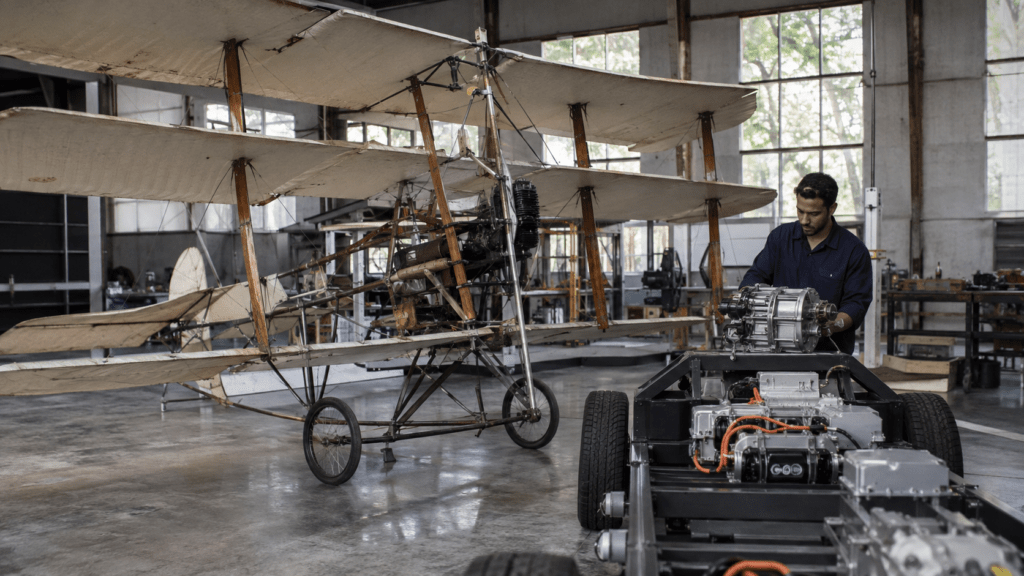
The Dominican Republic is better known internationally for music, baseball, tourism and its Caribbean culture than for technological invention. Yet the country has a documented history of innovation that reaches from the beginnings of aviation to modern efforts in renewable energy, electric transportation, accessibility and everyday technology.
Some of the most interesting examples are connected to the country’s intellectual-property system. The National Office of Industrial Property (ONAPI), the Dominican institution responsible for industrial-property rights, has documented patents and utility models developed by Dominican inventors. In 2021, ONAPI reported that 71 inventions developed by Dominicans had obtained patents in the Dominican Republic over the preceding 14 years. The examples included energy-saving devices, vehicle security systems, accessibility equipment and sports-training technologies.
The historical record also reaches much further back. In the early 20th century, engineer and aviator Zoilo Hermógenes García of La Vega developed the Poliplano, an aircraft with a distinctive multi-plane configuration. More than a century later, Dominican inventors have continued to develop technologies aimed at practical problems, including electricity generation and the conversion of combustion-powered vehicles to electric propulsion.
What Has the Dominican Republic Invented?
There is no single official list of everything invented in the Dominican Republic. A distinction is also important: an invention can be patented, registered as a utility model, developed without being commercialized, or remain at the prototype stage. A patent therefore documents intellectual-property protection; it does not by itself prove that a technology became widely used or commercially successful.
Within the documented record, Dominican inventions include an early aircraft, mechanical and electrical devices, transportation technologies, accessibility equipment, sports-training devices and products designed to solve relatively ordinary practical problems.
| Invention or innovation | Inventor(s) | Year | Context | Source |
|---|---|---|---|---|
| Poliplano aircraft | Zoilo Hermógenes García Peña | 1911 | Early aviation; a multi-plane aircraft developed by a Dominican engineer from La Vega | IDAC |
| Air generator | Regus Feliz Álvarez | 1992; patent granted 2020 | Energy technology conceived as a way of converting air into energy | WIPO |
| Bottle nozzle protector | Regus Feliz Álvarez | 1995; patent granted 2023 according to WIPO | Everyday product designed to protect a bottle opening and its contents | WIPO |
| System for converting combustion vehicles to electric vehicles | Héctor Julio Tolentino Martínez | 2016 application; patent granted 2019 | Electric mobility; conversion of combustion-powered vehicles using electric motors | ONAPI |
| Pedal güira | Dominican inventor recorded by ONAPI | Not specified in the cited ONAPI source | Utility model allowing a traditional Dominican güira to be played with the feet | ONAPI |
| Amphibious vehicle for people with reduced mobility | Dominican inventor recorded by ONAPI | Not specified in the cited ONAPI source | Accessibility; mobility across water and beach sand | ONAPI |
| Electronic vehicle anti-theft device | Dominican inventor recorded by ONAPI | Not specified in the cited ONAPI source | Vehicle security using electronic mechanisms | ONAPI |
| Arm-training and guidance device for baseball pitchers | Dominican inventor recorded by ONAPI | Not specified in the cited ONAPI source | Sports technology designed to train and guide the throwing arm | ONAPI |
This list is not intended to be a complete catalogue of Dominican patents. It brings together examples for which reliable institutional sources provide enough information to explain what was invented and why it is notable. In several cases, ONAPI’s published material identifies the technology but does not provide the inventor’s name or the original invention date in the same source. Where that information cannot be independently established, it is better to leave it unspecified than to fill the gap with an assumption.
Famous Dominican Inventors and Innovators
Zoilo Hermógenes García and the Poliplano
The best-known historical example is Zoilo Hermógenes García Peña, an engineer and aviator from La Vega who became a pioneer of Dominican aviation. The Dominican Institute of Civil Aviation (IDAC) identifies him as the creator of the Poliplano, an aircraft developed in 1911, and recognizes him as a pioneer of civil aviation in the Dominican Republic.
The aircraft was unusual because it used several lifting planes rather than the more familiar configuration associated with later airplanes. According to IDAC, the design was intended to provide additional support in the event of engine failure. The institution has also described García’s work as contributing innovations in aircraft design and pilot positioning.
García’s story has an international dimension. The CUNY Dominican Studies Institute, through its Ellis Island Project, documents his arrival in the United States in 1911 and identifies him as a Dominican civil engineer traveling from La Vega. IDAC records that the aircraft was later taken to the United States and flown there by García.
There is some variation in institutional accounts concerning the exact chronology of the Poliplano. IDAC consistently dates the invention to 1911, while material from the Academia Superior de Ciencias Aeronáuticas includes a reference to the aircraft being constructed in 1910 before separately describing the 1911 invention. For a general historical account, 1911 is therefore the most consistently documented date and the one used here.
The original aircraft did not survive. IDAC states that the aircraft was later destroyed when a hangar in New York was burned, leaving only a photograph of the historic machine. A scale replica has subsequently been displayed at the headquarters of the International Civil Aviation Organization in Canada as a tribute to García.
García’s importance is therefore not simply that he built an early aircraft. His story places a Dominican engineer inside the international technological experimentation that accompanied the first years of powered flight.
Regus Feliz Álvarez and Practical Energy Technology
A very different innovation story belongs to Regus Feliz Álvarez. His case illustrates how the path from invention to patent can sometimes take decades.
According to the World Intellectual Property Organization (WIPO), Álvarez invented an air generator in 1992, describing it as an innovation designed to convert air into energy. He did not initially have the financial resources to pursue patent protection, so the invention remained in storage for years.
His opportunity to revisit the invention came through the Dominican Republic’s Appropriate Technology Competition. WIPO reports that Álvarez was among the winners of the fourth edition in 2019. Through the program and training provided by the Dominican intellectual-property system, including instruction in patent drafting, he was able to pursue protection for his inventions.
ONAPI granted the patent for the air generator in 2020, according to WIPO. The story is significant because it demonstrates the difference between inventing something and bringing it into the formal intellectual-property system. An idea can exist for years before its creator has the resources, technical assistance or knowledge needed to protect it.
Álvarez also developed a bottle nozzle protector, an invention dating to 1995. WIPO says the patent for that second invention was granted in 2023. ONAPI’s own published records also document the invention under the title “Protector para Boquilla de Botella,” including an earlier utility-model registration and a 2021 patent-certificate event. The differing dates reflect different stages in the intellectual-property record, so the safest description is to distinguish the invention date from the later registration and grant stages rather than treating them as a single event.
Héctor Julio Tolentino Martínez and Electric Vehicle Conversion
Héctor Julio Tolentino Martínez represents another strand of Dominican innovation: adapting existing technology to a new use.
ONAPI records his invention as a system for converting internal-combustion vehicles into effective electric vehicles. The system was designed around the idea of replacing the conventional propulsion system of a gasoline-, diesel- or gas-powered vehicle with an electric system.
ONAPI’s records show an application dated March 3, 2016, under patent number P2016-0058. The agency’s 2019 institutional report states that Tolentino received the patent certificate on May 1, 2019. The documented technology uses three-phase asynchronous induction motors and a power-conversion arrangement designed to supply the electric motor and other vehicle systems.
The broader significance is the approach itself. Rather than starting with a completely new electric vehicle, a conversion system attempts to extend the useful life of an existing vehicle by changing its propulsion technology. That makes it a distinct engineering problem involving electric motors, power electronics, batteries and the integration of vehicle accessories.
Dominican Innovations by Field
Aviation and Aerospace Engineering
Aviation is the clearest historical example of Dominican engineering innovation. García’s Poliplano emerged during the formative period of powered flight, only a few years after the Wright brothers’ first powered flight. The Dominican government later established December 21, García’s birthday, as the National Aviator’s Day in his honor.
IDAC has repeatedly documented García’s role in the country’s aviation history and has preserved his legacy through exhibitions and replicas. A scale model of the Poliplano has also been displayed at the International Civil Aviation Organization’s headquarters in Montreal.
The surviving evidence is especially valuable because the original aircraft disappeared. Historical reconstruction therefore depends heavily on photographs, institutional records and later research rather than on the physical preservation of the aircraft itself.
Energy and Electricity
Energy is another recurring theme in the Dominican patent record. Álvarez’s air generator is one example, while ONAPI’s 2021 review also identified a device intended to reduce electricity consumption among inventions patented in the country.
ONAPI’s published records contain other energy-related technologies as well. For example, its patent publications include an “aerial electromechanical generator with counter-rotation” associated with Regus Feliz Álvarez. The published description presents the device as an electricity-generation system that could be incorporated into different energy systems.
These examples should not be confused with evidence that a particular technology achieved large-scale deployment. A patent establishes intellectual-property rights over an invention or technical solution; it does not by itself demonstrate commercial adoption, efficiency at scale or widespread use.
Transportation and Electric Mobility
The vehicle-conversion system developed by Héctor Julio Tolentino Martínez shows how transportation innovation can focus on modifying existing equipment rather than manufacturing an entirely new vehicle.
Its patent documentation is unusually detailed about the technical concept. ONAPI describes the use of general-purpose three-phase squirrel-cage induction motors and a power system designed to convert electrical energy for the vehicle’s propulsion and accessories.
The example is particularly relevant to the history of Dominican innovation because it illustrates a recurring pattern: solving a practical engineering problem with an adaptation of technologies that already exist elsewhere. Innovation does not necessarily require inventing every component from scratch.
Accessibility and Inclusive Design
ONAPI’s 2021 review also identified an amphibious vehicle for people with reduced mobility. The device was designed to allow mobility both in water and on beach sand, addressing an accessibility problem associated with environments where conventional wheelchairs and mobility equipment can be difficult to use.
The example is important because it broadens the definition of technological innovation. A useful invention can be valuable not because it introduces a completely new scientific principle, but because it combines engineering and design to address a specific barrier experienced by a particular group.
Sports Technology
Sports also appears in the Dominican patent record. ONAPI has documented a device and method for training and guiding the arm of baseball pitchers, as well as other patented equipment related to baseball training.
This type of invention reflects the country’s strong baseball culture while also demonstrating how specialized sporting activities can generate engineering problems of their own. Training equipment may be designed to control movement, repeat a motion or provide guidance that would be difficult to achieve through verbal instruction alone.
Music and Everyday Products
One of the more distinctive examples is the pedal güira, a utility model identified by ONAPI. The invention provides a way to play the Dominican güira using the feet, creating a different method of operating a traditional musical instrument.
Other examples are even more practical. ONAPI has documented an electronic anti-theft device for vehicles and a bottle nozzle protector. These inventions illustrate an important characteristic of utility models and practical technologies: innovation can involve a relatively small modification that changes how an existing object works or how it is used.
What Does a Dominican Patent Actually Prove?
The word “patent” can sometimes create confusion. A patent is a legal right relating to an invention; it is not automatically a certificate that a product is commercially successful, widely adopted or superior to existing alternatives.
ONAPI explains that Dominican industrial-property protection includes both patents of invention and utility models. Its 2021 overview stated that 41 of the 71 inventions in the group it described were utility models.
A utility model generally protects a new configuration, arrangement or improvement to an object that provides a different or improved function, use or technical effect. This helps explain why the Dominican patent record contains such a broad mixture of technologies, from energy systems and vehicle equipment to musical instruments and specialized tools.
For historical research, it is therefore useful to distinguish at least three different dates: when an inventor conceived an idea, when an application or registration was filed, and when intellectual-property protection was granted. The story of Regus Feliz Álvarez demonstrates why those dates should not automatically be treated as interchangeable.
How Many Dominican Inventions Have Been Patented?
ONAPI reported in April 2021 that 71 inventions developed by Dominicans had been patented in the Dominican Republic during the preceding 14 years. The figure included both patents of invention and utility models and covered technologies addressing a wide range of technical and practical problems.
This number should be understood in its original context rather than presented as a current total. It was an ONAPI figure published in 2021 and referred to the preceding 14-year period. It should therefore not be interpreted as the total number of Dominican inventions patented in the country since then.
The inventions cited by ONAPI included a device intended to reduce electricity consumption, an electronic anti-theft system for vehicles, an amphibious vehicle designed for people with reduced mobility, equipment for baseball training and the pedal güira. Together, these examples illustrate the range of fields in which Dominican inventors have sought intellectual-property protection, from energy and transportation to accessibility, sports and cultural technology.
Why These Inventions Matter
The historical importance of Dominican inventions lies partly in what they reveal about the country beyond the fields for which it is most internationally recognized.
García’s Poliplano places a Dominican engineer within the technological experimentation of the early aviation era. More recent inventors such as Regus Feliz Álvarez and Héctor Julio Tolentino Martínez show a different pattern, in which innovation is directed toward energy generation, everyday products and the conversion of existing transportation technology.
The patent record also demonstrates that invention is not synonymous with mass production. Some technologies remain prototypes, some receive intellectual-property protection without becoming widely commercialized, and others may be designed for a highly specific problem. Their historical value can nevertheless be substantial because the patent or registration record preserves evidence of technical experimentation and problem-solving.
There is also an institutional dimension. ONAPI’s work provides a formal mechanism through which Dominican inventors can seek intellectual-property protection, while programs such as the Appropriate Technology Competition have helped some inventors obtain training and support. WIPO’s account of Regus Feliz Álvarez illustrates how access to this ecosystem can affect whether an inventor is able to move from an idea kept in storage to a protected invention.
For the country’s broader history, these stories add another dimension to the traditional narrative. The development of the Dominican Republic can also be traced through engineers, inventors and innovators who experimented with machines, energy systems, transportation and specialized equipment.
A Broader History of Dominican Innovation
The history of invention in the Dominican Republic is broader than any single famous machine. The Poliplano provides a striking early example, but the patent record shows that Dominican innovation has continued in areas such as energy, transportation, accessibility, security, sports and everyday products.
These inventions should be understood on their own terms rather than measured only by whether they became globally dominant technologies. Some represent ambitious engineering projects; others are incremental improvements to familiar objects. What connects them is the attempt to solve a technical problem through an original design or adaptation.

For anyone studying Dominican history, that record adds an often-overlooked perspective. The country’s story is not only one of political change, migration, agriculture, music, sport and culture. It is also a history of engineers and inventors who experimented with new ways to make machines fly, produce energy, move people, secure vehicles, train athletes and improve ordinary objects.