 24°C


Ericsson Proposes 5G Network to Detect Drones in Dominican Republic
Ericsson is proposing a new use for 5G infrastructure in the Dominican Republic: detecting and tracking low-flying drones, including aircraft that do not transmit signals, to strengthen surveillance around ports, borders and critical facilities.


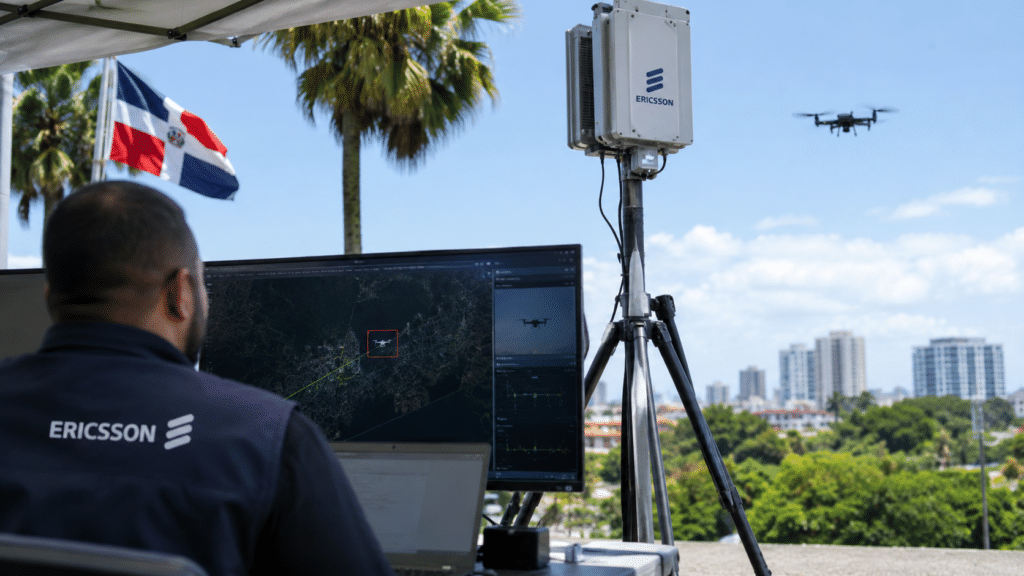
Telecommunications infrastructure could play a new role in public safety in the Dominican Republic, as Ericsson promotes a system that uses 5G mobile networks to detect and track drones operating at low altitudes.
The technology, known as the Ericsson ISAC System, turns mobile network sites into a distributed sensing platform. Rather than relying exclusively on dedicated radar installations, it analyzes radio signals reflected by objects in the surrounding environment to identify and follow airborne activity.
One of its main capabilities is detecting drones that are not connected to commercial mobile networks or transmitting their own communication signals. This could help address a surveillance challenge posed by small unmanned aircraft, which can be difficult to identify with conventional monitoring systems.
How Ericsson’s 5G drone detection system works
ISAC stands for Integrated Sensing and Communication. The approach combines telecommunications infrastructure with sensing capabilities, allowing network equipment to do more than carry data between connected devices.
The system coordinates observations from multiple 5G sites. By analyzing how radio waves bounce off moving objects and combining information collected from different locations, it can identify potential drones and maintain their tracks as they move through an area.
Advanced signal processing and artificial intelligence can support object classification and three-dimensional positioning. The resulting information can be shared through standardized interfaces with authorized command-and-control and security platforms.
Because the system builds on existing mobile network infrastructure, it could extend surveillance coverage without requiring a separate radar installation at every location. Ericsson nevertheless describes ISAC as a complement to conventional radar and other detection technologies, not a replacement for them.
Potential applications across the Dominican Republic
Ericsson sees several possible uses for the technology in the country, particularly in areas where unauthorized drone activity could create security risks.
These include border crossings and vulnerable coastal areas, as well as major maritime facilities such as Port of Caucedo and Río Haina Port. Other potential applications include monitoring power plants, refineries, water infrastructure and facilities considered strategically important.
The system could also provide an additional layer of monitoring around hotels, stadiums and large public events. In these settings, earlier detection of unauthorized aircraft could help security teams assess potential risks and coordinate an appropriate response.
Ericsson has also identified possible applications for the future management of commercial drone activity in urban areas such as Greater Santo Domingo and Santiago. As drone-based delivery and other low-altitude services develop, monitoring systems could become increasingly important for managing airspace shared by different operators.
International trials have demonstrated the technology
Ericsson has tested ISAC in several international settings. Demonstrations involving AT&T in the United States, Erillisverkot in Finland, and Play and Asseco in Poland have explored how mobile networks and complementary sensors can detect and track drones.
The trials have included monitoring around complex locations such as ports and major venues. Ericsson says the technology can maintain detection and tracking across multiple network sites, including when aircraft are not connected to a communications network.
In a separate announcement on November 2, 2026, Ericsson introduced its ISAC System as a commercial solution. The company said selected small-scale, sensing-only commercial pilots are expected to begin in 2027, with broader deployments anticipated from 2028. Those timelines describe the company’s wider commercialization plans and do not establish a deployment schedule for the Dominican Republic.
Deployment in the Dominican Republic remains a separate question
The proposal could give telecommunications infrastructure a broader role in the country’s security and public safety capabilities. However, identifying potential applications does not mean that the system is already operating at Dominican ports, borders or other facilities.
Any implementation would require decisions involving network operators, public authorities and the institutions responsible for security and critical infrastructure. Coverage, technical performance, data access and coordination with existing surveillance systems would also be important considerations.
For now, Ericsson’s proposal illustrates how 5G networks could evolve beyond connectivity and become part of a wider infrastructure for monitoring low-altitude airspace. Whether that capability becomes operational in the Dominican Republic will depend on future partnerships, testing and deployment decisions.
More information about the technology is available on Ericsson’s ISAC System page.