 24°C


Dominican Doctors’ Strike Disrupts Public Hospital Consultations and Elective Surgeries
A 24-hour nationwide doctors’ strike disrupted scheduled medical appointments and elective surgeries across the Dominican Republic’s public hospital network on Tuesday, October 13, while emergency departments and critical care units remained operational. The walkout centers on long-standing demands for pay incentives, additional medical positions and improved hospital security.


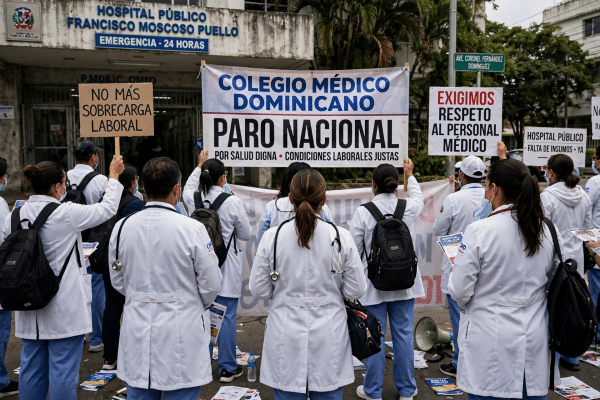
Public hospitals reported canceled appointments and postponed procedures as physicians observed the nationwide stoppage called by the Dominican Medical College (CMD). Emergency services and critical care units continued operating during the 24-hour action.
In Santiago, patients who arrived for scheduled appointments at Presidente Estrella Ureña Hospital and José María Cabral y Báez Hospital were unable to receive their planned consultations. Some had traveled from distant communities and said they had not known about the strike in advance.
Among those affected was Ana Collado, an older woman from Villa Bao who traveled to Estrella Ureña Hospital seeking treatment for a foot condition. Ángel Rodríguez, who came from Tavera, La Vega, for a nephrology consultation at Cabral y Báez Hospital, said he spent RD$1,000 on transportation for himself and his companion. He was given a new appointment for November 26.
The CMD’s Santiago branch, led by Penélope Gómez, supported the strike and organized a gathering outside Cabral y Báez Hospital. Participants highlighted concerns over staffing shortages, hospital security and inadequate supplies.
Doctors ratify strike as health authorities call for dialogue
The CMD’s national leadership, headed by Luis Alberto Peña Núñez and Secretary General Miosotte Lázala, reaffirmed the strike on Monday after what the organization described as unsuccessful efforts to resolve its demands through institutional channels.
The union said it had requested a meeting with President Luis Abinader and proposed technical working groups involving the Ministry of Public Health, the National Health Service (SNS), the Ministry of Higher Education, Science and Technology, and the National Institute of Transit and Land Transportation. According to the CMD, these initiatives had not produced the expected progress.
SNS Executive Director Julio César Landrón, meanwhile, guaranteed the continuity of services throughout the public hospital network and urged the medical association to postpone the stoppage. He proposed resuming negotiations after Abinader returned to the country, arguing that dialogue offered the best route to an agreement and would help prevent further disruption for patients.
The competing positions reflect an unresolved dispute over doctors’ compensation, working conditions and staffing. The authorities’ appeal for more time did not prevent the CMD from proceeding with the planned action.
CMD demands seniority incentives and higher on-call payments
One of the union’s main demands is payment of a seniority incentive for doctors with more than 15 years of service. It is also seeking updated compensation for on-site and remote on-call duties, which the organization says remains between RD$600 and RD$1,000 without adequate revisions for years.
The CMD is also pressing for the extension of remote on-call payments to Samaná and Santiago Rodríguez, arguing that physicians in these areas should receive comparable recognition for their work.
Thousands of additional medical positions sought
The association is calling for between 3,000 and 4,000 new medical positions across the health system. It estimates that more than 15,000 doctors are unemployed, while more than 5,000 candidates compete each year for approximately 1,400 to 1,500 medical residency places.
Those figures are estimates presented by the medical association and were not independently established by the information available for this report. The CMD argues that expanding employment opportunities and strengthening hospital staffing would benefit both medical professionals and patients who depend on the public health network.
Hospital security and working conditions among other grievances
Beyond compensation and employment, the CMD has raised concerns about security inside public hospitals. It alleges that some facilities lack entrance and security personnel after 6 p.m., leaving doctors exposed to additional risks while carrying out their duties.
The union is also seeking professional reclassification for specialists and an end to what it describes as mistreatment by certain hospital directors. It maintains that inadequate staffing and operational deficiencies place additional pressure on medical personnel and can affect the quality of care delivered to patients.
Medical association opposes proposed pharmaceutical legislation
The CMD has also rejected a bill submitted to the Chamber of Deputies that seeks to penalize doctors’ collaboration with the pharmaceutical industry. The organization argues that the proposal could interfere with continuing medical education and professional development.
The disagreement adds another issue to an already broad set of demands involving labor rights, hospital management and the professional autonomy of physicians. The association maintains that resolving these concerns is essential to improving conditions throughout the public health system.
Patients face delays as dispute remains unresolved
The immediate impact of the strike has been felt by patients whose consultations and elective procedures were postponed, including people who traveled long distances to reach public hospitals. Although emergency and critical care services remained available, the disruption highlighted the difficulties faced by patients who rely on scheduled appointments for ongoing treatment. The strike also underscores the importance of following Dominican Republic news to stay informed about developments affecting public services, healthcare policy and the everyday lives of citizens.
The CMD has urged the public to understand the reasons behind the protest, arguing that its demands extend beyond doctors’ working conditions to the quality and reliability of healthcare services. The government, through the SNS, has called for renewed negotiations to settle the dispute and avoid further interruptions to medical care.
As of the information available for this report, no final agreement resolving the union’s demands had been confirmed.