 25°C
25°C

Government Structure of the Dominican Republic: How the State Works
The Dominican Republic is a representative democracy with a presidential system of government and three constitutionally distinct branches: the executive, legislative and judicial powers. Based on the national Constitution, its political system distributes authority among the presidency, the National Congress, the courts and other public institutions. Municipal governments also have elected authorities, giving local communities a role in managing public affairs. Understanding how these institutions work together helps explain how the country makes laws, administers public services and protects constitutional rights.


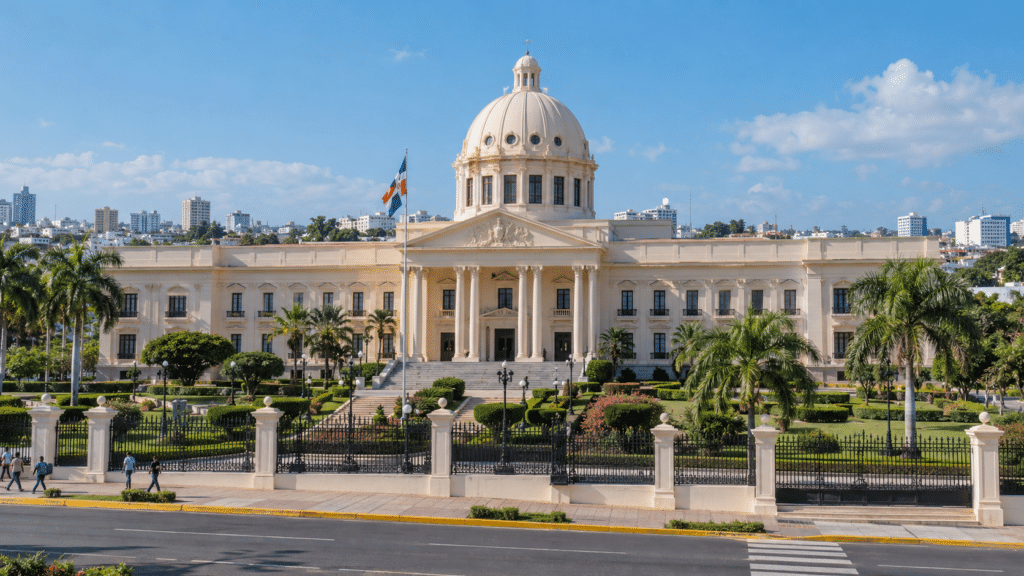
The government structure of the Dominican Republic is based on a constitutional system that separates public authority among three branches: the Executive, the Legislature and the Judiciary. Each branch has its own responsibilities, while constitutional rules establish how they interact and limit the exercise of state power. The system combines a directly elected president, a bicameral national legislature, an independent judicial branch and elected municipal governments.
The Constitution is the supreme legal framework of the Dominican state. Its most recent major revision was proclaimed on October 27, 2024, and it establishes the principles governing public institutions, elections, fundamental rights and the organization of government. Understanding this framework requires looking beyond the presidency to the Congress, the courts, autonomous constitutional bodies and local authorities.
Overview of the Dominican Republic’s Government Structure
The Dominican Republic is a sovereign, democratic, republican and representative state. Its political institutions operate under the Constitution, which defines the powers of public authorities and establishes limits on their exercise. National government is organized around three branches, but several independent or constitutionally autonomous institutions also perform essential functions.
The distinction between the state and the government is important. The state encompasses the permanent constitutional institutions, legal framework and public administration of the country. The government, in the narrower sense, refers principally to the authorities responsible for directing public policy and administering the executive branch during a constitutional term.
The following table summarizes the main components of the political system.
| Institution or branch | Main responsibility | Key institutions |
|---|---|---|
| Executive branch | Implements laws, directs public administration and conducts government policy | President, vice president, ministries and other executive agencies |
| Legislative branch | Debates and passes legislation, approves the national budget and exercises oversight | National Congress, Senate and Chamber of Deputies |
| Judicial branch | Administers justice and resolves legal disputes | Supreme Court of Justice and other courts |
| Constitutional jurisdiction | Reviews constitutional questions and protects constitutional supremacy | Constitutional Court |
| Electoral institutions | Organize elections and resolve electoral disputes | Central Electoral Board and Superior Electoral Tribunal |
| Local government | Manages municipal affairs and local public services within the law | Mayors, municipal councils and district municipal boards |
These institutions do not all belong to one of the three traditional branches in the same way. For example, the Constitutional Court has a distinct constitutional role, while the Central Electoral Board and the Superior Electoral Tribunal have separate responsibilities in electoral administration and electoral justice. Their functions are established by the Constitution and applicable legislation.
The Executive Branch: The President and the Government
The executive branch is responsible for administering the country, implementing legislation and directing national public policy. It is headed by the president of the Dominican Republic, who serves as both head of state and head of government. The president also has constitutionally defined responsibilities concerning national security, foreign relations, public administration and the execution of the national budget.
The President of the Dominican Republic
The president is elected by direct popular vote for a four-year constitutional term. The office carries substantial executive authority, including the appointment of government officials as provided by law, the direction of the administration and the promulgation of legislation approved by Congress. The president also represents the Dominican Republic in international affairs and exercises the powers assigned by the Constitution in relation to the armed forces.
The president does not possess unlimited authority. Executive decisions must comply with the Constitution and the laws, and the president’s powers are subject to the checks established by the political and legal system. Congress exercises legislative and oversight functions, while courts and other constitutional institutions operate within their respective jurisdictions.
The 2024 constitutional revision retained a two-term consecutive limit for the presidency. A president may seek one immediate consecutive reelection but cannot subsequently run again for the presidency or vice presidency under the applicable constitutional restriction. This rule is particularly important when comparing the Dominican system with presidential systems that permit different reelection arrangements.
The Vice President
The vice president is elected alongside the president as part of the same presidential ticket. The office provides for constitutional succession and includes responsibilities that may be assigned through the country’s legal and administrative framework. The vice president is not the head of a separate branch of government and does not independently direct the national administration simply by holding the office.
The constitutional rules governing succession establish how executive authority is maintained if the president cannot continue in office. These provisions are intended to preserve continuity in government while ensuring that the transfer of authority follows established legal procedures.
The Council of Ministers and Government Ministries
The executive branch operates through ministries, administrative agencies and other public institutions. Ministers oversee policy areas such as finance, foreign affairs, education, public health, tourism, industry, agriculture, public works and the environment. Their work translates presidential priorities and legal obligations into administrative programs, regulations and public services.
The Council of Ministers provides a framework for coordination among the president, the vice president and the ministers. Government departments are responsible for implementing policy within their respective mandates, managing resources and supervising the agencies that fall under their authority. Their decisions must remain within the powers granted by the Constitution and legislation.
The executive administration also includes institutions with specialized responsibilities. Some are organized as departments within ministries, while others operate under distinct legal arrangements, including autonomous or decentralized status. This administrative structure allows the state to carry out functions ranging from tax collection and infrastructure development to environmental regulation and social protection.
How the Executive Branch Affects Daily Life
For residents, businesses and visitors, the executive branch is often the most visible part of government. Ministries and agencies administer public services, issue permits, implement regulations and oversee programs. Businesses may interact with executive institutions when registering operations, complying with tax obligations or obtaining sector-specific authorizations. Residents encounter them through public education, healthcare, transportation, identification and other administrative services.
However, not every public institution is directly controlled by the president in the same manner. Constitutional autonomy, administrative decentralization and specific statutory mandates can limit or define the relationship between an agency and the central executive administration.
The Legislative Branch: The National Congress
The legislative branch is exercised by the National Congress, a bicameral institution composed of the Senate of the Republic and the Chamber of Deputies. The two chambers participate in the legislative process, represent different constituencies and perform constitutionally assigned oversight functions. Their organization reflects the principle that national legislation should pass through a representative parliamentary institution rather than being made exclusively by the executive.
Congress has several central responsibilities: considering and passing laws, examining public policy, approving the national budget through the constitutional process and exercising the oversight powers assigned to legislators. It also participates in certain appointments and institutional procedures specified by the Constitution.
The Senate of the Republic
The Senate is the upper chamber of Congress. It consists of 32 senators, with one elected from each of the Dominican Republic’s 31 provinces and one from the National District, which includes the national capital, Santo Domingo de Guzmán. Senators serve four-year terms.
The Senate participates in legislation and has specific constitutional responsibilities involving appointments and institutional oversight. It also considers matters that require the participation of the upper chamber under the Constitution. Its territorial composition gives each province and the National District an equal number of senators, regardless of differences in population.
The Chamber of Deputies
The Chamber of Deputies is the lower chamber of Congress. Under the constitutional framework established in 2024, it has 190 members. Deputies are elected for four-year terms, with representation determined by constitutional and electoral rules that account for territorial constituencies, population and other legally established forms of representation.
The Chamber considers proposed legislation, debates national policy and exercises oversight responsibilities. It also has specific powers in matters such as presenting candidate lists for certain constitutional appointments and initiating proceedings assigned to it by the Constitution. Its composition differs from the Senate because representation is not based exclusively on one seat for each province.
How Laws Are Made
The legislative process involves more than a vote in Congress. Bills may be introduced by constitutionally authorized actors, including legislators and the executive, as well as through other initiatives permitted by law. Proposals are examined, debated and voted on according to the procedures governing each chamber.
Depending on the subject and constitutional requirements, a proposal may need approval from both the Senate and the Chamber of Deputies. Once Congress completes the required legislative stages, the measure proceeds through the constitutional process for presidential promulgation and publication. The president’s role is governed by the Constitution, which also establishes procedures for objections, reconsideration and the treatment of legislation when disagreements arise.
Not every bill follows an identical route. Constitutional amendments, budget legislation and measures affecting particular institutions may be subject to specific requirements. These distinctions matter because a simple legislative majority does not automatically satisfy every constitutional threshold or procedure.
Congressional Oversight and Public Finances
Congress has an important role in controlling public expenditure and scrutinizing the work of the executive. The national budget must pass through the applicable constitutional and legislative process, giving elected representatives an opportunity to examine spending priorities and public revenue. Legislative oversight also allows members of Congress to investigate matters within their legal authority and demand accountability from public officials through established procedures.
Financial accountability is not the responsibility of Congress alone. The Chamber of Accounts performs external auditing and fiscal oversight functions, while the Comptroller General’s Office is responsible for internal control within the executive administration under its legal mandate. These mechanisms complement legislative scrutiny and help establish a framework for monitoring the use of public resources.
The Judicial Branch: Courts and the Administration of Justice
The judicial branch interprets and applies the law through the courts. Its responsibilities include resolving civil and criminal disputes, handling cases involving administrative decisions and protecting rights through the remedies established by law. Judicial independence is a fundamental element of the constitutional structure because courts must decide cases according to the applicable legal framework rather than simply following the preferences of political authorities.
The ordinary judicial system includes the Supreme Court of Justice, courts of appeal, courts of first instance, justice of the peace courts and other courts established by law. Their jurisdiction and procedures depend on the type of dispute and the applicable legal rules. Not every legal matter begins in the same court, and certain cases are assigned directly to higher courts.
The Supreme Court of Justice
The Supreme Court of Justice is the highest court within the ordinary judicial branch. It exercises powers established by the Constitution and legislation, including jurisdiction over certain cases involving senior public officials and the consideration of appeals in matters assigned to it by law. Its role also includes functions concerning the interpretation and application of ordinary law within its jurisdiction.
The Supreme Court should not be confused with the Constitutional Court. Although both are high-level judicial institutions, they have distinct mandates. The Supreme Court operates within the ordinary judicial system, while the Constitutional Court has specialized authority over constitutional review and disputes assigned to it by the Constitution.
Lower Courts and Courts of Appeal
The lower courts handle many of the disputes that arise in everyday life. Depending on their jurisdiction, they may consider contractual disagreements, property claims, criminal cases, family matters, employment disputes and other legal issues. Courts of appeal review decisions when the relevant procedural rules permit an appeal, while the Supreme Court hears the cases and legal challenges assigned to it.
The structure of the judicial system is intended to provide defined routes for bringing claims and challenging decisions. The applicable procedure depends on the nature of the case, the court’s jurisdiction and the legal remedy being sought. Anyone involved in a legal dispute should therefore distinguish between ordinary appeals, constitutional proceedings and specialized administrative or electoral cases.
The Constitutional Court
The Constitutional Court is a separate constitutional institution responsible for safeguarding the supremacy of the Constitution. Its jurisdiction includes reviewing the constitutionality of laws, regulations and other measures under the conditions established by the Constitution and the relevant organic legislation. It also resolves certain constitutional disputes and considers constitutional remedies assigned to it by law.
The Constitutional Court’s role is distinct from the ordinary administration of justice. A dispute about how a contract should be interpreted, for example, is not automatically a constitutional case. Constitutional jurisdiction becomes relevant when the nature of the claim and the applicable legal rules bring a matter within the court’s specific powers.
The National Council of the Judiciary
The National Council of the Judiciary, known in Spanish as the Consejo Nacional de la Magistratura, participates in selecting judges for designated high courts, including the Supreme Court of Justice and the Constitutional Court. Its composition and procedures are established by the Constitution and applicable laws.
The council is not another ordinary court and does not replace the judicial branch in deciding cases. Its institutional purpose includes participating in the appointment process for judges at the constitutional level. The rules governing its composition are designed to involve designated public officeholders and representatives of different institutions in decisions concerning high judicial appointments.
Independent and Autonomous Constitutional Institutions
The three-branch model provides the basic framework for understanding the Dominican government, but it does not describe every institution in the state. The Constitution also establishes or recognizes bodies with specialized responsibilities and varying degrees of institutional autonomy. These bodies perform functions that require defined procedures, separate mandates or particular safeguards against improper interference.
The Central Electoral Board
The Central Electoral Board, or Junta Central Electoral (JCE), is responsible for organizing, directing and supervising national electoral processes within its constitutional and legal mandate. It oversees elections for the presidency, Congress and municipal authorities. Its responsibilities also include the civil registry and the issuance of national identity and electoral identification documents.
Because electoral administration and identity registration are closely connected to citizenship and political participation, the JCE has a significant role beyond election day. It maintains essential records and administers processes that support the legal identification of individuals. Its powers, internal organization and procedures are defined by the Constitution and electoral legislation.
The Superior Electoral Tribunal
The Superior Electoral Tribunal, or Tribunal Superior Electoral (TSE), handles electoral disputes within its jurisdiction. It adjudicates contested electoral matters and certain disputes involving political parties, groups and movements. It also hears specified appeals and other cases assigned to it by the Constitution and legislation.
The separation between the JCE and the TSE is important. The JCE principally administers electoral processes, whereas the TSE performs a judicial role in resolving electoral controversies. This division helps distinguish the management of elections from the adjudication of disputes that arise during or around them.
The Chamber of Accounts
The Chamber of Accounts, or Cámara de Cuentas, is the country’s principal external public auditing institution. It examines public accounts and reviews the management and use of state resources within its legal mandate. Its work can help identify financial irregularities, weaknesses in public administration and areas requiring corrective action.
The Chamber of Accounts is distinct from the Comptroller General’s Office. The latter performs internal control functions within the executive administration, while the Chamber of Accounts exercises external fiscal oversight. Both contribute to the broader system of public accountability, alongside Congress and the mechanisms available for public scrutiny.
The Ombudsman’s Office
The Dominican Republic also has a constitutional Ombudsman’s Office, known as the Defensor del Pueblo. Its general purpose is to protect the rights of individuals in their dealings with public administration and other entities within its legally defined scope. It can receive complaints, investigate matters and make recommendations or take other actions authorized by law.
The Ombudsman’s Office does not replace the courts or automatically invalidate administrative decisions. Its role is to provide an additional institutional channel for the protection of rights and the examination of alleged administrative abuses. The remedies available in a particular case depend on the relevant legal framework.
Local Government in the Dominican Republic
Government in the Dominican Republic is not limited to national institutions based in Santo Domingo. The Constitution recognizes the National District, municipalities and municipal districts as the foundations of the country’s local political and administrative system. These local entities have legal personality and defined powers concerning administration, budgets, regulations and land use, subject to the Constitution and national legislation.
Local government is particularly important because many public concerns arise at the neighborhood or municipal level. Waste collection, local roads, public spaces, land-use decisions and certain community services may involve municipal authorities, although responsibilities can overlap with those of national ministries and agencies.
Provinces and the National District
The Dominican Republic is divided into provinces and the National District for administrative and representative purposes. Provinces provide an important framework for territorial organization, electoral representation and the coordination of public administration. The National District, which contains the capital, has a distinct status in the country’s political and administrative structure.

Provincial governors serve as representatives of the executive branch under the applicable constitutional and legal framework. They should not be confused with elected mayors. A governor’s role is connected to national administration at the provincial level, while municipal authorities exercise the responsibilities assigned to local government.
Municipalities and Mayors
Municipal governments are led by mayors and municipal councils. The mayor or mayoress heads the executive side of the municipal administration, while the council of regidores performs regulatory, deliberative and oversight functions within its legal mandate. Municipal authorities are elected by voters in the relevant jurisdiction for four-year terms.
Municipal governments have defined powers over local matters and can adopt measures within the limits established by law. Their responsibilities may include local planning, public spaces, waste management, municipal roads and the regulation of land use. The precise allocation of duties depends on national legislation and the arrangements governing particular public services.
Municipal Districts
Municipal districts are local administrative units with their own legally defined governing arrangements. They are generally administered by a district director and a board of vocales, which performs regulatory and oversight functions within its mandate. These authorities are elected under the rules applicable to municipal and district municipal elections.
Municipal districts should not be treated as identical to provinces or full municipalities. Their powers, administrative organization and relationship with the surrounding municipality are determined by law. This distinction can matter when identifying which authority is responsible for a local service, permit or administrative decision.
How Elections Shape the Government
Elections provide the principal mechanism through which citizens choose national and local representatives. Dominican voters elect the president and vice president, members of Congress and municipal authorities under the constitutional and electoral framework. These offices have different responsibilities, so elections determine not only who leads the national executive but also who represents constituencies in the legislature and manages local affairs.
The president and vice president are elected together for a four-year term. Senators and deputies also serve four-year terms, as do elected municipal authorities. The electoral calendar and the procedures for each type of election are governed by the Constitution and electoral legislation, including rules on candidate registration, campaigning, voting, vote counting and challenges.
The Role of Political Parties
Political parties organize candidates, develop policy platforms and compete for public office. They also help structure legislative representation and the formation of political majorities. The party or coalition associated with the president may hold a majority in Congress, but the constitutional responsibilities of legislators remain distinct from those of the executive.
When the president’s political group lacks a congressional majority, the administration may need to negotiate with legislators from other parties to secure support for bills and policy initiatives. When a party or coalition controls both the presidency and substantial congressional representation, it may have a different legislative environment, but constitutional procedures and institutional responsibilities continue to apply.
Electoral Administration and Disputes
The electoral system distinguishes between administering elections and resolving contested electoral matters. The Central Electoral Board manages electoral processes, while the Superior Electoral Tribunal adjudicates disputes assigned to its jurisdiction. This distinction helps establish a legal route for challenging electoral decisions rather than leaving every controversy to the institution that administered the process.
Electoral procedures can include challenges to candidacies, disputes over results and disagreements within political organizations. The specific remedy and deadline depend on the applicable law. Electoral disputes are therefore subject to specialized rules that may differ from the procedures governing ordinary civil or administrative litigation.
Checks and Balances: How the Institutions Interact
The separation of powers is intended to prevent the concentration of public authority in a single institution. Each branch has its own constitutional functions, but the system also contains procedures through which institutions interact. Congress passes legislation, the executive administers the law, and courts resolve legal disputes within their jurisdiction. Constitutional and autonomous institutions add further mechanisms of review and accountability.
The president cannot independently replace the legislative process with a general power to enact ordinary laws. Congress, in turn, must exercise its powers within constitutional limits. Courts must act within their jurisdiction and follow applicable procedures. The Constitution defines how these institutions exercise authority and how disputes about their powers may be resolved.
Legislative and Executive Checks
Congress can scrutinize executive action through its constitutionally assigned oversight powers, budgetary responsibilities and legislative work. The executive must implement laws and administer public funds within the applicable legal framework. Where the Constitution gives Congress a role in appointments, agreements or other decisions, the required procedures must be followed.
These relationships are not identical to those found in parliamentary systems. The Dominican Republic has a presidential system, meaning that the president’s executive mandate derives from the constitutional electoral process rather than from being selected as prime minister by a parliamentary majority. The president and legislators have separate electoral mandates, even when they belong to the same political party.
Judicial Review and Constitutional Limits
Courts and constitutional institutions provide legal mechanisms for addressing disputes over the interpretation and application of the Constitution and other laws. The Constitutional Court has a specialized role in reviewing constitutional questions, while ordinary courts adjudicate matters within their respective jurisdictions. Electoral and administrative disputes may also be governed by specialized legal procedures.
Judicial review does not mean that every disagreement with a government policy becomes a constitutional case. A claimant must use the legal procedure appropriate to the dispute, and the relevant institution must have jurisdiction. The distinction between political disagreement and a legally justiciable claim is essential to understanding how constitutional government operates.
Public Accountability and Transparency
Public accountability involves more than elections. Financial audits, legislative oversight, judicial remedies, access to public information and complaints to relevant oversight institutions can all contribute to scrutiny of government conduct. These mechanisms operate under different legal rules and do not necessarily provide the same remedy.
For example, a concern about public spending may fall within the mandate of an auditing institution, while a challenge to an administrative decision may require an administrative appeal or judicial action. A complaint involving an alleged violation of rights may raise different questions again. Identifying the institution with the relevant legal authority is often the first step toward understanding the available options.
The Constitution and the Legal Framework
The Constitution establishes the fundamental structure of the Dominican state, defines public powers and recognizes fundamental rights. The constitutional text proclaimed on October 27, 2024, is the central reference for understanding the current framework. It also contains provisions governing public administration, local government, constitutional institutions, elections and public finance.
Ordinary legislation provides further detail. Laws governing public administration establish the organization and operation of ministries and agencies, while electoral laws regulate elections and political organizations. Judicial organization, municipal administration, public procurement, access to information and financial oversight are also governed by specific laws and regulations.
For readers seeking the primary legal source, the official text is available through the Chamber of Deputies’ publication of the 2024 Constitution. Official institutional websites can also provide the laws, regulations and procedural information relevant to particular agencies.
How the Dominican System Differs from Other Government Models
Comparisons with other countries can help clarify the Dominican Republic’s institutional design. The country follows a presidential model, rather than a parliamentary model in which the head of government ordinarily depends on the confidence of the legislature. Its legislature is bicameral, with separate Senate and Chamber of Deputies functions, rather than a single national legislative chamber.
The Dominican system also distinguishes ordinary judicial authority from constitutional review and electoral adjudication. The Supreme Court of Justice is the highest court in the ordinary judicial branch, while the Constitutional Court has a specialized constitutional mandate and the Superior Electoral Tribunal handles electoral disputes. These separate jurisdictions mean that the phrase “highest court” requires context: the answer depends on the type of legal question involved.
Another important feature is the constitutional recognition of local government. Municipal authorities have their own defined responsibilities and elected mandates, although they operate within the national legal framework. This allows local decision-making without turning the country into a federation of states with constitutionally separate sovereign powers.
Frequently Asked Questions About the Dominican Government
What type of government does the Dominican Republic have?
The Dominican Republic is a democratic, republican and representative state with a presidential system. The Constitution separates national authority among the executive, legislative and judicial branches and establishes additional constitutional institutions with specialized responsibilities.
Who is the head of government in the Dominican Republic?
The president is both the head of state and the head of government. The president directs the executive branch, appoints officials as permitted by law and oversees the implementation of national policy within constitutional limits.
How many branches of government does the Dominican Republic have?
There are three principal branches: the Executive, the Legislature and the Judiciary. The constitutional system also includes institutions such as the Constitutional Court, the Central Electoral Board and the Superior Electoral Tribunal, which have distinct responsibilities.
What is the National Congress of the Dominican Republic?
The National Congress is the country’s bicameral legislature. It consists of the Senate, with 32 members, and the Chamber of Deputies, with 190 members under the constitutional framework established in 2024. Its responsibilities include passing legislation, approving the national budget through the required process and exercising oversight functions.
What is the difference between the Supreme Court and the Constitutional Court?
The Supreme Court of Justice is the highest court within the ordinary judicial branch and exercises jurisdiction over cases and appeals assigned to it by law. The Constitutional Court has a separate mandate focused on constitutional review and other constitutional matters established by the Constitution and legislation.
How long does the president serve?
The president serves a four-year term. Under the applicable constitutional rule, a president may seek one consecutive reelection but is then permanently barred from running again for the presidency or vice presidency.
Does the Dominican Republic have local governments?
Yes. The National District and municipalities are governed by municipal authorities, including mayors and councils of regidores. Municipal districts have their own governing arrangements. These authorities exercise the powers assigned to them by the Constitution and national legislation.
Who organizes elections in the Dominican Republic?
The Central Electoral Board organizes and supervises electoral processes within its legal mandate. The Superior Electoral Tribunal adjudicates electoral disputes assigned to its jurisdiction. The two institutions have distinct responsibilities in electoral administration and electoral justice.
What role does the Constitution play in government?
The Constitution is the supreme legal framework of the Dominican state. It defines the powers of public institutions, establishes fundamental rights and provides the rules governing elections, legislation, judicial authority and local administration. Public officials and state institutions must exercise their powers within this framework.
Conclusion
The government structure of the Dominican Republic combines a directly elected president, a bicameral Congress, an independent judicial branch, specialized constitutional institutions and elected local governments. Each institution has a defined role in making laws, administering public policy, resolving disputes or overseeing the use of public resources.
The Constitution provides the common framework for these institutions, while legislation establishes many of the procedures through which they operate. Understanding the distinction between national and local authority, ordinary courts and constitutional jurisdiction, and electoral administration and electoral justice offers a clearer picture of how the Dominican state functions.