 25°C


Net Minimum Wage Fails to Cover Basic Basket in Dominican Republic, Study Finds
The net minimum wage for workers at large companies in the Dominican Republic covers just 94.8% of the estimated monthly cost of the basic basket for the country's poorest households, according to a new study by the Dominican Political Observatory (OPD-FUNGLODE). The findings highlight the gap between statutory wages and the money workers actually take home after mandatory deductions, with even wider shortfalls among micro and small businesses and central government employees.


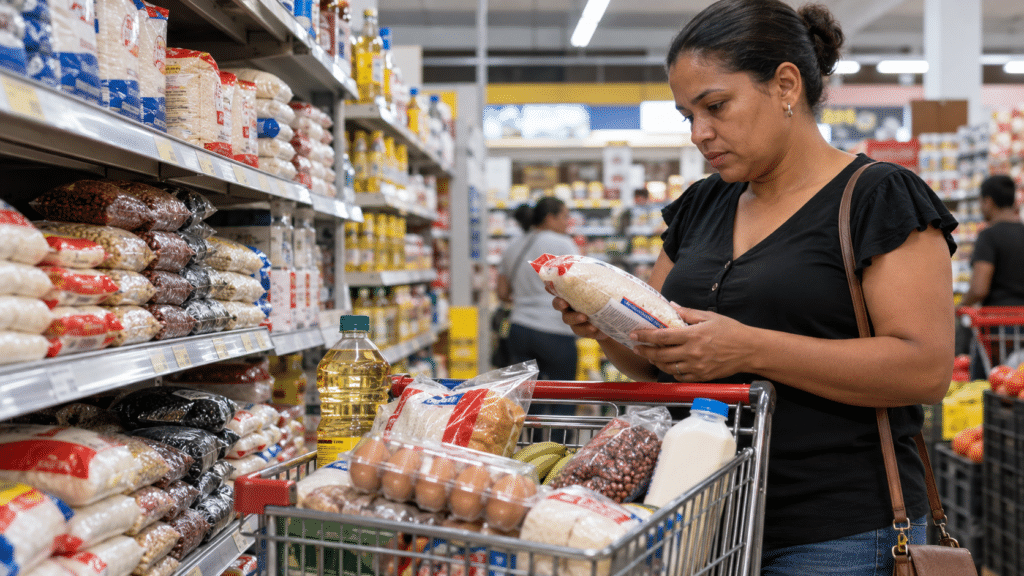
The minimum wage in the Dominican Republic remains insufficient to cover the basic household basket for the country’s lowest-income families, even for workers employed by large companies. A study published by the Dominican Political Observatory (OPD-FUNGLODE) finds that mandatory social security deductions reduce take-home pay below the estimated monthly cost of essential goods and services.
The report, titled “Minimum Wage and the Basic Basket in the Dominican Republic, 2000–2026,” was prepared by the observatory’s Public Policy Unit and authored by Greidys Joel Roa Chalas and Lisleyda Martínez Polanco. It compares minimum wages across employment sectors with the cost of the basic basket, a benchmark used to assess whether household income can cover essential needs.
Net minimum wage falls below the cost of basic needs
In 2026, the gross monthly minimum wage for workers at large companies stood at RD$29,988, while the estimated cost of the basic basket for the poorest 20% of households reached RD$29,756.89.
At first glance, the gross salary appears sufficient to cover that amount. However, after the 5.91% in mandatory deductions for health insurance and pension contributions, the worker’s net monthly income falls to RD$28,215.71, according to the study.
This leaves a shortfall of RD$1,541.18 per month. The take-home wage covers approximately 94.8% of the basic basket, meaning workers would need additional income to meet the benchmark even before accounting for other expenses specific to their households.
The distinction between gross and net wages is central to the report’s findings: a minimum salary that appears to match the cost of basic needs before deductions does not necessarily provide enough purchasing power once employees receive their pay.
Workers at smaller businesses face a larger gap
The situation is more difficult for employees of micro and small businesses. According to the report, these businesses account for approximately 98% of companies in the Dominican Republic, while net monthly wages in the categories analyzed range from RD$15,988 to RD$17,332.
Those earnings cover only between 53% and 58% of the basic basket for the poorest households. The comparison points to a substantial difference in purchasing power depending on the size of the employer, despite the importance of smaller businesses to the national economy.
The findings also underscore why wage comparisons need to distinguish between gross pay, take-home income and the cost of essential goods. The amount employees can actually spend may be considerably lower than the headline minimum wage suggests.
Central government minimum wage covers less than one-third
The report identifies an even wider gap for workers earning the minimum salary in the central government. That wage has remained at RD$10,000 per month since April 2019, according to the researchers.
After the deductions considered in the study, the net amount falls to RD$9,409. That covers just 31.6% of the basic basket for the poorest households and 18.8% of the average household basket nationwide.
The figures reveal a significant difference between the lowest central-government salary and the estimated cost of basic needs. They also show why the purchasing power of a wage depends on both the amount received and the expenses it must cover.
Rising prices add pressure to household budgets
The study found that between late 2020 and August 2026, prices rose by 36.55% for the lowest-income households, compared with 32.08% for the highest-income group.
Food and nonalcoholic beverages account for approximately 38.25% of spending among the poorest households, making them particularly exposed to increases in food prices. By comparison, the same category represents a smaller share of spending for wealthier families.
The cost of the basic basket for the poorest fifth of households increased by 48.4% between August 2019 and August 2026, equivalent to an additional RD$9,712 per month, according to the report.
These trends help explain the pressure on workers whose earnings have not kept pace with the cost of essential purchases. Readers seeking broader context on the cost of living in the Dominican Republic can consult consumer price index data published by the National Statistics Office (ONE).
Real wages have improved, but not equally across sectors
The researchers also identified a longer-term improvement in the purchasing power of workers at large companies. Between 2011 and 2026, the real minimum wage in this category recovered by 69.15%, reaching a level 18.85% above its pre-pandemic position in August 2019.
Internationally, the study places the minimum wage at large Dominican companies at approximately US$495 per month, within the middle-to-upper range of Latin America. Wages in micro and small businesses, estimated at US$281 to US$304, and the central-government minimum wage, at around US$165, fall within the lower third of the regional comparison.
However, the reported improvement in real wages for workers at large companies does not erase the gap between net earnings and the basic basket, nor does it reflect the different circumstances of workers across the economy.
What the findings mean for workers
The report’s central conclusion is that minimum wages must be assessed against the cost of basic needs using the income workers actually receive. In the case of large-company employees, the net minimum wage falls short of the basic basket for the poorest households. For many workers at smaller businesses and in the central government, the gap is substantially larger.
The figures do not mean that every household has identical expenses or that all workers earn the same amount. They do, however, illustrate the challenges faced by low-income families when essential costs absorb a large share of monthly income.
By comparing salaries across sectors and tracking price increases over time, the OPD-FUNGLODE study highlights the continuing difference between nominal wage levels and the purchasing power needed to cover basic household expenses in the Dominican Republic.