 25°C
25°C

Where Do Dominicans Living Abroad Live? Countries and Cities With the Largest Dominican Communities
More than 3 million Dominicans live outside the Dominican Republic, according to the latest sociodemographic registry published by the Dominican government in July 2026. The diaspora is overwhelmingly concentrated in the United States, followed by Spain, with particularly large communities in New York, New Jersey, Florida, Pennsylvania, Massachusetts, Madrid and Barcelona.


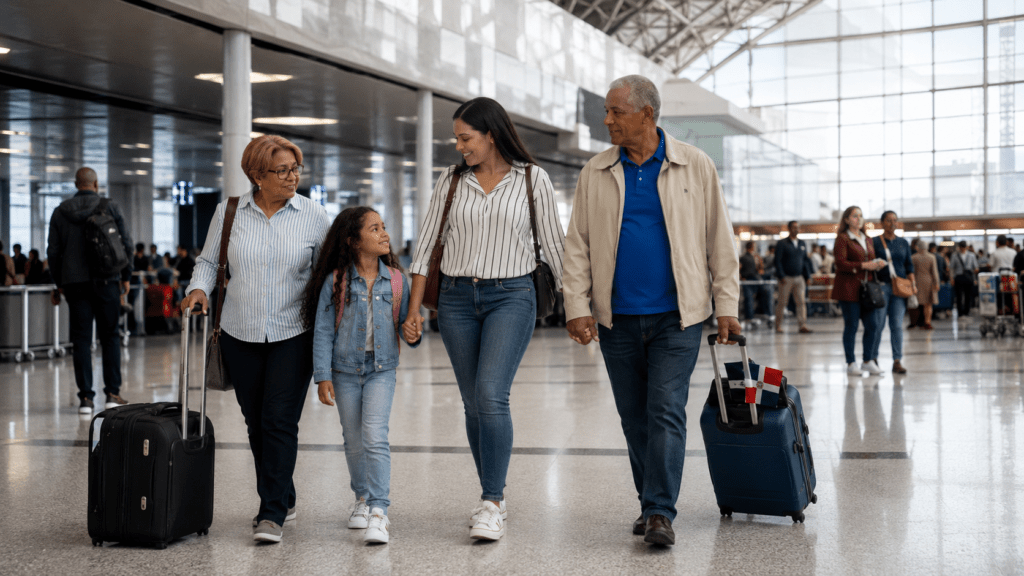
More than 3 million Dominicans live outside the Dominican Republic, according to the latest Dominican government registry. The Dominican diaspora is concentrated mainly in the United States and Spain, but established communities can also be found across Latin America, the Caribbean, Europe and other regions.
The United States is by far the largest destination, with more than 2.5 million Dominicans recorded in the latest official registry. Spain ranks second, while Italy, Chile, Canada and the Netherlands are among the other countries with significant Dominican communities.
How Many Dominicans Live Outside the Dominican Republic?
The latest edition of the Dominican government’s Registro Sociodemográfico de los Dominicanos en el Exterior, prepared by the Institute of Dominicans and Dominicans Abroad (INDEX), counted 3,030,647 Dominicans living in 129 countries and territories.
The figure is an official statistical estimate rather than an exact worldwide census of everyone of Dominican descent. INDEX’s methodology combines national censuses, population surveys, migration records and international demographic sources. The increase in the latest edition also partly reflects broader statistical coverage.
The latest registry indicates that North America accounts for 84.9% of the Dominican population registered abroad, while Europe represents another 9.8%.
The concentration is particularly strong in the United States. The country accounts for 2,539,893 Dominicans, followed by Spain with 207,135. Together, the two countries account for about 91% of the Dominican diaspora.
Countries With the Largest Dominican Communities
| Destination | Dominicans | Approximate share |
|---|---|---|
| United States | 2,539,893 | About 84% |
| Spain | 207,135 | About 7% |
| Italy | 30,200 | About 1% |
| Chile | 22,836 | Less than 1% |
| Canada | 22,125 | Less than 1% |
| Netherlands | 18,465 | Less than 1% |
Other established Dominican communities can be found in France, Venezuela, Mexico, Argentina, Panama, the United Kingdom, Germany, Switzerland and Costa Rica. The registry also identifies smaller Dominican communities in Asia, Africa and Oceania.
Where Do Most Dominicans Live in the United States?
The United States is the center of the global Dominican diaspora. Dominican communities are particularly concentrated in the Northeast, although Florida and several other states also have significant populations.
The latest INDEX figures identify New York, New Jersey, Florida, Pennsylvania and Massachusetts as the five U.S. states with the largest Dominican populations.
| U.S. state | Dominican population |
|---|---|
| New York | 873,294 |
| New Jersey | 389,580 |
| Florida | 323,418 |
| Pennsylvania | 227,647 |
| Massachusetts | 214,756 |
| Rhode Island | 64,396 |
| Texas | 57,494 |
| Connecticut | 56,346 |
| North Carolina | 41,117 |
| Georgia | 36,761 |
New York and New Jersey alone contain more than 1.2 million Dominicans in the latest registry, helping explain the exceptional concentration of the community in the northeastern United States.
New York City
New York City is the largest Dominican population center outside the Dominican Republic.
The Dominican presence is particularly strong in Upper Manhattan, the Bronx and parts of Queens and Brooklyn. Washington Heights has long been one of the most recognizable Dominican neighborhoods in the United States, although the wider community extends across the New York metropolitan area and neighboring New Jersey.
A New York State Senate record citing the 2020 Census reported 842,307 Dominicans in New York City. Different statistical sources can produce different totals because they may measure Dominican origin, ancestry, birthplace or other demographic categories.
Paterson and Other New Jersey Communities
New Jersey has the second-largest Dominican population of any U.S. state. Paterson, Passaic County and surrounding communities have particularly visible Dominican populations.
Other important centers include Newark, Jersey City, Elizabeth, Perth Amboy and Passaic. Their proximity to New York has helped create an interconnected Dominican population corridor across the metropolitan region.
Lawrence and Greater Boston
Massachusetts has one of the country’s most distinctive Dominican population centers.
Greater Boston has a large Dominican community, while Lawrence has developed an especially strong Dominican presence relative to its overall population. Boston itself is another important center, with Dominican communities extending into surrounding municipalities.
Providence
Providence, Rhode Island, is another major Dominican population center in the Northeast.
The Dominican community extends beyond the city into Providence County and other parts of Rhode Island. The relatively small size of the state’s overall population also makes the Dominican presence particularly visible.
Philadelphia and the Lehigh Valley
Philadelphia has a significant Dominican population and forms part of a broader Dominican corridor in Pennsylvania and neighboring New Jersey.
The Lehigh Valley, including Allentown, is another notable center. These communities illustrate how Dominican migration has expanded beyond traditional gateways such as New York and Boston.
Miami and South Florida
Florida has the third-largest Dominican population among U.S. states in the latest INDEX registry.
Miami and South Florida are important centers, although the Dominican population is historically less concentrated there than in New York. The region’s location also creates strong economic and social connections with the Dominican Republic.
Where Do Most Dominicans Live in Spain?
Spain is the second-largest destination for Dominicans worldwide, with 207,135 Dominicans recorded in the latest registry. Madrid and Barcelona are the country’s two largest Dominican population centers.
| Spanish area | Dominican population |
|---|---|
| Madrid | 69,747 |
| Barcelona | 41,966 |
| Balearic Islands | 5,817 |
| Asturias | 5,289 |
| A Coruña | 4,534 |
| Zaragoza | 4,344 |
| Navarra | 4,022 |
| Valencia | 3,806 |
| Las Palmas | 3,457 |
| Tarragona | 3,447 |
Madrid
Madrid is the largest Dominican population center in Spain, with 69,747 Dominicans recorded in the latest registry.
The community extends beyond the central municipality into the wider metropolitan area, an important consideration when comparing population figures between countries.
Barcelona
Barcelona is the second-largest Dominican center in Spain, with 41,966 Dominicans recorded in the latest INDEX data.
The wider Catalan region also has an established Dominican community, including families, businesses, cultural organizations and social networks.
Other Countries With Important Dominican Communities
Although the United States and Spain dominate the diaspora, Dominican communities are distributed across several other countries.
Italy is the third-largest destination in the latest registry, with 30,200 Dominicans. Chile follows with 22,836, making it the leading Dominican destination in South America.
Canada has 22,125 Dominicans, while the Netherlands has 18,465. Other established communities include those in France, Venezuela, Mexico, Argentina, Panama, the United Kingdom, Germany, Switzerland and Costa Rica.
Puerto Rico is also an important destination in the Caribbean, with nearly 58,000 Dominicans recorded in the latest registry.
Which Cities Have the Largest Dominican Communities?
Comparing Dominican populations by city can be difficult because countries use different geographic and demographic definitions. Metropolitan-area figures can therefore provide a more useful comparison than city-proper populations.
Census-based 2020 estimates identified these among the largest Dominican population centers in the United States:
| Metropolitan area | Dominican population, 2020 ACS |
|---|---|
| New York | 1,088,442 |
| Boston | 137,310 |
| Miami | 119,176 |
| Philadelphia | 57,025 |
| Providence | 56,945 |
| Orlando | 53,694 |
| Tampa Bay | 30,678 |
| Washington | 28,316 |
| Allentown-Bethlehem-Easton | 27,564 |
| Atlanta | 21,075 |
These figures use a different year and methodology from the latest INDEX registry and should therefore not be directly combined with the newer national figures.
Why Are So Many Dominicans Concentrated in New York?
New York’s dominance is the result of several decades of migration and the development of strong social networks.
Once a large Dominican community became established, new migrants could rely on relatives, friends, community organizations, businesses and cultural institutions already operating in the area.
This process is often associated with chain migration, although family reunification is only one factor. Employment opportunities, existing communities and the ability to maintain family and cultural connections also influence settlement patterns.
New York has consequently become the center of a much larger regional network extending into New Jersey, Connecticut and parts of Pennsylvania.
Are Dominican Communities Growing Outside New York?
Yes. The Dominican population in the United States is no longer limited to traditional settlement areas.
Housing costs, employment opportunities, family movements and domestic migration have contributed to the expansion of Dominican communities in Florida, Pennsylvania, North Carolina, Texas, Georgia and other states.
The result is a diaspora with both highly concentrated traditional centers and a growing network of secondary communities.
How Large Is the Dominican Diaspora Compared With the Population in the Dominican Republic?
The latest registry’s 3.03 million people abroad correspond to roughly 28% of the population living in the Dominican Republic, according to reporting accompanying the fifth INDEX edition.
This comparison should be interpreted carefully because the diaspora figure is based on the registry’s methodology and is not equivalent to a count of Dominican-born emigrants.
In countries such as the United States, a substantial share of the Dominican-origin population was born locally. Dominican communities can therefore continue growing even when the rate of new migration changes.
What Is the Largest Dominican Community Outside the Dominican Republic?
New York City is the largest Dominican urban center outside the Dominican Republic.
The broader New York metropolitan area contains more than one million people of Dominican origin in Census-based estimates, while New York State alone had 873,294 Dominicans in the latest INDEX registry.
Other major centers include Paterson, Boston, Lawrence, Providence, Philadelphia, Allentown and Miami in the United States, as well as Madrid and Barcelona in Spain.
Frequently Asked Questions
How many Dominicans live outside the Dominican Republic?
The latest Dominican government registry counts 3,030,647 Dominicans living in 129 countries and territories.
Which country has the most Dominicans outside the Dominican Republic?
The United States, with 2,539,893 Dominicans recorded in the latest INDEX registry.

Which U.S. state has the most Dominicans?
New York, with 873,294 Dominicans in the latest INDEX figures.
Which U.S. city has the largest Dominican population?
New York City is the largest Dominican urban center outside the Dominican Republic, although totals vary depending on the demographic definition used.
Where do most Dominicans live in Spain?
The largest concentrations are in Madrid and Barcelona, with 69,747 and 41,966 Dominicans respectively.
Is Puerto Rico one of the main destinations for Dominicans?
Yes. Puerto Rico has one of the largest Dominican communities in the Caribbean, with nearly 58,000 Dominicans recorded in the latest registry.
Are there Dominican communities outside the Americas and Europe?
Yes. The latest registry identifies Dominican nationals and communities in countries across Asia, Africa and Oceania, demonstrating the increasingly global reach of the Dominican diaspora.
The Global Geography of the Dominican Diaspora
The Dominican diaspora is global, but it is highly concentrated. More than eight out of every ten Dominicans registered abroad live in North America, with the United States accounting for the overwhelming majority.
Spain is the principal European center, while Italy, Chile, Canada and the Netherlands have smaller but established communities.
At the city level, New York remains the dominant global center of Dominican life outside the island, supported by interconnected communities throughout New Jersey and the wider Northeast.
The geography of Dominican migration therefore combines one exceptionally large metropolitan hub with a network of regional communities. That structure helps explain the growing visibility of Dominican culture, businesses, family networks and institutions across the United States, Spain and other countries.