 28°C
28°C

Is Tap Water Safe to Drink in the Dominican Republic?
Tap water in the Dominican Republic can leave a treatment plant as potable water and still face quality risks before it reaches the glass. In Greater Santo Domingo, CAASD says treated water is subject to routine monitoring, but intermittent supply, damaged pipes, leaks, and poorly maintained household cisterns and tanks can affect water quality between the treatment plant and the consumer. For residents and visitors, the key question is therefore not simply whether the water is treated, but whether the entire supply and storage system is being adequately maintained.


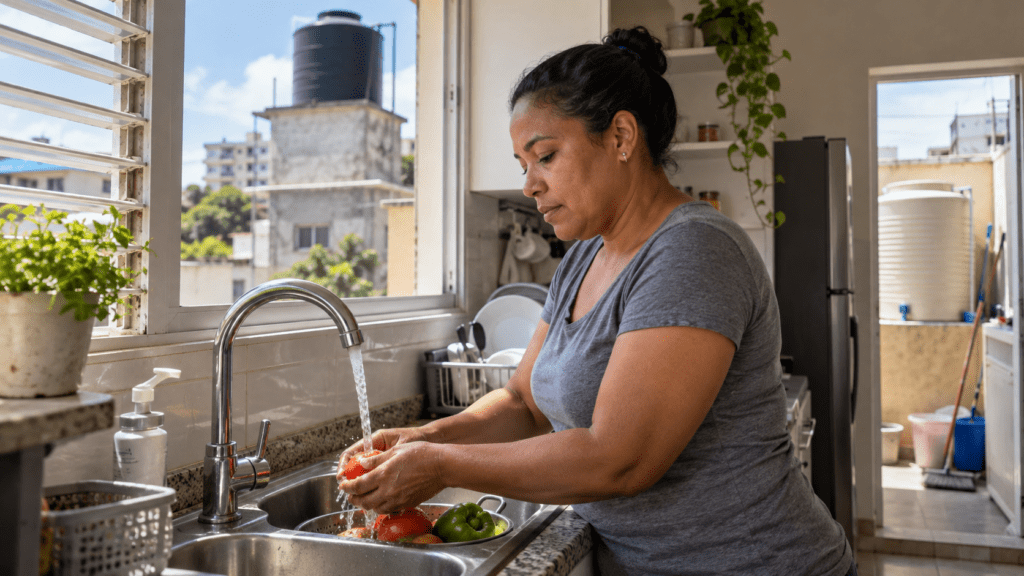
Whether tap water is safe to drink in the Dominican Republic depends on where the water comes from, how it is distributed, and what happens to it before consumption. Water treatment is only one part of the process. Distribution networks, pressure changes, pipe damage and household storage can all influence the quality of water that ultimately reaches a kitchen tap.
This distinction is particularly important in Greater Santo Domingo. The Santo Domingo Water and Sewerage Corporation (CAASD), the public utility responsible for water and sewerage services in the capital area, says its treatment plants produce potable water and that the distribution network is subject to sanitary monitoring. CAASD publishes water-quality reports and provides laboratory testing for drinking water.
At the same time, CAASD water-quality director José Mateo Mota has highlighted a separate issue: water can deteriorate after leaving the treatment plant because of intermittent service, damaged pipes, leaks and inadequate maintenance of household storage systems. That means the condition of the water at the point of consumption can be different from its condition when it left the treatment facility.
So, Is Tap Water Safe to Drink in the Dominican Republic?
There is no single answer that applies to every home, building or location. In areas supplied by a properly operated public water system, treated water can meet drinking-water requirements at the point where it enters the distribution network. However, the safety of water at a particular tap also depends on the condition of the distribution system and, especially, on how the water is stored inside the property.
For visitors, this distinction matters because the U.S. Centers for Disease Control and Prevention (CDC) advises travelers to avoid drinking tap water when they are not reasonably certain that it is safe. The CDC also recommends using appropriately treated water for drinking, cooking, making ice and brushing teeth when water quality is uncertain.
For residents, the more useful approach is to identify the source of the water, understand whether the property relies on a cistern or rooftop tank, check how those systems are maintained, and test the water when there is a specific concern.
Why Water Quality Can Change Between the Treatment Plant and Your Tap
Drinking-water safety is not determined solely at a treatment plant. Water passes through a chain that can include treatment facilities, distribution pipes, building connections, cisterns, pumps, rooftop tanks and household plumbing before it reaches the consumer.
The World Health Organization treats drinking-water safety as a risk-management process extending from the source through distribution and storage to the point of consumption. Protecting water resources is therefore only one part of ensuring safe drinking water; maintaining treatment, distribution and storage systems is equally important.
Problems can arise at several stages, even when the original treated water is of good quality.
Intermittent Water Service
One of the factors identified by CAASD is the intermittency of the water supply. When water does not flow continuously, buildings often need storage systems to maintain a supply between periods of service.
Intermittent distribution can also create additional challenges within a water network. Changes in pressure can increase the opportunity for contaminants to enter damaged sections of a pipe, while stagnant water may remain in parts of the system for periods of time. The World Health Organization identifies intermittent operation and low pressure as potential risks that need to be managed within drinking-water systems.
This does not mean that every interruption makes tap water unsafe. It means that interruptions make proper maintenance, monitoring and household storage more important.
Damaged Pipes and Leaks
Water can also encounter problems while traveling through the distribution network. Cracks, damaged joints and leaks can affect the integrity of pipes, particularly when pressure conditions change.
For this reason, water quality at a treatment plant does not automatically guarantee identical quality at every point in a distribution system. Water utilities monitor networks for precisely this reason, while building owners and residents also have a role in maintaining plumbing and storage infrastructure on their properties.
Household Cisterns
Cisterns are common in Dominican homes and buildings, particularly where a continuous water supply cannot always be relied upon. They provide an important practical function by allowing water to be stored for later use.
The problem arises when a cistern is treated simply as a permanent container rather than as part of the drinking-water system. Sediment can accumulate over time, while damaged covers, insects, rainwater and inadequate cleaning can create opportunities for contamination.
CAASD water-quality director José Mateo Mota specifically identified the lack of regular cleaning and disinfection of household cisterns as an important factor affecting water quality in Dominican homes.
Rooftop Water Tanks
The same principle applies to elevated water tanks. A tank may be necessary for maintaining a household supply, but it needs to be protected from outside contamination and maintained appropriately.
The World Health Organization recommends that drinking-water storage tanks be protected from contamination, kept covered and designed so they can be cleaned and maintained. A properly maintained tank can support water availability without becoming a source of contamination.
A neglected tank can do the opposite. Dirt, sediment, insects and other contaminants can enter if the tank is poorly sealed or inadequately maintained.
What CAASD Says About Water Quality in Greater Santo Domingo
CAASD has stated that the urban area of the National District and Santo Domingo province receives water from treatment plants that produce potable water, with sanitary controls carried out on the distribution network.
The utility also publishes water-quality information on its website. Its available reports include monthly water-quality data for multiple years, including 2024, 2025 and 2026. CAASD also operates a laboratory offering physical-chemical and microbiological analyses of drinking water.
According to Mota’s comments reported by the newspaper Hoy, CAASD collects more than 80 samples from the networks each day for bacteriological analysis. This monitoring is intended to assess the quality of water within the distribution system rather than relying only on testing performed at treatment plants.
CAASD’s laboratory services include microbiological analysis for indicators such as total and fecal coliforms and Pseudomonas, as well as physical-chemical testing that evaluates characteristics and minerals in water intended for human consumption.
Readers who want to review official information can consult CAASD’s published drinking-water quality data and its water laboratory services.
How Household Storage Can Affect Drinking Water
Household storage is one of the most important considerations when evaluating tap water in a Dominican home. The water may enter the property in good condition but spend hours or days inside a cistern or tank before reaching the tap.
Safe storage requires more than simply having a container. The storage system should prevent outside materials from entering, allow regular cleaning and inspection, and minimize direct contact between stored water and hands, cups or other potentially contaminated objects.
The World Health Organization recommends covered storage tanks and regular cleaning and disinfection. Storage containers should also be protected against intrusion by insects, animals and other contaminants.
For homeowners and tenants, practical warning signs include a visibly dirty tank, accumulated sediment, a damaged or missing cover, insects inside the storage area, standing water around the tank, or a storage system that has not been maintained for a long period.
Does Clear, Odorless Water Mean It Is Safe?
Not necessarily. Appearance, smell and taste can provide useful clues, but they cannot establish that water is microbiologically safe.
Water containing harmful microorganisms may look completely normal. Conversely, a change in taste, odor or color does not automatically mean that the water contains a health-threatening contaminant. A noticeable change can nevertheless justify investigation, particularly if it appears suddenly or occurs together with a change in pressure or service conditions.
The CDC recommends testing tap water or consulting available water-quality information when there are concerns about drinking-water safety. Laboratory analysis is more reliable than judging water quality by appearance alone.
How to Check the Quality of Tap Water at Home
The most reliable way to determine whether water from a particular property is suitable for drinking is to have a representative sample analyzed by a qualified laboratory.
CAASD provides laboratory services for both physical-chemical and microbiological analysis of drinking water. Its laboratory can assess characteristics of the water and test for microbiological indicators associated with contamination.
When arranging a test, it is important to explain where the sample was collected. Testing water directly from a distribution point can answer a different question from testing water collected from a kitchen tap after it has passed through a building’s cistern, tank and plumbing.
For a household concerned about its actual drinking water, the point-of-consumption sample can therefore be particularly informative because it reflects more of the system that the consumer actually uses.
What Should You Do If You Are Unsure About the Water?
If you are uncertain about the safety of tap water in a particular property, avoid assuming that clear water is automatically safe or that all tap water in the country has the same quality. Instead, establish where the water comes from and how it is stored.
- Ask how the property receives water. Determine whether it is supplied directly from the public network, through a cistern, through a rooftop tank, or through another source.
- Check the storage system. Look for a secure cover, visible cleanliness and evidence of regular maintenance.
- Consider recent service interruptions. A period of low pressure or interrupted supply can be relevant when evaluating a change in water quality.
- Pay attention to unusual changes. Sudden changes in color, odor or taste should not be ignored, even though they do not by themselves prove contamination.
- Test the water when there is a genuine concern. A certified or appropriately qualified laboratory can provide evidence that visual inspection cannot.
For travelers who cannot establish that the water is safe, the CDC recommends using commercially bottled water from an unopened, factory-sealed container or water that has been adequately treated. This applies not only to drinking but also to preparing beverages, making ice, cooking and brushing teeth when water safety is uncertain.
Should You Boil Tap Water?
Boiling is an established method for reducing the risk from disease-causing microorganisms when water safety is uncertain. The CDC advises bringing water to a full rolling boil for one minute and allowing it to cool before use.
Boiling, however, is not a universal solution for every possible water-quality problem. It is primarily a method for controlling microbial hazards. It does not address every chemical contaminant that could potentially be present in water.
For that reason, persistent concerns about water quality are better addressed by identifying the source of the problem and, when appropriate, testing the water rather than relying indefinitely on boiling without knowing what is causing the concern.
What About Water Filters?
Water filters can be useful, but their effectiveness depends entirely on what they are designed to remove. A filter intended to improve taste or reduce certain chemicals should not automatically be assumed to remove bacteria, viruses or parasites.
The CDC recommends testing water and choosing a treatment system according to the contaminants of concern. Filters also require proper installation, cleaning and replacement according to the manufacturer’s instructions. A poorly maintained filter can become another point of concern rather than a solution.
For a Dominican household with a specific water-quality problem, identifying the contaminant first can therefore be more useful than buying a generic filter without knowing what it is designed to address.
Common Mistakes That Can Reduce Water Quality
Some water-quality problems originate not in the municipal supply but inside the property. Common mistakes include treating a cistern or tank as maintenance-free, leaving storage systems inadequately covered, failing to remove accumulated sediment and assuming that water that looks clean must be safe.
Another mistake is testing only the incoming supply when the real concern is the water being consumed at the kitchen tap. If a property has a cistern, pump, rooftop tank and internal plumbing, each component forms part of the path between the treatment plant and the glass.
It is also important not to confuse a water-quality problem with a water-availability problem. A building may experience interruptions because of supply conditions without the interruption itself proving that the water is contaminated. The two issues require separate assessment.
Tap Water for Residents and Travelers: The Practical Difference
| Situation | What matters most | Practical approach |
|---|---|---|
| Resident with a well-maintained public supply | Network and household plumbing | Monitor service conditions and maintain the property’s water system. |
| Home or apartment with a cistern | Storage hygiene and maintenance | Keep the cistern covered, clean and properly maintained. |
| Building with a rooftop tank | Tank condition and protection from contamination | Inspect, clean and maintain the tank regularly. |
| Property with uncertain water quality | Evidence rather than appearance | Have a representative sample analyzed by a qualified laboratory. |
| Traveler unsure about local tap water | Exposure prevention | Use sealed bottled water or adequately treated water for drinking and food preparation. |
Why Water Quality Should Be Considered at the Point of Consumption
A useful way to understand drinking-water safety is to think of the system as a chain. Treatment protects the water at its source; distribution protects it on the way to the property; and storage and plumbing protect it until it reaches the consumer.
A weakness at any stage can affect the final result. This is why international drinking-water guidance emphasizes risk management across the entire supply chain rather than treating the treatment plant as the only point where safety matters.
For Dominican households, the lesson is particularly relevant when water is stored because of an intermittent supply. Storage can provide continuity, but it also creates another part of the system that must be kept sanitary.

Frequently Asked Questions
Is tap water safe to drink in Santo Domingo?
Water supplied by CAASD is treated and monitored within the public distribution system, and the utility publishes water-quality data. However, the safety of water at a particular household tap can also depend on the building’s pipes, cistern, tank and maintenance practices. When there is uncertainty, testing the water at the point of consumption provides more useful evidence than assuming that all properties have identical conditions.
Can a dirty cistern contaminate drinking water?
Yes. A poorly maintained cistern can allow sediment and other contaminants to accumulate and can provide opportunities for contamination if it is inadequately covered or exposed to insects, rain or other external sources. Regular cleaning, disinfection and protection from outside contamination are important parts of safe storage.
Does bottled water eliminate all water-safety concerns?
No. Bottled water is not automatically safe simply because it is sold commercially. For travelers in areas where tap-water safety is uncertain, the CDC recommends unopened, factory-sealed bottled water. The integrity of the seal and the source and treatment of the water matter.
Can I tell whether tap water is contaminated by looking at it?
No. Water can appear clear and still contain microorganisms that cannot be seen. Conversely, unusual color, taste or odor does not by itself prove that water is dangerous. Laboratory testing is the appropriate way to investigate a specific water-quality concern.
How often should a household water tank be maintained?
Proper maintenance depends on the design and circumstances of the storage system, but regular cleaning and disinfection are essential. CAASD’s water-quality director has emphasized a six-month cleaning interval for household cisterns. Property owners should also inspect tanks and cisterns for damage, inadequate covers, sediment and other conditions that could allow contamination.
Where can drinking water be tested in Santo Domingo?
CAASD operates a laboratory that offers physical-chemical and microbiological analyses of drinking water. Its published information describes procedures for submitting samples and obtaining analysis. Other qualified private laboratories may also provide water-quality testing.
The Bottom Line for Drinking Water in the Dominican Republic
The question of whether tap water is safe to drink in the Dominican Republic cannot be answered solely by looking at the treatment plant or by applying one rule to every property. In Greater Santo Domingo, CAASD states that treated water is produced as potable water and that the distribution network is subject to sanitary monitoring. But the water that reaches a household can also be affected by intermittent service, damaged infrastructure and the condition of private storage systems.
For residents, maintaining cisterns, tanks and household plumbing is therefore an important part of protecting drinking-water quality. For visitors, the practical approach is to use treated or factory-sealed bottled water when the safety of local tap water cannot be established.
When there is genuine uncertainty, the most reliable answer is not based on taste, appearance or assumptions about an entire city. It comes from understanding the property’s water system and, when necessary, obtaining a laboratory analysis of the water actually being consumed.