 25°C
25°C

Why Some Global Car Brands Are Missing From the Dominican Republic
The Dominican Republic’s automotive market is shaped by a mix of dominant Japanese and Korean manufacturers, established American brands, smaller European operations and vehicles brought in through independent importers. Understanding the difference between official representation and simple availability helps explain why some globally recognized brands have a surprisingly limited presence on Dominican roads.


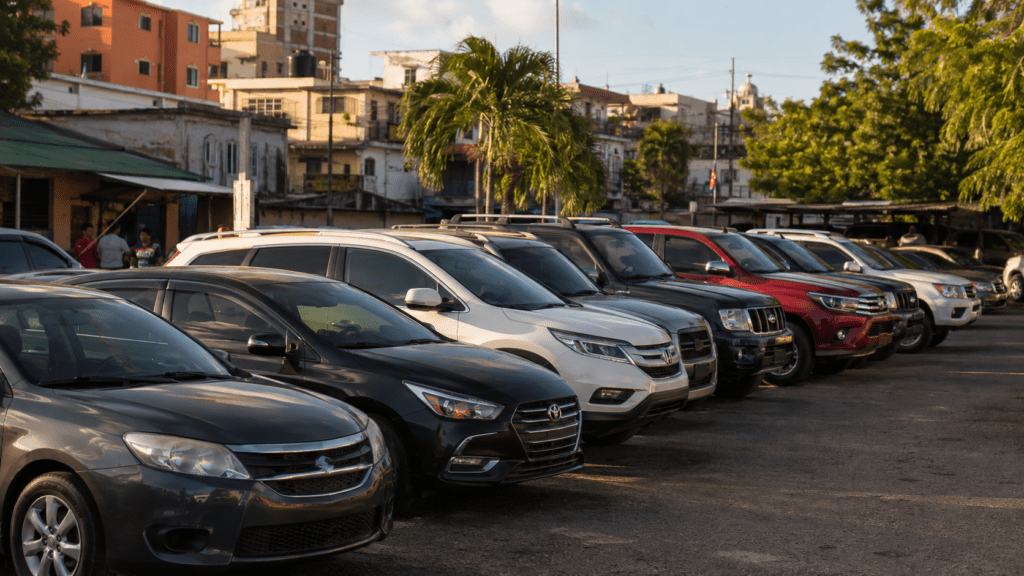
One of the most important characteristics of the Dominican market is the scale of used-vehicle imports. During the first half of 2026, the country imported 25,435 new vehicles compared with 46,110 used vehicles. Used-vehicle imports increased 5.8% year over year, while new-vehicle imports declined slightly.
The United States is particularly important in this system. Dominican imports of vehicles and related products from the United States were valued at approximately US$722 million in 2025, compared with US$450 million from Japan and US$195 million from South Korea.
That connection with the U.S. market gives Dominican consumers access to a much broader range of vehicles than the official dealership network alone would suggest. American auctions and dealers provide a large supply of used vehicles that can be exported to the Caribbean, allowing independent Dominican dealers to offer models that may not have been officially launched locally.
This is why two concepts should always be separated when evaluating the Dominican automotive market: officially sold and available. A car can be available for purchase without the manufacturer having an authorized national retail and service network.
Dacia Shows How a Brand Can Be Present Without Its European Identity
Dacia is one of the clearest examples of how international automotive strategies can differ between markets. The Romanian brand has become highly successful in Europe with practical, relatively affordable models such as the Sandero, Duster and Jogger. Its position in the Dominican Republic, however, is very different.
Renault has an established official presence in the country, with Euromotors CxA identified as Renault Group’s Dominican representative. Some products associated with Dacia in Europe are instead sold under the Renault name in other markets.
The Duster is the clearest example. European buyers generally know it as the Dacia Duster, while the Dominican market has an official Renault Duster. The Renault range in the country also includes models such as the Arkana, Austral, Oroch and Master.
This does not necessarily indicate a lack of interest in Dacia’s products. Instead, it reflects a decision to use an established Renault brand, dealer network and after-sales infrastructure rather than create a separate Dacia operation.
Tesla Illustrates the Difference Between Availability and Official Representation
Tesla presents a different version of the same issue. The American electric-vehicle manufacturer has established official operations in several markets across North America, Latin America, Europe and Asia. The Dominican Republic, however, is not included in Tesla’s official network of markets with stores and service centers.
That does not mean Tesla vehicles are absent from the country. Imported Model 3 and Model Y vehicles can be found in the Dominican market, creating a smaller secondary market supplied in part by independent importers.
For a buyer, the distinction matters because ownership can depend on more than the vehicle itself. An officially represented manufacturer can provide a coordinated system for service, warranties, parts, recalls and customer support. An imported vehicle can still be legitimate and functional, but the support structure may be different.
American Brands Have a Particularly Strong Connection to the Used Market
The geographic and commercial relationship with the United States gives American vehicles an important role in the Dominican market. Ford, Chevrolet and Jeep have established recognition, while other American brands can enter the country through used-vehicle channels even when their official presence is smaller.
Ford and Lincoln, for example, are represented by Grupo Viamar. Lincoln has a smaller installed base than dominant brands such as Toyota and Honda, but it has an official distributor and continues to introduce new models.
Cadillac offers another example of how representation can change over time. The brand returned officially to the Dominican Republic in 2023 after several years away. Santo Domingo Motors reintroduced Cadillac with models including the XT4 and Escalade.
That return also demonstrates the challenge of supporting a premium brand in a relatively small market. Forbes reported that Santo Domingo Motors had imported approximately 225 Cadillac vehicles since the reintroduction, compared with more than 1,700 Cadillac vehicles registered in the country overall.
Some American Vehicles Are Available Mainly Through Imports
GMC is another useful example. Vehicles such as the Sierra and Yukon can be found in the Dominican used-car market, including through local dealer listings. Their presence on the road, however, should not automatically be interpreted as evidence of a nationwide official distribution structure equivalent to that of a major established brand.
This distinction becomes increasingly relevant as vehicles become more technologically complex. A parallel-imported vehicle may have different specifications, software configurations or warranty arrangements from a model sold through an authorized Dominican distributor.
For buyers, the purchase price is therefore only one part of the calculation. Service availability, parts, warranty coverage and the ability to maintain the vehicle over several years can affect the overall cost and convenience of ownership.
European Car Brands Have a Smaller but Established Presence
The Dominican Republic is not without European automotive brands. Volkswagen, Audi, Mercedes-Benz, BMW, Porsche, Peugeot, Citroën, Renault and Volvo have established some level of local presence, while SEAT is represented by Avelino Abreu, which operates dealerships in Santo Domingo and Santiago.
Peugeot offers models including the 2008, 3008, 5008, Rifter, Partner and Landtrek, while Citroën has sales and service locations in Santo Domingo and Santiago. Volvo also maintains an established local operation.
The important point is that European manufacturers are not necessarily excluded from the Dominican market. Their challenge is scale. Their presence is considerably smaller than that of the Japanese and Korean manufacturers that dominate both imports and the registered vehicle fleet.
Why Some Global Car Brands Do Not Build Dominican Dealership Networks
Establishing an official automotive operation requires far more than importing vehicles. A manufacturer or distributor needs showrooms, workshops, spare-parts inventories, trained technicians, warranty operations, vehicle homologation, marketing, financing, customer service, recall management and logistics.
Those investments can make economic sense when a brand expects to sell thousands or tens of thousands of vehicles. If annual sales are limited to a few hundred units, maintaining a complete national network becomes considerably more difficult.
The Dominican market is large enough to support numerous automotive brands, but it is not large enough for every global manufacturer to operate a full-scale network profitably. Distributors therefore have to decide which brands and models can generate enough demand to justify the necessary infrastructure.
Why the Origin of a Vehicle Matters
For Dominican buyers, knowing where a vehicle came from can be almost as important as knowing which brand produced it. A model imported from the United States may differ from the version officially sold in the Dominican Republic, even when the nameplate is identical.
Differences can involve equipment, specifications, warranty coverage, parts availability and software. These considerations become especially important for electric vehicles, where charging requirements and manufacturer-specific service capabilities can influence the ownership experience.
The growth of parallel imports also means that buyers should distinguish between a vehicle’s local availability and the existence of an official manufacturer support network. A car advertised by a Dominican dealer is not necessarily part of the same distribution system used by an authorized national representative.
What Buyers Should Consider Before Choosing a Brand
The unusually diverse structure of the Dominican automotive market gives consumers more choice, but it also makes due diligence important. Buyers comparing vehicles should consider not only the model and purchase price but also how the vehicle will be supported after the sale.
Parts availability can affect both maintenance costs and waiting times. A model with a large installed base is generally more familiar to local mechanics, while a rare or recently introduced vehicle may require more specialized support.
Resale value is another important consideration. Brands with a large presence in the Dominican fleet can benefit from a broader pool of potential secondhand buyers. This can influence how easily a vehicle can be sold later.
Warranty and service coverage should also be checked carefully, particularly when a vehicle has been imported independently. The existence of a local dealer selling the vehicle does not necessarily mean that the manufacturer’s full official support structure applies.
Finally, buyers considering an electric vehicle should pay particular attention to charging and service arrangements. The availability of an imported EV does not automatically mean that the manufacturer has established the same infrastructure in the Dominican Republic that it operates in larger markets.
The Dominican Automotive Market Has Two Interconnected Layers
The structure of the market can ultimately be understood as two interconnected layers. The first is the official market, supplied through authorized manufacturers and distributors with established sales, service and parts operations.
The second is the parallel and import market, supplied by independent dealers and international vehicle flows. This second layer allows Dominican consumers to access vehicles that may not otherwise be available locally, including some American-market models and electric vehicles.
The two systems overlap. A vehicle can have strong brand recognition despite limited official representation, while an officially distributed brand can remain relatively small compared with the dominant manufacturers.
What the Dominican Car Market Reveals About Consumer Choice
The country’s automotive landscape shows why global popularity does not automatically translate into local market share. Manufacturers compete not only with other vehicles but with established habits, existing infrastructure, resale expectations and the availability of mechanics and parts.
Japanese and Korean brands have benefited from that ecosystem for years, while American vehicles have an additional advantage through the country’s close connection with the U.S. used-car market. European brands have established a smaller but recognizable presence, while brands such as Dacia and Tesla demonstrate how products can reach Dominican consumers without reproducing the exact commercial structure found in their largest markets.
For consumers, the central lesson is straightforward: the absence of an official showroom does not necessarily mean the absence of a vehicle brand. In the Dominican Republic, a model may arrive through an authorized distributor, another brand within the same automotive group, or an independent importer.
That distinction is likely to remain important as the market continues to diversify. For anyone buying a vehicle in the Dominican Republic, understanding not just what brands are available but how those vehicles entered the country can provide a clearer picture of service, parts, warranty, resale and long-term ownership.