 26°C
26°C

Dominican Road Safety Study Records 4,387 Risky Behaviors
A direct-observation study by the Fundación Movilidad Vial Dominicana (MOVIDO) recorded 4,387 risky road behaviors during 30 hours at 10 major intersections in Santo Domingo, highlighting repeated violations involving drivers, motorcyclists and pedestrians.


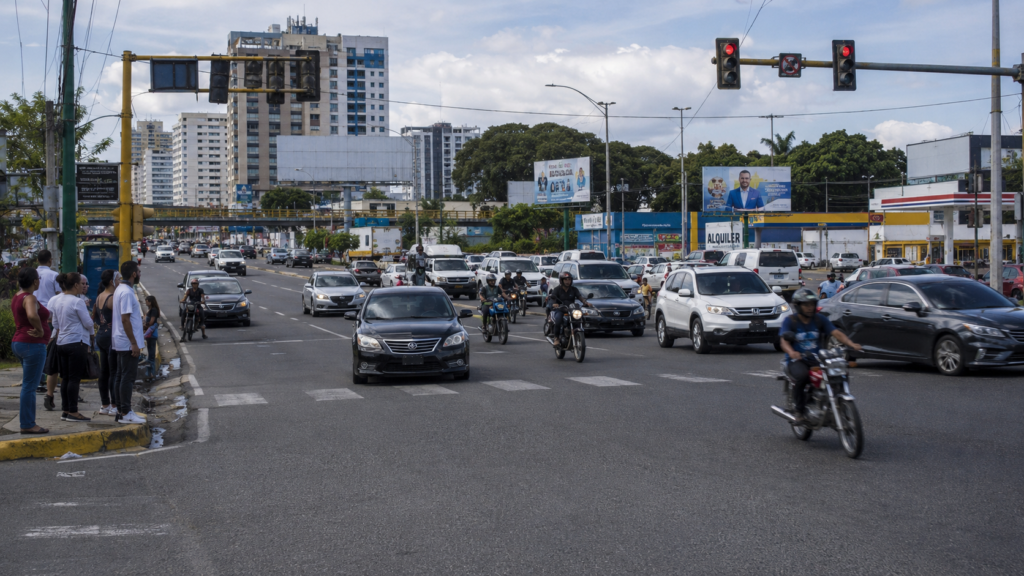
A road safety study in Santo Domingo recorded 4,387 risky behaviors during 30 hours of direct observation at 10 major intersections in the Dominican capital, offering a snapshot of traffic violations that researchers say occur repeatedly rather than as isolated incidents.
The study was conducted by the Fundación Movilidad Vial Dominicana (MOVIDO), a nonprofit organization focused on mobility and road safety. Its observers documented an average of 146 risky behaviors per hour, or approximately one every 25 seconds.
Unlike a public-opinion survey, the exercise relied on direct observation of drivers, motorcyclists and pedestrians. MOVIDO said the objective was to examine the behaviors that can precede traffic crashes rather than focus only on incidents after someone has been injured or killed.
Red-Light Violations Were the Most Common Finding
Vehicles running red lights accounted for 1,284 of the observed behaviors, while motorcycles were recorded crossing against a red signal in another 763 cases.
Intersection blocking was another significant problem. Observers counted 684 vehicles stopped inside intersections even though they could not proceed, creating obstructions and increasing the potential for conflicts between road users.
The study also recorded 512 cases of drivers using mobile phones, 476 pedestrians crossing improperly, 391 prohibited turns by vehicles and 277 instances of motorcycles traveling or remaining on sidewalks.
Because the observations were conducted at selected high-traffic locations and over a limited period, the figures provide a snapshot of behavior at those sites rather than a nationwide measure of every traffic violation in the Dominican Republic.
Motorcycles Accounted for a Significant Share
Motorcycles featured prominently in the observations. MOVIDO recorded 2,324 risky behaviors directly involving two-wheeled vehicles, including red-light violations, sidewalk use and other dangerous maneuvers.
The organization nevertheless cautioned against treating motorcycles as the sole source of unsafe behavior. Its president, Miguel Jiménez, said violations were observed across all groups of road users, including motorists who run red lights, block intersections or use phones while driving, as well as pedestrians who disregard traffic rules.
The findings are consistent with the broader focus on motorcycle safety in the Dominican Republic. In 2024, the government declared road safety a matter of high national interest and established the National Road Safety Plan 2025-2030, coordinated by the National Institute of Transit and Land Transportation (INTRANT), the country’s main road-transport authority.
Ten Santo Domingo Intersections Were Observed
The MOVIDO exercise covered 10 intersections selected because of factors including traffic volume, motorcycle presence, congestion and their importance to urban mobility.
The locations were 27 de Febrero Avenue at Abraham Lincoln Avenue; 27 de Febrero at Winston Churchill; John F. Kennedy at Abraham Lincoln; John F. Kennedy at Winston Churchill; Máximo Gómez at John F. Kennedy; Máximo Gómez at 27 de Febrero; Independencia at Abraham Lincoln; George Washington at Máximo Gómez; José Contreras at Abraham Lincoln; and Ortega y Gasset at 27 de Febrero.
Observations were conducted during different periods of the day to identify potential variations in road-user behavior by time. MOVIDO said it plans to repeat this type of measurement periodically and use the results to assess whether education and enforcement measures are changing behavior.
MOVIDO Plans Periodic Road Behavior Monitoring
The organization announced the creation of the Radar MOVIDO de Conducta Vial, a monitoring tool intended to track road-user behavior periodically. The initiative would allow future observations to be compared with previous measurements, although the information provided does not establish a timetable or methodology for subsequent rounds.
The study comes as road safety remains a major public-policy issue in the Dominican Republic. INTRANT has been working with government agencies, private-sector organizations and civil-society groups on the 2025-2030 national road safety strategy, with the stated goal of improving safety for all road users.
For MOVIDO, the value of observing risky behavior before crashes occur is that it shifts attention toward prevention. The organization’s findings suggest that enforcement and education efforts face a recurring challenge: changing everyday decisions made by drivers, motorcyclists and pedestrians at some of the capital’s busiest intersections.