 23°C
23°C

How Many Colmados Are in the Dominican Republic?
The Dominican Republic has one of the Caribbean’s most extensive networks of neighborhood grocery stores, known locally as colmados. The best available public estimates put the number somewhere between 65,000 and 90,000 establishments, depending on the definition and source. There is no reliable national statistic for the average customer ticket, but available industry figures provide a useful way to estimate daily sales: a typical small colmado may operate around the RD$15,000–RD$25,000 daily sales range, while larger or better-positioned stores can exceed RD$700,000 per month.


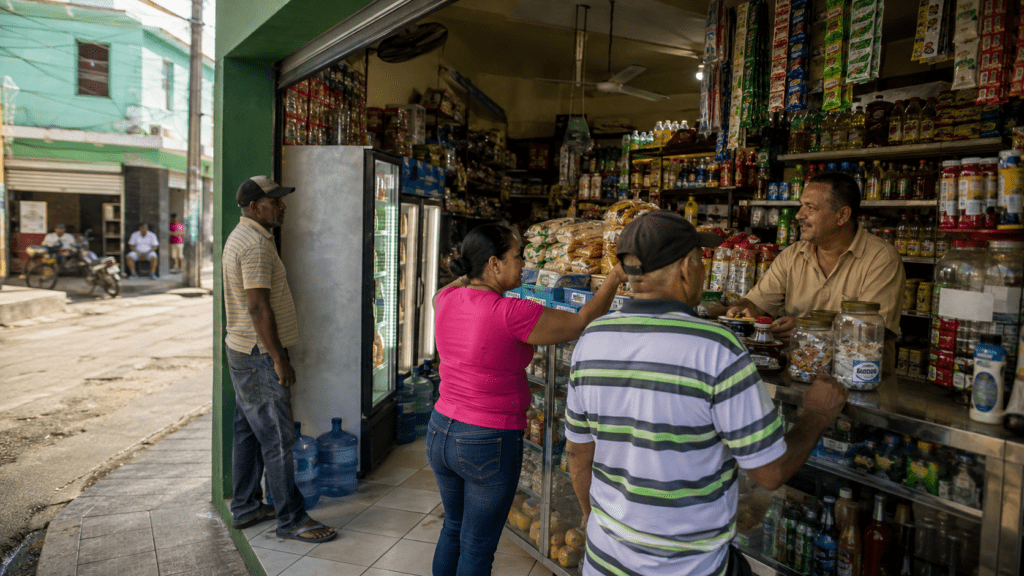
The colmado is one of the most important retail businesses in the Dominican Republic. These neighborhood stores sell food, beverages, household products and other everyday necessities, often serving customers who make frequent small purchases rather than large weekly shopping trips. Their importance extends beyond convenience: government sources have described colmados as a principal food-supply channel for a large share of Dominican households.
There is, however, an important limitation when trying to measure the sector. The Dominican Republic does not appear to maintain a single, regularly updated official census that provides both the exact number of operating colmados and their average sales and customer ticket. Different institutions and industry representatives have therefore produced different estimates. The most useful approach is to distinguish between documented figures and reasonable calculations based on those figures.
How Many Colmados Are There in the Dominican Republic?
The most credible recent estimates place the number of colmados in the Dominican Republic in a broad range of approximately 65,000 to 90,000 establishments.
In 2024, an INFOTEP document associated with the Federación Nacional de Comerciantes y Empresarios de la República Dominicana (FENACERD) referred to approximately 65,000 colmados and stated that the broader retail-provision sector moved RD$438 billion during 2023.
Government officials have also used a substantially higher estimate. Fernando Durán, then administrator of the Banco Agrícola, said in connection with the government’s “A Comer: Del Campo al Colmado” program that studies indicated approximately 90,000 colmados nationwide. The same figure was published in official government material describing the program.
In another 2023 statement, the government gave a narrower estimate of 60,000 to 90,000 colmados.
The difference does not necessarily mean that one source is wrong. The informal nature of a significant portion of Dominican neighborhood commerce makes the universe difficult to count. Different estimates may also include or exclude very small establishments, ventorrillos, bodegas and other forms of neighborhood retail.
| Source or reference | Estimated number | Context |
|---|---|---|
| INFOTEP/FENACERD, 2024 | About 65,000 | Reference to the colmado sector and retail food provision |
| Banco Agrícola/government program | About 90,000 | Estimate used for the national “Del Campo al Colmado” initiative |
| Banco Agrícola statement, 2023 | 60,000–90,000 | Broad national estimate |
For market-sizing purposes, a reasonable conclusion is therefore that the Dominican Republic has tens of thousands of colmados, probably somewhere around 65,000–90,000, rather than a single precisely measured national total.
How Much Does a Customer Spend at a Dominican Colmado?
This is the most difficult of the three questions to answer with a verified national statistic. I could not identify a reliable official study that publishes a nationwide average ticket size per colmado customer.
That distinction matters because the economics of a colmado are built around frequent purchases. A customer may enter to buy a single beverage, bread, eggs or another basic item, while another customer may purchase several groceries at once. Delivery orders can also be considerably larger than walk-in purchases.
For that reason, a fixed number such as “the average Dominican spends RD$X per visit” should not be presented as an official statistic unless it is supported by a representative transaction dataset.
For business planning, however, a working assumption of roughly RD$200–RD$300 per customer visit can be useful as an illustrative range. This is an estimate rather than a published national average, and the actual figure can vary substantially by neighborhood, store format, product mix, delivery activity and customer income.
The reason the range is plausible is the nature of the merchandise sold. Individual purchases can be very small, but a modest basket containing several everyday products can quickly reach a few hundred pesos. Recent reporting on colmado prices illustrates how individual staples can already account for significant portions of a small basket.
How Much Money Does a Colmado Make in a Day?
The answer depends heavily on the size and location of the business. Industry statements provide several useful reference points.
A frequently cited conservative figure is approximately RD$15,000 in daily sales. This figure appears in reporting on the Dominican colmado sector and was described as a conservative average for small retail outlets.
Another industry representative reported that some smaller establishments generate approximately RD$10,000 per day, equivalent to roughly RD$300,000 per month. The same source said that colmados below RD$700,000 in monthly sales were difficult to make economically viable, although that threshold should be understood as an industry opinion rather than a national profitability statistic.
That RD$700,000 monthly figure is equivalent to approximately RD$23,300 in sales per calendar day if divided across 30 days. It therefore provides a useful benchmark for understanding the scale of a more established operation, but it should not be confused with an official average.
| Daily sales | Approximate monthly sales | Interpretation |
|---|---|---|
| RD$10,000 | RD$300,000 | Small or low-volume operation |
| RD$15,000 | RD$450,000 | Conservative historical sector benchmark |
| RD$20,000 | RD$600,000 | Moderate-volume operation |
| RD$23,300 | RD$700,000 | Approximate level cited as an economic viability benchmark by an industry representative |
| RD$30,000 | RD$900,000 | Higher-volume neighborhood store |
These figures represent sales revenue, not profit. A colmado that sells RD$25,000 worth of products in a day does not earn RD$25,000. The business must first pay for the merchandise it sells and then cover expenses such as rent, electricity, employees, transportation, refrigeration, losses, taxes and other operating costs.
What Does the National Colmado Market Move?
One of the most useful figures comes from INFOTEP and FENACERD. Their 2024 material stated that the retail food-provision economy moved approximately RD$438 billion during 2023 and referenced around 65,000 colmados.
If the entire RD$438 billion figure were divided evenly among 65,000 establishments and 365 days, the mathematical result would be approximately RD$18,500 per establishment per day.
That calculation should be treated carefully. The source describes the broader retail-provision sector, so it cannot be used as a precise audited average for an individual colmado. Nevertheless, it provides a useful order of magnitude and is broadly consistent with the other industry estimates around RD$15,000–RD$25,000 per day.
Using the same RD$438 billion figure, the implied monthly average would be approximately RD$1.5 billion per day nationwide and about RD$36.5 million per day per 65,000 stores only if interpreted incorrectly; therefore the calculation must remain at the individual-store level: RD$438 billion divided by 65,000 stores and 365 days gives roughly RD$18,500 per store per day.
How Many Customers Would a Colmado Need?
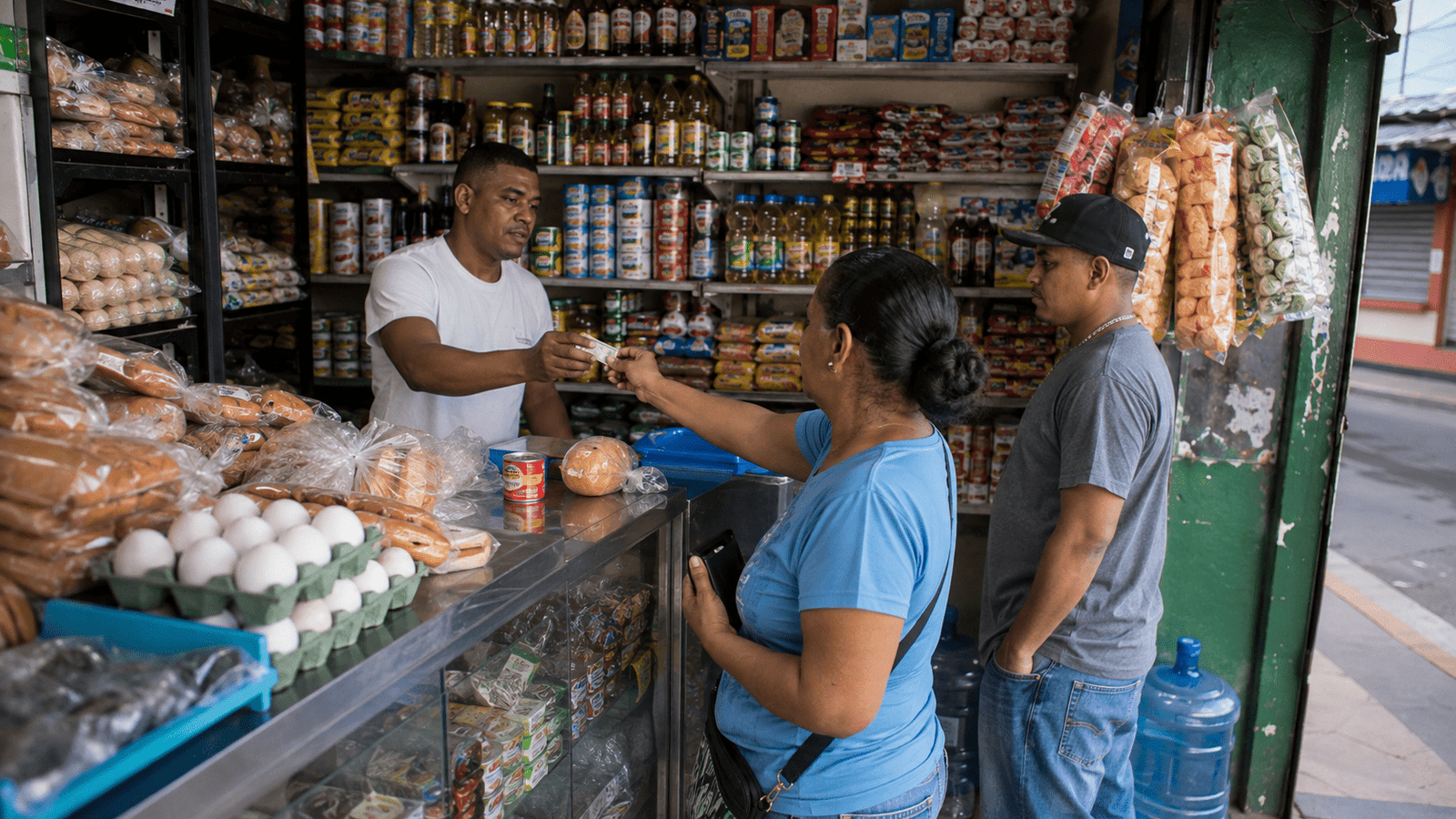
Customer volume and average ticket are two sides of the same equation. If a store sells RD$15,000 per day, its required number of transactions changes dramatically depending on the average purchase.
| Daily sales | Average ticket | Transactions needed |
|---|---|---|
| RD$15,000 | RD$150 | 100 |
| RD$15,000 | RD$200 | 75 |
| RD$15,000 | RD$250 | 60 |
| RD$15,000 | RD$300 | 50 |
| RD$25,000 | RD$200 | 125 |
| RD$25,000 | RD$250 | 100 |
| RD$25,000 | RD$300 | 83 |
These are mathematical examples, not measurements of actual customer traffic. They demonstrate why a business owner should track both daily sales and the average ticket. A store can increase revenue either by attracting more transactions or by increasing the value of each transaction.
Why Colmado Sales Vary So Much
There is no single economic model for a Dominican colmado. A small neighborhood store selling primarily basic groceries can have very different sales from a larger establishment with refrigerators, alcoholic beverages, prepared food, delivery and a wider inventory.
Location is one of the most important variables. A store in a densely populated urban neighborhood can have a much higher number of daily transactions than one serving a sparsely populated rural community. The government’s own description of the sector emphasizes the presence of colmados in both urban neighborhoods and rural areas.
Product mix also matters. A store focused on low-value convenience purchases needs many transactions to produce substantial sales. A store selling larger grocery baskets can generate the same revenue with fewer customers.
Delivery can change the economics considerably. Industry reporting has documented colmados in which delivery represents a large share of total sales, although those examples should not be treated as representative of the entire country.
Operating costs are another major variable. One industry representative cited operating costs of approximately RD$150,000 per month for rent, electricity, gasoline and employees in a particular business context. That illustrates why sales volume alone cannot be used to estimate profit.
Sales Are Not the Same as Profit
This distinction is especially important when evaluating a colmado as a business investment. A store generating RD$700,000 in monthly sales may look significantly more attractive than one generating RD$300,000, but the difference in profitability depends on gross margins, inventory turnover, payroll, rent, electricity, shrinkage, credit sales and other expenses.
Colmados also operate in a competitive environment where customers can compare prices with supermarkets, wholesalers and other nearby stores. Because the business depends heavily on fast-moving everyday products, inventory management and purchasing prices can have a major effect on the amount of money ultimately retained by the owner.
What Is the Best Estimate?
For someone trying to understand the Dominican colmado market rather than obtain a single artificially precise number, the available evidence supports the following working picture:
- Number of colmados: approximately 65,000–90,000 nationwide, depending on the source and definition.
- Average customer ticket: no reliable official national figure is publicly established; RD$200–RD$300 is better treated as a planning assumption than as an official statistic.
- Daily sales: approximately RD$15,000 is a conservative historical benchmark, while RD$20,000–RD$25,000 is a reasonable working range for a moderately active store based on available sector figures.
- Higher-volume stores: some businesses can exceed RD$700,000 per month, equivalent to roughly RD$23,300 per day over 30 days.
- Daily sales are revenue: they should never be confused with the owner’s profit.
The most important caveat is that the Dominican Republic lacks a comprehensive public dataset linking every colmado to its number of transactions, average ticket, sales and profitability. Consequently, the number of establishments can be estimated with reasonable confidence, while the average customer purchase and average daily revenue require more caution.
Frequently Asked Questions
How many colmados are there in the Dominican Republic?
The best available public estimates range from approximately 65,000 to 90,000 colmados. A government program used an estimate of about 90,000, while an INFOTEP/FENACERD document referenced approximately 65,000.
How much does a customer spend at a colmado?
There is no reliable nationwide official average ticket that can be cited. For financial modeling, RD$200–RD$300 per transaction can be used as an illustrative assumption, but actual spending varies considerably by customer and store.
How much does a colmado sell per day?
Historical industry figures cite approximately RD$15,000 per day as a conservative benchmark. Other industry commentary identifies businesses selling around RD$10,000 per day and larger stores exceeding RD$700,000 per month.
Is RD$20,000 in daily sales good for a colmado?
It represents approximately RD$600,000 in monthly sales if maintained every day. Whether that is profitable depends on the store’s gross margin and operating costs. Revenue alone is not enough to determine whether a colmado is financially healthy.
How much money does the entire colmado sector generate?
INFOTEP/FENACERD material reported that the retail food-provision sector moved approximately RD$438 billion during 2023. Because the figure refers to the broader retail-provision economy rather than a fully audited colmado-only dataset, it should not be interpreted as an exact total for colmados alone.
Conclusion
The Dominican colmado market is large, fragmented and difficult to measure with a single official statistic. The strongest available evidence places the number of establishments somewhere between 65,000 and 90,000, making the colmado network one of the country’s most significant retail distribution channels.
For sales, the most defensible benchmark is that a small colmado can generate around RD$15,000 per day, with moderate-volume businesses potentially operating around RD$20,000–RD$25,000 or more. The average customer ticket is less certain because there is no representative national transaction dataset; RD$200–RD$300 should therefore be treated as a modeling assumption, not an official statistic.
The central lesson for anyone analyzing the sector is that customer traffic, average ticket, gross margin and operating costs must be considered together. A colmado can generate substantial daily revenue without necessarily producing a large profit, while a smaller store with strong inventory turnover and controlled expenses can have a healthier business model.