 24°C
24°C

How Much Electricity Does the Dominican Republic Consume?
The Dominican Republic's electricity system is operating at historically high levels of demand. The latest complete annual data show that the Sistema Eléctrico Nacional Interconectado (SENI) received 23,868.5 GWh of electricity in 2025, while the country's peak demand reached 3,923 MW during the year. By April 2026, electricity injected into the SENI had reached 7,194.6 GWh, and a new record instantaneous peak of 4,077.97 MW was recorded in June, illustrating how rapidly the country's electricity requirements are expanding.


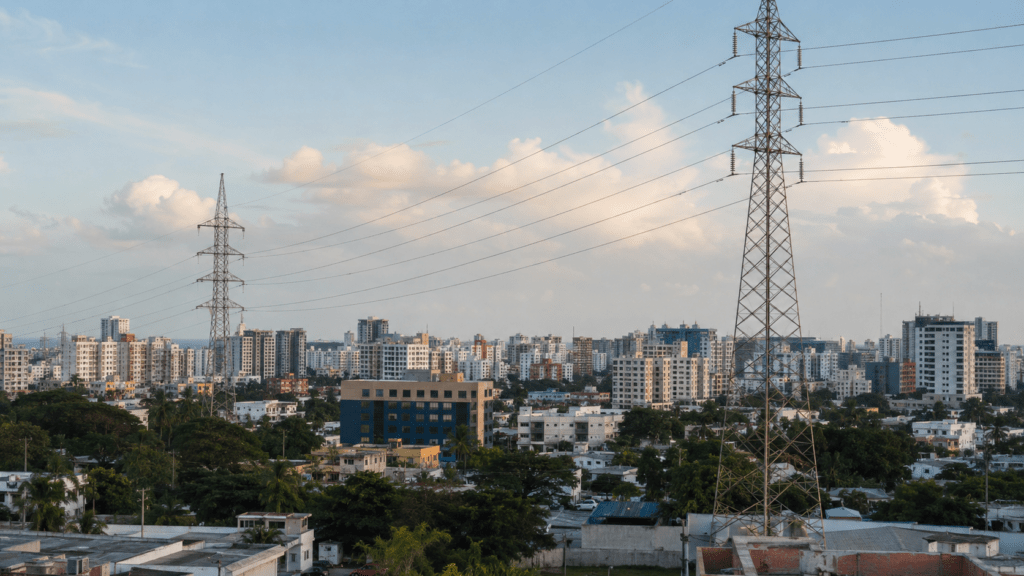
The Dominican Republic is using more electricity than it did only a few years ago, driven by economic activity, population growth, tourism, industrial development, greater air-conditioning use and the continuing electrification of everyday life. Measuring that consumption, however, requires distinguishing between electricity generated, electricity injected into the national grid, and electricity actually demanded by users. These figures are related but are not interchangeable.
How Much Electricity Does the Dominican Republic Use?
The clearest recent benchmark is the performance of the Sistema Eléctrico Nacional Interconectado (SENI), the interconnected power system that supplies most of the country’s electricity. During 2025, a total of 23,868.5 GWh was injected into the SENI, according to the Dominican Ministry of Energy and Mines. That was 799.9 GWh more than in the previous year, indicating continued growth in the amount of electricity moving through the national system.
Twenty-three thousand eight hundred sixty-eight GWh is equivalent to approximately 23.9 terawatt-hours (TWh). Averaged across the year, that represents roughly 65.4 GWh per day of electricity entering the interconnected system. The daily figure is only an average: electricity demand changes substantially depending on the time of day, temperature, economic activity and season.
| Indicator | Latest figure | What it shows |
|---|---|---|
| Electricity injected into the SENI in 2025 | 23,868.5 GWh | Annual electricity supplied into the interconnected system |
| Average equivalent per day in 2025 | About 65.4 GWh | Annual injection divided by 365 days |
| Peak demand served in 2025 | 3,923 MW | Highest instantaneous demand recorded during the year |
| Electricity injected, January-April 2026 | 7,194.6 GWh | Latest complete 2026 period reported by the Ministry |
| Record instantaneous demand, June 2026 | 4,077.97 MW | New national peak for power demand |
These figures should not be interpreted as meaning that every kilowatt-hour generated in the Dominican Republic is consumed by a household or business. Electricity is lost during transmission and distribution, and the SENI also includes different categories of users and system consumption. For that reason, electricity injection is best understood as a measure of the electricity supplied to the interconnected system rather than a direct measure of electricity appearing on consumers’ meters.
What Does 23.9 TWh Mean in Practical Terms?
A terawatt-hour is one billion kilowatt-hours. The kilowatt-hour, or kWh, is the unit normally used on electricity bills, while GWh and TWh are more practical for describing an entire country’s electricity system.
At 23,868.5 GWh, the electricity injected into the SENI during 2025 was equivalent to 23.87 billion kWh. Dividing that figure by the World Bank’s 2024 Dominican Republic population estimate of 11.43 million people gives a simple system-wide equivalent of about 2,089 kWh per person per year. This is an illustrative calculation, not a measure of each person’s household consumption, because the national electricity system also serves businesses, factories, hotels, public facilities and other users.
The distinction matters particularly in a country such as the Dominican Republic, where tourism, commercial activity and industrial electricity use are significant components of total demand. A national per-capita figure therefore should never be confused with the electricity consumed by an average household.
Electricity Demand Is Rising Rapidly
The strongest evidence of the change in the Dominican electricity system is not just the annual amount of energy supplied but the growth in peak power demand. Energy measures how much electricity is used over a period of time; power measures how much electricity the system must deliver at a particular moment.
In 2025, the Dominican Republic recorded a maximum instantaneous demand of 3,923 MW. In June 2026, that record was surpassed when the SENI reached 4,077.97 MW at 10:24 p.m., according to the Presidency of the Dominican Republic. The government described the new peak as evidence of sustained growth in electricity requirements and linked the increase to tourism, industry, commerce, households and high temperatures.
The difference between energy and power is important. A country could consume a large amount of electricity over an entire year without necessarily setting an exceptionally high peak. Conversely, a sharp evening peak can create a major infrastructure challenge even if it lasts only a short period. Generators, transmission lines and substations must be capable of handling those periods of maximum demand.
How Much Electricity Was Used Before the Recent Increase?
Longer-term international datasets also show the Dominican Republic’s rising electricity requirements. A commonly used international series reports electricity consumption of 22,193 GWh in 2023, compared with 20,040 GWh in 2022 and 19,114 GWh in 2021. The same dataset reports 20,991 GWh for 2024.
These international consumption figures are not directly interchangeable with the Dominican government’s SENI injection figures because the underlying definitions and system boundaries differ. For a current assessment of the Dominican grid, the SENI data are more useful for understanding how much electricity the interconnected system is handling, while international consumption datasets are valuable for historical comparisons.
How Much Electricity Does the Dominican Republic Generate?
Generation and consumption are closely connected but are not identical. The country must generate enough electricity to satisfy demand while also accounting for technical losses and other electricity used within the power system.
In 2025, the Ministry of Energy and Mines reported 23,868.5 GWh injected into the SENI. For comparison, the corresponding 2024 figure was 23,068.6 GWh. That means the amount injected into the interconnected system increased by about 3.5% between the two years.
The increase is part of a longer trend. The Ministry reported 21,758.2 GWh injected into the SENI in 2023, followed by 23,068.6 GWh in 2024 and 23,868.5 GWh in 2025. In just two years, the annual amount injected into the interconnected system therefore increased by roughly 2.1 TWh.
What Sources Produce the Dominican Republic’s Electricity?
The Dominican Republic relies on a diversified electricity-generation mix. Thermal plants remain essential to the system, particularly natural-gas and coal-fired facilities, while hydroelectric, solar, wind and biomass generation provide renewable electricity.
During the first half of 2025, the generation mix reported by the Ministry showed natural gas at 39.5%, coal at 29.2%, non-conventional renewable sources at 16.4%, fuel oil No. 6 at 8.3% and hydropower at 6.6%. The non-conventional renewable category included solar, wind and biomass.
The renewable contribution has been increasing. The National Energy Commission reported in 2025 that renewable sources accounted for around 22% to 23% of electricity demand earlier in the year, while by the end of 2025 it reported that 25% of electricity produced in the country came from clean sources.
This change is significant because electricity demand is increasing at the same time that the country is adding solar and wind capacity. Renewable generation can reduce dependence on imported fossil fuels, but its variable nature also creates a need for adequate dispatchable generation, transmission infrastructure and increasingly, energy storage.
Why Is Electricity Demand Growing in the Dominican Republic?
Several factors are contributing to the increase. One is the country’s expanding economy. Businesses, hotels, restaurants, shopping centers, factories and other commercial facilities all require electricity, and electricity use generally rises as economic activity expands.
Air conditioning is another important factor. The Dominican Republic has a tropical climate, and periods of high temperatures can sharply increase electricity demand, particularly during the afternoon and evening. The government specifically cited high temperatures as one factor behind the record peak reached in June 2026.
Tourism also matters. Hotels and resorts require electricity for cooling, refrigeration, lighting, water pumping, kitchens, elevators and other services. As tourism infrastructure expands, the electricity system must accommodate additional demand in the areas where those facilities are concentrated.
Household electrification is another long-term factor. The World Bank reports that 99.6% of the Dominican population had access to electricity in 2023. As access becomes nearly universal, growth increasingly comes from how much electricity connected households use rather than simply from connecting new customers.
What Is the Difference Between Electricity Demand and Electricity Consumption?
For readers comparing statistics from different sources, terminology can be confusing. Electricity demand generally refers to the amount of power or energy requested by users from the electricity system. Electricity consumption usually refers to electricity actually used by consumers. Generation is electricity produced by power plants, while injection refers to electricity delivered into the interconnected system.
These values can differ because electricity is lost while it travels through transmission and distribution networks. Some electricity is also consumed by the power system itself. Consequently, a national electricity-generation figure will normally be higher than the electricity ultimately recorded as consumption by end users.
This is why a statement such as “the Dominican Republic consumes 23.9 TWh” can be misleading if the underlying figure is actually the 23,868.5 GWh injected into the SENI. The more precise wording is that 23,868.5 GWh was injected into the interconnected system in 2025.
How Much Electricity Is the Dominican Republic Using in 2026?
The latest complete period published by the Ministry of Energy and Mines provides a useful snapshot of 2026. From January through April 2026, 7,194.6 GWh was injected into the SENI, an increase of 128.6 GWh over the corresponding period of the previous year.
The January-April figure is not a full-year consumption figure, so it should not be presented as the amount the Dominican Republic will use during all of 2026. It does, however, confirm that electricity flows through the national system remain high.
The June 2026 peak provides an additional indication of the direction of demand. At 4,077.97 MW, the new record was approximately 4% higher than the 2025 maximum of 3,923 MW. A single peak does not determine annual energy consumption, but it demonstrates the increasing capacity that the electricity system must be prepared to supply at critical moments.
How Does the Dominican Republic’s Electricity System Compare With Household Consumption?
National electricity statistics should not be used to estimate the average electricity bill of a Dominican household. Household consumption is only one part of total electricity demand, alongside commercial, industrial, governmental and other users.
For an individual property, electricity use depends heavily on factors such as air-conditioning, water heating, refrigeration, cooking, pool equipment, appliances and the number of people living in the home. These expenses are also an important part of the overall cost of living in the Dominican Republic.
The national figures are instead useful for understanding the scale of the infrastructure required to power the country. They help explain why generation capacity, transmission networks, substations, renewable projects and storage facilities have become increasingly important to the Dominican economy.
What Is the Outlook for Electricity Demand?
The available evidence points toward continued pressure on the electricity system. The combination of economic growth, tourism, urbanization, higher cooling demand and increasing electricity use has pushed the national system to repeated demand records.
At the same time, the Dominican Republic is expanding renewable generation. The National Energy Commission reported that the country had more than 7,400 MW of new renewable and other energy projects in development in 2025, although projects in a development pipeline should not be confused with capacity already operating.
The challenge is therefore not simply to generate more electricity. The system must also ensure that enough capacity is available when demand peaks, that transmission and distribution infrastructure can carry the electricity to where it is needed, and that variable renewable generation can be integrated without compromising reliability.
Frequently Asked Questions
How many GWh of electricity does the Dominican Republic use?
The latest complete annual SENI figure is 23,868.5 GWh injected into the interconnected system in 2025. This is a system-supply figure rather than a direct measurement of electricity recorded on consumers’ meters.
What was the Dominican Republic’s electricity demand record?
The country reached a new instantaneous demand record of 4,077.97 MW in June 2026. The previous annual benchmark was 3,923 MW in 2025.
How much electricity was injected into the Dominican grid in 2024?
The Ministry of Energy and Mines reported 23,068.6 GWh injected into the SENI during 2024. The figure increased to 23,868.5 GWh in 2025.
Is the Dominican Republic using more renewable electricity?
Yes. Renewable sources have taken a growing share of the electricity mix. The National Energy Commission reported that clean sources supplied 25% of electricity produced in the country by the end of 2025.
Does electricity consumption equal electricity generation?
No. Generation and system injection occur before electricity reaches final consumers, and transmission and distribution losses mean that the amount produced or injected will not necessarily equal the amount ultimately recorded as end-user consumption.
Why does peak electricity demand matter?
Peak demand determines how much generating, transmission and distribution capacity the system must have available at the most demanding moments. A rapidly increasing peak can require new infrastructure even when annual electricity consumption grows more gradually.
The Bottom Line
The Dominican Republic’s electricity requirements have entered a period of sustained growth. The national interconnected system handled 23,868.5 GWh of injected electricity in 2025, while the country’s maximum demand reached 3,923 MW. In 2026, the system continued to operate at high levels: 7,194.6 GWh had been injected during the first four months of the year, and a new record peak of 4,077.97 MW was reached in June.
The most important trend is therefore not a single annual number but the combination of rising energy throughput and increasingly high peak demand. For the Dominican Republic, meeting that growth will depend on adding generation while simultaneously strengthening transmission, distribution, system flexibility and renewable integration. The country’s growing use of solar, wind, hydro and other renewable sources is changing the generation mix, but the underlying requirement remains the same: enough reliable electricity must be available when households, businesses and industries need it.
For official statistics and continuing updates, readers can consult the Dominican Ministry of Energy and Mines, the National Energy Commission and the Organismo Coordinador of the SENI.