 26°C
26°C

Dominican Republic Moves Beyond Chronic Hunger, but Food Insecurity Remains
The Dominican Republic has fallen below the FAO’s 2.5% threshold for chronic undernourishment, marking a major improvement in national food security. Yet 41.3% of the population still faces moderate or severe food insecurity, highlighting persistent problems with household income, access to healthy food and regional inequality.


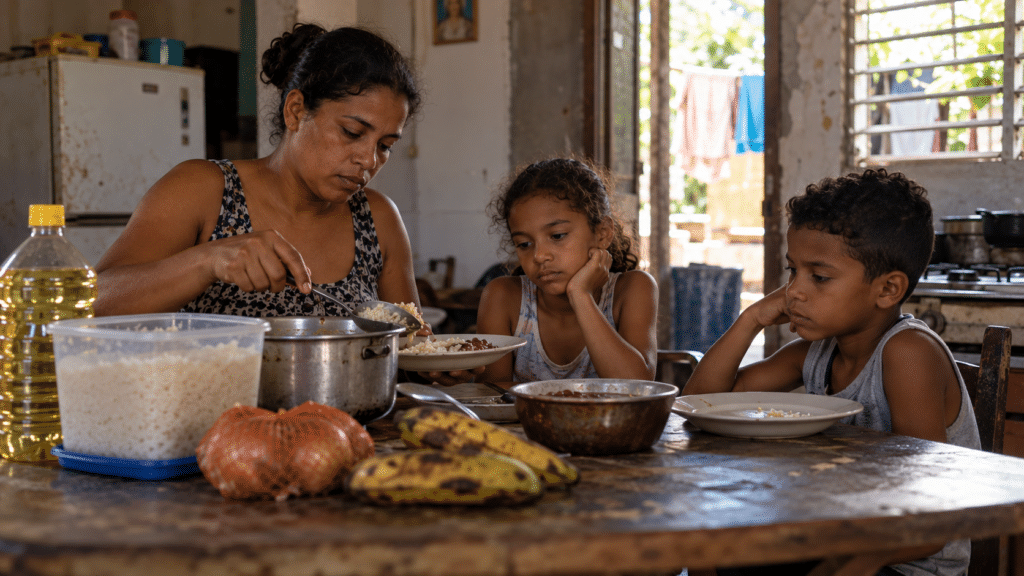
The Dominican Republic has reached a significant milestone in its fight against hunger, with the prevalence of chronic undernourishment falling below 2.5%, according to the Food and Agriculture Organization of the United Nations (FAO). The figure places the Caribbean country outside the organization’s statistical threshold for the lowest levels of chronic hunger.
The national improvement, however, does not mean that food insecurity has disappeared. An estimated 41.3% of the Dominican population, or about 4.7 million people, still experience moderate or severe food insecurity. Around 2.1 million people, equivalent to 17.9% of the population, face severe food insecurity.
The contrast between the two figures reflects two different measures. The FAO’s Prevalence of Undernourishment indicator measures chronic insufficient food consumption at the population level, while the Food Insecurity Experience Scale examines whether people have had difficulty accessing adequate food, including situations in which households reduce the quantity or quality of what they eat.
Why Chronic Hunger and Food Insecurity Are Different
A household can therefore live in a country with a very low prevalence of chronic undernourishment while still struggling to afford a sufficiently nutritious diet. In the Dominican Republic, the issue increasingly concerns economic access rather than the simple availability of food.
FAO representative in the Dominican Republic Rodrigo Castañeda has described the challenge as one in which lower-income families have less ability to purchase food. Economist Jorge Paz, a researcher associated with Argentina’s National Scientific and Technical Research Council and the National University of Salta, has similarly noted that a person can fall outside the chronic hunger threshold while still experiencing food insecurity.
The distinction becomes particularly important when national averages are compared with household experiences. A country may have enough food available nationally while some families are forced to reduce portions, buy cheaper products or sacrifice other essential expenses to cope with the cost of living and keep food on the table.
For Some Households, Food Security Depends on Income
The situation is visible in communities near the Dominican-Haitian border. In Palo Blanco, a community in Dajabón province, 58-year-old Reina Jiménez Contreras relies on the government’s Aliméntate social assistance program after years without employment.
Jiménez receives 1,650 Dominican pesos, roughly $28, through the program, alongside assistance for electricity and cooking gas. Her food budget is concentrated on staples such as rice and cooking oil, while meat and fruit are less frequent purchases.
Her experience illustrates the difference between having food available in local markets and being able to afford a varied diet. When her money does not stretch far enough, she said she buys less of everything and has sometimes had to choose between food and medical expenses.
Social Programs Have Helped Reduce Hunger
The country’s progress against chronic hunger has been linked to a combination of factors, including increased agricultural production, food imports, rising incomes and social protection programs.
The Aliméntate program, administered through the government’s Supérate social development system, increased its monthly benefit from 825 pesos to 1,650 pesos and expanded coverage to about 1.4 million households during the current administration, according to officials cited in the report.
The national school feeding program has also played a substantial role. Government officials say more than two million people receive food through schools each day, reducing the pressure on lower-income households.
Other measures include family agriculture initiatives such as the 50 shade houses operated through Supérate. These projects are intended to strengthen food production at the household and community level while supporting vulnerable families.
The Border Shows the Limits of National Averages
The country’s seven provinces along the Haitian border — Montecristi, Dajabón, Santiago Rodríguez, Elías Piña, Independencia, Bahoruco and Pedernales — contain some of the vulnerabilities that are less visible in national statistics.
One government response is Mi Frontera RD, a development program focused on employment, basic services and investment in the border region. According to government officials, the share of households with low or very low incomes in the area fell from 65% in 2018 to 59% in 2022.
Dajabón also illustrates how food access is connected to cross-border commerce. The city hosts one of the Dominican Republic’s principal binational markets, where Haitian buyers purchase food and other products from Dominican sellers. The market operates on scheduled trading days and is an important part of the local economy.
For merchants, however, the trade also demonstrates the difference between availability and purchasing power. When food prices rise, sellers report that customers with limited incomes reduce their purchases.
Food Production Faces Its Own Challenges
The food security equation also depends on the ability of Dominican farmers to produce food at sustainable costs. In Dajabón, rice farmer José Lucio Gil García says high expenses for fertilizer, labor and fuel reduce the margin available to producers.
Water availability is another constraint. Gil García has farmland that cannot be fully used because rainfall is limited and irrigation infrastructure does not reach all of his property.
The agricultural challenge is becoming more closely linked to climate conditions. The FAO representative cited in the report warned that precipitation in the Dominican Republic could decline by 23% by 2050, increasing pressure to invest in agricultural research, technology and climate adaptation.
Agriculture officials say the Dominican Republic currently produces more than 85% of the basic food it consumes. At the same time, the sector faces the need to diversify production, strengthen family farming, improve market access and process agricultural surpluses that might otherwise be lost.
What the Food Security Challenge Means for the Dominican Republic
The country’s progress against chronic hunger represents an important change in its national food security indicators, but the remaining challenge is increasingly about affordability, nutrition and inequality.
Food insecurity is associated with factors including household income, education, family composition and gender. Research cited in the report indicates that households with lower incomes, children or female heads of household can face greater vulnerability.
This means that improvements in the national average do not necessarily reach every province or household at the same pace. The border region, rural communities and lower-income families remain important areas for food-security policy.
The next stage will therefore involve maintaining the gains already made while improving economic access to nutritious food. That includes social protection, agricultural productivity, reliable water supplies, access to markets and measures that help farmers adapt to changing climate conditions.
For the Dominican Republic, moving below the FAO’s chronic hunger threshold marks a major statistical milestone. The broader food-security challenge is more complex: ensuring that households across the country can consistently afford enough nutritious food, even when incomes are limited and local economic or environmental conditions make access more difficult.