 22°C
22°C

Abinader Highlights Public Procurement Reform At Dominican Forum
President Luis Abinader called for faster, more transparent and accountable government procurement as officials reviewed the implementation of the Dominican Republic’s new Public Procurement Law at a two-day forum in Santo Domingo.


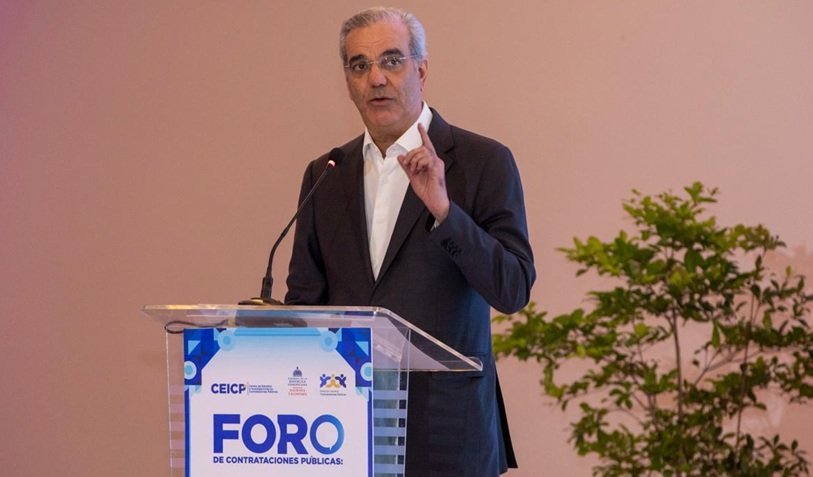
Santo Domingo — President Luis Abinader said Wednesday that reforming public procurement is essential to improving government services, strengthening institutional credibility and ensuring that public spending produces tangible benefits for citizens.
Speaking at the second Public Procurement Forum in Santo Domingo, Abinader linked the quality of government contracting to projects and services that directly affect daily life, including schools, hospital equipment, medicines and road infrastructure.
“A public procurement process works when what was contracted arrives on time, meets the expected quality and responds to a real need of the people,” the president said.
New Rules Reshape Government Contracting
The forum, held Wednesday and Thursday under the theme of strengthening governance for integrity and transparency, focused on the progress, challenges and implementation of Law 47-25 on Public Procurement.
The law is part of a broader overhaul of the Dominican Republic’s public procurement system. Its implementing regulation, approved through Decree 52-26 in January, established a new framework centered on planning, competition, oversight and traceability. The government has described the reform as a shift toward a more transparent and predictable system for institutions and suppliers.
Abinader said effective implementation will require trained public servants, responsible suppliers, fully functioning oversight bodies and rules applied fairly. He also emphasized greater digital traceability, new procurement methods and stronger monitoring mechanisms.
More Competition And Greater Access For Suppliers
Carlos Pimentel, director general of the General Directorate of Public Procurement (DGCP), presented figures showing the changes recorded in the procurement system. He said 59.8% of participants were awarded contracts in 2025, while small and medium-sized businesses received 44.7% of the total amount awarded, equivalent to about RD$123 billion.
Pimentel also reported that the number of bids received increased by more than 370%, while the State Supplier Registry expanded by 56%. The number of institutions required to use the Electronic Public Procurement System rose by 121%, according to the figures presented at the forum.
Coverage of hospitals integrated into the system increased by 826%, while 195 municipalities and municipal districts were added, representing growth of more than 400% in that area.
These changes come as the Dominican Republic continues implementing the new procurement framework. The DGCP, the government body responsible for overseeing the national public procurement system, has also introduced additional rules during 2026 covering the electronic system and other operational aspects of the new law.
Officials Stress Anti-Corruption Enforcement
Attorney General Yeni Berenice Reynoso focused on the legal consequences of corruption, urging public officials to maintain high standards of integrity.
She highlighted the new legal framework’s recognition of criminal liability for legal entities and the possibility of accumulating penalties in corruption cases, including bribery. Reynoso argued that the combination of the new Criminal Code and legislation covering public procurement, asset forfeiture and money laundering provides the Dominican Republic with a broader legal framework for prosecuting corruption.
Her remarks underscore one of the central challenges facing the procurement reform: ensuring that new rules are accompanied by effective oversight and enforcement. The forum’s agenda includes sanctions, risk prevention, monitoring mechanisms, dispute resolution, the role of oversight institutions and citizen participation.
Implementation Remains The Central Challenge
Abinader said the reform should bring together government institutions, the private sector, academia, civil society and international organizations. He urged participants to use the forum to identify shortcomings and determine what still needs to be corrected as the new system is implemented.
The Dominican Republic’s new procurement framework became effective in January 2026 after a 180-day period following the law’s promulgation in July 2025. Its implementing regulation subsequently established the operational framework for applying the new rules across institutions covered by the legislation.
For businesses seeking government contracts, the changes mean a procurement system increasingly built around digital processes, competition and traceability. For citizens, the stated objective is to ensure that public spending translates more effectively into the services and infrastructure for which government contracts are awarded.
The two-day forum is being coordinated by the DGCP through its Center for Studies and Research in Public Procurement, with discussions focused on how the new framework can be applied consistently while strengthening transparency, accountability and efficiency across the public sector.