 31°C
31°C
Dominican Republic Urges UN to Strengthen Haiti Security Mission
The Dominican Republic has formally called on the United Nations Security Council to renew the mandate of the international security mission in Haiti, arguing that restoring security is essential before the country can hold free and credible elections.


The Dominican Republic has reaffirmed its support for renewing the mandates of the Multinational Security Support Mission (MSS)—referred to in Spanish as the Gang Suppression Force (GSF)—and the United Nations Integrated Office in Haiti (BINUH) during a meeting of the United Nations Security Council. The government said strengthening security in neighboring Haiti remains the only viable path toward restoring institutional stability and enabling future democratic elections.
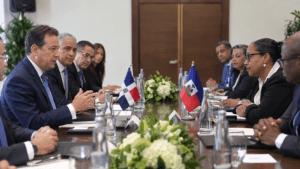
Presenting the Dominican Republic’s position, Foreign Affairs Minister Roberto Álvarez urged the international community to accelerate the deployment of the remaining international contingents needed for the mission to reach its projected strength of 5,500 personnel. He said achieving full operational capacity is critical to helping Haitian authorities regain control over the country’s security situation.
Call for Greater International Support
Álvarez identified the shortage of strategic air transport as one of the mission’s principal logistical challenges and appealed to countries with those capabilities to make them available for the operation.
“No obstacle of a purely logistical nature should stand between the international community and the protection of an entire people,” the minister said during his address.
Security Before Elections
The foreign minister emphasized that restoring public security is a prerequisite for Haiti’s political normalization and democratic transition. He argued that elections cannot be successfully organized without first creating a secure environment for voters, candidates, and public institutions.
“It will not be elections that produce security; it will be security that makes elections possible,” Álvarez said, reiterating the Dominican Republic’s hope that Haiti will eventually hold free, inclusive, and credible elections.
Enforcing Sanctions Against Armed Gangs
The Dominican Republic also called on UN member states to strengthen the enforcement of sanctions established under UN Security Council Resolution 2653. Álvarez urged governments to take firmer action against individuals and organizations that finance or provide support to armed gangs operating in Haiti.
The Dominican government’s intervention reflects its continued position that a coordinated international response is necessary to address Haiti’s prolonged security crisis, which has had significant humanitarian and regional implications, including for the Dominican Republic, the two countries that share the island of Hispaniola.