 23°C


Dominican Republic Strengthens Haiti Border Security as Gang Violence Escalates
The Dominican Republic’s border barrier is taking on greater strategic importance as armed gangs continue to destabilize Haiti and Salvadoran forces join security operations there. Near Jimaní, Dominican troops combine patrols, drones and electronic surveillance to monitor the frontier.


The Dominican Republic is reinforcing security along its border with Haiti as the neighboring country faces escalating violence from armed gangs and an expanded foreign military presence. The situation has placed renewed attention on the government’s border barrier, a project designed to strengthen territorial control while supporting military surveillance across the frontier.
Near Jimaní, in Independencia province, the concrete-and-metal structure runs through an arid, mountainous landscape. Barbed wire tops sections of the barrier, while military patrols, surveillance towers and checkpoints form part of a broader security network.
The Dominican authorities refer to the project as the Intelligent Border Perimeter Fence. Its role extends beyond the physical obstacle: the system combines infrastructure, military deployment and technology intended to detect and respond to irregular crossings and other illegal activities.
How security is organized around Jimaní
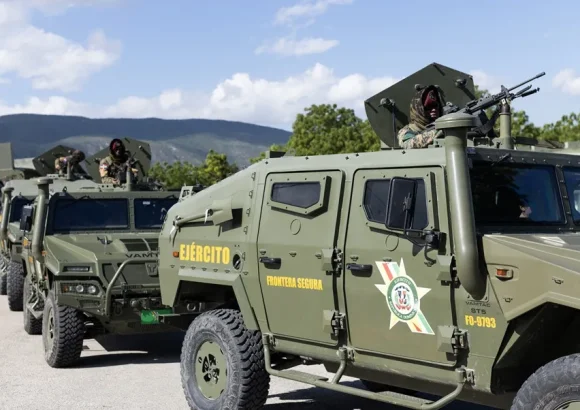
Military personnel patrol the area in armored vehicles and four-wheel-drive trucks, supported by drones, cameras and observation towers equipped with electronic systems. Special forces soldiers also operate tactical high-mobility vehicles, including Spanish-made VAMTAC units.
The Fifth Infantry Brigade, commanded by Brigadier General Freddy Rafael Soto Thormann, is responsible for security in this part of the frontier. The Army works alongside the Specialized Land Border Security Corps, known as Cesfront, which also monitors the movement of people involved in cross-border commerce.
Soto Thormann has described the border as reinforced and calm, while emphasizing that troops remain prepared for possible incidents. According to the commander, there have been no reported attempts in this sector by people linked to the armed gangs operating mainly around Port-au-Prince and in Haiti’s Artibonite department.
A 391-kilometer border and a 160-kilometer barrier project
The land boundary between the Dominican Republic and Haiti stretches approximately 391 kilometers. The planned perimeter fence is expected to cover about 160 kilometers, concentrating primarily on populated and vulnerable areas where authorities consider irregular crossings more likely.
Construction is continuing in Jimaní. On September 5, 2026, the Dominican government announced the start of a new 14.5-kilometer section, described as the second stage of the project in the area. The planned infrastructure includes six surveillance towers, 35 culverts and patrol roads on both sides of the barrier.
The government says the work forms part of its broader Frontera Fuerte strategy, which combines military presence, infrastructure, technology, mobility and coordination among state institutions. The initiative is also intended to improve control over a region with significant commercial activity, including one of the country’s main binational markets.
The area around Jimaní has particular geographic characteristics. Lake Azuei, also known as Lake Étang Saumâtre or Lake of the Fondo, lies near the border opposite the Haitian locality of Fond Parisien. Its presence creates a natural obstacle in parts of the frontier, although it does not replace the need for patrols and surveillance.
Salvadoran deployment adds a new dimension to the crisis
The security situation has become more complex following El Salvador’s deployment of troops to Haiti. The operation expanded after four Salvadoran personnel serving with the international security mission were reported missing following an armed ambush on October 18 near Croix-des-Bouquets, outside Port-au-Prince.
By mid-November, Salvadoran forces had grown to more than 2,000 personnel, according to international reporting. Their presence is intended to support operations against armed gangs alongside Haitian security forces, although the deployment’s command arrangements and duration have remained subjects of discussion.
The Dominican Republic has also played a logistical role in facilitating the movement of Salvadoran personnel and equipment toward Haiti. President Luis Abinader has publicly acknowledged cooperation with El Salvador, including logistical and intelligence support. That assistance should be distinguished from the Dominican military’s own mission: Salvadoran forces are operating in Haiti, while Dominican units remain responsible for defending and monitoring their country’s territory.
Border security remains a broader challenge
The Dominican government’s response relies on more than the construction of a barrier. Military patrols, surveillance technology, checkpoints and coordination between the Army and Cesfront are intended to maintain control across a frontier that extends well beyond the principal official crossings.
The situation in Haiti continues to create uncertainty for both countries. While the Dominican authorities describe the Jimaní sector as calm, the continuing presence of armed groups across the border means that security forces are maintaining a permanent readiness posture.
For communities on both sides, the border is also an economic corridor. Jimaní is an important crossing for transport and binational trade, making the balance between security controls and the movement of people and goods a continuing concern for authorities and local businesses.
Further details on the Dominican government’s current construction plans and security infrastructure are available through the Presidency of the Dominican Republic.