 25°C
25°C

AI Is Reshaping Internal Audit With Continuous Risk Monitoring
The rapid growth of artificial intelligence and data is pushing organizations toward a new approach to internal auditing, with continuous monitoring and broader data analysis replacing periodic reviews based largely on samples.


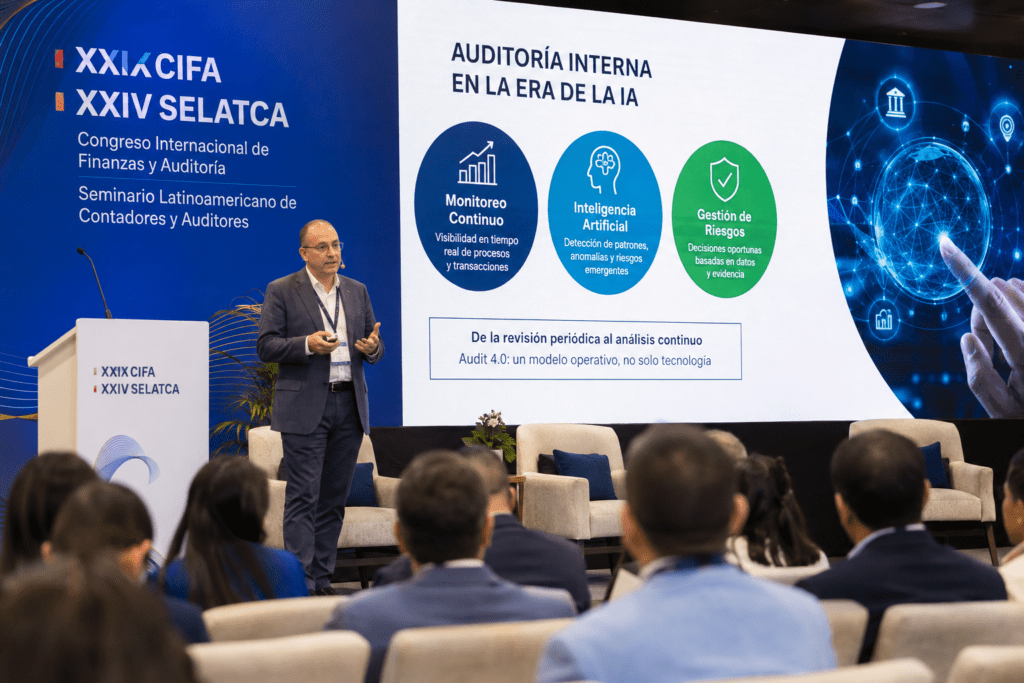
The expansion of artificial intelligence (AI) and the growing volume of corporate data are forcing organizations to rethink how they manage risk and conduct internal audits, according to Matías Nicolás Marasca, executive chairman of Hullop Solutions.
Speaking at the XXIX International Finance and Auditing Congress (CIFA) and the XXIV Latin American Seminar for Accountants and Auditors (Selatca) in Boca Chica, Marasca argued that traditional audit models are struggling to keep pace with the speed at which transactions and information are generated.
From Periodic Reviews to Continuous Monitoring
Traditional internal auditing often relies on periodic reviews and the analysis of selected samples. Marasca said that approach is increasingly insufficient in an environment where organizations generate large volumes of information continuously.
The alternative, he said, is a model based on continuous monitoring, analysis of complete data sets and artificial intelligence. Rather than waiting for an audit cycle to identify problems, organizations can use technology to monitor operations more frequently and identify potential risks earlier.
AI can automate repetitive tasks, identify patterns and generate alerts when potential anomalies appear. This can shorten the time between the emergence of a problem and the organization’s response, particularly in environments where large numbers of transactions make manual review more difficult.
Technology Does Not Replace Professional Judgment
Despite the growing role of AI, Marasca stressed that technology should not replace the professional judgment of auditors. Operational tasks can be automated, he said, but strategic decisions must remain under the responsibility of qualified professionals.
That distinction becomes particularly relevant as companies deploy AI systems of their own. The technology used to improve risk management can also introduce new risks, making oversight of AI-based systems another area that internal audit and internal-control functions must evaluate.
Organizations therefore face a dual challenge: using AI to strengthen their ability to identify irregularities while also establishing appropriate controls around the systems making those analyses possible.
Auditing Moves Toward Prevention
The evolution described by Marasca represents a broader shift in the purpose of internal auditing. Instead of focusing primarily on identifying errors after they occur, organizations can use continuous analysis to detect warning signs and intervene earlier.
This approach requires more than adding new software to existing processes. It involves integrating technological tools into risk management and changing how organizations use information to support operational and strategic decisions.
Marasca described this transformation as “Audit 4.0,” emphasizing that it should be understood as an operating model rather than a specific technology product. For internal audit teams, that means combining data capabilities and AI with the expertise needed to interpret findings, assess risks and determine appropriate responses.