 27°C

Dominican Students Reach Samsung Solve for Tomorrow 2026 Final
A student team from La Romana has secured a place in Samsung's regional innovation final with PropioPasos, a low-cost technology designed to help people with severe motor disabilities communicate and control connected devices.


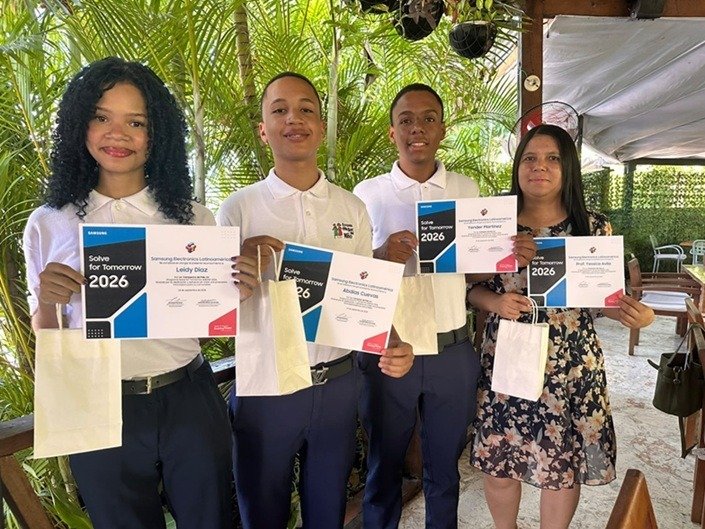
A student team from the Dominican Republic has secured a place in the regional final of Samsung’s Solve for Tomorrow (SFT) 2026 competition, earning recognition for a technology project designed to help people with severe motor disabilities communicate and interact with their surroundings.
The team from Politécnico Escuela Hogar del Niño in La Romana will present its project, PropioPasos, at the regional final scheduled for November 18 in Panama. The Dominican students will compete against national representatives from Nicaragua and Trinidad and Tobago for the regional title.
PropioPasos aims to improve communication for people with disabilities
The Dominican team’s proposal is a low-cost electromyography (EMG) headband designed to translate subtle muscle contractions, such as movements of the eyebrow or jaw, into synthesized voice messages and commands for controlling connected home devices.
The technology is intended for students with severe motor disabilities who may depend on other people to communicate or interact with their environment. By using muscle signals to trigger messages and commands, the project aims to provide an additional means of communication and greater independence in everyday activities.
The initiative reflects how young innovators in the Dominican Republic are developing practical solutions to real-world challenges. Projects like PropioPasos highlight the potential of Dominican inventions to address accessibility needs and improve people’s quality of life through technology.
Three teams advance to the regional final
The three finalists were selected from 13 national-winning projects presented during the competition’s September stage. A panel of judges assessed the proposals based on their practical feasibility, relevance to community needs, development work and the guidance students received from teachers and Samsung volunteer mentors.
Alongside the Dominican Republic, the finalists represent Nicaragua and Trinidad and Tobago. Their projects address different challenges, ranging from health support to environmental monitoring, demonstrating the range of issues young innovators are tackling through science and technology.
Nicaragua presents a project focused on anemia support
The team from Colegio Técnico Niño Jesús de Praga in Nicaragua will compete with Nutriskin, a proposed transdermal patch featuring microneedles designed to release iron and vitamin B12 in a controlled manner over a period of 24 to 48 hours.
The project is intended as a complementary support for cancer patients experiencing anemia associated with chemotherapy. It is not designed to replace established medical treatment. Its stated objective is to explore a technology-based approach to supporting patients who face health complications during cancer care.
Trinidad and Tobago develops an oil spill detection device
Representatives from Hillview College in Trinidad and Tobago will present the Oil Spill Detection and Confirmation Device, an environmental monitoring concept built around an autonomous buoy.
The device uses the Brewster angle and polarization filters to optically distinguish oil from water in the waters of the Gulf of Paria. It is intended to complement satellite monitoring systems by offering a potentially lower-cost method of confirming suspected oil spills.
Early identification of oil contamination can be important for communities that depend on fishing and tourism, as well as for authorities responsible for responding to environmental incidents. The team’s proposal seeks to provide an additional monitoring tool to support those efforts.
Regional final scheduled for November 18 in Panama
The three teams are expected to travel to Panama for the in-person final on November 18, 2026. The event will bring together students whose projects have advanced through national competition stages and regional evaluation.
María Fernanda Hernández, Samsung Electronics’ Corporate Citizenship Manager for Central America, the Caribbean, Ecuador and Venezuela, said the program’s value extends beyond the final ranking. She emphasized the learning, practical experience and personal development students gain throughout the process, regardless of which team ultimately wins.
Additional recognition for the finalists
Beyond the main competition, Solve for Tomorrow 2026 includes two additional forms of recognition. The Samsung Community award is selected by company employees, who evaluate the finalist projects and choose the initiative they consider most deserving based on factors such as innovation and social impact.
The Virtual Community recognition allows members of the public to support a finalist through online voting on the program’s official platform during the designated voting period. Details about voting dates and access should be confirmed through Samsung’s official channels.
For the Dominican team, reaching the regional final gives PropioPasos an opportunity to present its accessibility-focused concept to a wider audience. The competition also highlights how students in the Dominican Republic and across Latin America and the Caribbean are applying technology to challenges affecting health, inclusion and the environment.