 29°C
29°C

Electric Vehicles in Latin America Surpass One Million
Latin America and the Caribbean surpassed one million electrified light-duty vehicles in circulation by June 2026, as electric mobility expanded across major regional markets and generated an estimated $1.519 billion in annual energy savings.


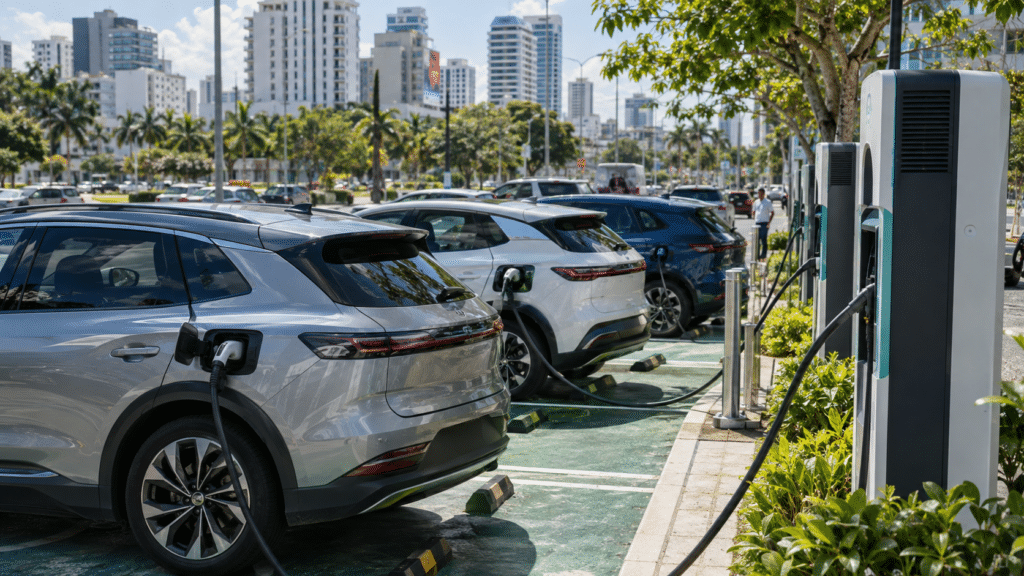
Latin America and the Caribbean crossed a new threshold in electric mobility during the first half of 2026, reaching 1,016,034 battery-electric and plug-in hybrid vehicles in circulation, according to the latest Monitor from the Latin American and Caribbean Energy Organization (OLACDE), a regional institution focused on energy cooperation and analysis.
The regional fleet grew by 285,785 vehicles between January and June, compared with 17,541 units recorded in 2020. Battery-electric vehicles (BEVs) and plug-in hybrid electric vehicles (PHEVs) accounted for 10% of all light-duty vehicles sold in the region during the first half of 2026, marking a significant expansion of electrified mobility in the regional automotive market.
Brazil Leads the Regional Electric Vehicle Market
Brazil remained the largest market for electrified vehicles, recording 91,483 sales during the first six months of the year. Its total electrified fleet exceeded 580,000 vehicles, giving the country a clear lead in absolute numbers across Latin America and the Caribbean.
Several other markets also posted rapid year-on-year growth. Argentina recorded an 873% increase, followed by Ecuador at 261%, Colombia at 236%, Brazil at 193% and Uruguay at 151%. When measured against population size, Uruguay and Costa Rica recorded the region’s highest levels of electrified-vehicle penetration.
The figures show that adoption is expanding beyond the region’s largest automotive economies. For consumers and businesses, however, the continued growth of electric vehicles depends increasingly on the availability of charging infrastructure, electricity networks and financing that can support wider adoption.
Electric Buses Continue to Expand
Public transportation is also becoming an important part of the transition. The regional fleet reached 10,685 electric buses, with 967 units added over the period measured by OLACDE.
Chile has the largest electric-bus fleet, with 5,059 vehicles, followed by Brazil with 2,317, Colombia with 1,658 and Mexico with 1,095. The concentration of electric buses in these markets highlights the growing role of public transportation in regional electrification.
Charging Infrastructure Is Expanding
The expansion of vehicles is being accompanied by new charging capacity, although infrastructure remains one of the key challenges for the next stage of adoption. Brazil had reached 25,429 public charging stations, while Mexico more than doubled its network in one quarter, increasing from 2,046 to 4,802 charging points.
OLACDE says further growth will require faster deployment of charging infrastructure, stronger planning for electricity distribution networks and competitive financing conditions. These factors will become increasingly important as electric vehicles move from a growing market segment toward broader adoption.
Electric Mobility Generates $1.519 Billion in Annual Savings
The economic impact extends beyond vehicle sales. OLACDE estimates annual energy savings of $2,240 for each fully electric car and $26,210 for each electric bus. Applied to the current regional fleet, those savings amount to approximately $1.519 billion per year, or nearly $4 million per day.
Lower fuel consumption can reduce exposure to fluctuations in international gasoline and diesel prices while easing pressure on countries’ trade balances. The financial effect therefore extends beyond individual vehicle owners to the broader energy and transport systems.
For the Dominican Republic, the regional figures provide a measure of how quickly electric mobility is developing across Latin America and the Caribbean. The latest OLACDE announcement does not provide a specific breakdown of the Dominican market, so the country’s position within the regional total cannot be established from these figures alone.
The next phase of the regional transition will focus increasingly on infrastructure, grid planning and access to financing. OLACDE is scheduled to address those issues at the First Regional Sustainable Mobility Summit in Quito, Ecuador, on November 26, 2026, where regional cooperation on sustainable transportation will be part of the agenda.