 25°C


Construction Industry in the Dominican Republic: A Guide
The construction industry in the Dominican Republic connects private investment, public infrastructure spending, manufacturing, employment and demand for building materials. It encompasses residential, commercial and industrial projects, as well as roads, transportation systems, water infrastructure and other civil engineering works. Understanding the sector requires looking beyond property transactions to examine construction output, financing, material costs, business activity and the economic conditions that determine whether projects move forward.


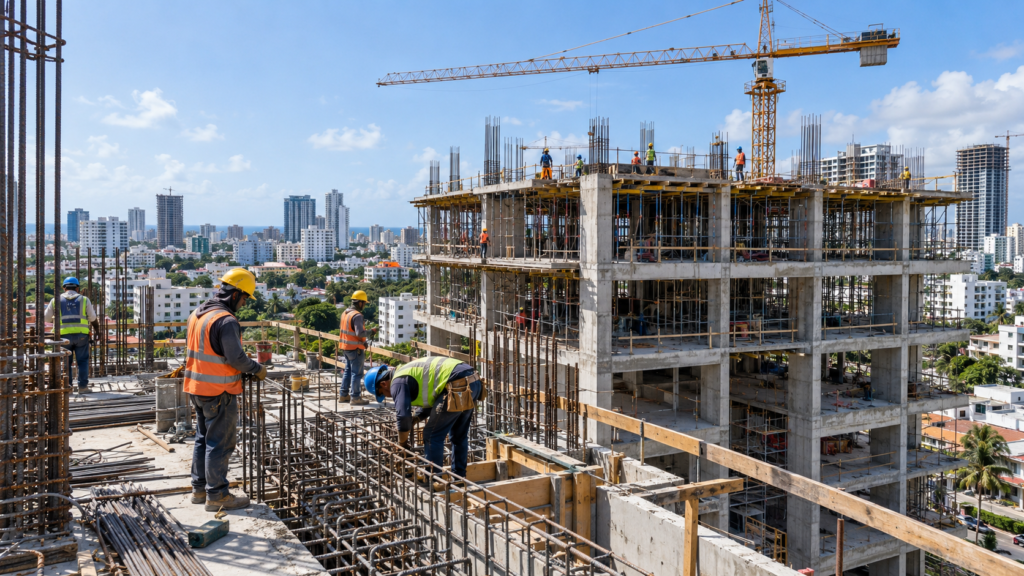
The construction industry in the Dominican Republic is an important part of the country’s productive economy, linking investment decisions with employment, manufacturing, transportation and infrastructure development. Its activity ranges from housing and commercial buildings to industrial facilities, highways, public transportation systems and water infrastructure.
The sector’s performance depends on several interconnected factors. Private developers must assess financing costs, expected demand and construction budgets, while public projects depend on government investment priorities, procurement and execution. Contractors, engineers, architects, material suppliers and specialized trades all contribute to turning these decisions into completed structures and infrastructure.
Official economic indicators illustrate why construction activity should be evaluated separately from the real estate market. The Dominican Republic’s construction sector contracted by 1.8% in 2025, according to preliminary figures published by the Central Bank, following growth of 2.1% in 2024. By August 2026, however, construction recorded year-over-year growth of 7.9%, reflecting stronger activity in private residential and nonresidential projects and government-related civil engineering works. These figures measure changes in productive activity rather than movements in property prices.
What the Construction Industry Includes
Construction is a productive activity concerned with building, expanding, renovating and maintaining physical structures. It includes the work performed on a project, the labor and equipment used, and the coordination of materials, contractors and technical services required to complete it.
In the Dominican Republic, the industry can be divided into several broad segments:
Residential construction: The development of houses, apartment buildings, multifamily housing and other residential structures. Activity depends on household purchasing power, access to mortgages, developer financing, population growth and demand for new housing.
Commercial construction: The construction and renovation of offices, retail premises, shopping centers, hotels, restaurants, warehouses and other facilities used by businesses. Tourism-related development is an important source of demand for hotels and associated commercial facilities.
Industrial construction: The development of factories, production facilities, logistics centers, industrial warehouses and other structures used for manufacturing and distribution. Demand is connected to business expansion, supply-chain requirements, industrial investment and the development of export-oriented operations.
Infrastructure and civil engineering: The construction, expansion and maintenance of highways, roads, bridges, public transportation systems, drainage networks, water supply facilities and other public or private infrastructure. These projects can generate demand for heavy equipment, aggregates, cement, steel, engineering services and specialized contractors.
Renovation and maintenance: Work on existing buildings and infrastructure, including structural repairs, improvements, extensions and upgrades. This segment serves residential, commercial, industrial and public-sector clients.
These segments often overlap. A tourism development, for example, may combine hotel construction, access roads, utility connections, commercial facilities and supporting infrastructure. Measuring the sector therefore requires a broader view than counting new buildings or residential units alone.
How Construction Differs From the Real Estate Market
Construction and real estate are closely connected, but they measure different economic activities. Construction concerns the production of buildings and infrastructure. Real estate focuses more broadly on land and property ownership, transactions, leasing, property management and investment in existing or future properties.
A new apartment building illustrates the distinction. Construction activity includes site preparation, structural work, installation of electrical and plumbing systems, finishing and other services required to complete the building. The subsequent sale or rental of the apartments belongs primarily to the real estate market.
The distinction also affects economic analysis. A property can be sold several times without any new construction taking place. Conversely, a contractor can complete a public road, industrial facility or privately commissioned building without the project involving a conventional property sale.
Construction output can therefore decline even when property prices rise. Higher prices for existing properties do not necessarily indicate that more buildings are being constructed, that contractors are receiving more work or that the volume of building materials being used is increasing.
For the same reason, the value of mortgage lending should not automatically be interpreted as a measure of construction production. Mortgage loans may finance existing properties, while construction loans support the development process. Some official financial statistics combine lending for construction and housing acquisition, so their scope must be checked before drawing conclusions about productive activity.
Residential Construction and Housing Development
Residential building is a major component of construction demand in the Dominican Republic. Projects range from individual houses and small residential developments to apartment complexes and large multifamily buildings.
Demand is influenced by household formation, urban growth, employment, income, access to credit and the availability of financing for developers and buyers. Government housing initiatives and private-sector development can also affect the number and type of projects undertaken.
However, demand for housing does not translate automatically into completed construction. Developers must secure financing, obtain the necessary approvals, contract suppliers and workers, and manage costs throughout the building process. If borrowing becomes more expensive or material prices rise, a project may be delayed, redesigned or phased over a longer period.
Residential projects also generate activity beyond the construction site. They require cement, steel reinforcement, concrete, blocks, plumbing equipment, electrical systems, windows, doors, paint and finishing materials. Transport companies, equipment rental businesses and professional service providers benefit when projects move from planning to execution.
The National Statistics Office (Oficina Nacional de Estadística, ONE) publishes a Direct Construction Cost Index for Housing, known by its Spanish acronym, ICDV. It tracks changes in direct construction costs for selected one- and two-story single-family houses and four-story and eight-story-or-higher multifamily buildings in the National District and Santo Domingo province.
The index is useful for monitoring cost movements, but its coverage is limited. It excludes land, architectural design, construction permits, financing costs and the contractor’s profit. It should not be treated as a complete measure of the cost of developing a property or as a national index covering every type of construction.
Commercial, Industrial and Tourism-Related Construction
Commercial construction responds to the need for physical facilities used by service businesses, retailers, offices, logistics operators and hospitality companies. Projects may involve new buildings, extensions, interior fit-outs or renovations to existing premises.
Tourism is an important source of construction demand because new hotel capacity and related facilities require substantial building work. Hotel developments can involve guest accommodation, restaurants, kitchens, recreational facilities, parking areas, utility systems and supporting infrastructure.
Industrial construction follows a different set of demand drivers. Manufacturers and logistics operators require production buildings, warehouses, loading facilities, storage areas and reliable connections to electricity, water and transportation networks. Investment in export-oriented industries can therefore create opportunities for contractors and suppliers beyond the residential market.
These projects are sensitive to business confidence, expected operating revenue, financing conditions and the availability of suitable infrastructure. A company may postpone a factory extension or commercial development even when the wider economy is growing if expected demand does not justify the investment.
Commercial and industrial buildings also require specialized technical work. Depending on the project, this may include electrical installations, ventilation, fire protection, refrigeration, industrial flooring, structural steelwork and systems designed for specific production or storage requirements.
Infrastructure and Public Construction Projects
Public infrastructure is another important source of construction demand. Government-funded works can include road construction and rehabilitation, bridges, bypasses, public transportation, drainage, water supply and sanitation systems, and improvements to urban infrastructure.
These projects create demand for civil engineering contractors, heavy machinery, aggregates, asphalt, cement, steel, surveying, design and technical supervision. Their effects can extend to local transport businesses, equipment suppliers and other firms providing services to construction sites.
Public investment can also support private-sector activity by improving access to industrial areas, tourist destinations, commercial districts and residential communities. Better transportation and utility infrastructure can reduce logistical constraints and make additional development possible.
However, the impact of public spending depends on actual execution rather than budget announcements alone. Project preparation, procurement, financing, permits, land availability and coordination between public agencies can affect when construction begins and how quickly work progresses.
Government capital expenditure is therefore a useful indicator when assessing future infrastructure demand. It should be considered alongside actual project execution and the construction sector’s output data, since approved spending does not necessarily translate immediately into completed work.
Construction Investment and Financing
Construction projects generally require substantial upfront expenditure before they begin generating income or delivering their intended public benefits. Financing arrangements vary according to the type of project, the identity of the client and the expected period of execution.
Private developers may combine equity, bank financing, advance payments and other funding arrangements. Industrial and commercial clients may finance buildings as part of a broader business investment, while public infrastructure projects depend on government budgets and, where applicable, external financing.
Interest rates influence both the cost of borrowing and the financial viability of new projects. Higher financing costs can increase the total cost of development, reduce the number of projects that meet investment criteria and encourage developers to delay construction. Easier credit conditions can support activity, provided that demand and project economics remain sound.
Credit statistics need to be interpreted carefully. The Central Bank reported that financial-system resources channeled to construction and housing acquisition reached RD$628.8 billion at the end of 2025, an increase of approximately 15% from the previous year. This combined measure indicates the scale and growth of financing linked to construction and housing, but it does not represent construction output alone.
Investment analysis should distinguish between financing approved, funds actually disbursed, construction work performed and projects completed. Each measures a different stage of economic activity, and changes in one indicator may take time to appear in the others.
Employment and Construction Businesses
Construction generates employment for workers with a wide range of qualifications. Labor requirements include engineers, architects, project managers, surveyors, equipment operators, electricians, plumbers, masons, carpenters, welders, painters and general construction workers.
The sector also supports employment outside construction sites. Manufacturers and distributors supply building materials, while transport operators, equipment rental companies, maintenance providers and professional services support project delivery.
Construction employment can fluctuate with the project cycle. Large developments may employ substantial workforces during active building phases, but labor requirements decline as projects approach completion. A slowdown in new project starts can affect subcontractors and suppliers before the full impact becomes visible in broader economic indicators.
Employment statistics should distinguish between formal and informal work, as well as between employees and other labor arrangements. Formal business surveys may also cover only enterprises above a specified employment threshold, meaning their results do not represent every small contractor or independent worker in the country.
ONE’s National Economic Activity Survey for the construction sector provides structural information on employment, remuneration, costs, expenses, revenues and other business variables for enterprises with 16 or more employees. It complements the Central Bank’s national accounts and labor-market indicators, although its coverage differs from statistics that include smaller firms and informal activity.
For a meaningful assessment of the industry’s labor market, employment figures should be considered alongside wages, hours worked, project activity and business revenues. A rise in employment does not necessarily mean that productivity or output per worker has increased.
Building Materials and Supply Chains
Building materials are central to construction costs and production. Major inputs include cement, ready-mixed concrete, reinforcing steel, structural steel, blocks, aggregates, asphalt, timber, glass, paint, plumbing equipment and electrical components.
The Dominican Republic has domestic production and distribution channels for important construction inputs, but the sector also relies on imported products and equipment. Import dependence varies by material and product specification, making exchange rates, shipping costs, international prices and customs procedures relevant to project budgets.
Cement, steel reinforcement and aggregates are particularly important in many structural and infrastructure projects. Changes in their prices or availability can affect the cost and timing of work, while shortages or delivery delays can disrupt the sequence of construction activities.
Material indicators can also help explain changes in sector output. The Central Bank’s preliminary full-year 2025 figures showed a 0.9% increase in domestic cement sales and a 9.7% increase in paint sales, while local reinforcing-steel sales fell by 8.7%. Imported asphalt cement volume increased by 15.9%.
These movements were not uniform across materials. They illustrate why no single product provides a complete picture of construction demand: cement may be used in residential buildings and infrastructure, while asphalt cement is more closely associated with road works and reinforcing steel is an important input in reinforced concrete structures.
Contractors manage supply-chain risk through procurement planning, supplier diversification, delivery schedules and monitoring of price changes. Long-duration projects may require particular attention to the difference between the prices assumed when a contract was awarded and the costs incurred as work progresses.
Construction Costs and the Factors That Influence Them
Construction costs depend on more than the price of raw materials. Labor, equipment, transport, site conditions, technical requirements, financing, project duration and regulatory compliance all influence the final budget.

Material costs can change because of domestic demand, production expenses, international commodity prices, exchange-rate movements and freight charges. Imported machinery and specialized equipment may be particularly sensitive to currency fluctuations and international logistics.
Labor costs depend on the skills required, workforce availability, productivity and the complexity of the project. Infrastructure works and specialized industrial facilities may require technical expertise and equipment that are not interchangeable with those used for simpler building projects.
Site conditions also matter. Ground stability, drainage requirements, access to utilities and the need for earthworks can create significant differences between projects of similar size. In areas exposed to heavy rainfall or coastal conditions, appropriate drainage, structural design and material selection may be especially important.
Permits and administrative procedures affect project schedules and indirect costs. Delays can extend equipment rentals, site management, financing and labor arrangements. Poor coordination between design, procurement and construction can produce similar cost pressures even when material prices remain stable.
The ICDV published by ONE helps monitor direct residential construction costs, but it does not capture every cost category or every geographic market. For commercial, industrial and infrastructure projects, a more specific cost breakdown may be necessary.
Comparisons between projects should therefore use consistent assumptions about scope, location, quality, materials, labor, project duration and included expenses. A cost per square meter is meaningful only when the projects being compared are sufficiently similar.
What Drives Construction Demand?
Demand for construction in the Dominican Republic reflects a combination of private investment, public expenditure and wider economic conditions. Several factors can reinforce or offset one another.
Economic growth and business confidence: Expanding economic activity can encourage companies to invest in new premises, production capacity, logistics facilities and commercial buildings. Weak confidence can lead businesses to postpone capital expenditure.
Interest rates and credit availability: Financing conditions influence developers, homebuyers, industrial companies and public investment. Higher borrowing costs can make projects less viable, while improved credit access can help move planned developments into construction.
Government capital expenditure: Public funding supports roads, transportation and other infrastructure. Actual execution, procurement and project readiness determine how quickly this demand reaches contractors and suppliers.
Tourism and industrial investment: Hotel construction, hospitality facilities, factories and logistics centers can create demand for buildings and supporting infrastructure. Their effect depends on whether announced investments progress into active construction.
Material prices and availability: Rising input costs can reduce project margins or require budget revisions. Delivery delays can also extend schedules and increase indirect expenses.
Permits and administrative efficiency: Approval times and regulatory coordination affect when work can begin. Predictable procedures help project owners plan financing, procurement and workforce requirements.
Household income and demographic change: Residential construction depends partly on the ability of households to finance housing and on the need for additional accommodation. These factors influence demand, but they do not determine construction volumes on their own.
These drivers explain why the sector may behave differently from the wider economy. Overall growth can remain positive while construction contracts if financing becomes more restrictive, investment is delayed or major projects are postponed.
Key Indicators for Measuring the Construction Industry
No single statistic fully describes the performance of construction. Analysts should combine measures of output, materials, financing, employment, costs and public investment to distinguish changes in production from changes in prices or financial activity.
Construction value added: Published by the Central Bank as part of national accounts and economic activity reporting, this is a central indicator of the sector’s contribution to production. Real growth rates help show whether activity is expanding or contracting after accounting for price changes.
Monthly Economic Activity Index: The Central Bank’s Indicador Mensual de Actividad Económica (IMAE) provides a more frequent view of economic performance. Construction-specific results help identify changes that may not yet be visible in annual figures.
Sales and imports of construction materials: Cement, reinforcing steel, paint and asphalt-related indicators provide evidence about demand for selected inputs. Their usefulness depends on the materials covered and the type of projects driving demand.
Direct Construction Cost Index for Housing: ONE’s ICDV tracks changes in selected direct residential construction costs. It is useful for monitoring input-cost movements, but it excludes important indirect expenses and does not cover all types of construction.
Employment and remuneration: Labor-force statistics and ONE’s economic activity surveys help measure employment and the structure of formal construction businesses. Differences in coverage must be considered when comparing datasets.
Construction-related credit: Banking data indicate the availability and use of financing. Analysts should check whether figures cover construction alone or combine construction lending with housing acquisition.
Government capital expenditure: Budget execution and public investment data help assess the pipeline of publicly funded infrastructure work. Approved allocations should be distinguished from payments, executed contracts and completed projects.
Business revenues and operating costs: Enterprise surveys provide information on income, expenses, wages and other structural characteristics. These measures help explain how activity translates into business performance, especially among formal firms covered by the survey.
In 2025, preliminary Central Bank data showed a 1.8% contraction in construction value added after 2.1% growth in 2024. In August 2026, the sector recorded year-over-year growth of 7.9%, supported by private residential and nonresidential investment and civil engineering linked to government capital spending. Read together, these figures show the importance of tracking both annual performance and more recent changes rather than assuming that a single year’s result defines the industry’s longer-term direction.
Business Opportunities and Operational Challenges
The construction industry creates opportunities for contractors, engineering firms, architects, equipment rental companies, material manufacturers, distributors and specialized service providers. Opportunities vary by project type, technical requirements, location and the scale of investment.
Residential development creates demand for structural work, finishing, plumbing, electrical installations and building systems. Commercial and industrial projects may require specialized installations, while infrastructure contracts often depend on experience in civil engineering, heavy equipment, materials testing and project management.
Suppliers can serve multiple segments, but successful participation requires an understanding of payment terms, delivery requirements, product specifications and the financial position of clients. Contractors must also evaluate whether contract prices adequately reflect labor, material and financing risks over the project’s duration.
Challenges include cost volatility, delays in approvals, financing constraints, payment delays, workforce availability and coordination among multiple subcontractors. Poor planning can result in idle equipment, material waste, rework and missed deadlines.
Companies can reduce these risks by preparing realistic budgets, maintaining accurate project schedules, checking supplier capacity, monitoring cash flow and documenting changes to the scope of work. Compliance with applicable building requirements, safety procedures and environmental obligations is also essential to project delivery.
Business performance should be assessed through completed work, revenues, margins, productivity, payment collection and the quality of the project pipeline. A large volume of announced developments does not necessarily translate into equivalent revenue if projects are delayed, contracts are unprofitable or payments are not collected on time.
Regulation, Technical Standards and Project Approvals
Construction projects must comply with applicable Dominican planning rules, building requirements, safety provisions and environmental regulations. The specific approvals depend on the type of project, its location, its technical characteristics and whether it affects protected areas or public infrastructure.
Depending on the development, project owners may need to address land-use compatibility, building permits, structural design, fire safety, utility connections, environmental authorization and other administrative requirements. Public works may also be subject to procurement and contract-management procedures.
Early coordination among designers, contractors, suppliers and the relevant authorities can reduce the risk of costly changes after construction has begun. Technical documentation should be consistent with the approved project scope, and changes to the design should be evaluated for their effects on safety, cost and schedule.
Regulatory requirements should be checked against the rules applicable to the specific project rather than assumed to be identical across the country. A residential building, industrial facility, road project and development near a protected environmental area may face different technical and approval requirements.
The Dominican construction industry ultimately depends on the interaction between investment, productive capacity, financing, labor, materials and project execution. Tracking these factors together provides a more reliable picture of sector performance than relying on property prices or real estate transactions alone.