 25°C
25°C

Dominican Republic Real Estate Market 2026: Prices Rise Amid Tourism and Investment
The Dominican Republic real estate market remains one of the Caribbean’s most dynamic in 2026, with residential prices continuing to rise as record tourism, strong foreign investment, remittances and a sharp construction recovery support demand, while high mortgage costs, currency movements, limited affordable housing and growing supply in some areas point to a more selective market in which location, rental potential and property quality are becoming increasingly important.


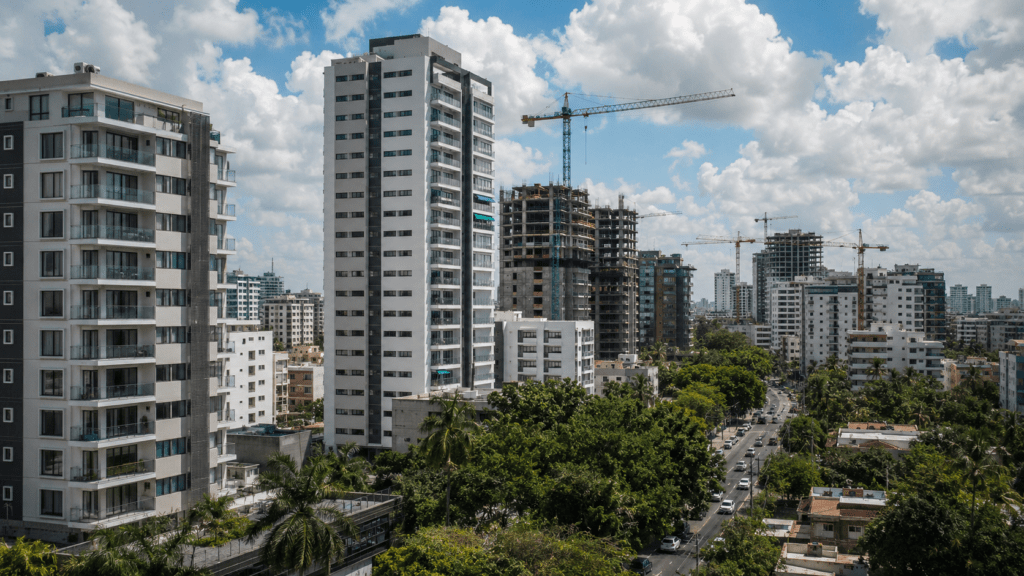
The Dominican Republic’s real estate market enters the second half of 2026 in a fundamentally stronger position than it appeared to be a year earlier. House prices are still rising, tourism continues to set records, foreign direct investment remains robust, remittances are feeding domestic housing demand, and construction has staged a powerful recovery after contracting through much of 2025.
Yet the market is also changing. Price appreciation has slowed, financing remains relatively expensive, the Dominican peso has strengthened sharply against the U.S. dollar, and the biggest structural problem in the sector is no longer a lack of demand but a persistent mismatch between the housing that the country needs and the housing that developers can profitably bring to market.
That combination makes 2026 a more interesting year for real estate than a simple price-growth headline would suggest. The Dominican Republic remains one of the Caribbean’s most dynamic property markets, but investors increasingly need to distinguish between locations, buyer segments, rental strategies and development models.
The Market Is Still Rising, but the Boom Has Become More Selective
Available national asking-price data compiled from Properstar shows Dominican residential prices rising 7.7% year over year in March 2026. Inflation-adjusted growth was approximately 3.0%. That is still positive, but it is materially below the 10.3% nominal increase recorded in 2025 and the 12.5% increase in 2024. Global Property Guide’s latest Dominican Republic house-price series shows clearly that the acceleration seen during the post-pandemic recovery has been fading.
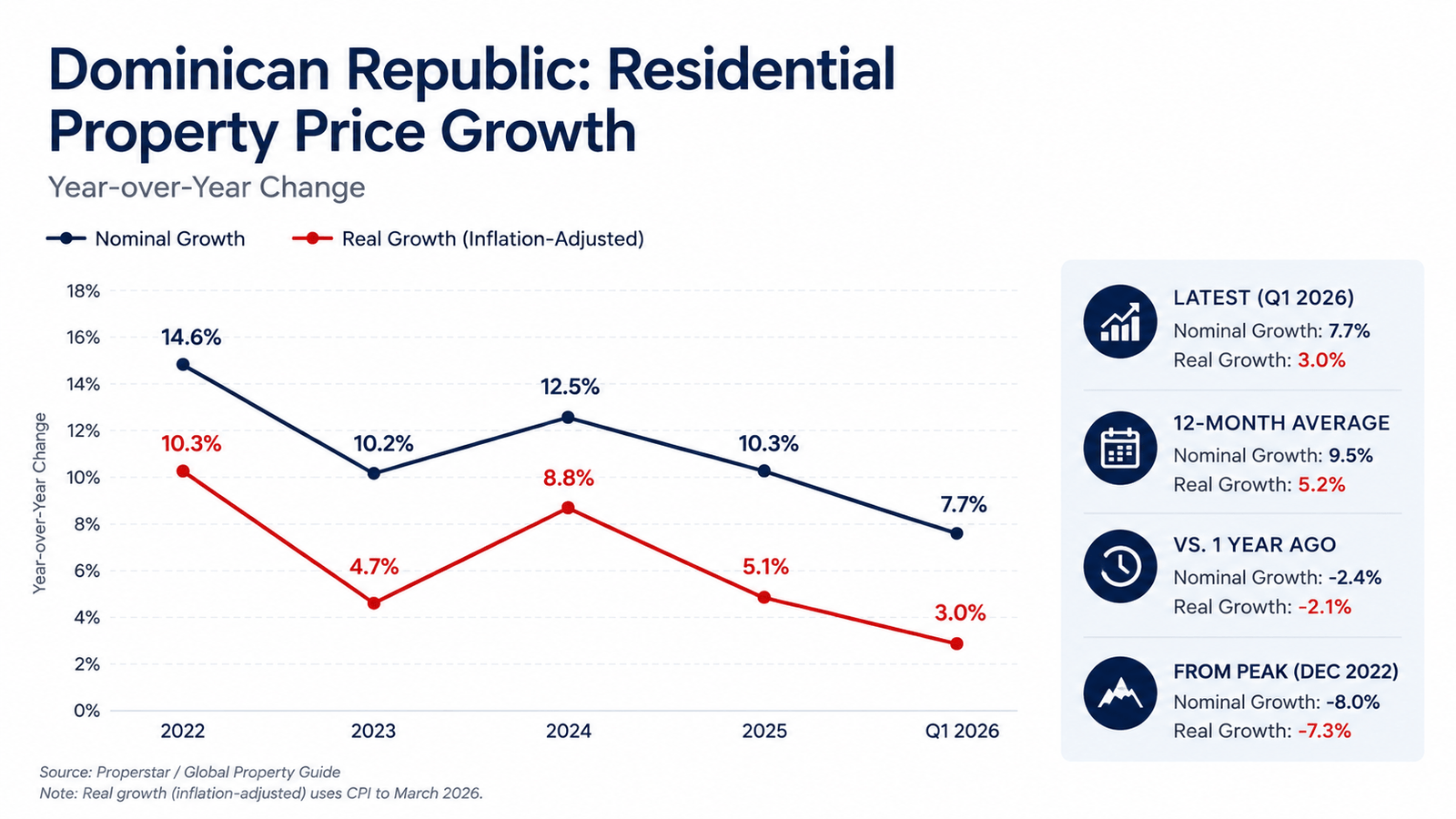
The distinction between nominal and real growth is particularly important. A property market can appear to be delivering strong returns in local currency while producing much weaker gains after inflation. For the first quarter of 2026, real price growth was only around 3%, indicating that the underlying appreciation in purchasing power was considerably more modest than the headline figure.
The market has also become more volatile since 2022. Periods of quarterly real-price declines have repeatedly been followed by recoveries later in the year. That pattern suggests a market that is normalising rather than collapsing: sellers remain confident enough to maintain high asking prices, while buyers have become more selective about what those prices actually justify.
Properstar’s listing data also provides useful context for current price levels. In June 2026, median asking prices were approximately DOP 139,000 per square metre for apartments and DOP 108,300 per square metre for houses, equivalent to roughly US$2,373 and US$1,848 respectively at the prevailing exchange rate used by the dataset. These are asking prices rather than completed transaction prices and should therefore be interpreted as an indicator of market positioning, not as an official national transaction index.
There Is No Single Dominican Property Market
One of the most important conclusions from the latest data is that the national average tells only part of the story. The Dominican real estate market is highly fragmented geographically, with prices and investment dynamics varying dramatically between central Santo Domingo, its expanding metropolitan periphery, Santiago and the country’s tourism corridors.
The Dominican Republic’s National Statistics Office (ONE) provides one of the most useful sources for understanding this divergence through its Registro de Oferta de Edificaciones (ROE), a twice-yearly statistical operation covering the urban area of Greater Santo Domingo. The latest edition examines construction activity, prices, financing, project status and the geographical distribution of new supply. ONE’s ROE 2025-2 report was published in March 2026.
According to the latest data, average asking prices across Greater Santo Domingo were around DOP 109,000 per square metre at the end of 2025. But that average conceals a large geographical spread.
| Area | Indicative asking price per m² | Approx. USD/m² |
|---|---|---|
| Piantini | DOP 172,377 | US$2,942 |
| La Julia | DOP 165,457 | US$2,824 |
| Renacimiento | DOP 162,539 | US$2,774 |
| Distrito Nacional average | DOP 132,730 | US$2,265 |
| Boca Chica | DOP 84,258 | US$1,438 |
| Santo Domingo Este | DOP 75,545 | US$1,289 |
| Santo Domingo Norte | DOP 75,467 | US$1,288 |
| Santo Domingo Oeste | DOP 67,584 | US$1,153 |
| Pedro Brand | DOP 58,144 | US$992 |
| Los Alcarrizos | DOP 31,738 | US$542 |
The figures underline the extraordinary importance of location. The difference between a prime District National neighbourhood and a peripheral municipality is not a marginal variation: it can amount to several multiples of the price per square metre.
Some of the sharpest year-on-year movements have occurred on the metropolitan fringe, where relatively thin formal supply means that a small number of new projects can materially alter average asking prices. Such movements should therefore be interpreted carefully. A 20% or 30% annual change in a small peripheral market does not necessarily indicate that comparable existing homes appreciated by the same amount.
Greater Santo Domingo Is Becoming More Expensive, but Also More Unequal
The geography of the capital reveals one of the sector’s most important structural tensions.
Prime areas continue to attract high-income domestic buyers, expatriates, corporate tenants and investors seeking assets in neighbourhoods where commercial activity, services, schools, hospitals and transport infrastructure are already established. At the same time, households unable to absorb central-city prices are increasingly pushed towards lower-cost areas of the metropolitan region.
This is not simply a real estate story. It is an urban-planning story.
The farther prices move away from what average households can afford, the more important transport costs, infrastructure quality and access to employment become. A cheaper property can become considerably less affordable in practical terms if residents must spend more time and money reaching jobs and essential services.
The result is a market in which the premium for established infrastructure can remain high even when the country as a whole continues to add new housing.
Punta Cana and the Resort Corridor Operate on a Different Set of Economics
Tourism has fundamentally changed the geography of Dominican real estate. In Punta Cana, Bávaro, Cap Cana, La Romana and other resort destinations, property prices are determined much more by international demand, tourism volumes and short-term rental economics than by local wages alone.
This is why properties in some tourism zones can command substantial premiums over urban neighbourhoods in Santo Domingo despite the very different infrastructure and employment environments.
The investment proposition is also different. A central Santo Domingo apartment may derive much of its rental demand from professionals, families, students and companies. A Punta Cana condominium may depend more heavily on tourists, vacation rentals and seasonal demand.
Neither model is inherently superior. They simply carry different risks.
Tourism Remains the Most Powerful External Driver of Coastal Property Demand
The tourism numbers remain extraordinary. The Dominican Republic received 6,616,671 visitors in the first six months of 2026, according to figures presented by the Ministry of Tourism. That represented growth of 7.7% compared with the same period of 2025 and 11% compared with 2024.
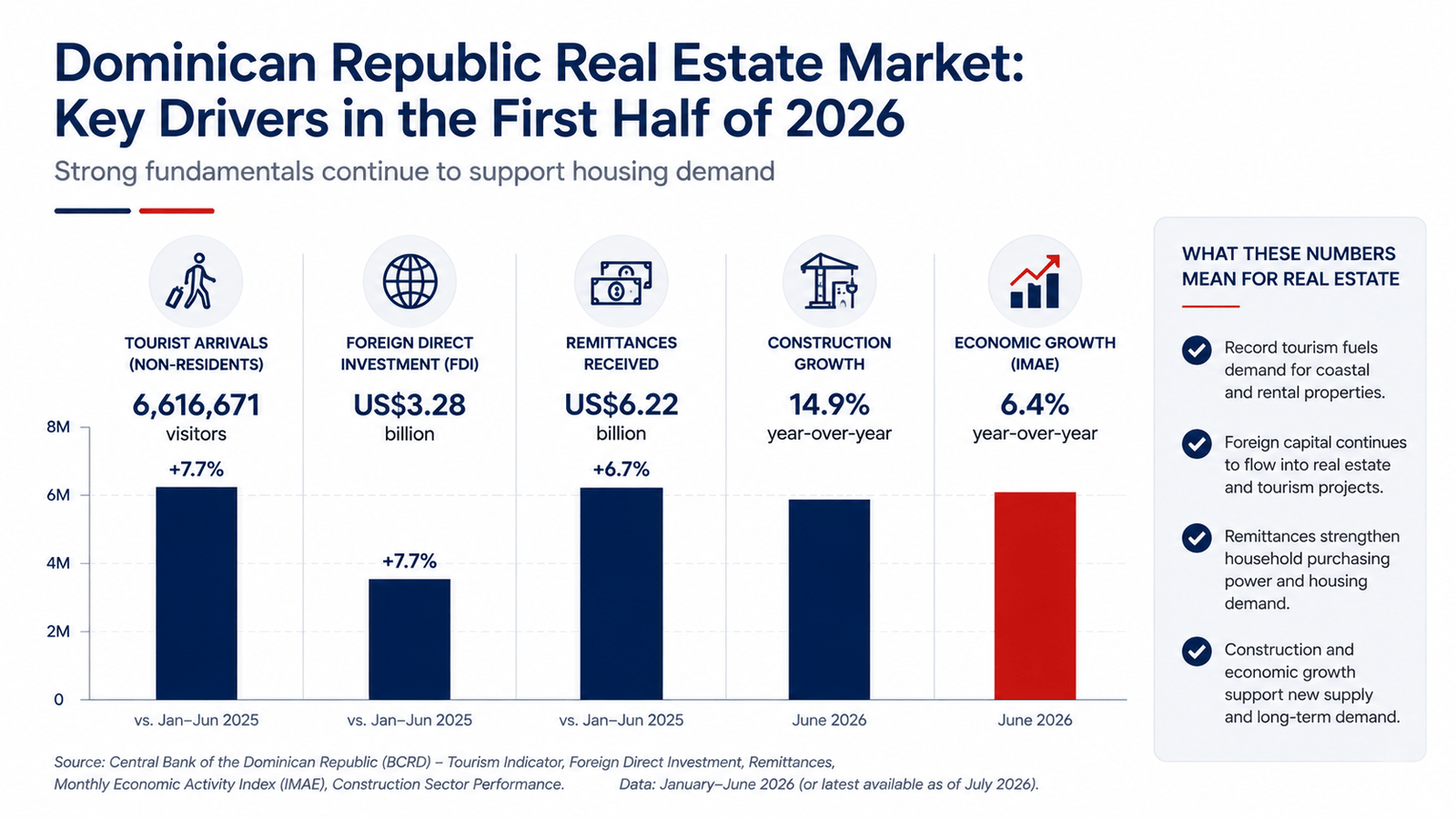
Of those visitors, 4,963,542 arrived by air and 1,653,129 by sea. Hotel occupancy averaged 71% during the first half of the year. Punta Cana accounted for approximately 53% of June’s air arrivals, reinforcing the eastern region’s dominant role in international tourism.
These figures matter to real estate because tourism creates several layers of demand at once.
- Visitors create demand for short-term accommodation.
- Tourism employment creates demand for long-term housing.
- Hotel and infrastructure investment creates additional commercial and residential development.
- Growing international exposure increases the pool of potential foreign property buyers.
But investors should avoid a simplistic equation between rising tourist numbers and guaranteed property appreciation. The relationship is strong, but it is not automatic.
When large numbers of developers simultaneously target the same tourist market, new supply can outpace effective rental demand. In that situation, occupancy and rental rates can weaken even while tourism itself continues to grow.
The lesson for buyers is straightforward: tourism is an important demand driver, but the individual property’s location, management, competitive positioning and operating costs ultimately determine its performance.
Foreign Capital Continues to Flow Into the Dominican Economy
Foreign investment provides another important source of support for the property market.
The Central Bank reported preliminary foreign direct investment of US$3.2765 billion during the first half of 2026, an increase of 7.7% from the first half of 2025. Approximately two-thirds of the inflows, or US$2.1946 billion, represented new capital contributions.
The importance for real estate extends beyond the amount invested directly in property. Foreign investment also finances tourism, infrastructure, services, manufacturing and other activities that strengthen the wider economic environment in which residential property operates. The Central Bank’s July 2026 release provides the latest official breakdown.
Tourism and real estate remain closely connected within the investment cycle. New hotels, resorts, marinas, commercial facilities and transportation infrastructure can all increase the value proposition of surrounding residential developments.
For international investors, the Dominican Republic also retains a major structural advantage: the country does not impose the kind of broad restrictions on foreign ownership found in several other markets. Foreign buyers can generally acquire residential property without requiring a local partner.
The Peso Has Quietly Rewritten the Foreign-Buyer Equation
Currency movements are one of the least appreciated variables in the current market.
The Dominican peso strengthened significantly during the first half of 2026. The Central Bank reported an appreciation of 7.2% against the U.S. dollar over the 12 months to July 8, 2026. At the end of June, the currency was also substantially stronger than at the end of 2025.
This matters because the Dominican real estate market operates in two currencies at the same time.
High-end and resort properties are often marketed in U.S. dollars, while a large portion of domestic incomes, operating costs and local transactions are denominated in pesos.
For a dollar-based investor, a stronger peso can make a peso-priced property more expensive in U.S.-dollar terms even without a comparable increase in its local price. For a Dominican buyer earning pesos, the same currency appreciation can make dollar-priced coastal properties comparatively more affordable.
The implication is that property returns should not be judged solely in nominal local-currency terms. Currency exposure can materially change the final investment outcome.
Remittances Are a Major Housing Demand Engine
The Dominican diaspora continues to play an important role in the residential market.
Remittances reached US$6.2193 billion in the first half of 2026, up 6.7% from the same period of 2025. June alone generated US$1.0493 billion, while 81.4% of the month’s formal remittance inflows originated in the United States.
The geographical concentration is also notable. The Distrito Nacional received 51% of June’s remittance inflows, while Santiago and Santo Domingo provinces accounted for another 16.4%. Together, those areas absorbed more than two-thirds of the month’s remittance flow. The Central Bank’s latest macroeconomic data tracks both remittances and exchange-rate developments.
Remittances can enter the housing market in several ways: financing home construction, supporting mortgage payments, contributing to down payments, funding renovations and enabling diaspora families to purchase property for eventual return to the country.
This segment helps explain why domestic residential demand can remain strong even when mortgage financing is expensive.
Construction Has Made a Sharp Comeback
The biggest change on the supply side is the dramatic recovery in construction.
The sector contracted throughout much of 2025, but the trend reversed in 2026. According to the Central Bank, construction expanded 14.9% year over year in June 2026, accounting for roughly 30% of the growth in the country’s monthly economic activity indicator that month.
The wider economy also accelerated. The IMAE increased 6.4% year over year in June, while the April-June quarter expanded 5.0%. For the first half of 2026, average economic growth reached 4.5%. The Central Bank’s June 2026 economic report provides the latest sectoral breakdown.
This rebound matters for real estate because construction activity today determines housing supply tomorrow.
If developers continue restarting projects that were delayed during the 2025 slowdown, the market could see a significant increase in available inventory over the next two years.

That would be positive for buyers, but it could also create tougher competition among developers in areas where projects are heavily concentrated.
The Construction Pipeline Is Large, but Not Evenly Distributed
ONE’s ROE data shows that the Dominican construction market is strongly concentrated in multifamily residential development and that the distribution of projects varies sharply across municipalities.
The latest ROE recorded thousands of active housing projects in Greater Santo Domingo, with 76.4% of active residential works consisting of buildings of one or two floors. Apartments nevertheless dominate the residential development structure in the most urbanised parts of the metropolitan region.
This mix matters because the market is gradually moving away from an exclusively land-intensive suburban model towards higher-density urban development, particularly where land values and infrastructure constraints make vertical construction more economically viable.
The next phase of Santo Domingo’s housing growth is therefore likely to be characterised by more apartment-led development and increasingly sophisticated mixed-use projects.
Construction Costs Have Stopped Accelerating at the Same Pace
One of the more positive developments for developers is the moderation of construction-cost inflation.
ONE’s Índice de Costos Directos de la Construcción de Viviendas (ICDV) ended 2025 up 3.74%, considerably below the extreme cost increases recorded during the pandemic-era building boom. By June 2026, the index had risen approximately 1.9% year over year.
That easing has important implications for the market.
When materials and labour costs rise rapidly, developers have three basic options: reduce margins, delay projects or raise selling prices. None is ideal.
The more moderate environment in 2026 gives developers greater room to restart projects and potentially improve profitability without passing the entire increase through to buyers.
However, land, finance, permits, labour and infrastructure remain significant costs. A slowdown in construction-cost inflation therefore does not automatically translate into cheaper homes.
Permitting Remains One of the Sector’s Weak Points
The construction rebound is taking place against a background of persistent administrative bottlenecks.
ONE’s national data for 2025 recorded 1,362 private construction permits against 4,163 registered buildings. The discrepancy does not mean that thousands of structures were necessarily illegal; the statistics measure different administrative and statistical concepts. But the gap does highlight the complexity and fragmentation of the development process.
The problem is particularly visible in La Altagracia, the province that includes Punta Cana, where construction activity is exceptionally high.
Industry representatives have also repeatedly pointed to permitting delays, particularly where environmental approvals are required before construction licences can be issued.
For investors buying pre-construction property, this is more than a regulatory detail. Delays affect carrying costs, developer financing, delivery dates and, ultimately, the timing of rental income.
The Housing Shortage Is Much Larger Than the Current Construction Cycle
The Dominican Republic’s biggest long-term real estate opportunity is not necessarily luxury development. It is the enormous deficit of adequate and affordable housing.
The World Bank has previously estimated the country’s housing deficit at approximately 1.4 million units. The institution has also highlighted the fact that the deficit includes both a shortage of new homes and a large stock of existing dwellings requiring improvements because of overcrowding, poor construction materials or inadequate access to basic services.
The Bank approved US$100 million in support for the country’s National Housing Plan, with the objective of helping lower- and middle-income households obtain access to formal and more resilient housing. The World Bank’s housing programme documentation remains one of the clearest references for the scale and nature of the structural housing problem.
This creates an important paradox.
The Dominican Republic can simultaneously experience a construction boom, strong property investment and a massive housing deficit.
The reason is that these are not necessarily the same market.
Much of the private development pipeline is aimed at middle- and upper-income buyers, second-home purchasers and international investors, while the greatest unmet need is at the affordable end of the market.
Affordable Housing Could Become the Most Important Long-Term Opportunity
The challenge is not a lack of demand. It is the economics of delivering a product at a price households can afford.
Land values, financing costs, construction expenses, utility infrastructure and regulatory requirements can make formal housing difficult to build profitably for lower-income households without subsidies or innovative financing structures.
Government programmes such as Familia Feliz and Mi Vivienda attempt to bridge that gap through subsidies and preferential financing.
The strategic question for the private sector is whether it can develop housing models that are simultaneously affordable, commercially viable and attractive enough to generate sustainable investment returns.
That could become one of the most important themes of Dominican real estate over the next decade.
Rental Yields Remain One of the Market’s Main Attractions
Income-producing property remains a major reason investors are attracted to the Dominican Republic.
Global Property Guide’s Q1 2026 data puts the country’s average gross residential rental yield at 8.53%.
| Market | Average gross yield |
|---|---|
| Santo Domingo | 9.09% |
| Punta Cana / Bávaro | 7.98% |
| Dominican Republic average | 8.53% |
Within Santo Domingo, Global Property Guide estimates gross yields of 9.87% for two-bedroom apartments and 9.74% for three-bedroom apartments. In Punta Cana and Bávaro, the average yield is lower, although two-bedroom apartments can still generate around 8.20% on a gross basis.
The difference is consistent with the underlying demand structures. Santo Domingo benefits from a deeper year-round tenant base, while Punta Cana and Bávaro depend more heavily on tourism and short-term rental demand.
These figures should not be confused with net investment returns. The published yields are calculated before taxes, maintenance, vacancy, property management, repairs, insurance and other operating expenses. Global Property Guide notes that net yields are typically around 1.5 to 2 percentage points lower.
Rents Are Rising, but Not at a Breakneck Pace
The rental market provides an important counterpoint to the property-price data.
Global Property Guide’s rental-price series, based on Central Bank data, shows nominal rents increasing by about 3.0% year over year in early 2026. That is meaningful, but considerably less dramatic than the headline gross yield figures might imply.
This distinction matters because a high rental yield can result from a combination of relatively high rents and moderate property prices. It does not necessarily mean rents themselves are accelerating rapidly.
For investors, the most attractive market is therefore not automatically the one with the highest published yield. It is the one where rental demand is likely to remain durable relative to future housing supply.
Mortgage Financing Remains Expensive
The credit market continues to be one of the main constraints on domestic housing demand.
The Central Bank has maintained its policy rate at 5.25% during 2026, while inflation was 5.67% year over year in June. The country’s formal inflation target remains 4% plus or minus one percentage point. The Central Bank’s current macroeconomic dashboard provides the latest interest-rate and inflation data.
Mortgage borrowing remains substantially more expensive than the central policy rate because banks price housing loans according to funding costs, credit risk, collateral, term and other factors.
The broader lending environment has nevertheless improved compared with the tightest conditions of 2025, and housing credit continues to expand.
This creates a market with two different profiles: cash buyers, who are less sensitive to financing costs, and leveraged domestic buyers, for whom interest rates remain a major determinant of affordability.
Foreign Buyers Have a Different Set of Advantages and Risks
For foreign buyers, the Dominican Republic offers several structural attractions:
- Foreign ownership is generally open and does not require a local equity partner.
- Tourism provides a deep source of international rental demand in several destinations.
- Rental yields can be comparatively attractive.
- Major tourism markets offer established international connectivity.
- The country continues to receive significant foreign investment.
But foreign buyers also face additional risks:
- Exchange-rate movements can materially change returns.
- Short-term rental income can be more volatile than conventional leases.
- Property management is critical for absentee owners.
- Title, zoning, permits and project documentation require professional verification.
- Pre-construction investments carry delivery and developer risks.
For that reason, the strongest investment thesis is usually not simply “buy in Punta Cana” or “buy in Santo Domingo”. It is to identify a particular property with a demonstrable demand base, credible developer, transparent title structure, realistic operating assumptions and sufficient margin between purchase price and sustainable rental income.
Property Taxes, Transfer Costs and Incentives Matter to the Final Return
Transaction costs should be included in every serious property analysis.
The Dominican Republic generally applies a 3% real estate transfer tax, calculated according to the applicable taxable value of the property. The Dominican tax authority, DGII, states that the transfer should generally be completed within six months of the execution of the transfer document to avoid the applicable penalties and interest. DGII’s official guidance on real estate transfers explains the procedure.
There are also important exceptions and incentives. Qualifying tourism projects benefiting from CONFOTUR treatment can receive significant tax advantages, meaning that the fiscal structure of an individual project can materially affect the investment case.
That makes it essential to verify the precise legal and tax status of a development rather than assuming that all tourism properties receive identical treatment.
Economic Growth Is Supporting the Property Market
Real estate is closely linked to the broader economy, and the Dominican economy has regained momentum in 2026 after an unusually weak 2025.
GDP growth slowed to 2.1% in 2025, but the monthly economic activity indicator accelerated sharply during the first half of 2026. June’s 6.4% growth was the strongest monthly result of the year at that point, while the first half averaged 4.5% growth.
The Central Bank’s current data also shows strong performance in construction, mining, financial services, transportation and hospitality. The June 2026 Central Bank report provides the latest sectoral figures.
International institutions remain broadly constructive on the medium-term outlook. The World Bank’s April 2026 country profile projected 3.6% growth in 2026 and 4.4% in 2027, supported by a rebound in private investment and construction, resilient consumption backed by remittances, tourism and foreign investment
The IMF’s November 2025 Article IV assessment had projected 4.5% growth for 2026, illustrating the relatively broad consensus that the economy should return to a stronger expansion rate after the 2025 slowdown.
Inflation and the Exchange Rate Remain the Main Macro Variables to Watch
The macroeconomic picture is favourable but not without risks.
Inflation reached 5.67% in June 2026, above the upper end of the Central Bank’s target range, although core inflation remained lower at 4.96%. At the same time, the peso strengthened considerably against the dollar.
The combination creates an unusual environment for property investors.
On one hand, a stronger currency can reduce imported costs and improve purchasing power for local consumers buying dollar-priced assets. On the other hand, it can reduce the competitiveness of dollar earnings when converted back into pesos and increase the effective dollar cost of peso-priced real estate.
The longer-term sustainability of the peso’s strength will therefore matter to international property investors.
Climate and Infrastructure Are Becoming Increasingly Relevant to Valuation
Another factor likely to become more important in the coming years is climate resilience.
The Dominican Republic is highly exposed to hurricanes, flooding, coastal hazards and other extreme-weather events. These risks are increasingly relevant to property because insurance, drainage infrastructure, building standards, coastal protection and elevation can affect both operating costs and long-term asset values.
The World Bank has identified climate resilience and urban infrastructure as important development priorities for the country, particularly as urbanisation continues. The World Bank’s Dominican Republic climate and green-growth material highlights the increasing exposure of urban and housing assets to climate-related risks.
For coastal investment, this should become part of the valuation process rather than an afterthought.
What the Market Could Look Like in 2027
The most likely scenario is not a collapse in property prices, but continued expansion at a slower and more uneven pace.
Several forces should continue to support demand:
- Tourism remains at record levels.
- Foreign direct investment remains strong.
- Remittances continue to support household purchasing power.
- Construction has returned to rapid growth.
- The economy is recovering from the 2025 slowdown.
- Residential rental yields remain attractive by regional standards.
At the same time, several factors could limit price acceleration:
- Mortgage rates remain relatively high.
- New construction could create periods of oversupply in specific locations.
- Affordable housing remains undersupplied relative to national need.
- Currency appreciation has complicated the economics for foreign buyers.
- Permitting and labour constraints can delay new projects.
- Global tourism and geopolitical shocks remain external risks.
The most probable outcome is therefore a market with continued nominal price growth but greater variation between locations and property types.
Where the Strongest Opportunities May Be
Several segments appear particularly well positioned.
Prime Santo Domingo residential
The capital’s established central districts benefit from a deep domestic and expatriate rental market, employment concentration and limited availability of land in the most desirable neighbourhoods. The main challenge is valuation: prime areas can already command substantial premiums.
Middle-market urban housing
This segment may offer the strongest structural demand because of population growth, household formation and the shortage of formal affordable housing. The challenge is producing units at prices that households can actually finance.
Selected Punta Cana and Bávaro properties
Tourism fundamentals remain exceptionally strong, but investors should be highly selective. Properties with strong management, realistic occupancy assumptions, differentiated amenities and access to established infrastructure are likely to be more resilient than generic developments competing mainly on price.
Mixed-use and infrastructure-linked developments
As Greater Santo Domingo becomes denser, projects combining residential, retail and services may benefit from changing urban patterns and the increasing value of convenience.
Affordable and workforce housing
This is arguably the largest long-term opportunity, provided developers can overcome the financing and cost constraints that currently make the segment difficult to serve at scale.
The Main Risks for Investors
A professional assessment of the Dominican property market should also recognise that strong national statistics can conceal substantial project-level risks.
The most important are likely to be oversupply in individual tourism submarkets, construction delays, developer liquidity, title or permitting issues, unrealistic rental projections, excessive leverage, currency fluctuations and inadequate property management.
Buyers should also remember that advertised prices and yields are not transaction data. A seller’s asking price is not necessarily the final market price, and a projected rental return is not the same thing as an achieved net return.
That distinction becomes more important as the market matures.
Bottom Line: The Dominican Property Story Is Getting More Sophisticated
The Dominican Republic remains one of the Caribbean’s most compelling real estate markets in 2026, but the investment story is evolving.
The era of simply buying property because prices were rising rapidly is giving way to a more selective market in which income, location, infrastructure and execution matter more.
The country’s fundamental drivers remain powerful. Tourism is producing record visitor numbers. Foreign direct investment is increasing. Remittances continue to provide a major source of household purchasing power. Construction has rebounded sharply. The economy is accelerating again after the 2025 slowdown.
But those strengths coexist with real structural challenges. Housing affordability remains a major problem, mortgage financing is expensive, formal supply is skewed toward the middle and upper segments, permitting can delay projects and the construction sector remains sensitive to labour and migration policies.
For international investors, the Dominican Republic still offers an unusual combination of relatively strong rental yields, tourism exposure, international connectivity and an open ownership environment.
For domestic buyers, however, the central issue is increasingly affordability.
And for developers, the next great opportunity may not be to build more of the same. It may be to solve the market’s biggest unmet need: delivering well-located, resilient and financially accessible housing to a rapidly urbanising population.
The most important conclusion for 2026 is therefore not that Dominican property prices are rising.
It is that the market is becoming more discriminating.
As construction accelerates and more capital enters the sector, investors will have to work harder to identify the assets capable of producing durable rental income and long-term appreciation. In that environment, location, product quality, legal structure, infrastructure and realistic financial modelling are likely to matter considerably more than a national headline price-growth figure.
Key 2026 Indicators at a Glance
| Indicator | Latest figure |
|---|---|
| Residential price growth, March 2026 | +7.7% year over year |
| Real residential price growth, March 2026 | +3.0% |
| Average gross rental yield | 8.53% |
| Santo Domingo average gross rental yield | 9.09% |
| Punta Cana/Bávaro average gross rental yield | 7.98% |
| Tourist arrivals, January-June 2026 | 6,616,671 |
| Foreign direct investment, January-June 2026 | US$3.2765 billion |
| Remittances, January-June 2026 | US$6.2193 billion |
| IMAE growth, June 2026 | +6.4% |
| Construction growth, June 2026 | +14.9% |
| Inflation, June 2026 | 5.67% |
| Central Bank policy rate, July 2026 | 5.25% |
Sources and Further Reading
Banco Central de la República Dominicana — macroeconomic indicators, monetary policy, construction, remittances and external-sector data.
Banco Central — Economic Activity, June 2026.
Banco Central — Foreign Direct Investment, First Half of 2026.
Oficina Nacional de Estadística (ONE) — Registro de Oferta de Edificaciones 2025-2.
Presidencia de la República / MITUR — Tourism Results, First Half of 2026.
Global Property Guide — Dominican Republic House Price Index.
Global Property Guide — Dominican Republic Rental Yields.
World Bank — Dominican Republic Economic and Development Profile.
World Bank — National Housing Plan and Housing Deficit.
DGII — Real Estate Transfer Tax Guidance.
For more Dominican business news, follow the latest developments in investment, trade, companies and the economic forces shaping the Dominican Republic.