 22°C
22°C

Dominican Republic Military Industry: From Arms to Aerospace
The Dominican Republic military industry has evolved from the arms factories of the Trujillo era into a broader state-backed industrial system producing or assembling aircraft, armored vehicles, uniforms, ambulances, tactical vehicles and other equipment. The transformation gained institutional momentum in 2025, when the government established Industria Militar Dominicana, S.A. as a state-owned company, while projects such as the TP-75 Dulus aircraft and FURIA armored vehicles demonstrated how defense spending can also create manufacturing capacity, technical skills and measurable savings. The available evidence, however, also shows why claims about the sector's economic impact must be distinguished between documented savings and longer-term expectations about exports, employment and industrial development.


The Dominican Republic military industry has a longer history than its current generation of aircraft and armored vehicles might suggest. Its most ambitious early experiment was built around the San Cristóbal arms factory, where Dominican authorities developed and manufactured the Cristóbal carbine during the 1950s. After that industrial base disappeared, military production became more fragmented, with the armed forces maintaining capabilities in areas such as textiles, maintenance, naval workshops and specialized manufacturing.
A new phase began in the 2020s. The Dominican government expanded local assembly and manufacturing projects and, in April 2025, formally constituted Industria Militar Dominicana, S.A. (IMDOM) as a state-owned company attached to the Ministry of Defense. Its legal mandate is considerably broader than weapons production: it includes textiles, armaments, naval construction and repair, metalworking, woodworking, aerospace technology, research and development, logistics, ambulances and the manufacture, assembly and maintenance of tactical vehicles.
The significance of this model is therefore not simply whether the country can manufacture military hardware. It is whether defense procurement can retain more technical work inside the Dominican economy, reduce selected import costs, develop specialized human capital and eventually support exports. Some of those effects are already documented. Others remain goals rather than proven economic outcomes.
How the Dominican Military Industry Began
The first major industrial experiment dates to the middle of the 20th century, when the government of Rafael Leónidas Trujillo sought to establish a domestic arms manufacturing capability. The San Cristóbal factory, known as La Armería, was developed with the assistance of European specialists, including Hungarian engineers who had settled in the Dominican Republic after World War II.
One of the most important figures associated with the project was Hungarian weapons designer Pál Király. The resulting Cristóbal weapon combined elements of Király’s delayed-blowback engineering with manufacturing capabilities developed at the Dominican factory. The best-known version used the .30 Carbine cartridge and was manufactured in San Cristóbal.
Historical accounts differ on production totals and on some details of the factory’s chronology. A detailed study published by Small Arms Review estimates that production of the Cristóbal was approximately 1,000 weapons per month during part of the 1950s, with lower production later. The same study estimates that roughly 84,000 weapons were produced from 1950 through 1957, while other secondary references give substantially higher totals for the broader 1950-1966 production period. Because the surviving historical record is not sufficiently consistent to establish one definitive production figure, it is safer not to present the larger estimates as settled fact.
The weapon was not simply a domestic military product. Historical arms research documents efforts to market Cristóbal carbines abroad, particularly in Latin America and the Caribbean. Cuba was an important customer during the Batista period, before the Cuban Revolution. Claims that the weapon was exported specifically “during the revolution” therefore require qualification: its documented Cuban sales predated the 1959 revolutionary victory.
The Cristóbal also acquired a wider historical footprint. Secondary arms histories associate examples of the weapon with the Cuban Revolution and with armed groups in Colombia. Those accounts are useful for understanding the weapon’s circulation, but they should not be confused with official Dominican export statistics, which are not readily available in a comprehensive historical series.
Why the First Arms Industry Disappeared
The San Cristóbal industrial project proved difficult to sustain financially. By the early 1960s, the factory’s machinery was considered among the most modern in the region, but utilization was limited and attempts to diversify into civilian products did not solve its financial problems. A historical review published by Small Arms Review reports that a government inquiry in 1962 found the machinery underused and that the factory ultimately shut down in April 1965.
This is an important correction to a common simplified version of the story. The decline of Dominican arms manufacturing cannot be explained solely by the assassination of Trujillo in 1961. Political change was part of the broader context, but the factory also faced serious commercial and operational problems. The historical record points to a combination of political transformation, financial difficulties, underused industrial capacity and an unsuccessful attempt to find a sustainable civilian market.
The closure meant that the Dominican Republic lost an unusually ambitious domestic weapons-manufacturing capability. For decades afterward, the armed forces depended heavily on imported equipment while maintaining more limited domestic capabilities in repair, maintenance, uniforms, naval workshops and other support activities.
The Return of a Formal Military Industry
The contemporary revival is more institutionalized than the original San Cristóbal experiment. On April 28, 2025, Decree 221-25 established Industria Militar Dominicana, S.A. as a public company with a single state shareholder. The company is attached to the Ministry of Defense and operates under the framework of Dominican commercial-company legislation.
The legal mandate is significant because it treats military industry as a diversified production platform rather than simply an arms factory. According to the Dominican government’s public registry of state institutions, its activities include textile manufacturing, armaments, naval construction and repair, metalworking, woodworking, aerospace technology, research and development, defense infrastructure, military logistics, ambulances and tactical-vehicle manufacturing, assembly and maintenance.
This structure also explains why the economic argument surrounding the industry is broader than the value of weapons manufactured locally. A state industrial facility can use the same technical capabilities for military vehicles, emergency ambulances, school furniture, uniforms and other public-sector requirements. In principle, that creates more continuous demand for machinery, technicians and production facilities than a factory dedicated exclusively to specialized military hardware.
The San Cristóbal Vehicle Plant
The physical revival of the San Cristóbal industrial complex became visible in May 2025, when President Luis Abinader inaugurated the first phase of a vehicle assembly plant. The facility was presented as the centerpiece of the renewed military-industrial program and as a way to bring more assembly, maintenance and manufacturing activity into the country.
The government said the plant could eventually support more than 400 jobs. It also announced an annual capacity of approximately 400 ambulances, together with the assembly of Level 3 armored vehicles and other specialized vehicles.
One of the government’s most frequently cited economic figures is a claimed saving of more than 25 percent per unit compared with acquisition from abroad. This figure should be understood as an official estimate associated with the vehicle assembly program rather than as an independently audited economy-wide measure of the military industry’s contribution to GDP.
The distinction matters. A local assembly operation can reduce costs through lower logistics expenses, local labor, maintenance advantages and reuse of domestic infrastructure, but the final economic benefit depends on what percentage of the vehicle’s components are imported, how the accounting treats labor and capital costs, and whether the locally assembled unit is being compared with an equivalent international product under equivalent specifications.
FURIA: The First Dominican-Assembled Armored Vehicle
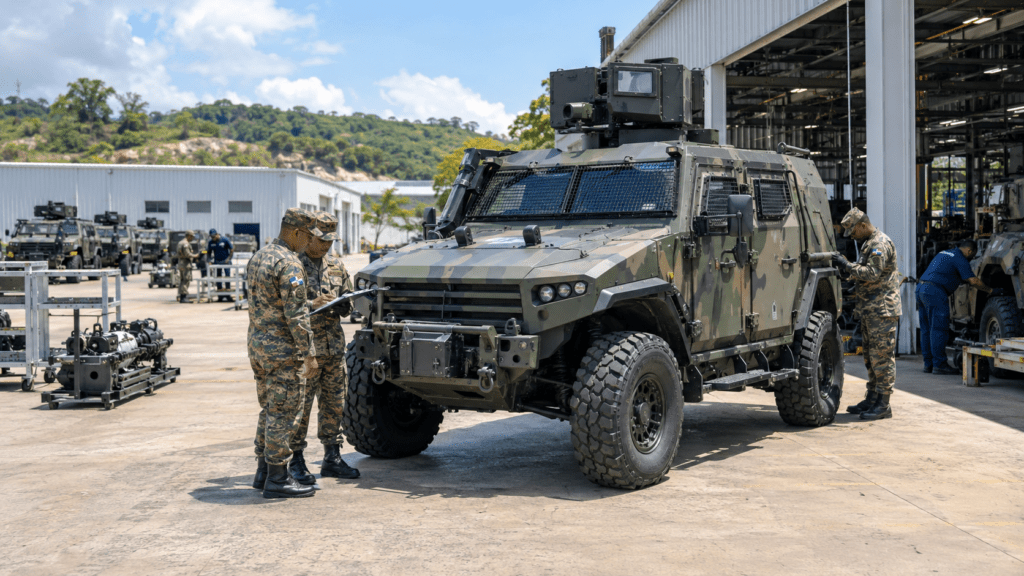
The most visible result of the new vehicle program is FURIA, short for Fuerza Unificada de Respuesta Inmediata Armada. The VBD-1 was presented in January 2026 as the first military armored vehicle assembled by the Dominican military industry.
According to the Ministry of Defense and the Presidency, the VBD-1 is based on a Ford Super Duty F-250 chassis and can carry up to 11 soldiers. It incorporates Level 3 ballistic protection, ballistic steel, multilayer ballistic glass, run-flat tires, reinforced suspension and a 360-degree rotating turret. It also includes surveillance cameras, GPS and other tactical systems.
The government has estimated the international-market price of a comparable vehicle at approximately US$400,000 and said local assembly can reduce the value by roughly 50 percent. If that estimate is applied directly to the US$400,000 reference price, the implied difference would be about US$200,000 per vehicle. However, the government has not published an independent audit establishing that saving across a standardized series of purchases, so the 50 percent figure should be treated as an official estimate rather than a verified industry-wide average.
The program has expanded beyond the original VBD-1. In July 2026, the government presented the FURIA VBD-2, described as the latest armored vehicle developed and assembled by IMDOM at that point. The government said the first VBD-2 formed part of a program for 18 vehicles intended for brigades deployed along the second line of defense of the country’s land border.
The Centauro Tactical Vehicle
Local production is not limited to fully armored platforms. In July 2026, the armed forces received 10 Centauro tactical vehicles developed and modified by IMDOM for the Army’s Commando Battalion.
The vehicles are based on Chevrolet Silverado pickups and were described by the government as having capacity for 12 soldiers, reinforced protection and a 360-degree armored rotating turret capable of supporting military weapons systems.
The Centauro program illustrates an important characteristic of the Dominican approach: local military manufacturing does not necessarily mean producing every component domestically. Much of the industrial value can instead come from integration, modification, engineering, fabrication, maintenance and adaptation of commercial platforms to military requirements.
The TP-75 Dulus and the Development of Aerospace Skills
The Dominican Republic’s most technically distinctive contemporary project is the TP-75 Dulus, an aircraft used for training and light patrol missions.
The Dulus is based on the Italian Flying Legend Tucano Replica 915iS, itself a 70 percent-scale replica of the Embraer EMB-312 Tucano. The Dominican aircraft are assembled at the San Isidro Air Base by personnel of the Dominican Air Force. The original acquisition involved 10 aircraft, purchased from Flying Legend in 2022.
The project is best described as local assembly and technical integration rather than an aircraft manufactured entirely from Dominican raw materials. The Dominican government has said that each aircraft contains approximately 5,000 parts, while the Italian Embassy in Santo Domingo has confirmed that the aircraft were assembled at San Isidro under the cooperation arrangement with Flying Legend.
The aircraft is powered by a Rotax 915iS engine rated at approximately 141 horsepower. The Italian Embassy has reported a maximum speed of about 287 kilometers per hour and a range of approximately 1,166 kilometers. The aircraft were adapted for military training and patrol duties and can be equipped with surveillance systems, including thermal imaging equipment.
The project’s industrial value extends beyond the aircraft themselves. Dominican technicians received specialized training connected to the program, allowing the country to accumulate experience in aircraft assembly, inspection, systems integration and maintenance. Those skills can be more strategically important over time than the value of any individual aircraft because they create a base for future aerospace projects.
How Many Dulus Aircraft Are in Service?
Public reporting on the fleet has evolved as the aircraft entered service. In March 2025, the Italian Embassy reported that five of the 10 aircraft had become operational. By March 2026, Dominican reporting stated that the full first group of 10 TP-75 Dulus aircraft had been placed into operational use.
The aircraft have been used for training and patrol missions, including surveillance activities. Dominican authorities have also presented the Dulus at international aviation events, helping expose the country’s emerging aerospace capabilities to potential foreign customers.
The government has reported 1,769 flight hours accumulated by the fleet and estimated operating costs at roughly US$60 per flight hour. It also reported an estimated saving of RD$208.4 million associated with the aircraft program. These figures are government-reported operational and savings estimates; publicly available information does not provide a full independent cost-benefit analysis of the project.
Could the Dulus Become an Export Product?
The possibility of exports is one of the most important potential economic consequences of the Dulus program. In 2025, Dominican officials said that other countries had contacted them regarding the aircraft and that assembly for foreign demand could begin after the country’s own requirements were met.
In August 2026, the president of Honduras, Nasry Asfura, publicly expressed interest in obtaining TP-75 Dulus aircraft and FURIA armored vehicles from the Dominican Republic. He said discussions had begun with President Luis Abinader.
That development is significant, but it should not yet be described as a completed export contract. Public reports available in August and September 2026 indicate interest and negotiations, but do not establish a finalized quantity, purchase price or delivery schedule for Honduran Dulus or FURIA acquisitions.
If a foreign contract is eventually signed, the economic implications would be different from those of domestic procurement. Exports could generate foreign-currency revenue, increase production volumes and spread fixed industrial costs across a larger number of units. They could also encourage local suppliers to meet higher technical standards.
Textiles: One of the Most Measurable Areas of Savings
The military industry’s economic contribution is not limited to complex machinery. Textile production is one of the clearest examples of a relatively straightforward activity in which local manufacturing can replace imported or externally sourced products.
In January 2026, the Ministry of Defense reported that a reengineering program had increased annual production capacity at the military textile facilities to approximately 120,000 uniforms in Bonao and more than 180,000 T-shirts and sweaters in San Cristóbal.
The ministry said the increase represented growth of more than 350 percent and generated savings of more than RD$300 million. It also said that the armed forces would reach self-sufficiency in the production of their uniforms beginning in 2026.
These figures are among the stronger quantitative indicators available for the Dominican military industry’s domestic economic effect because they relate directly to production volumes and reported procurement savings. They should nevertheless be understood as institutional figures rather than as a national economic-impact study.
Ambulances and Civilian Applications
An unusual feature of the Dominican model is that some military-industrial capacity is being used to supply civilian public services. The vehicle plant was designed not only for defense equipment but also for ambulances and other specialized vehicles.
By January 2026, authorities reported that 46 ambulances manufactured by the military industry were already operating, with three additional units ready for delivery. They also reported confirmed orders for 65 more ambulances during 2026 for the national emergency system and RD Vial.
This diversification matters economically because it creates production runs for vehicles that do not depend exclusively on defense procurement. It also gives the industrial organization an opportunity to maintain technical personnel, machinery and supply chains between military orders.
The same logic applies to school furniture. The military industry reported a production capacity of approximately 500 school chairs per day and a contract with the Ministry of Education for 150,000 new units, in addition to repairs of another 150,000 units.
Naval Industry: A Longer-Running Capability
The Dominican Republic’s naval industrial experience predates the current IMDOM structure. Research published by the Instituto Superior para la Defensa traces the development of Dominican naval infrastructure to the construction of a dry dock at Las Calderas in 1939. The same research notes the creation of the Benítez shipyards in 1953 and naval shipyard facilities during the Trujillo era.
The naval sector has historically concentrated on construction, maintenance and repair rather than the large-scale construction of ocean-going warships. Dominican naval workshops have nevertheless produced smaller vessels. For example, four fiberglass boats delivered to the state-owned hydroelectric generation company EGEHID in 2016 were constructed by personnel of the Dominican naval shipyards.
The country’s defense planning has also contemplated greater use of domestic shipbuilding. Earlier government planning documents identified the construction of two coast-guard vessels as a means of strengthening the Dominican naval industry and potentially creating a foundation for future fleet renewal and regional sales.
IMDOM’s legal mandate now explicitly includes the manufacture and repair of maritime vessels. That provision creates an institutional framework for the naval side of the military-industrial strategy, although the publicly available evidence does not yet demonstrate a large-scale export shipbuilding industry comparable with established naval manufacturing centers.
What the Numbers Actually Tell Us
The available figures show that the Dominican military industry has moved beyond a purely conceptual stage. There are identifiable production facilities, completed vehicles, aircraft, uniforms, ambulances and school furniture, as well as documented production capacities and government-reported savings.

| Area | Documented figure | What it indicates |
|---|---|---|
| Vehicle plant | More than 400 potential jobs | Expected employment associated with the expanded industrial operation |
| Vehicle assembly | More than 25% reported saving per unit | Government estimate compared with external acquisition |
| Ambulances | 46 operating by January 2026 | Evidence of production for civilian public services |
| Ambulance orders | 65 additional units for 2026 | Confirmed domestic demand reported by the Ministry of Defense |
| Military uniforms | 120,000 annually in Bonao | Expanded domestic textile capacity |
| Military clothing | 180,000 T-shirts and sweaters annually in San Cristóbal | Expanded textile output |
| Textile savings | More than RD$300 million | Government-reported annual savings |
| School furniture | 500 units per day | Reported production capacity |
| School furniture contract | 150,000 new units | Public-sector demand for the industrial facility |
| TP-75 Dulus | 10 aircraft | Initial aircraft acquisition and domestic assembly program |
| Dulus flight hours | 1,769 hours | Government-reported operational use |
| FURIA VBD-2 | 18-vehicle program | Production program announced for border-defense units |
| Centauro | 10 vehicles delivered | Locally developed and modified tactical vehicles |
The figures also demonstrate why the industry’s economic significance should not be measured solely by its direct revenue. A locally produced uniform, ambulance or vehicle can create savings for the public sector while simultaneously generating demand for labor, maintenance, transportation, engineering and other services. Those secondary effects are economically relevant even when they do not appear as export earnings.
How Much Money Does the Military Industry Receive?
The 2026 public budget documents provide an important piece of context. Industria Militar Dominicana appears in the public-sector budget with an allocation of approximately RD$150.1 million.
This figure should not be interpreted as the company’s total economic output or revenue. A budget allocation is a public financing figure, not a measurement of production, sales, savings or gross value added. The distinction is particularly important for a young state-owned enterprise whose operations include both internally funded production and contracts with other public institutions.
The available public data also do not yet provide a sufficiently long series of audited annual financial statements from which to calculate the military industry’s contribution to Dominican GDP, its return on invested capital or its net fiscal impact. Such measurements would be necessary before describing the sector as a major contributor to the national economy in conventional macroeconomic terms.
Where the Economic Benefits Come From
The strongest economic argument for Dominican defense manufacturing is not that military spending automatically creates growth. It is that some forms of procurement can be reorganized so that a greater portion of the spending remains inside the domestic production system.
Several channels are particularly relevant.
- Import substitution: locally manufactured uniforms, furniture, ambulances and selected vehicles can reduce the need to purchase complete products abroad.
- Technical employment: aircraft assembly, vehicle integration, metalworking, textiles and naval repair require specialized workers.
- Human-capital development: training technicians for aircraft and vehicle programs creates capabilities that can potentially be used in civilian industries.
- Maintenance capacity: local repair can reduce downtime and dependence on foreign facilities or overseas suppliers.
- Supplier development: larger production programs can create demand for domestic metalworking, textiles, machining, logistics and other services.
- Export potential: foreign sales could turn defense manufacturing from an import-saving activity into a source of foreign exchange.
The last point remains the least established. Domestic savings and production are already documented, whereas sustained defense exports remain an emerging possibility rather than an established source of Dominican foreign-exchange earnings.
Technology Transfer Is as Important as the Hardware
For a small economy, technology transfer may be one of the most important long-term benefits of a military-industrial program. Aircraft assembly illustrates the point particularly well. The value of the Dulus program is not limited to the number of aircraft delivered to the Air Force. It also includes the experience gained by Dominican technicians in assembling complex systems, inspecting components, maintaining aircraft and integrating surveillance equipment.
The same principle applies to armored vehicles. Building or modifying a tactical vehicle requires capabilities in welding, metal fabrication, electrical systems, suspension, communications, ballistic protection, vehicle integration and maintenance. Even when the base chassis is imported, the industrial knowledge surrounding the final product can be developed locally.
This is why the distinction between manufacturing, assembly and integration matters. The Dominican Republic should not be described as producing every component of its military systems domestically. Its current model is better characterized as a combination of local manufacturing, assembly, engineering, adaptation, maintenance and technology transfer.
The Role of the Armed Forces as an Industrial Customer
The Dominican military-industrial model benefits from having a large institutional customer: the state itself. The armed forces require uniforms, vehicles, aircraft support, boats, furniture, emergency vehicles, maintenance and logistical equipment on a continuing basis.
This provides an initial market that a private manufacturer might struggle to obtain when entering a specialized defense sector. Once a product has been developed for domestic use, however, the manufacturer can potentially improve it and seek foreign customers.
That pathway is visible in the Dulus and FURIA programs. Both were initially linked to domestic requirements, while government officials later began discussing foreign interest. The model therefore resembles an industrial-development strategy in which public procurement serves as an initial customer base and potential exports become a later stage of development.
The Importance of San Cristóbal
San Cristóbal has an unusual place in Dominican military-industrial history. It was the location of the country’s best-known 20th-century arms factory and has now become the location of the renewed vehicle assembly program.
The connection is more than symbolic. The modern program is effectively using the historical association of San Cristóbal with defense manufacturing while introducing a substantially different industrial model. The old factory sought to produce a wide range of weapons and ammunition. The contemporary operation emphasizes diversified assembly and manufacturing, including armored vehicles, ambulances, textiles and other products.
That diversification may help address one of the central problems that affected the earlier factory: maintaining sufficient utilization of expensive industrial assets. A plant capable of serving multiple public-sector markets can potentially keep workers, machinery and supply chains active for more of the year.
What the Dominican Republic Still Does Not Produce Domestically
Despite the progress of the last several years, the term “military industry” should not be confused with complete defense self-sufficiency. The Dominican Republic remains dependent on foreign suppliers for many sophisticated systems, components, engines, weapons, electronics and platforms.
The Dulus program itself illustrates this limitation. The aircraft is assembled domestically, but its design originates with an Italian company and its engine is a Rotax product. Likewise, FURIA uses an imported commercial chassis. Local industrial participation can therefore be substantial without making the entire supply chain domestic.
This is not unusual. Even countries with advanced defense industries rely on international supply chains for specialized components. The strategic question is therefore not whether every component can be made domestically, but whether the country controls enough of the engineering, integration, maintenance and production process to retain meaningful industrial capability.
Is the Dominican Republic Already a Regional Defense Manufacturer?
The evidence supports a more cautious description. The Dominican Republic has developed a growing regional defense-manufacturing capability, but it is too early to describe it as a major regional defense exporter.
The country now has documented local assembly of military aircraft, development and assembly of armored vehicles, tactical-vehicle modification, military textile production, ambulance manufacturing and naval industrial capabilities. Foreign interest in the Dulus and FURIA programs is also publicly documented.
What has not yet been demonstrated at scale is a sustained export business involving significant annual foreign sales, a large private supplier ecosystem or a defense-manufacturing sector whose economic output can be measured separately from government procurement. Those milestones would mark a more mature defense industry.
Honduras and the Emerging Export Question
Honduras provides the clearest current test of whether Dominican defense products can move beyond the domestic market. During an official visit in August 2026, Honduran President Nasry Asfura said his government was interested in obtaining Dulus aircraft and FURIA armored vehicles and that discussions had begun with the Dominican government.
The development creates a potential export opportunity, but no final sale should be assumed until a contract, quantity, price and delivery schedule are publicly confirmed. The distinction is essential because expressions of interest are common in international defense markets and do not necessarily become completed purchases.
If the Dominican Republic secures its first significant foreign defense contract, the consequences could extend beyond the value of that individual transaction. It would provide an external validation of the country’s products, create a reference customer and potentially make future negotiations with other countries easier.
The Main Challenges Ahead
The revival of the military industry also presents challenges that will determine whether the current expansion becomes a sustainable industrial sector.
First is scale. Defense manufacturing involves high fixed costs, specialized equipment and limited domestic demand. Without sufficient production volume, unit costs can remain high.
Second is quality control. Military and aviation products require rigorous standards. A successful export industry would have to demonstrate consistent quality, reliability, documentation and after-sales support.
Third is supply-chain depth. Assembly is easier to establish than a complete domestic supply chain. The greater the percentage of components that can be manufactured or serviced locally, the larger the potential domestic economic impact.
Fourth is financial transparency. Because the industry is state-owned and its principal customer is often the government, transparent accounting will be essential for determining whether reported savings are genuinely reducing public costs and whether individual production lines are financially sustainable.
Fifth is market diversification. A military industry that depends almost entirely on domestic government orders remains vulnerable to changes in procurement priorities. Civilian products such as ambulances and school furniture can help broaden the customer base.