 25°C
25°C

Natural Gas Industry in the Dominican Republic
Natural gas has become a central component of the Dominican Republic's energy system, helping reduce dependence on petroleum-based fuels while supporting electricity generation, industrial activity, and the expansion of renewable energy. The country relies on imported liquefied natural gas (LNG), supported by specialized storage and regasification facilities, pipelines, and power plants. New infrastructure in Manzanillo is also changing the geography of supply, creating opportunities for additional generation capacity while raising important questions about import costs, energy security, and long-term demand.


1. Overview of the Natural Gas Industry in the Dominican Republic
The Dominican Republic has developed a substantial natural gas market by combining imported liquefied natural gas, dedicated import infrastructure, gas-fired power plants, and distribution networks serving industrial and commercial customers. Unlike countries with large domestic gas reserves, the Dominican Republic depends on international suppliers to meet its natural gas requirements.
The industry began taking shape with the opening of the AES Andrés LNG terminal in 2003. Over time, natural gas expanded from a relatively specialized fuel into one of the principal sources of electricity generation. The conversion of existing power plants from petroleum-based fuels to natural gas, together with the construction of additional infrastructure, has supported this transition.
According to AES Dominicana, liquefied natural gas accounted for approximately 41% of the country’s energy mix in 2024, compared with about 24% in 2019. These figures describe the company’s reported energy-mix measure and should not be confused with natural gas’s share of electricity generation, which uses a different denominator.
The sector’s development reflects several structural factors:
- Electricity demand: Economic growth, tourism, manufacturing, commercial activity, and urbanization increase the need for reliable power generation.
- Fuel diversification: Natural gas provides an alternative to petroleum products and coal, reducing exposure to dependence on any single generating fuel.
- Import infrastructure: LNG terminals, storage tanks, regasification equipment, and pipelines make it possible to import gas by sea and deliver it to power plants and other customers.
- Renewable energy integration: Gas-fired plants can provide dispatchable electricity when solar and wind generation fluctuate, although their actual operating flexibility depends on plant design and system requirements.
The resulting market is closely linked to the electricity sector. Power generators are the main source of large-scale demand, while industrial and commercial consumers provide an additional market for natural gas distributed through pipelines, trucks, and other delivery systems.
2. Natural Gas Imports and Supply Sources
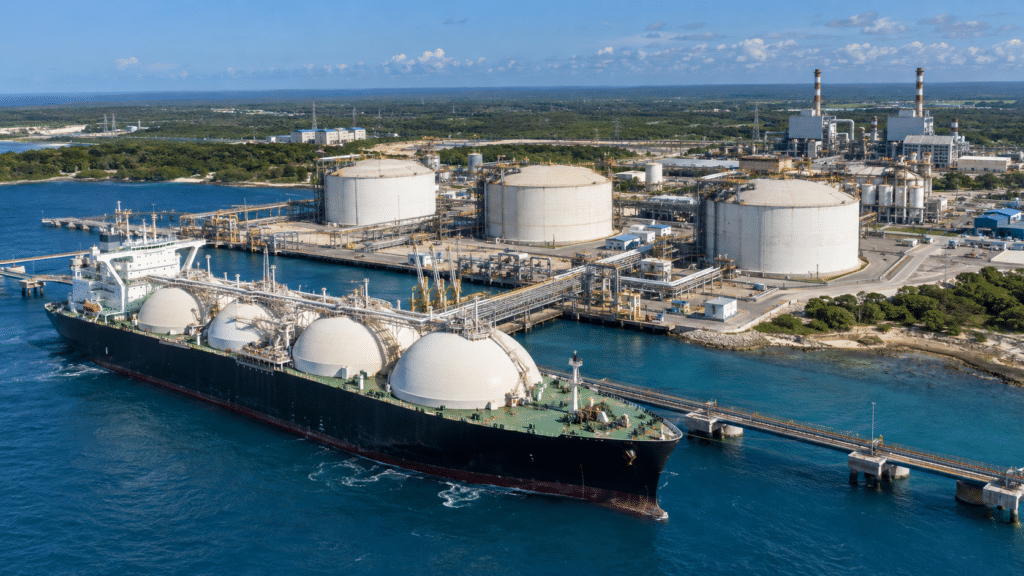
The Dominican Republic imports natural gas in liquefied form because LNG can be transported by specialized ships and stored in relatively compact volumes. At the receiving terminal, the LNG is unloaded, stored at very low temperatures, and converted back into gaseous form through regasification before entering the pipeline network or being delivered through other distribution channels.
The country therefore depends on three interconnected elements: international LNG suppliers, maritime transportation, and domestic infrastructure capable of receiving and distributing the fuel. Interruptions or cost increases in any of these areas can affect the cost and reliability of electricity generation.
Major LNG suppliers
International trade data published through the World Bank’s World Integrated Trade Solution platform show that the Dominican Republic imported approximately 1.842 billion kilograms of LNG in 2024, with a reported import value of about US$790.1 million.
The reported imports by origin were:
- United States: Approximately 1.031 billion kilograms, valued at US$451.7 million.
- Trinidad and Tobago: Approximately 793.8 million kilograms, valued at US$330.5 million.
- United Kingdom: Approximately 17.5 million kilograms, valued at US$7.9 million.
These figures are based on reported import records for the relevant customs classification. They illustrate the importance of North American and Caribbean supply sources, but they should not be interpreted as a complete account of contractual arrangements, cargo scheduling, or the physical origin of every molecule of gas. Differences between import and export reporting can also arise from customs valuation and trade-recording methods.
For the Dominican Republic, access to multiple LNG-producing markets is important because the country has no established domestic natural gas production industry on a scale sufficient to supply its power sector. International purchasing arrangements and access to shipping capacity consequently play a major role in the reliability and cost of supply.
How LNG procurement works
LNG buyers can obtain supplies through long-term purchase agreements, shorter-term contracts, or purchases arranged in the spot market. Each approach has different commercial implications.
Long-term contracts can help secure volumes for power plants with predictable fuel requirements. Spot purchases provide flexibility when demand changes or additional cargoes are needed, but they can expose buyers to international price volatility and competition for available shipments.
The balance between contracted and flexible supplies matters because electricity demand is not constant. Hot weather, industrial activity, outages at generating plants, and the availability of renewable electricity can all change the amount of gas required by the power system.
Import costs are also influenced by LNG market conditions, shipping expenses, exchange rates, terminal charges, and the terms under which gas is sold to domestic customers. The international commodity price alone does not determine the final cost of natural gas delivered to a power plant.
3. LNG Storage, Regasification, and Distribution Infrastructure
Natural gas infrastructure is one of the defining features of the Dominican market. LNG must be received, stored, converted into gas, and transported to customers before it can be used for electricity generation or industrial applications.
AES Andrés LNG terminal
The AES Andrés terminal, located in the Boca Chica area near Punta Caucedo in southeastern Dominican Republic, began operations in 2003. It established the country’s first large-scale LNG import and regasification facility and became the foundation of the domestic natural gas market.
The complex includes marine unloading infrastructure, LNG storage, regasification equipment, truck-loading facilities, and connections to gas pipelines. It supplies AES-associated power generation and supports sales to third-party generators and other natural gas customers.
The terminal’s original LNG storage tank has a capacity of approximately 160,000 cubic meters. Its location near major electricity demand centers in the eastern part of the country has made it particularly important for the supply of gas-fired generation.
EnaDOM and the second storage tank
Energía Natural Dominicana, commonly known as EnaDOM, was established through a partnership between AES and Energas to develop additional LNG infrastructure and commercialize natural gas. Its investment expanded storage capacity at the AES Andrés complex and strengthened the network serving customers in the eastern region.
A second LNG storage tank, with a capacity of 120,000 cubic meters, entered commercial service following construction that was completed in 2023. Together, the two tanks provide approximately 280,000 cubic meters of LNG storage capacity.
The additional tank increases the volume of LNG that can be held at the terminal and helps improve the flexibility of cargo handling and supply scheduling. It also supports a larger market for natural gas beyond the direct requirements of the terminal’s associated power plants.
EnaDOM and AES have also developed the Eastern Gas Pipeline, an approximately 50-kilometer connection that expands the delivery of natural gas to power generators in the eastern part of the country. A separate pipeline from the Andrés complex serves other connected users, including the Los Mina generation facilities.
Manzanillo LNG infrastructure
The development of Manzanillo, in Pepillo Salcedo municipality in Montecristi province in the northwest, represents a major change in the geography of the country’s gas market. The project is intended to provide LNG import and regasification capacity close to new gas-fired power generation facilities, reducing the need to transport all imported gas through infrastructure concentrated in the southeast.
A floating storage and regasification unit, or FSRU, provides an alternative to a conventional onshore terminal. The vessel stores LNG and converts it back into gas, which can then be delivered to the receiving infrastructure. The Dominican Republic’s Manzanillo supply arrangement has used the Energos Freeze FSRU under a three-year charter associated with the Energía 2000 project.
New Fortress Energy announced that the 125,000-cubic-meter vessel was intended to begin operations in September 2025. Its role is to support natural gas supply for electricity generation and potential industrial demand in the northwest.
Manzanillo should not be treated as a single completed infrastructure project. The floating LNG supply arrangement, the Energía 2000 power plant, and the separate Manzanillo Gas & Power development are distinct elements with different construction and operating schedules.
The government-authorized Manzanillo Gas & Power project comprises two planned combined-cycle generation blocks of 420 MW each, for a total of 840 MW, together with associated import and regasification infrastructure. In September 2026, the Dominican government reported that this project was 66.9% complete and scheduled to enter operation in 2028. The planned capacity should therefore not be counted as fully operational generation before commissioning.
How the infrastructure works together
The Dominican natural gas supply chain can be understood as a sequence of interconnected operations:
- Importation: LNG cargoes arrive from international suppliers aboard specialized vessels.
- Unloading and storage: LNG is transferred to terminal tanks or an FSRU and held in liquid form.
- Regasification: Equipment converts the LNG into gaseous natural gas.
- Transmission and distribution: Pipelines carry gas to connected power plants and other large users, while truck-loading facilities support customers without direct pipeline access.
- Consumption: Gas is used to generate electricity or supply industrial and commercial applications.
The distinction between storage and regasification is important. Storage capacity indicates how much LNG can be held, while regasification capacity indicates how quickly it can be converted into usable gas. Neither figure alone establishes the amount of fuel that can be delivered throughout the year, which also depends on cargo availability, operating constraints, pipeline capacity, and demand.
4. Natural Gas in Electricity Generation
Electricity generation is the principal driver of natural gas demand in the Dominican Republic. Gas-fired power plants provide substantial generating capacity and help the electricity system meet demand while the country expands solar, wind, and other renewable resources.
The importance of gas is particularly evident when renewable output is insufficient to meet electricity consumption. Solar generation declines after sunset, wind output varies with weather conditions, and electricity demand can remain high during periods of heat. Dispatchable thermal plants can help bridge these gaps when they are available and economically competitive.
In January 2024, the Dominican Electricity Superintendency reported that natural gas accounted for approximately 35.6% of electricity generation in the cited operating-period statistics. This illustrates the fuel’s substantial role, although a single reporting period should not be interpreted as an annual average.
Major gas-fired generation facilities
The main gas-fired generation assets include facilities associated with AES Dominicana, independent generators, and newer projects in the Manzanillo region. Their capacities and operating arrangements differ, and installed capacity should not be confused with the electricity they actually produce over a year.
AES Andrés: The power plant forms part of the integrated LNG and electricity complex in Boca Chica. Its proximity to the import terminal links fuel supply directly to generation.
Los Mina: AES operates gas-fired generation facilities in the Santo Domingo metropolitan area. Their connection to the natural gas network allows them to use imported gas rather than relying exclusively on liquid fuels.
Energas: The company operates generation facilities in San Pedro de Macorís and participates in the infrastructure and commercial arrangements that support the expansion of natural gas use. Its role is relevant both to electricity production and to the development of additional gas supply channels.
CESPM: The San Pedro de Macorís Electricity Company converted its approximately 300 MW generating facility from diesel to natural gas, completing the conversion in 2020. The change demonstrated how existing thermal generation assets could be adapted to use a different fuel without replacing the entire generation facility.
Energía 2000: The project in Manzanillo adds another important source of gas-fired electricity. In March 2026, the National Energy Commission reported that the plant had begun operating with capacity near 290 MW and was expected to reach approximately 400 MW in its full phase. This is distinct from the separate 840 MW Manzanillo Gas & Power project.
Combined-cycle generation and system efficiency
Several of the country’s gas-fired plants use combined-cycle technology. In a combined-cycle plant, a gas turbine produces electricity, while the heat remaining in its exhaust is used to produce steam that drives a second turbine. This recovers energy that would otherwise be lost and generally improves fuel efficiency compared with a simple-cycle configuration.
Combined-cycle generation can be particularly useful in a system that needs large volumes of dependable electricity. However, the benefits depend on plant design, maintenance, operating conditions, and the cost of fuel. A highly efficient gas plant can still produce expensive electricity when LNG prices or other supply costs rise sharply.
Natural gas also produces less carbon dioxide per unit of energy than coal or many petroleum fuels when burned, although the overall climate benefit depends on the fuel displaced and methane emissions across the supply chain. Gas-fired generation is therefore a potential means of reducing emissions relative to more carbon-intensive thermal alternatives, not a zero-emissions source of electricity.
5. Major Companies and Market Participants
The Dominican natural gas market combines international fuel suppliers, LNG terminal operators, infrastructure developers, power generators, distributors, and government institutions. Because imported gas must pass through specialized facilities, terminal access and pipeline connections are particularly important to the structure of the market.
AES Dominicana
AES Dominicana is a central participant in the country’s LNG sector through the Andrés terminal and associated gas-fired generation assets. The company also supplies regasified LNG to third-party power plants and other customers. Its position links import infrastructure, fuel procurement, and electricity production.
The AES complex has helped establish a market in which natural gas is supplied not only to its own generators but also to independent producers and commercial customers. This wider customer base makes the terminal important to the operation of the national energy system.
EnaDOM
EnaDOM focuses on LNG infrastructure, storage expansion, and the commercialization of natural gas. Its partnership with AES and Energas has supported the second storage tank and the Eastern Gas Pipeline, extending the reach of the gas network beyond the original terminal complex.
The company’s role is especially significant because the development of a broader customer base depends on infrastructure that can serve generators and industrial consumers with different demand profiles.
Energas
Energas is a power-generation company with an important role in the San Pedro de Macorís energy cluster. Through its partnership with AES and its participation in natural gas infrastructure development, it contributes to the expansion of the domestic gas market.
New Fortress Energy
New Fortress Energy is an international LNG and natural gas infrastructure company. Its involvement in the Manzanillo supply chain through the Energos Freeze FSRU supports the development of an additional LNG receiving point in the northwest. The arrangement illustrates how floating infrastructure can be used to provide import and regasification services without relying exclusively on a new permanent onshore storage complex.
Manzanillo project developers
The new Manzanillo developments involve several companies and project structures. Manzanillo Gas & Power is associated with a project comprising an LNG terminal and two planned 420 MW combined-cycle generation blocks. Its development consortium includes Haina Investment Company, Shell Gas & Power Development, and Energía de las Américas.

Manzanillo Energy is associated with a separate generation development, while Energía 2000 has its own power plant and LNG supply arrangements. These distinctions matter when assessing project ownership, financing, commissioning schedules, and the amount of capacity that can realistically be expected to enter the electricity system.
Government and regulatory institutions
Public institutions oversee energy policy, technical regulation, market development, and the operation of the electricity system. Their responsibilities include monitoring sector performance, coordinating planning, and establishing the framework within which private companies invest in generation and fuel infrastructure.
- Ministry of Energy and Mines: Responsible for national energy policy and the broader development of the energy sector.
- National Energy Commission (CNE): Coordinates energy planning and publishes information on sector development and investment priorities.
- Electricity Superintendency (SIE): Regulates and supervises relevant aspects of the electricity sector.
- Electricity system coordinator: Coordinates the interconnected electricity system, including generation dispatch and the operational balance between supply and demand.
The commercial gas market and the electricity market are closely related but not identical. Gas suppliers and terminal operators manage fuel procurement and delivery, while power generators use the fuel to produce electricity under their respective commercial arrangements and applicable electricity-market rules.
6. Industrial and Commercial Demand
Although electricity generation dominates the natural gas market, demand also comes from industrial and commercial customers. These users can benefit from gas-fired boilers, process heating, and other equipment that uses natural gas as an alternative to liquid fuels.
The expansion of the market depends partly on the availability of distribution infrastructure. Large consumers close to pipelines may be supplied directly, while smaller or more geographically dispersed customers can receive LNG or other gas products through truck-based distribution arrangements, where technically and commercially suitable.
Potential users include manufacturing facilities, hotels and resorts, commercial buildings, selected transport applications, and other businesses with sufficiently large or regular fuel requirements. The economics of conversion depend on equipment requirements, expected consumption, the cost of alternative fuels, and the reliability of gas deliveries.
A company that uses a relatively small amount of fuel may not find a conversion worthwhile if it must invest heavily in new equipment. Larger facilities with steady thermal demand can be better positioned to spread those costs across a greater volume of fuel consumption.
The market can also develop through new uses such as LNG bunkering, which involves supplying LNG to ships as fuel. However, the scale of this activity depends on vessel demand, port infrastructure, regulatory requirements, and the commercial availability of LNG. It should not be treated as a major established source of domestic demand without supporting operational data.
7. Natural Gas Demand and Market Evolution
The development of the Dominican gas market has been driven by the interaction of electricity demand, fuel substitution, and infrastructure investment. The opening of the Andrés terminal in 2003 created the basis for LNG imports, while subsequent pipeline connections and storage expansion enabled more generating plants and industrial users to consume gas.
The conversion of CESPM to natural gas in 2020 was an important step in this process. It showed how existing thermal capacity could be adapted to use imported LNG, helping reduce reliance on petroleum-based fuels without requiring an entirely new generating plant.
The addition of EnaDOM’s second storage tank in 2023 further increased the capacity of the southeastern supply complex. New projects in Manzanillo are now adding a second geographic focus for gas imports and generation.
Demand growth is closely connected to the Dominican Republic’s wider economic development. Tourism, manufacturing, urbanization, commercial activity, and rising electricity consumption all influence the need for generation capacity. The National Energy Commission has emphasized the need to expand electricity supply as the economy grows, while combining new thermal capacity with renewable generation and energy storage.
Demand projections should nevertheless be interpreted cautiously. Announced plant capacity does not translate automatically into equivalent fuel consumption. Actual gas demand depends on commissioning schedules, plant availability, electricity demand, fuel prices, renewable output, and the position of each generator in the dispatch order.
8. Natural Gas and Renewable Energy
Natural gas and renewable electricity play different but complementary roles in the Dominican energy transition. Solar and wind power can reduce fuel consumption and operating emissions when their output is available. Gas-fired plants can provide dispatchable generation to help maintain the balance between electricity supply and demand.
This relationship is particularly relevant as renewable capacity increases. A system with more solar and wind generation must manage variations in output over the course of the day and across weather conditions. Gas plants can help meet residual demand, provided they have sufficient fuel, are technically available, and can operate within their design limits.
Gas-fired generation is not automatically the cheapest way to balance renewable output. Batteries, demand response, transmission upgrades, improved forecasting, and other flexible resources can also contribute. The most appropriate mix depends on the cost and performance of each option, as well as the reliability requirements of the electricity system.
The Dominican Republic has set national renewable-energy goals while continuing to develop gas-fired capacity. The National Energy Commission has described a strategy that combines renewable generation, new gas plants, and storage systems to support the expansion of electricity supply.
The long-term challenge is to ensure that new gas infrastructure supports reliability without unnecessarily locking the country into fuel consumption that could become uneconomic as renewable generation and storage technologies expand.
9. Economic and Environmental Benefits
Natural gas offers several potential benefits for the Dominican Republic, particularly when it replaces more expensive or more carbon-intensive fuels in thermal power generation.
Fuel diversification and electricity reliability
Gas-fired generation provides another source of electricity alongside coal, petroleum-based fuels, hydroelectricity, solar, and wind. Diversification can reduce reliance on individual technologies, although it does not eliminate energy-security risks when the gas itself is imported from international markets.
LNG storage also provides a buffer between the timing of cargo arrivals and the daily requirements of power plants. Larger storage capacity can improve operational flexibility, but its effectiveness depends on available inventory, replenishment schedules, and the ability to regasify and deliver the fuel when needed.
Potential operating-cost advantages
Gas-fired plants can be economically attractive when LNG is competitively priced and the generating equipment operates efficiently. Converting an existing plant from liquid fuel to natural gas can also avoid some of the capital costs associated with replacing the entire facility.
However, natural gas is not inherently cheaper than every alternative. LNG procurement, shipping, terminal operations, pipelines, financing, and plant efficiency all affect the final cost of electricity. International gas-price increases can weaken or reverse the cost advantage over other fuels.
Emissions and air quality
When burned, natural gas generally emits less carbon dioxide per unit of electricity than coal-fired generation and many oil-fired alternatives, particularly in efficient combined-cycle plants. It can therefore help reduce the emissions intensity of electricity production when it displaces those fuels.
Natural gas remains a fossil fuel, however, and its overall climate impact depends partly on methane leakage during production, processing, liquefaction, shipping, and distribution. Methane is a potent greenhouse gas, so leakage can reduce the climate advantage associated with switching fuels.
The environmental benefits of gas also depend on what it replaces. Using gas instead of coal or heavy fuel oil can produce a different outcome from using it instead of renewable electricity that would otherwise have been generated. This distinction is essential when evaluating the long-term role of gas in the Dominican energy transition.
10. Challenges Facing the Dominican Natural Gas Industry
The expansion of natural gas infrastructure creates opportunities, but it also introduces financial, operational, and strategic risks that must be considered when assessing the industry’s prospects.
Dependence on imported LNG
The Dominican Republic remains exposed to international LNG prices, shipping conditions, and the availability of cargoes. Diversified sourcing can reduce dependence on a single supplier, but it cannot eliminate exposure to global market disruptions.
Because imported gas supports a substantial share of electricity generation, prolonged supply difficulties or a sharp increase in LNG prices can affect the cost of producing power. Long-term contracts may improve supply predictability, but their benefits depend on contractual terms and the balance between fixed commitments and flexible purchases.
Infrastructure investment and utilization
LNG terminals, storage tanks, pipelines, and combined-cycle plants require substantial upfront investment. Their economic performance depends on sustained use over time, as well as on the availability of sufficient fuel and electricity demand.
If new generating capacity is used less often than expected, its fixed costs must be recovered over a smaller volume of electricity. Conversely, insufficient capacity or pipeline bottlenecks can constrain supply even when the country has purchased enough LNG in aggregate.
Geographic concentration and transmission requirements
The development of Manzanillo is intended to diversify the geographic distribution of electricity generation and gas supply. Yet new generation in the northwest also requires adequate transmission infrastructure to deliver electricity to major demand centers.
Gas infrastructure and the electricity grid must therefore be planned together. A plant may have access to fuel and be technically available, but its contribution to the national system can still be limited by transmission constraints or other operational conditions.
Competition from renewables and storage
As solar, wind, and battery storage expand, gas-fired plants may operate for fewer hours or provide more of their value through flexibility rather than continuous generation. This can change the economics of new gas projects, especially those with substantial fixed costs or inflexible fuel-purchase commitments.
The challenge for planners and investors is to match new gas capacity with realistic demand projections and the operational needs of the electricity system. Installed megawatts alone are not enough to determine whether a project will be economically successful.
11. Future Outlook for Natural Gas in the Dominican Republic
The outlook for natural gas depends on the pace of electricity demand growth, the completion of new infrastructure, the cost of imported LNG, and the speed at which renewable generation and storage expand. The country’s existing gas infrastructure provides a foundation for continued use, while Manzanillo introduces the possibility of a more geographically diversified supply system.
Additional generation capacity
The Dominican government has identified new gas-fired generation as part of its broader strategy to strengthen electricity supply. Energía 2000’s development and the separate Manzanillo Gas & Power project illustrate the scale of investment being directed toward the sector.
These developments could increase the need for LNG imports if the new plants operate at substantial utilization rates. The eventual effect on demand will depend on their commissioning, commercial arrangements, operating efficiency, and competition with other generating sources.
Expansion of industrial demand
Additional storage and distribution capacity may make it easier to serve industrial and commercial customers that cannot justify the cost of building dedicated gas infrastructure. Greater access could support fuel switching in manufacturing, hotels, and other businesses with significant thermal-energy requirements.
Nevertheless, industrial expansion will depend on delivered gas prices, reliability, customer investment, and the availability of alternatives. Infrastructure alone does not guarantee that new consumers will convert to natural gas.
Greater supply flexibility
The combination of the Andrés terminal, EnaDOM’s expanded storage, and the Manzanillo LNG supply arrangement gives the country more options for managing its imported gas. If the new infrastructure and associated pipelines operate as planned, the market could become less dependent on a single receiving location.
Greater geographic diversification may improve resilience, but it will not remove the country’s dependence on imported LNG. Reliable operations will still require effective procurement, maintenance, sufficient inventory, and coordination between fuel suppliers and electricity generators.
The role of gas in a lower-carbon electricity system
Natural gas is likely to remain relevant as the Dominican Republic expands renewable electricity, particularly where dispatchable generation is needed to meet demand during periods of low renewable output. Its long-term role will depend on whether it can provide this reliability at a competitive cost as storage and other flexibility options develop.
New gas investments will therefore need to account for both near-term electricity requirements and the possibility of changing utilization patterns over the life of the assets. Projects that are commercially viable under one set of fuel-price and demand assumptions may perform differently as the electricity mix evolves.
12. Key Indicators to Monitor
Anyone assessing the Dominican natural gas market should distinguish between infrastructure announcements, installed capacity, actual operations, and realized fuel demand. The following indicators offer a practical basis for tracking the sector’s development.
- LNG import volumes and prices: Reveal how much fuel the country purchases and how exposed the market is to international commodity costs.
- Terminal and storage availability: Indicates whether import infrastructure can receive, store, and regasify LNG reliably.
- Pipeline capacity and connections: Determines which power plants and industrial customers can access gas directly.
- Gas-fired electricity generation: Shows how much natural gas is actually being used in the power system, rather than merely how much capacity has been installed.
- Project commissioning milestones: Helps distinguish operational facilities from developments that remain under construction.
- Renewable generation and battery storage: Affect the amount of dispatchable thermal generation required to balance electricity supply and demand.
- Industrial customer conversion: Indicates whether natural gas is expanding beyond the electricity sector and creating a broader demand base.
Useful primary sources include the National Energy Commission’s National Energy Information System, the National Statistics Office’s energy statistics, and the Electricity Superintendency. Together, these resources help readers follow generation trends, infrastructure development, and the evolution of the wider energy system.
Frequently Asked Questions
Does the Dominican Republic produce its own natural gas?
The country relies on imported LNG to supply its established natural gas market. Its principal gas supply chain is based on maritime imports, domestic storage and regasification infrastructure, and distribution to power plants and other consumers rather than on a large domestic production industry.
Where does the Dominican Republic import natural gas from?
The United States and Trinidad and Tobago are major reported sources of LNG imports. World Bank trade data for 2024 also record smaller volumes associated with the United Kingdom. Supplier shares can change with international market conditions and individual cargo arrangements.
Where is the main LNG terminal located?
The AES Andrés LNG terminal is located in the Boca Chica area near Punta Caucedo in southeastern Dominican Republic. It began operating in 2003 and is supported by additional storage infrastructure developed through EnaDOM.
How much LNG storage capacity does the country have?
The Andrés complex has approximately 280,000 cubic meters of LNG storage across its original 160,000-cubic-meter tank and the additional 120,000-cubic-meter EnaDOM tank. Manzanillo’s floating LNG supply arrangement provides a separate storage and regasification resource, with the vessel’s nominal storage capacity reported at 125,000 cubic meters.
These figures describe storage capacity, not annual imports or the amount of gas that can be delivered continuously. Actual supply depends on regasification rates, vessel operations, fuel inventory, and pipeline capacity.
What is natural gas mainly used for in the Dominican Republic?
Electricity generation is the principal use. Natural gas also supplies industrial and commercial customers through pipeline connections and other distribution methods. Additional applications may include transport and marine fuel, depending on infrastructure availability and commercial demand.
Is natural gas cheaper than oil in the Dominican Republic?
It can be, particularly when efficient gas-fired plants replace less efficient oil-fired generation and LNG is competitively priced. However, the final cost depends on international gas prices, shipping, terminal and pipeline expenses, plant efficiency, and the cost of the alternative fuel. Natural gas is not always the cheapest option under every market condition.
Is natural gas renewable energy?
No. Natural gas is a fossil fuel. It generally produces less carbon dioxide during combustion than coal and many petroleum fuels, but its extraction, processing, transportation, and use can still contribute to greenhouse gas emissions, including methane leakage. It is distinct from renewable sources such as solar, wind, and hydroelectric power.
What is the Manzanillo project expected to change?
Manzanillo is intended to diversify the geographic distribution of gas supply and electricity generation by adding LNG infrastructure and new generating capacity in the northwest. Energía 2000 and Manzanillo Gas & Power are separate developments, and their operating status and expected capacities should be assessed individually.
Conclusion
The natural gas industry in the Dominican Republic has evolved from a market centered on a single LNG terminal into a broader system linking imported fuel, storage, regasification, pipelines, power generation, and industrial consumption. Its development has helped diversify the country’s electricity supply and provided an alternative to more carbon-intensive thermal fuels.
The next phase will depend on the successful operation of existing infrastructure, the commissioning of new projects, and the ability to secure competitively priced LNG. Manzanillo offers the prospect of greater geographic diversification, while the expansion of renewable electricity and storage will influence how frequently gas-fired plants are needed.
For the Dominican Republic, the central issue is not simply how much natural gas infrastructure can be built, but how effectively it can support reliable and affordable electricity while remaining compatible with the country’s longer-term energy transition. Import security, infrastructure utilization, fuel costs, and the evolving balance between thermal and renewable generation will determine the sector’s lasting economic value.