 25°C
25°C

Renewable Energy Investment in the Dominican Republic: Opportunities, Incentives and Risks
The Dominican Republic has emerged as one of the Caribbean's most active renewable energy markets, driven by strong solar resources, established wind and hydropower generation, rising electricity demand and a growing pipeline of private projects. For investors, the opportunity extends beyond utility-scale solar and wind to distributed generation, battery storage, hybrid plants, biomass and grid infrastructure, although permitting, transmission capacity, financing costs and project execution remain critical to profitability.


The country’s renewable energy market is supported by a combination of natural resources, growing electricity demand, government planning, long-term power purchase agreements and incentives established under the renewable energy framework. At the same time, the market is no longer simply a matter of building generation capacity. The availability of transmission, the terms of electricity contracts, permitting, financing costs and the ability to manage intermittent generation can determine whether a project is commercially viable.
Why the Dominican Republic Is Attracting Renewable Energy Investment
The country’s electricity system has expanded considerably as economic activity, tourism, industrial development and population growth have increased demand. Renewable energy has become an important part of that expansion. The National Energy Commission (CNE) reported that the country had connected around 40 renewable energy projects to the national electricity system over the five years through 2026, compared with roughly 11 or 12 projects in operation before 2019.
The scale of the investment opportunity is also reflected in the development pipeline. In 2025, the CNE reported more than 7,400 MW of renewable projects in development and estimated that approximately US$5.4 billion in additional investment would be needed to reach the country’s 2030 renewable-generation objective.
This does not mean that every project in the pipeline will be built. A project can hold a concession or reach an advanced development stage and still face financing, land, environmental, transmission or commercial challenges. For investors, the size of the pipeline is therefore best understood as an indication of market demand and opportunity rather than guaranteed future capacity.
Solar Energy: The Largest Renewable Investment Opportunity
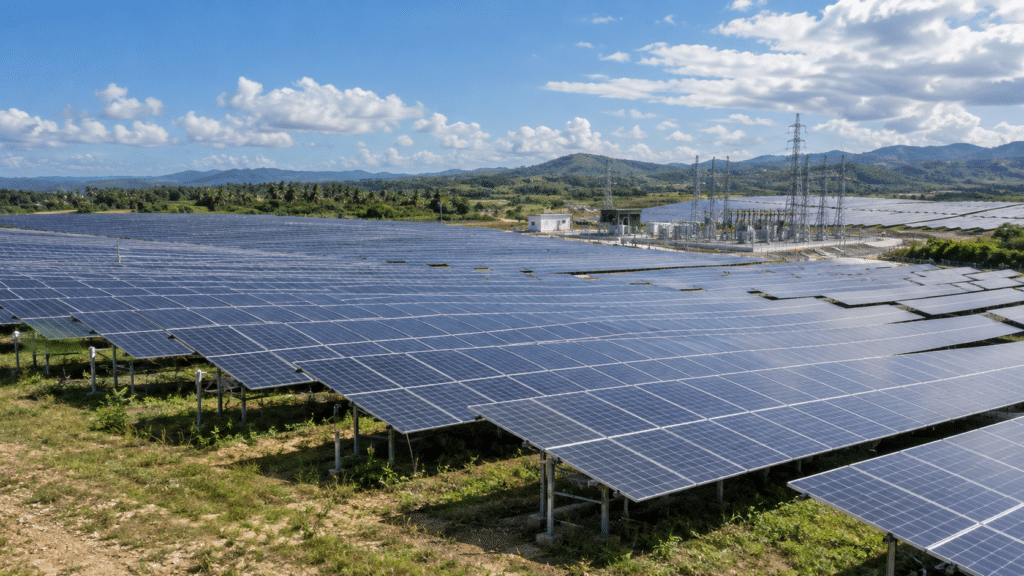
Solar photovoltaic generation is arguably the clearest renewable investment opportunity in the Dominican Republic. The country has strong solar irradiation across much of its territory, making utility-scale photovoltaic plants, commercial installations and distributed generation commercially relevant.
IRENA has identified solar resources as one of the country’s major renewable advantages. Its assessment found global horizontal irradiation of roughly 5–7 kWh per square meter per day across much of the Dominican Republic, with particularly favorable conditions for photovoltaic systems.
The country’s recent development confirms that this resource is being translated into actual investment. The CNE’s concession database contains numerous utility-scale solar projects in different provinces, illustrating the geographic expansion of photovoltaic development.
Utility-scale solar
Large solar farms offer investors the possibility of generating electricity at relatively predictable operating costs after construction. The Dominican market is particularly interesting for projects capable of securing long-term electricity contracts because predictable revenue can make it easier to finance capital-intensive infrastructure.
A notable example is Esperanza Renovable in Valverde province. The project combines 90 MW of Esperanza Solar 1, 60 MW of Esperanza Solar 2 and a 49.5 MW wind facility, creating a 200 MW renewable complex. The total investment reported for the development was US$246.5 million.
Hybrid projects are particularly significant because combining solar and wind can improve the generation profile compared with relying on a single intermittent resource. When combined with battery storage, the investment case can become even stronger by allowing developers to shift electricity production toward periods of greater system demand.
Commercial and distributed solar
Another opportunity exists below the utility scale. Hotels, factories, warehouses, supermarkets, office buildings and other commercial facilities can use solar generation to reduce their dependence on electricity purchased from the distribution system.
The Dominican Republic’s distributed-generation market is supported by a regulatory framework that allows qualifying customers to interconnect renewable systems with the distribution network. A new regulation approved by the Superintendence of Electricity (SIE) in 2026 shortened the maximum approval period for applications to 45 days and introduced a mechanism for 100% annual compensation of accumulated excess energy under the applicable scheme.
For investors, this creates opportunities not only in owning solar assets but also in engineering, procurement and construction, financing, operations and maintenance, energy management and commercial solar-as-a-service models.
Wind Energy: Established Technology With Selective Opportunities
Wind power has a longer operating history in the Dominican Republic than utility-scale solar. Projects such as Los Cocos, Larimar, Los Guzmancito and other developments have established wind generation as part of the national electricity mix, while the CNE continues to list additional wind projects under its concession system.
The country’s strongest wind resources are concentrated geographically, meaning that site selection is more critical than in the case of solar. Developers must evaluate long-term wind measurements, turbine logistics, land rights, environmental considerations and proximity to transmission infrastructure before committing significant capital.
Wind projects can nevertheless offer attractive characteristics where resource quality and grid access are favorable. Their generation profile can also complement solar because wind production does not necessarily follow the same daily pattern as photovoltaic generation.
The main investment challenge is that not every location with technically adequate wind will be commercially attractive. Transmission congestion, construction logistics and the cost of connecting a remote project to the grid can materially change project economics.
Hydropower: A Strategic but More Site-Specific Opportunity
Hydropower remains an important component of the Dominican Republic’s renewable electricity system. Unlike solar and wind, hydroelectric generation can provide electricity with a different operating profile and, depending on the project, valuable system flexibility.
ProDominicana has previously identified significant undeveloped hydroelectric potential in the country, although estimates of theoretical potential should not be interpreted as economically developable capacity. Hydropower projects depend on water availability, environmental constraints, topography, infrastructure and the economics of civil construction.
For investors, this makes hydropower a more selective opportunity than solar. Projects with favorable existing infrastructure, reliable hydrological conditions and manageable environmental requirements can be attractive, while new large-scale developments can require lengthy development periods and substantial upfront capital.
Pumped storage
One of the most strategically interesting developments is the emergence of pumped-storage hydropower as a way to support a renewable-heavy electricity system. The government has announced plans for the country’s first pumped-storage project in Sabaneta, San Juan province, with a planned capacity of 250 MW.
Although pumped storage is not equivalent to conventional renewable generation, it can become increasingly valuable as solar and wind penetration rises because it allows electricity to be stored and dispatched when needed.
Biomass, Biogas and Waste-to-Energy
Biomass represents a smaller but potentially important segment of the Dominican renewable energy market. The country’s agricultural economy provides potential feedstocks, particularly from sugar production and agricultural residues.
The CNE’s project database includes biomass and biogas initiatives, including a 7 MW renewable-energy project associated with the Ingenio Barahona sugar operation, a 5 MW biogas project in Monte Plata and a 10 MW biodigester project in Espaillat province.
The investment case for biomass differs from solar and wind because the availability and cost of feedstock become central to profitability. A biomass plant is not simply an electricity-generation asset; it is also dependent on a reliable supply chain.
This can create opportunities where investors can integrate energy generation with agricultural or industrial operations. Sugar mills, food-processing companies, livestock operations and waste-management businesses may be able to convert residues into energy while reducing disposal costs.
Waste-to-energy and biogas projects can also provide an additional revenue or cost-saving component because they address waste-management problems as well as electricity generation. However, investors must carefully assess feedstock contracts, collection logistics, technology performance and environmental permits.
Battery Storage Is Becoming a Major Investment Theme
Battery storage is changing the economics of renewable energy in the Dominican Republic. As solar and wind penetration increases, the value of generation increasingly depends on when electricity can be delivered rather than simply how many megawatt-hours a plant produces.
The shift became particularly visible with the country’s first major renewable-energy procurement process incorporating battery storage. In 2025, the government launched a public tender for up to 600 MW of new renewable generation through long-term contracts, with battery energy storage included as a requirement for participating projects.
The regulatory framework has also evolved. The SIE issued technical requirements for variable renewable-energy projects incorporating battery storage systems, creating a clearer framework for developers combining generation and storage.
This creates several potential investment models: solar-plus-storage plants, wind-plus-storage projects, standalone batteries, commercial storage systems and grid-support services.
The Regulatory Framework for Renewable Energy Investment
The central piece of legislation is Law 57-07 on Incentives for the Development of Renewable Energy Sources and their Special Regimes, together with its implementing regulations and subsequent amendments.
The framework provides incentives for renewable-energy development and establishes procedures for projects seeking to operate under the special renewable-energy regime. In 2026, the CNE approved new procedural manuals specifically for solar photovoltaic and wind-generation concessions, covering requirements from provisional concession applications through definitive concessions and access to the applicable incentives.
This is important for investors because regulatory clarity affects development timelines, financing and risk allocation. A project that can demonstrate a clear permitting pathway is generally easier to evaluate than one dependent on uncertain administrative procedures.
Tax Incentives for Renewable Energy Projects
The renewable-energy framework provides several fiscal incentives. The CNE currently administers procedures for a 100% exemption from import taxes on qualifying renewable-energy equipment covered by Law 57-07, as well as a 100% ITBIS exemption for qualifying equipment purchased locally.
For qualifying self-generation projects, the CNE also describes a tax credit of up to 40% of the investment in eligible equipment as a one-time income-tax credit.
Investors should distinguish carefully between incentives available to self-producers and those applicable to utility-scale generation projects. The treatment can depend on the project’s legal structure, technology, equipment, approvals and applicable regulatory regime.
Older descriptions of Law 57-07 sometimes refer to incentives that have since been modified, expired or been affected by subsequent legislation. A serious investment analysis should therefore rely on the current CNE procedures and applicable regulations rather than assuming that every incentive described in older investment guides remains unchanged.
Long-Term Power Purchase Agreements
For utility-scale projects, the commercial structure of electricity sales can be more important than the tax incentive package.
Long-term power purchase agreements, or PPAs, can provide revenue visibility over many years and make projects more financeable. The Dominican Republic has been moving toward competitive procurement for new renewable generation, including the 600 MW tender initiated in 2025.
Competitive procurement can improve price transparency and reduce the risk that projects depend entirely on individually negotiated commercial arrangements. For investors, however, a lower contracted electricity price can also reduce returns, making construction cost, financing terms and capacity factor critical.
The key question is therefore not simply whether a project has a PPA. Investors should examine the tariff, contract duration, indexation, curtailment provisions, payment security, termination provisions, change-in-law protection and the creditworthiness of the contractual counterparties.
Foreign Investment in Dominican Renewable Energy
Foreign investors can participate directly in the Dominican energy market. Under the country’s foreign-investment framework, ProDominicana states that foreign investors receive national treatment and that foreign investment is generally open across economic sectors, subject to sector-specific permits and restrictions established by law.
The framework also provides mechanisms for registering foreign investment and allows the repatriation of investment proceeds under the applicable rules.
Foreign capital is already significant in the energy sector. ProDominicana’s investment guide reports that foreign direct investment in energy totaled approximately US$4.11 billion between 2015 and 2024, representing about 13% of total FDI attracted by the Dominican Republic during that period.
The investment environment is therefore not limited to domestic developers. International utilities, infrastructure funds, renewable-energy companies, financial institutions and strategic investors can participate through project development, acquisitions, joint ventures, project finance or direct ownership.
Where Renewable Energy Investment May Be Most Attractive
| Technology | Main opportunity | Key advantage | Main risk |
|---|---|---|---|
| Solar PV | Utility-scale, commercial and distributed generation | Strong solar resource and scalable deployment | Grid congestion, land and merchant-price exposure |
| Wind | Large-scale projects in high-resource areas | Established technology and operating experience | Site-specific resource and transmission constraints |
| Hydropower | Existing and selected new hydro projects | Potential for dispatchable renewable generation | High development cost and environmental constraints |
| Biomass and biogas | Agricultural, industrial and waste-related projects | Can combine energy production with waste management | Feedstock availability and logistics |
| Battery storage | Solar-plus-storage, wind-plus-storage and grid services | Improves flexibility and dispatchability | Capital cost, degradation and evolving market rules |
The Importance of Transmission Infrastructure
One of the most important lessons for renewable-energy investors is that a strong solar or wind resource does not automatically make a project viable.
The location of the project relative to the electricity grid can determine how much it costs to connect, whether the system can accept additional generation and whether electricity can be delivered during periods of high production.
The CNE has warned that some areas, particularly in the northwest, are experiencing high levels of transmission-network occupation. Future renewable projects in those areas may therefore depend on transmission expansion or alternative technical solutions.

This makes grid studies essential during the earliest stage of project development. Investors should evaluate available transmission capacity before acquiring land or committing substantial development capital.
What Determines Renewable Energy Project Profitability?
There is no single return profile for renewable energy investment in the Dominican Republic. Two solar projects with similar installed capacity can have very different economics depending on their location, financing, electricity contract and interconnection costs.
1. Solar or wind resource
The quality and consistency of the renewable resource directly affect annual electricity production. A higher-capacity-factor project can generate more revenue from the same installed capacity.
2. Construction cost
Equipment prices, transportation, civil works, labor, interconnection infrastructure and financing during construction all affect the initial investment. Island logistics can be particularly relevant because major equipment must be imported.
3. Cost of capital
Renewable projects require significant upfront investment and generate revenue over many years. Interest rates, debt terms, currency exposure and the availability of long-term project finance can therefore have a substantial impact on returns.
4. Electricity price and contract structure
A predictable long-term PPA can reduce revenue risk, while merchant exposure can potentially increase returns but also increases volatility. Investors must analyze the balance between contracted and market-based revenue.
5. Grid connection
Connection costs and transmission constraints can turn an apparently attractive project into an expensive one. Grid availability should be treated as a core investment criterion rather than a technical detail to be addressed later.
6. Battery requirements
As the electricity system incorporates more intermittent generation, storage may become increasingly important. Batteries can increase capital expenditure but may also improve the value and flexibility of renewable generation.
7. Land and permitting
Land ownership, zoning, environmental authorization, construction permits and concession procedures can affect both development time and total project cost. Delays are particularly important because capital tied up during development does not yet generate electricity revenue.
Key Risks for Renewable Energy Investors
The Dominican Republic offers substantial renewable-energy potential, but investors should not interpret strong policy support as an absence of risk.
Regulatory risk includes changes to electricity-market rules, distributed-generation compensation, concession procedures and technical requirements. The 2026 regulatory changes demonstrate that the framework continues to evolve as renewable penetration increases.
Grid risk is increasingly important as renewable capacity grows. A project can have excellent generation economics but still face constraints if the local transmission network cannot accommodate additional power.
Currency risk should also be considered. Project costs can be denominated partly in U.S. dollars while some revenues or operating expenses may be exposed to the Dominican peso. The degree of currency mismatch depends on the project structure and contractual arrangements.
Construction and supply-chain risk can affect imported equipment, shipping, installation and commissioning. Investors should therefore assess equipment warranties, supplier quality, spare parts and long-term maintenance arrangements.
Finally, off-taker risk matters. A long-term electricity contract reduces revenue uncertainty only to the extent that the contractual counterparty is financially capable of meeting its obligations.
How Investors Can Evaluate a Renewable Energy Project
A disciplined investment assessment should begin before land acquisition and should integrate technical, legal, financial and commercial analysis.
- Confirm the renewable resource. Use long-term solar irradiation, wind or hydrological data and validate the resource through appropriate technical studies.
- Evaluate the grid. Determine the nearest viable interconnection point and assess available transmission capacity.
- Review land rights. Confirm ownership, leases, access roads, easements and potential competing claims.
- Map the permitting process. Identify concession, environmental, construction and interconnection requirements.
- Determine the revenue model. Compare long-term PPAs, competitive procurement and other legally available electricity-sale structures.
- Model financing. Test different debt levels, interest rates, currency assumptions and construction periods.
- Stress-test the project. Examine lower-than-expected generation, higher construction costs, delays, curtailment and changes in operating expenses.
- Assess the exit strategy. Determine whether the project could eventually be sold to an infrastructure fund, utility, strategic investor or other long-term asset owner.
The Investment Outlook
The Dominican Republic’s renewable-energy market is moving from an early expansion phase toward a more sophisticated power system in which generation, storage, transmission and electricity-market design must develop together.
Solar is likely to remain the largest source of new renewable capacity because of the country’s strong resource and the scalability of photovoltaic technology. Wind remains important where high-quality sites and grid access coincide. Hydropower provides strategic value because of its different generation characteristics, while biomass and biogas can serve more specialized agricultural, industrial and waste-management applications.
The next stage of development is likely to place greater emphasis on energy storage and grid flexibility. The government’s 600 MW renewable procurement process, which incorporates battery storage, illustrates how the market is adapting to increasing solar and wind penetration.
For investors, the strongest opportunities are therefore unlikely to be defined by technology alone. The projects with the best risk-adjusted prospects will tend to be those that combine a strong renewable resource with secure land rights, adequate transmission capacity, competitive construction costs, reliable counterparties, appropriate financing and a clear regulatory pathway.