 23°C
23°C

Exporting From the Dominican Republic: What Businesses Need to Know
Exporting goods from the Dominican Republic requires more than preparing a shipment: the exporter must coordinate commercial documents, product-specific requirements, customs declarations, transport and the rules of the destination market. The Dominican Republic’s official export guidance identifies the commercial invoice, packing list, export declaration, certificate of origin, transport document and, where applicable, agricultural or other special certificates as key elements of the process.


For a Dominican company, exporting begins before the goods reach a port or airport. The business must first establish that the product can legally enter the destination market, prepare the merchandise and its documentation, arrange international transport, complete the Dominican customs process and make sure the buyer receives the shipment under the agreed commercial terms.
The process is not identical for every product. Requirements can vary according to the nature of the merchandise, its tariff classification, the destination country and whether the shipment is subject to sanitary, phytosanitary, technical, licensing or other controls. Exporters should therefore treat customs clearance in the Dominican Republic and import requirements in the destination country as two related but separate processes. ProDominicana, the Dominican Republic’s government trade and investment promotion agency, notes that export requirements depend on the characteristics of the product and the market to which it is being sent.
What an Exporter Needs Before Shipping
A company preparing its first international shipment should establish its commercial, tax and operational foundations before booking transport. ProDominicana’s export guidance includes the commercial name, Mercantile Registry and National Taxpayer Registry among the basic steps for businesses entering the export process. Its official guidance also lists the commercial invoice, packing list, exporter registration, DUA, certificate of origin, applicable agricultural requirements, transport document and inspection as elements of the export process. ProDominicana’s export process guide provides the official sequence of these steps.
There is an important distinction between being prepared to export and holding a general export license. ProDominicana states that a general export license is not required because the former licensing requirement was repealed by Decree 377-92. This does not mean that every product can be exported without additional authorization: merchandise subject to special controls can require certificates, permits or approvals from the relevant Dominican authority.
Check the Product and Destination Requirements First
The most expensive export problems often arise when a company prepares the shipment before determining what the destination country requires. The exporter should identify the product’s tariff classification, applicable Dominican controls and the import conditions imposed by the buyer’s country.
This review is particularly important for food, agricultural products, plants, animals, pharmaceuticals, chemicals, cosmetics and other regulated merchandise. Depending on the product and destination, the shipment may require sanitary, phytosanitary, health, quality, origin or other documentation. ProDominicana identifies compliance with special agricultural requirements as part of the export process and lists a phytosanitary certificate among the basic documents that may apply.
The buyer should also confirm the destination country’s import requirements before the goods leave the Dominican Republic. A shipment can be correctly cleared for export in the Dominican Republic and still be delayed or rejected at destination if it does not meet the importing country’s rules.
Prepare the Merchandise for International Transport
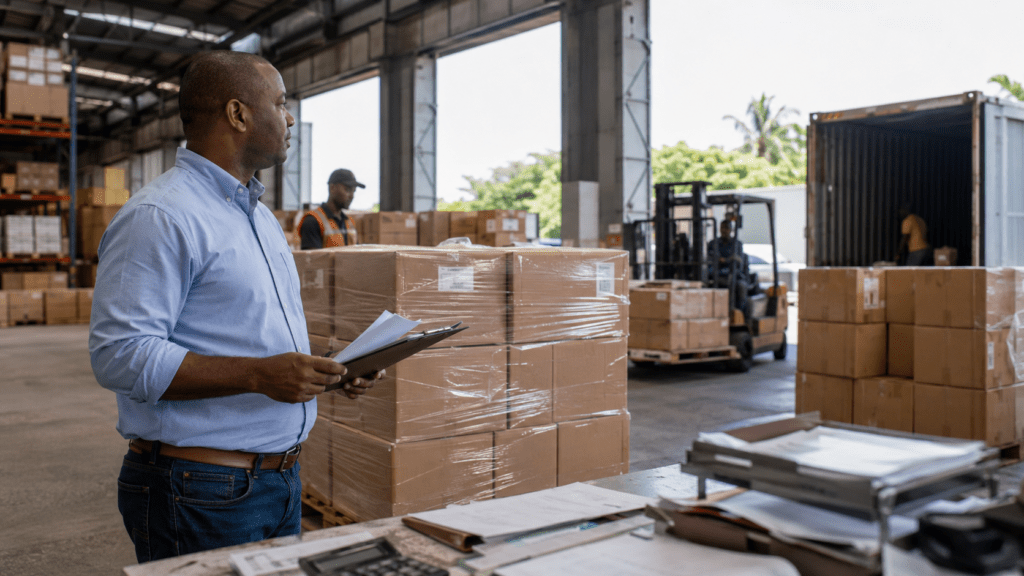
Export preparation starts with the physical condition of the goods. The exporter should verify quantities, product descriptions, packaging, labeling, weights and dimensions against the commercial documents before the cargo is handed to the carrier.
Packaging must protect the merchandise during handling, storage and international transportation. The appropriate method depends on whether the cargo is transported by sea, air, courier or another mode. Fragile, perishable, temperature-sensitive or hazardous goods can require additional packaging, handling instructions or specialized transportation.
Labels also deserve attention. The Dominican export process is only one part of the compliance chain. The destination country may impose requirements concerning language, ingredients, nutritional information, country of origin, safety warnings, measurements, lot numbers, expiration dates or other product information.
The packing list should correspond to the actual shipment. It normally provides practical information about packages, quantities, weights and dimensions, allowing carriers, customs authorities and the buyer to identify the cargo. Discrepancies between the packing list, invoice and physical shipment can create avoidable delays.
Prepare the Commercial Invoice
The commercial invoice is one of the core documents used in an international shipment. It identifies the seller and buyer and describes the transaction and merchandise. The information should be consistent with the customs declaration and transport documents.
At a minimum, an exporter should ensure that the invoice accurately reflects the parties to the transaction, product descriptions, quantities, prices, currency and agreed commercial terms. The precise information required can depend on the shipment and destination.
Descriptions should be specific enough to identify the goods rather than relying on vague terms such as “products” or “samples.” Accurate descriptions also help support the correct tariff classification and customs processing.
Complete the Dominican Export Declaration
The Declaración Única Aduanera (DUA) is the electronic customs declaration used to provide information about imports and exports in the Dominican Republic. The Dirección General de Aduanas (DGA), the country’s customs authority, states that the DUA is submitted electronically through its customs management system, SIGA.
The export declaration contains information concerning the exporter, buyer, merchandise, transport and shipment. DGA’s export documentation also shows fields for the port of departure, destination country, carrier, voyage or flight and transport mode, illustrating why the customs declaration must be coordinated with the logistics information for the shipment.
For exporters, accuracy is critical. Product descriptions, quantities, values, tariff classifications, packages and transport information should agree with the supporting documents. Errors may require corrections and can delay the release of the cargo.
DGA publishes instructions for completing export declarations and continues to update its online customs documentation. Exporters should consult the latest DGA instructions rather than relying exclusively on older screenshots or third-party explanations.
Use the Ventanilla Única When Special Authorizations Apply
The Dominican Republic’s Ventanilla Única de Comercio Exterior (VUCE) provides an electronic mechanism for processing certain permits and authorizations associated with foreign trade. The applicable process depends on the product, export regime and government agency involved.
For regulated merchandise, the exporter may need to submit supporting documents or certificates through the appropriate electronic process before the shipment can proceed. DGA documentation describes VUCE procedures in which exporters or customs agents submit authorization requests and attach supporting files.
The practical lesson is simple: do not wait until the cargo is already at the port or airport to discover that a special authorization is required. Product-specific requirements should be identified during the planning stage.
Certificate of Origin and Preferential Trade
A certificate of origin establishes the origin of merchandise for purposes defined by the applicable trade regime or destination-country rules. It is not automatically the same thing as a general export document for every shipment.
Its importance increases when the Dominican Republic has a trade agreement or preferential arrangement with the destination market and the buyer wants to claim reduced or preferential customs treatment. The exporter must satisfy the applicable rules of origin and use the documentation required under the relevant agreement.
DGA documentation, for example, describes the use of the EUR.1 movement certificate in circumstances where goods qualify for preferential treatment under the relevant agreement with the European Union.
Exporters should therefore distinguish between proving that goods are being exported from the Dominican Republic and proving that those goods qualify as originating goods under a particular trade agreement. The second question can involve detailed rules concerning where materials were obtained and how the product was manufactured.
Choose the Transport Method
The main international transport decision is generally between ocean and air freight, although courier and other logistics services may be appropriate for smaller shipments.
Ocean Freight
Sea transport is commonly used for larger or heavier consignments because it can accommodate substantial cargo volumes. It normally involves a longer transit time than air freight and requires coordination among the exporter, freight forwarder, carrier, port, customs authorities and buyer.
Air Freight
Air transport is generally suited to shipments where speed is more important or where the cargo’s size and value make air freight practical. The transport document is normally an Air Waybill (AWB).
Courier and Small Shipments
Courier services can be useful for samples and smaller commercial consignments. However, exporters should not assume that a courier shipment eliminates customs obligations. The treatment of commercial courier shipments depends on the applicable rules, value and nature of the merchandise.
For conventional international exports, ProDominicana identifies the transport document—such as a bill of lading or air waybill—as part of the core export documentation. DGA likewise identifies the bill of lading or air waybill among the documents used to support the customs declaration.
Coordinate With a Freight Forwarder and Customs Agent
An exporter does not necessarily have to manage every logistical or customs task internally. Freight forwarders can coordinate transportation and related logistics, while customs agents can assist with customs procedures where their services are used.
The important point is to establish responsibilities before shipment. The exporter should know who is preparing the DUA, who is booking the vessel or aircraft, who is delivering the cargo to the port or airport, who is providing the final transport document and who will communicate with the buyer.
This becomes particularly important when the sale uses an Incoterm. The agreed Incoterm allocates defined responsibilities between seller and buyer for transportation, costs, risk and certain customs-related obligations. It should therefore be agreed before the shipment is booked, not after the cargo is already moving.
Present the Cargo to Dominican Customs
Once the goods, documents and transport arrangements are ready, the shipment moves into the Dominican export clearance process. The exporter or its authorized representative submits the relevant declaration and supporting documentation through the applicable customs system.
DGA identifies the commercial invoice and the bill of lading or air waybill as documents required for the DUA process. Additional documents may be necessary depending on the merchandise, destination or applicable authorization.
Customs may review the declaration and documentation and may subject the shipment to inspection. ProDominicana’s export process specifically includes inspection as one of the stages to consider. The exporter should therefore ensure that the physical cargo matches the declared information and that the documents can be produced promptly when requested.
Understand the Particularities of the Exit Process
Export customs clearance differs from import clearance because the Dominican customs process is focused on the lawful departure of merchandise from the country. The declaration identifies the destination and the means of transport, while customs controls the cargo and documentation before or in connection with its departure.
This makes timing particularly important. The exporter must coordinate the customs declaration with the carrier’s operational deadlines. A shipment that arrives at a port or airport without the required documentation may miss a vessel, flight or cargo receiving deadline even if the commercial transaction itself is ready.
DGA’s published export-declaration documentation includes fields for the port of departure, destination country, transport company, voyage or flight and transport mode.
For that reason, the export process should be viewed as a chain rather than a single customs transaction: product compliance → documentation → customs declaration → inspection or authorization when applicable → carrier acceptance → departure → destination-country import clearance → delivery.
After Dominican Customs Clearance
Once the shipment has completed the required Dominican export procedures and is accepted for international transport, the exporter should retain the final documentation and monitor the shipment until it reaches the buyer or the agreed destination point.
The carrier or freight forwarder normally provides shipment information that allows the parties to follow the cargo. For sea shipments, the bill of lading provides the principal transport-document framework; for air shipments, the air waybill serves that function.
The exporter should also provide the buyer with the documents needed for destination-country customs clearance. Depending on the product and market, these can include the commercial invoice, packing list, transport document, certificate of origin and product-specific certificates or permits.
Destination Customs and Delivery to the Buyer
Leaving the Dominican Republic does not mean the shipment has completed international customs clearance. The destination country’s customs authority applies its own import rules, which can include tariffs, taxes, product standards, licenses, sanitary controls and documentary requirements.
Responsibility for these procedures depends partly on the sales contract and agreed Incoterm. The exporter should make sure the buyer understands which documents will be supplied by the Dominican seller and which import procedures must be handled by the buyer or its customs representative.
Once destination customs requirements have been satisfied and any applicable charges have been paid, the goods can proceed to final delivery. The transaction is operationally complete when the merchandise reaches the delivery point defined by the commercial agreement and the parties have the documentation needed to close the shipment.
Basic Export Documents
The precise document set depends on the product and destination, but the Dominican authorities identify several documents that commonly form part of an export operation.
| Document | Purpose | When It Matters |
|---|---|---|
| Commercial invoice | Documents the international sale and identifies the goods and transaction. | Core document for commercial and customs processing. |
| Packing list | Details packages, quantities, weights and related shipment information. | Useful for cargo handling, customs and buyer receiving. |
| DUA | Provides the customs declaration for the export. | Required for the applicable customs export process. |
| Bill of lading or air waybill | Documents the international carriage of the goods. | Used according to the transport mode. |
| Certificate of origin | Documents origin when required by the destination or applicable trade regime. | Especially important when preferential tariff treatment is claimed. |
| Phytosanitary or other special certificate | Demonstrates compliance with specific regulatory requirements. | Applies to products subject to agricultural, sanitary or other controls. |
ProDominicana lists the commercial invoice, export declaration, certificate of origin, bill of lading or air waybill and phytosanitary certificate among basic export documents, while emphasizing that requirements vary according to the product and destination.
Common Export Mistakes
Preparing the Cargo Before Checking Destination Rules
An exporter may correctly complete the Dominican side of the transaction while overlooking an import requirement in the buyer’s country. The solution is to confirm destination requirements before production, packaging and shipment.
Using Inconsistent Product Descriptions
The description on the invoice, packing list and customs declaration should describe the same merchandise. Inconsistencies can create questions during customs processing and make it harder to establish the correct classification.

Leaving Special Certificates Until the Last Minute
Certificates involving agricultural, sanitary or other regulated products can require coordination with government agencies. Waiting until the cargo is already scheduled for departure can create avoidable delays.
Ignoring Carrier Cut-Off Times
Customs clearance and transportation operate on linked schedules. Missing a cargo-receiving deadline can result in a shipment remaining at the facility or being moved to a later sailing or flight.
Confusing Export Clearance With Import Clearance
A shipment can leave the Dominican Republic legally and still face problems when it arrives abroad. Exporters and buyers should treat destination customs compliance as a separate stage of the transaction.
A Practical Export Sequence
For a standard commercial shipment, the process can be organized into the following sequence:
- Confirm that the product can be exported and identify any Dominican permits or certificates that apply.
- Confirm the destination country’s import requirements with the buyer or its customs representative.
- Classify the merchandise correctly and establish the applicable commercial terms.
- Prepare and package the goods according to transport and destination requirements.
- Prepare the commercial invoice and packing list.
- Obtain any required certificates of origin, phytosanitary certificates or other special documents.
- Arrange the transport booking and establish the carrier’s cargo cut-off date.
- Prepare and submit the applicable DUA and supporting documents through the Dominican customs system.
- Complete any inspection or authorization process required for the shipment.
- Deliver the cargo to the port, airport or other agreed export facility.
- Obtain the final transport documentation and provide the buyer with the documents required for destination clearance.
- Monitor the shipment through arrival, import clearance and final delivery.
The exact sequence can change for special regimes, regulated products, free-zone operations, courier shipments and other forms of international trade. DGA and ProDominicana publish specific guidance for different export situations.
How to Make the Process More Reliable
The most effective approach is to create an internal export file for every shipment. It should contain the purchase or sales agreement, invoice, packing list, customs declaration, transport information and every certificate or authorization associated with the product.
Before the goods leave the warehouse, the exporter should perform a final reconciliation of the physical shipment against the documents. Quantities, package counts, weights, product descriptions and destination information should agree.
It is also useful to establish a clear communication chain between the exporter, buyer, freight forwarder, customs agent, carrier and any government authority involved. A single discrepancy can affect several stages of the shipment, so resolving questions before cargo delivery is generally easier than correcting them after departure.
For official guidance, exporters can consult ProDominicana’s export process guide, its export documentation resources, and the Dirección General de Aduanas. DGA also maintains current instructions and legal materials for customs procedures.