 25°C
25°C

How the Tourism Industry Works in the Dominican Republic
The tourism industry in the Dominican Republic is not a single business but a network of interconnected companies, workers, infrastructure providers and public institutions. A visitor may buy a flight from an international airline, stay at a resort, use an airport transfer, book excursions through a tour operator, eat at restaurants, shop locally or arrive by cruise ship. Each transaction sends part of the visitor's spending to a different business, while those businesses create further demand for labor, food, transportation, construction, finance, utilities and other services. Understanding this chain explains why tourism has effects far beyond hotel revenues and why the way tourists spend their money matters to the wider Dominican economy.


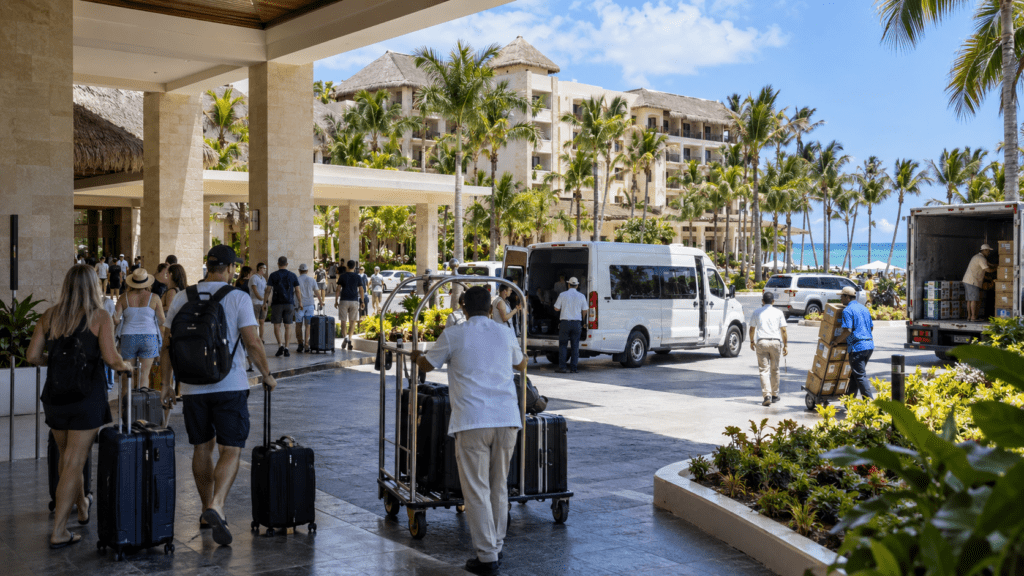
Tourism in the Dominican Republic is best understood as an economic chain rather than a single industry. The visitor is the final source of demand, but the money generated by that visitor can pass through airlines, airports, hotels, tour operators, travel agencies, restaurants, transportation companies, cruise operators, entertainment businesses, retailers, farmers, manufacturers, financial institutions and many other suppliers.
The Dominican Republic has developed a large tourism economy centered particularly on beach destinations and resort tourism, while also maintaining urban, cultural, cruise, nature, business and other forms of travel. The country’s tourism statistics system separately tracks air arrivals, maritime arrivals, hotel activity, air traffic, tourist spending and other indicators, reflecting how many different parts of the economy are involved in the sector.
What Makes Tourism an Economic Industry?
Tourism is an export activity even though the product is consumed inside the country. Instead of shipping a physical product abroad, the Dominican Republic attracts foreign visitors who bring or spend foreign currency while consuming accommodation, transportation, food, entertainment and other services locally.
This distinction is important. A hotel room sold to an international visitor, a taxi ride from an airport, a restaurant meal, or an excursion purchased during a vacation can all represent economic activity generated by demand from outside the country. The Central Bank of the Dominican Republic therefore tracks tourism spending and tourism foreign-exchange earnings alongside visitor arrivals and hotel indicators.
The scale is substantial. In 2023, the country received about eight million visitors and tourism receipts reached approximately US$9.8 billion, according to World Bank analysis based on Dominican Central Bank data. The same analysis reported more than 424,000 tourism-related jobs in 2023. These figures illustrate why tourism affects sectors far beyond hotels and restaurants.
How Money Moves Through the Dominican Tourism Chain
A simple way to understand the system is to follow a hypothetical international visitor from the decision to travel to the end of the trip. The exact distribution varies according to the type of traveler, destination, booking method and services purchased, but the economic sequence is broadly similar.
| Stage | Main participants | How money enters the chain |
|---|---|---|
| Travel planning | Travel agencies, online booking platforms, tour operators | The visitor purchases or reserves travel products and services. |
| International transport | Airlines and cruise lines | Part of the travel payment goes to transportation providers. |
| Gateway | Airports, ports and related service companies | Passenger traffic creates demand for airport, port and ground services. |
| Accommodation | Hotels, resorts, villas and other lodging businesses | Visitors pay for rooms, packages and related services. |
| Local mobility | Taxis, buses, private transfers, rental companies and drivers | Visitors pay to move between airports, hotels and attractions. |
| Experiences | Tour operators, guides, excursion companies and activity providers | Visitors purchase excursions, tours and recreational activities. |
| Consumption | Restaurants, shops, entertainment venues and local businesses | Additional spending takes place outside the accommodation provider. |
| Suppliers | Farmers, food processors, distributors, contractors and service providers | Tourism businesses purchase inputs required to operate. |
The important point is that the visitor’s original payment does not necessarily remain with the company that first receives it. A hotel, for example, uses revenue to pay employees, purchase food and beverages, contract maintenance, consume electricity and water, buy equipment, pay financial and professional services, and meet taxes and other obligations. Those payments create additional rounds of economic activity.
The Role of Hotels and All-Inclusive Resorts
Hotels are one of the most visible parts of the Dominican tourism economy, particularly in destinations such as Punta Cana, Bávaro, Puerto Plata, La Romana, Bayahibe and other coastal areas. The country’s tourism intelligence system monitors hotel availability and occupancy by tourism zone, showing how accommodation performance is closely connected to visitor flows.
The hotel business has several revenue streams. The most obvious is accommodation, but properties can also earn from food and beverages, meetings, entertainment, spa services, excursions, retail operations and other activities. In an all-inclusive resort, many of these services are bundled into the price paid by the guest rather than purchased separately.
This model changes how tourist spending is distributed locally. A guest staying at an all-inclusive resort may spend much of the vacation budget inside the property. The resort can therefore capture a larger share of the visitor’s on-site consumption, while independent restaurants, shops and excursion providers may receive less spending from that particular traveler.
At the same time, an all-inclusive hotel still requires a large supply network. It needs food, beverages, furniture, cleaning products, maintenance, construction services, utilities, transportation, security, professional services and labor. Consequently, a resort can generate substantial economic activity outside its physical property even when guests make relatively few purchases in surrounding businesses.
Why Hotels Matter to Farmers, Manufacturers and Suppliers
The tourism supply chain extends backward from the hotel to businesses that visitors may never see. A resort restaurant needs meat, fish, fruit, vegetables, beverages and processed foods. Housekeeping departments need linens, cleaning products and amenities. Engineering departments need spare parts and technical services. Construction and renovation projects require materials, equipment and specialized contractors.
The degree to which these inputs are sourced domestically affects tourism’s local economic impact. When a hotel purchases from a Dominican producer, distributor or service provider, part of the tourist dollar remains within the domestic economy and can circulate through additional businesses. When a product is imported, the domestic economy still receives value from distribution, transportation, retailing or other local services, but the imported component represents a leakage of spending from the domestic production chain.
Older World Bank research on the Dominican tourism sector found significant local sourcing of food and nonalcoholic beverages among surveyed hotels, while also documenting imports of some alcoholic beverages, linens, towels, furniture and other inputs. The composition of hotel procurement can therefore determine how strongly tourism connects with domestic production.
Airlines: The First Major Link in Many Tourist Trips
For most international visitors, the tourism economy begins before they arrive in the Dominican Republic. Airlines connect the country with its source markets and determine how easily travelers can reach different destinations.
The Dominican Republic has multiple international airports serving different parts of the country. Official tourism information identifies eight international airports and emphasizes the importance of choosing an arrival gateway that matches the final destination because travel distances across the island can be significant.
The airline receives payment for the air journey, but the flight also generates demand for a much wider aviation ecosystem. Airports require ground handling, security, baggage services, maintenance, concessions, parking, transportation and other services. Passengers then move into the domestic tourism network through taxis, buses, rental cars, private transfers and other forms of transportation.
This makes air connectivity an economic input into tourism rather than simply a means of transportation. When flights increase, the potential customer base for hotels, restaurants, excursions and other tourism businesses increases as well.
Airports Turn Passenger Traffic Into Local Economic Activity
Airports function as gateways between international demand and the domestic tourism economy. They provide infrastructure through which visitors enter the country, but the economic effects extend beyond airport operations themselves.
A visitor arriving at an airport may immediately generate spending on transportation to a hotel. The hotel then receives accommodation revenue, while the visitor may later purchase excursions, meals, shopping and entertainment. Airport passenger volumes therefore provide an important indicator of the potential demand entering the tourism system.
The Dominican tourism authorities maintain separate statistical information on air arrivals, airport flows and flight activity. This allows the relationship between connectivity and tourism demand to be monitored at the national and destination levels.
Travel Agencies and Tour Operators Connect Supply With Demand
Travel agencies and tour operators occupy an intermediary position in the tourism chain. Their economic function is to connect travelers with hotels, airlines, excursions, transfers and other suppliers.
A traveler may purchase a package that combines flights, accommodation and transfers. In other cases, an agency may arrange only the hotel or a specific excursion. Tour operators can aggregate demand and negotiate or contract services from hotels, transportation providers and activity companies.
This intermediary role is particularly important for international tourism because the buyer and the supplier may be located in different countries. A foreign travel company can market the Dominican Republic to customers abroad while relying on Dominican hotels, receptive operators, guides and transportation companies to deliver the local part of the experience.
The Dominican Ministry of Tourism maintains a licensing system covering travel agencies, tour operators, hotels, restaurants, guides, adventure tourism and other tourism-related businesses. This illustrates the breadth of the formal tourism supply chain.
Ground Transportation Connects the Different Parts of the Economy
Transportation is the physical link between tourism businesses. Visitors need to move from airports to hotels, from hotels to restaurants or attractions, and between different destinations.
The sector includes taxis, private transfer companies, buses, rental cars, chauffeurs, excursion vehicles and other transportation providers. Each service creates direct income for operators and workers while also supporting the wider tourism product.
Transportation spending can also influence where tourism revenue goes geographically. A visitor who travels beyond a resort area may generate economic activity in several communities rather than concentrating spending at the accommodation property and its immediate surroundings.
Restaurants and Food Businesses Capture Spending Outside Hotels
Restaurants are one of the clearest examples of tourism’s relationship with the wider economy. Visitors who stay in hotels without all-inclusive packages may purchase meals throughout their trip, while even resort guests may dine outside their accommodation when exploring a destination.
Restaurant spending can reach farmers, fishermen, food processors, wholesalers, beverage companies, transport providers and workers. The economic effect therefore depends not only on how much a visitor spends, but also on the origin of the inputs used to provide the meal.
The same principle applies to bars, bakeries, supermarkets, specialty food businesses and other establishments serving tourists. Tourism creates demand for their products when visitors spend money outside the hotel environment.
Cruise Tourism Works Differently From Resort Tourism
Cruise tourism creates a different spending pattern because the visitor’s accommodation, transportation between destinations and many meals are normally provided by the cruise ship. A cruise passenger arriving at a Dominican port therefore does not necessarily generate the same local spending pattern as a visitor who stays for several nights in a hotel.
The local economy can nevertheless benefit from cruise arrivals through port services, ground transportation, excursions, restaurants, shopping, entertainment and other activities. The distribution depends heavily on how long passengers remain ashore and which services they purchase.
The Dominican tourism statistics system tracks maritime arrivals separately and records cruise passengers and vessels by port. Official tourism data have identified major cruise gateways including Amber Cove, Taíno Bay, La Romana, Samaná and ports in Santo Domingo.
The Central Bank’s tourism statistics also include specific surveys of cruise passenger spending. This is important because the number of cruise passengers alone does not show how much economic value is generated locally; spending behavior and the services purchased in the destination matter as well.
Excursions and Experiences Increase Local Circulation
Excursions can distribute tourism revenue beyond the hotel zone. Depending on the destination, visitors may purchase boat trips, cultural tours, nature activities, adventure experiences, guided visits, water sports or other recreational services.
An excursion can involve several businesses at once. A tour operator may sell the activity, a transportation company may carry the visitor, a guide may provide interpretation, a restaurant may provide food, and local suppliers may provide fuel, equipment or other inputs.
This is one reason tourism should be viewed as a network. A single visitor transaction can generate income for several businesses that do not necessarily belong to the same company or even operate in the same sector.
Retail and Local Services Add Another Layer
Tourists also spend money on clothing, souvenirs, handicrafts, jewelry, personal services, entertainment and other goods. These purchases are especially relevant in destinations where visitors spend substantial time outside their hotels.
The local economic effect depends on the origin of the merchandise. A product made by a Dominican artisan can create income for the producer and potentially for local suppliers, transport companies and retailers. An imported product may still create local retail and distribution activity, but a larger portion of the underlying production value is generated abroad.
This distinction helps explain why tourism’s economic impact cannot be measured simply by adding up hotel sales. The composition of tourist spending and the domestic content of the goods and services purchased are equally important.
How Tourism Creates Jobs
Tourism employment exists at several levels. Hotels require front-desk employees, housekeepers, cooks, managers, maintenance workers and other staff. Airlines and airports require aviation and passenger-service workers. Tour operators need sales staff, guides and operations personnel. Restaurants, transportation companies, retailers and entertainment businesses create additional employment.
There are also indirect jobs among suppliers. A hotel that purchases food supports agricultural and food-processing activity. A restaurant that purchases local products supports producers and distributors. A construction project for a tourism property creates demand for contractors, engineers, materials and specialized labor.
The World Bank’s analysis of the Dominican Republic estimated that tourism supported more than 424,000 jobs in 2023. Such estimates demonstrate the distinction between direct tourism employment and the broader employment supported by tourism demand.
How Tourism Revenue Reaches the Government
Tourism also generates public-sector revenue through taxes, fees and other fiscal channels associated with economic activity. The exact tax burden varies according to the transaction and business involved.
The Central Bank publishes indicators for tourism-related fiscal revenues, while the Ministry of Tourism regulates and licenses many categories of tourism businesses. Public institutions also provide or oversee infrastructure, destination management, regulation, promotion and other functions required for the industry to operate.
Government revenue is therefore another destination for part of the economic value generated by tourism. Public spending can then support infrastructure and services that affect both visitors and residents, although the relationship between tourism revenues and specific public expenditures depends on fiscal policy and budget decisions.
Foreign Ownership and the Distribution of Tourism Income
The nationality of ownership can also matter when analyzing where tourism income ultimately goes. A tourism business operating in the Dominican Republic can employ local workers and purchase locally while also transferring part of its profits, financing costs or other payments to owners or suppliers abroad.
This does not mean that foreign-owned tourism businesses have no local economic effect. Their investment can create employment, demand for domestic suppliers, infrastructure and tax revenues. The relevant economic question is how much value is created domestically and how much of the resulting income ultimately remains in the country.
The same principle applies to international airlines, cruise companies, booking platforms and overseas travel intermediaries. A tourism transaction can involve businesses in several countries before the visitor ever arrives in the Dominican Republic.

The Difference Between Direct, Indirect and Induced Effects
Economists often distinguish between several layers of tourism’s economic impact.
- Direct effects: spending that goes directly to tourism businesses and services, such as hotels, restaurants, excursions and transportation.
- Indirect effects: economic activity generated when tourism businesses purchase goods and services from suppliers, such as food, maintenance, construction, utilities and professional services.
- Induced effects: additional economic activity created when workers and businesses receiving tourism-related income spend part of that income elsewhere in the economy.
These categories should not be confused with tourism revenue itself. Adding all three layers together produces a broader estimate of economic impact, but it is not equivalent to saying that every dollar spent by a tourist becomes a dollar of national income. Imports, profits paid abroad, taxes, savings, intermediate inputs and other factors affect the final domestic value created.
Why Local Linkages Matter
The strength of tourism’s economic impact depends partly on the connections between tourism businesses and domestic producers. The World Bank describes tourism as a sector that links international demand with local suppliers across hospitality, transport, food systems, cultural services and retail.
In the Dominican Republic, this question has particular importance because the country has developed a large resort sector. Historical studies have found substantial local sourcing in parts of the hotel supply chain, while also identifying imported inputs and limitations in productive linkages.
The result is that two hotels with similar revenues can have different domestic economic effects depending on their procurement, labor structure, ownership, imports and spending patterns.
Why All-Inclusive Tourism Can Have Mixed Economic Effects
The all-inclusive model has an important structural advantage: it gives hotels a predictable way to sell accommodation, food, beverages and activities as a package. It can support large properties, stable employment and substantial procurement.
Its limitation is that a visitor may have fewer reasons to spend money outside the resort. A traveler who purchases meals, drinks and entertainment inside the property has less of the vacation budget available for independent restaurants, retailers and other businesses.
This does not mean that all-inclusive tourism is economically isolated. Resorts still purchase large quantities of inputs and employ many workers. Rather, it means that the distribution of visitor spending differs from a model in which travelers purchase accommodation separately and consume a larger share of services throughout the destination.
A Simple Example of Tourism Spending
Consider a hypothetical visitor who spends US$2,000 on a Dominican Republic vacation. The amount is illustrative rather than a representation of an official spending pattern.
Part of the payment may go to an airline. Another part may go to an overseas travel agency, online intermediary or tour operator. The Dominican hotel then receives the portion allocated to accommodation and local services. From that revenue, the hotel pays employees, suppliers, utilities, contractors and other expenses.
The visitor may also pay for an airport transfer, an excursion, meals outside the hotel and local purchases. Those payments generate revenue for transportation companies, guides, restaurants, retailers and other businesses. Each business then purchases inputs and pays workers, creating further rounds of economic activity.
The example demonstrates why the economic value of tourism cannot be understood by looking only at the final hotel bill. The tourism economy is a chain of transactions connected by the visitor’s demand.
What Determines How Much Tourism Spending Stays in the Dominican Republic?
Several factors influence the domestic share of tourism value.
- Local procurement: greater use of Dominican agricultural products, food processing, manufacturing and services can increase domestic linkages.
- Visitor spending outside resorts: spending on independent restaurants, excursions, transportation and local businesses can spread demand across more companies and communities.
- Import dependence: imported goods and equipment can reduce the domestic production component of tourism spending.
- Ownership and profit flows: some income can ultimately accrue to owners or investors outside the country.
- Employment: wages paid to Dominican workers can circulate through the domestic economy when employees spend their income locally.
- Length and type of stay: a resort guest, a cruise passenger and an independent traveler can have very different spending patterns.
- Destination structure: tourism concentrated in a resort enclave distributes spending differently from tourism spread across several towns and attractions.
Why Tourism Infrastructure Matters
Tourism depends on infrastructure that visitors may barely notice. Airports, roads, ports, water systems, electricity, telecommunications, waste management and public spaces all contribute to the functioning of a destination.
Infrastructure also affects residents and businesses. A road connecting a tourism destination to an airport can reduce travel time for visitors while also improving access for local workers and suppliers. Likewise, utilities serving hotels can form part of the broader infrastructure used by surrounding communities.
The relationship can work in the opposite direction as well. Rapid tourism growth can increase pressure on roads, water, waste systems, housing and other services. The World Bank has noted that infrastructure and basic services in some communities surrounding Dominican tourism destinations have not always kept pace with sector growth.
Tourism Is Also an Investment Cycle
The tourism economy does not begin when the first guest checks into a hotel. It also includes investment in land, buildings, airports, ports, roads, utilities, restaurants, attractions and other assets.
Hotel construction creates demand for architects, engineers, contractors, construction workers, equipment suppliers and building materials. Once a property opens, the economic structure changes from an investment phase to an operating phase, with recurring demand for labor, supplies and services.
The Dominican Republic maintains a specific framework for tourism investment incentives, administered through the tourism development authorities. This demonstrates that tourism policy addresses not only visitor promotion but also the conditions under which tourism infrastructure and projects are developed.
How Tourism Risk Spreads Through the Economy
The same connections that allow tourism to generate broad economic benefits can transmit shocks through the economy. If international travel falls sharply, hotels can reduce occupancy, airlines can reduce capacity, transportation companies lose passengers, restaurants receive fewer customers and suppliers receive fewer orders.
Tourism is therefore sensitive to factors outside the control of individual Dominican businesses, including international economic conditions, airline connectivity, natural disasters, geopolitical events, health emergencies and changes in consumer behavior.
Diversification can reduce some of these risks. A tourism economy serving different source markets and offering several types of tourism products may not depend on a single visitor group or destination pattern. The Central Bank has highlighted market diversification as one factor contributing to the sector’s resilience in its analysis of tourism dynamics.
How the Tourism Industry Is Organized in Practice
The Dominican tourism system combines private companies, international businesses, local entrepreneurs and public institutions.
The Ministry of Tourism is responsible for important regulatory, promotional and administrative functions. Its tourism intelligence system collects and publishes information on air arrivals, maritime arrivals, hotel activity, spending and other indicators. The Ministry also operates licensing processes covering multiple categories of tourism businesses.
The Central Bank of the Dominican Republic produces official tourism statistics covering visitor flows, tourist expenditure, average stays, hotel occupancy, maritime arrivals and other economic indicators. These statistics provide the basis for understanding tourism not only as a travel activity but as part of the national economy.
Private businesses then provide the commercial infrastructure through which visitors consume the destination: airlines, airports, hotels, resorts, restaurants, travel agencies, tour operators, transportation companies, cruise lines, shops, attractions and suppliers.
Air Tourism and Cruise Tourism Create Different Economic Chains
| Characteristic | Air-based stay tourism | Cruise tourism |
|---|---|---|
| Accommodation | Usually provided by hotels, resorts or other lodging businesses in the destination. | Primarily provided aboard the cruise ship. |
| Meals | May be purchased from hotels and independent restaurants. | Many meals are provided aboard the vessel. |
| Local transportation | Often includes airport transfers and destination transportation. | Typically centers on movement between port, attractions and shopping areas. |
| Excursions | Can occur throughout a multi-day stay. | Often concentrated during the passenger’s time ashore. |
| Hotel demand | Directly supports accommodation capacity. | Generally much less direct hotel demand per passenger. |
| Local spending pattern | Can be distributed across accommodation, food, transport, entertainment and retail. | Depends strongly on purchases made during the port visit. |
Neither model should be measured simply by counting arrivals. A tourist who stays several nights and spends across many categories can create a different economic footprint from a cruise passenger who spends several hours ashore. This is why official tourism statistics separately monitor air and maritime activity and collect information on tourist and cruise passenger expenditure.
Why Tourist Spending Matters More Than Tourist Arrivals Alone
Visitor numbers are an important indicator, but they do not tell the whole economic story. Two destinations can receive the same number of tourists and generate different amounts of domestic economic activity if visitors have different lengths of stay, spending levels and consumption patterns.
The Dominican Central Bank therefore publishes both tourism-flow statistics and spending indicators. Its research has also examined real tourism expenditure as an important factor in understanding the sector’s economic dynamism.
For policymakers and businesses, this distinction matters. Increasing arrivals can expand the customer base, but the wider economic outcome also depends on what visitors buy, where they buy it, how long they stay and how much of the supply chain is connected to domestic production.
Common Misunderstandings About the Tourism Economy
Tourism Money Does Not All Go to Hotels
Hotels are central, but tourism spending is distributed among many businesses. Airlines, travel intermediaries, restaurants, transportation providers, attractions, retailers and suppliers all participate in the chain.
Hotel Revenue Is Not the Same as Economic Impact
A hotel’s sales are only one measure of tourism activity. The wider impact includes purchases from suppliers, employee income and other economic effects. At the same time, not every dollar of hotel revenue represents domestic value added because hotels also purchase imported goods and services and may make payments to owners or creditors outside the country.
More Tourists Do Not Automatically Mean the Same Economic Benefit
The economic effect depends on spending behavior. Length of stay, expenditure per visitor, type of accommodation, local procurement and the geographic distribution of spending all influence the final result.
Cruise Passengers Are Not Economically Equivalent to Hotel Guests
Cruise passengers can generate meaningful local spending, but their accommodation and much of their consumption take place on the vessel. Their local economic footprint therefore differs from that of a visitor who stays in the country for several nights.
Frequently Asked Questions
How does tourism generate money for the Dominican Republic?
International and domestic visitors purchase accommodation, transportation, food, excursions, entertainment, retail goods and other services. Businesses receiving that spending then purchase labor, products and services, creating additional economic activity throughout the supply chain.
What industries benefit most from tourism?
Hotels, restaurants and transportation are among the most directly connected activities, but tourism also supports agriculture, food processing, construction, retail, finance, utilities, professional services, telecommunications and other sectors through indirect demand.
Does tourism create jobs outside hotels?
Yes. Tourism-related employment extends to airlines, airports, restaurants, transportation companies, tour operators, guides, retailers and suppliers. Indirect employment can also arise in agriculture, manufacturing, construction and professional services.
Why are airports important to tourism?
Airports provide the main gateway through which many international visitors enter the country. Passenger traffic creates demand for airport services and connects visitors with hotels, transportation companies, restaurants, attractions and other businesses.
How do cruise ships contribute to the Dominican economy?
Cruise passengers can generate spending on port-related services, transportation, excursions, restaurants, shopping and other activities while ashore. The size of the local economic effect depends on passenger spending patterns and the services purchased in the destination.
Does an all-inclusive resort keep all tourist spending inside the hotel?
No. Guests may make many purchases inside the resort, but the resort itself purchases goods and services from a wide range of suppliers and employs workers. The important distinction is that all-inclusive tourism can concentrate a larger share of the visitor’s direct consumption inside the property.
Why does local sourcing matter?
When tourism businesses purchase goods and services from Dominican producers and companies, more of the tourism value chain is connected to domestic economic activity. Imported inputs can still generate local distribution and service activity, but part of the underlying production occurs abroad.
What is the biggest difference between tourism revenue and tourism’s economic impact?
Tourism revenue measures money received from tourism-related transactions, while economic impact considers the broader effects created through suppliers, employment and subsequent spending. These concepts should not be treated as interchangeable.
Conclusion
The Dominican Republic’s tourism industry works as a connected economic system in which the visitor provides the initial demand but many different businesses and workers capture portions of the resulting spending. Airlines bring travelers to the country, airports connect them with destinations, hotels provide accommodation, tour operators organize experiences, transportation companies move visitors, restaurants and retailers capture additional consumption, and suppliers provide the goods and services required to keep the system operating.
The most important economic question is therefore not simply how many tourists arrive. It is how much they spend, where that spending occurs, how long they stay, which businesses receive it, how much of the supply chain is domestic, and how much value remains within the Dominican economy after imports and external payments are taken into account.
That perspective explains why tourism can influence agriculture, construction, manufacturing, transportation, employment and public revenues as well as hotels and restaurants. It also explains why the structure of tourism matters: the same number of visitors can produce very different economic results depending on the connections between international demand and Dominican businesses.