 25°C
25°C

Leading Tourism Destinations in the Dominican Republic
The Dominican Republic’s tourism economy is increasingly diversified beyond its dominant beach-resort market. Punta Cana remains the country’s largest tourism platform, while Santo Domingo, Puerto Plata, La Romana, Samaná, Santiago, Miches and emerging destinations offer different combinations of hotel activity, visitor flows, transport connectivity, real estate development and investment potential. For businesses and investors, the relevant question is therefore not simply which destination attracts the most visitors, but which destination offers the strongest conditions for a particular tourism or property strategy.


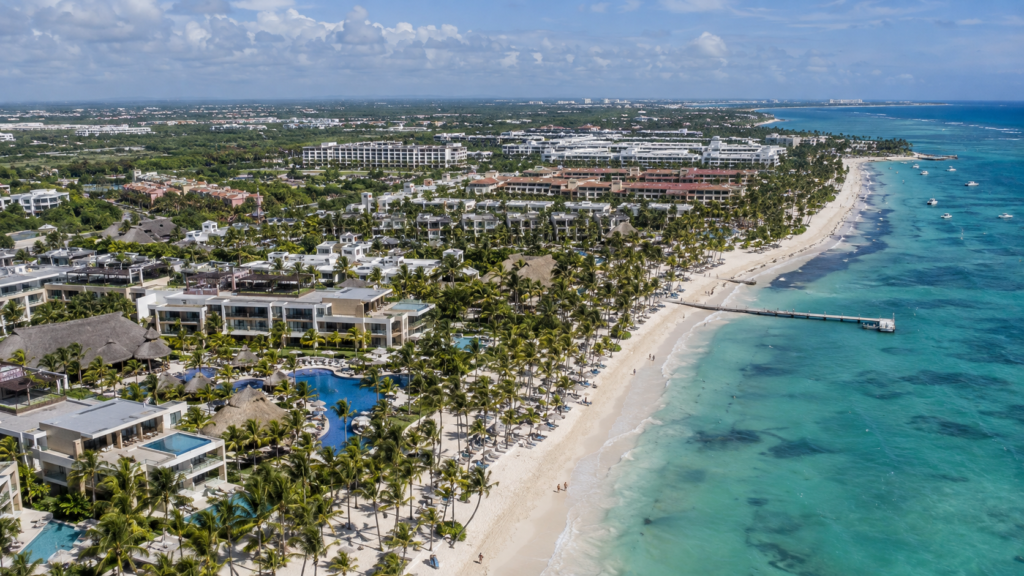
The Dominican Republic has one of the Caribbean’s most developed tourism economies, but its destinations do not operate under the same business model. Punta Cana-Bávaro is built around high-volume international air connectivity, large resort complexes and extensive tourism-related real estate. Santo Domingo has a more urban profile, with stronger links to business, culture, meetings and conventions. Puerto Plata combines established resorts, cruise activity and a growing diversification strategy, while La Romana has a more concentrated luxury, golf, marina and cruise proposition. Samaná competes through nature, boutique hospitality and lower-density development. Other areas, including Santiago, Miches and Pedernales, represent different stages of tourism development and therefore different investment profiles.
For businesses assessing the Dominican Republic, destination selection should be evaluated through several variables rather than visitor volume alone. Hotel supply, air and cruise connectivity, infrastructure, visitor demand, development pipeline, real estate activity, market positioning and the ability to diversify the tourism product can all affect the commercial outlook.
How the Dominican Republic’s Tourism Destinations Differ
The country’s tourism geography is unusually diverse for a Caribbean market. The official tourism intelligence system, SITUR, maintains destination-specific reports for areas including La Altagracia, Puerto Plata, Samaná, La Romana, Santo Domingo and Santiago, as well as specialized investment profiles. This reflects an increasingly differentiated tourism strategy rather than a single national resort model.
At the national level, the Dominican Republic benefits from an extensive network of airports, ports and roads. An investment guide published by ProDominicana describes the country as having multiple international air and sea connections and emphasizes the role of transport infrastructure in tourism development.
That infrastructure creates distinct business environments. A large resort operator may prioritize international airport capacity and land availability, while a hotel focused on business travelers may place greater importance on urban access, convention facilities and proximity to corporate activity. A residential tourism project may instead prioritize long-term real estate demand, infrastructure and the destination’s ability to attract repeat visitors.
| Destination | Core Tourism Model | Business Strength | Development Profile |
|---|---|---|---|
| Punta Cana-Bávaro | Large-scale resort and leisure tourism | International air connectivity and scale | High-density tourism and real estate development |
| Santo Domingo | Urban, cultural, business and meetings tourism | Large urban market and diversified demand | Urban hospitality and mixed-use opportunities |
| Puerto Plata | Resort, cruise, cultural and adventure tourism | Multiple tourism products and northern connectivity | Established market with diversification potential |
| La Romana-Bayahíbe | Luxury, resort, golf and cruise tourism | Integrated tourism infrastructure | More concentrated, higher-end development model |
| Samaná | Nature, boutique and experiential tourism | Distinctive natural assets | Lower-density and selective development |
| Santiago | Business, urban and regional tourism | Economic importance and inland connectivity | Potential for diversified urban hospitality |
| Miches | Luxury and nature-oriented tourism | New destination development | Emerging investment market |
| Pedernales | Nature and new tourism development | Expansion potential | Early-stage destination development |
Punta Cana: The Dominican Republic’s Largest Tourism Platform
Punta Cana-Bávaro is the country’s dominant international tourism destination and has the greatest concentration of large-scale resort activity. The official tourism portal describes Punta Cana as the Dominican Republic’s leading tourist destination, with a tourism model combining major resorts, golf, entertainment and excursion activity.
Its principal business advantage is scale. Punta Cana International Airport provides a direct international gateway to the resort corridor, reducing the dependence on transfers from other parts of the country. Historical destination data from SITUR identified the airport as the country’s busiest and reported that it accounted for half of national passenger arrivals in 2019.
That connectivity has supported a substantial hotel and tourism-services ecosystem. The official tourism website currently lists more accommodation establishments in Punta Cana than in any other destination in its destination-based directory, illustrating the breadth of the local hospitality market.
From an investment perspective, Punta Cana is particularly relevant for projects that depend on international leisure demand, resort infrastructure, branded hospitality, golf, entertainment and tourism-oriented residential development. Its main limitation is not lack of demand but the maturity and intensity of competition. New projects must differentiate themselves within an established tourism ecosystem rather than rely solely on the destination’s name.
Santo Domingo: The Country’s Urban Tourism and Business Center
Santo Domingo operates under a fundamentally different tourism model. As the national capital and largest metropolitan market, it combines tourism with government, commerce, professional services, culture, gastronomy and business activity. The tourism investment strategy published through SITUR identifies Santo Domingo with urban, gastronomic and meeting-related tourism.
This diversification gives the capital a business profile that is less dependent on the traditional all-inclusive resort model. Hotels can target leisure visitors, corporate travelers, events, conventions and visitors combining business with tourism. The colonial area also provides a cultural tourism component that differentiates the city from the country’s major beach destinations.
For investors, the opportunity is therefore broader than adding traditional resort rooms. Urban hotels, serviced accommodation, mixed-use projects, restaurants, entertainment, meeting facilities and tourism services can all fit within the metropolitan ecosystem. The trade-off is that Santo Domingo competes in an urban hospitality market where location, product quality and demand segmentation can matter more than proximity to a resort beach.
Puerto Plata: A Diversifying Tourism Market
Puerto Plata is one of the Dominican Republic’s most established tourism regions and has a more diversified tourism proposition than a conventional beach-resort destination. The northern coast combines hotels and resorts with cruise tourism, cultural attractions, adventure activities and access to areas such as Sosúa and Cabarete.
The destination has also become an important part of the country’s strategy to diversify tourism beyond the largest resort markets. SITUR’s investment material identifies Puerto Plata with luxury and wellness, mixed development, cruises, the cable car, water sports and Punta Bergantín.
The business case is consequently linked to both existing demand and future repositioning. Established tourism infrastructure reduces some of the development risk associated with completely new destinations, while projects such as Punta Bergantín represent a potential expansion of the destination’s tourism and real estate ecosystem.
Puerto Plata may therefore be particularly relevant to businesses looking for a destination with an established visitor base but additional room for product diversification. The market is not as concentrated as Punta Cana, which can create opportunities for hospitality, entertainment, residential tourism and experiences aimed at different visitor segments.
La Romana and Bayahíbe: An Integrated High-End Tourism Environment
La Romana and neighboring Bayahíbe occupy a distinctive position in the Dominican tourism economy. Their proposition is associated with resorts, golf, luxury tourism, maritime activity and access to attractions such as Saona Island. The area also benefits from an international airport and port infrastructure.
SITUR’s investment strategy classifies La Romana within an urban and cultural tourism context while highlighting the broader destination diversification strategy. Historical investment material for La Romana also documents its international airport and port connectivity.
The commercial opportunity is consequently less about creating an entirely new mass-market destination and more about serving a mature tourism ecosystem. Integrated resorts, golf-related hospitality, premium accommodation, marina-related services and tourism experiences can benefit from the concentration of complementary infrastructure.
For real estate investors, the destination can be attractive when a project is closely connected to an established tourism product. However, its more concentrated market structure means that the investment thesis should be based on the specific location, operator, customer segment and surrounding development rather than on national tourism growth alone.
Samaná: Nature, Boutique Hospitality and Lower-Density Development
Samaná offers a different proposition from the large resort corridors. The peninsula is associated with beaches, nature, marine attractions and experiential tourism, while Las Terrenas has developed a more independent hospitality and residential identity.
The official tourism investment strategy positions Samaná around eco-tourism and adventure tourism, distinguishing it from the high-density resort model associated with La Altagracia.
That positioning can create opportunities for boutique hotels, nature-oriented accommodation, premium experiences, restaurants, wellness concepts and residential projects that depend on destination character rather than resort scale.
The principal business consideration is connectivity. Samaná has El Catey International Airport, but its tourism market does not have the same scale of direct international air connectivity as Punta Cana. This can influence hotel economics, seasonality, construction decisions and the depth of the potential customer base.
Santiago: A Different Opportunity Beyond Beach Tourism
Santiago de los Caballeros is not primarily a traditional international beach destination, but it matters to the broader tourism and business ecosystem because of its economic importance and regional role.
Its tourism proposition is more closely connected to business travel, domestic demand, culture, gastronomy and events than to large-scale all-inclusive resorts. SITUR maintains a dedicated 2025 destination report for Santiago, reflecting its inclusion in the country’s wider tourism intelligence framework.
For investors, Santiago illustrates why visitor volume alone is an incomplete measure of tourism opportunity. A market can support hotels and tourism-related businesses through corporate and regional demand without competing directly with Punta Cana for beach travelers.
Miches: An Emerging Luxury Development Area
Miches represents a different stage of the destination life cycle. Rather than competing with an already saturated resort corridor, its investment proposition is associated with the development of a newer tourism market.
The national tourism investment strategy identifies Miches with luxury and sustainability and specifically highlights hotel development.
For investors, emerging destinations can offer greater development flexibility and the possibility of establishing a project within a new tourism cluster. They also carry greater execution risk. Infrastructure, workforce availability, market depth, supply chains and the pace at which complementary tourism businesses emerge can matter more than they would in an established destination.
Pedernales and Cabo Rojo: Long-Term Destination Development
Pedernales represents one of the clearest examples of destination development rather than simple expansion of an established tourism market. The national strategy associates the area with the Cabo Rojo port, hotel development and community tourism.
The commercial opportunity is therefore tied to the creation of new infrastructure and tourism capacity. Such markets can eventually generate substantial first-mover opportunities, but they require a longer investment horizon and a greater tolerance for development and execution risk than established destinations.
Hotel Activity and Accommodation Scale
Hotel supply is one of the clearest indicators of the maturity of a tourism market, although it should not be interpreted in isolation. A large room inventory indicates established demand and infrastructure, but it also usually means stronger competition. A smaller inventory can indicate either limited demand or an opportunity for new supply, depending on the destination.
SITUR provides a dedicated hotel-industry dashboard covering hotel availability, operating rooms, occupancy and the distinction between foreign and local visitors. The system allows the data to be examined by tourism zone, making it particularly useful for comparing destination-level hotel performance.
The official tourism accommodation directory also illustrates the relative scale of the major destinations. Its current directory lists Punta Cana ahead of Santo Domingo, Puerto Plata, Samaná and La Romana in the number of accommodation establishments shown by destination. These directory counts should be treated as an indicator of the breadth of the listed accommodation market rather than as a complete census of hotel rooms.
Connectivity Is a Major Competitive Variable
For tourism businesses, connectivity can be as important as the destination’s physical attractions. International travelers need efficient access, while hotel operators depend on a sufficiently broad catchment area to maintain occupancy and pricing power.
The Dominican Republic has a relatively broad international transport network. Official tourism material identifies eight international airports and multiple cruise ports serving different parts of the country.
Punta Cana has the strongest direct relationship between airport connectivity and resort demand. Santo Domingo benefits from its metropolitan airport and urban location. Puerto Plata combines airport and cruise infrastructure, while La Romana has both airport and port connectivity. Samaná has an international airport but a smaller overall tourism platform.
For a business plan, the relevant metric is therefore not simply distance to an airport. Investors should examine the origin markets served, frequency of flights, transfer times, seasonality, road access and whether the destination can attract visitors without relying on another tourism hub.
Real Estate Development and Tourism Investment
Tourism and real estate are closely connected in the Dominican Republic, particularly in destinations where hotels, branded residences, vacation properties, golf developments and mixed-use projects form part of the same economic ecosystem.
The national investment framework identifies tourism as a priority sector and provides information on incentives and procedures for tourism projects. ProDominicana lists tourism investment opportunities across hotels and resorts, ecotourism, adventure tourism, cultural tourism and other segments.
However, the investment profile differs substantially by destination. Punta Cana and La Altagracia offer a highly developed ecosystem for resort and tourism-oriented real estate. Santo Domingo provides an urban market where mixed-use and hospitality concepts can serve multiple demand sources. Puerto Plata offers opportunities linked to an established tourism base and destination diversification. Samaná and emerging destinations such as Miches offer different propositions based more heavily on nature, lower-density development or new tourism infrastructure.
Investment incentives should also be analyzed separately from commercial fundamentals. ProDominicana identifies tax incentives available to qualifying tourism projects, while the applicable development, environmental, construction and classification procedures remain relevant to project feasibility.
Which Destinations Have the Strongest Business Potential?
There is no single ranking that applies to every tourism investment. The strongest destination depends on the business model, capital requirements, target customer and investment horizon.
| Business Objective | Destinations With Strong Relevance | Why |
|---|---|---|
| Large-scale resort development | Punta Cana-Bávaro, La Romana-Bayahíbe | Established international leisure demand and tourism infrastructure |
| Urban hotel or business hospitality | Santo Domingo, Santiago | Corporate, institutional, cultural and regional demand |
| Destination diversification | Puerto Plata | Resort, cruise, cultural, adventure and new development opportunities |
| Boutique and nature tourism | Samaná | Distinctive natural assets and lower-density positioning |
| Emerging luxury tourism | Miches | New destination development and luxury positioning |
| Long-term destination creation | Pedernales | New infrastructure and tourism development strategy |
Punta Cana is the strongest platform for businesses that need scale, international leisure demand and mature tourism infrastructure. Santo Domingo is more compelling for businesses seeking diversified urban demand. Puerto Plata combines maturity with diversification potential, while La Romana offers a concentrated premium tourism ecosystem.
Samaná is better understood as a differentiated destination rather than a smaller version of Punta Cana. Miches and Pedernales, meanwhile, represent development-stage opportunities in which the potential return must be considered alongside infrastructure and execution risk.
What Businesses Should Evaluate Before Choosing a Destination?
A destination-level investment decision should begin with the business model rather than the destination’s reputation. A project aimed at international resort guests has different requirements from an urban hotel, a boutique property, a restaurant, a convention business or a tourism-oriented residential development.
At minimum, investors should examine:
- Demand: visitor volumes, source markets, seasonality and length of stay.
- Hotel supply: existing rooms, planned developments, occupancy and competitive positioning.
- Connectivity: international flights, domestic access, roads, ports and transfer times.
- Land and development: availability, infrastructure, zoning, environmental requirements and development costs.
- Real estate: residential demand, absorption, pricing and the relationship between property development and tourism.
- Competition: existing operators, international brands and the level of market concentration.
- Workforce: availability of trained employees and access to supporting services.
- Regulation: tourism classifications, environmental approvals, construction requirements and applicable incentives.
- Investment horizon: established destinations may offer faster market validation, while emerging destinations may require a longer development cycle.
The Ministry of Tourism’s tourism intelligence platform provides destination and hotel-industry data that can support this analysis. ProDominicana also maintains investment information and sector-specific guidance for businesses considering projects in the country.