 22°C
22°C

Immigrant Workers Remain Essential to Key Sectors of the Dominican Economy
Immigrants continue to play a vital role in the Dominican Republic's labor market, particularly in agriculture, construction and tourism, although many remain concentrated in informal employment with limited access to labor protections.


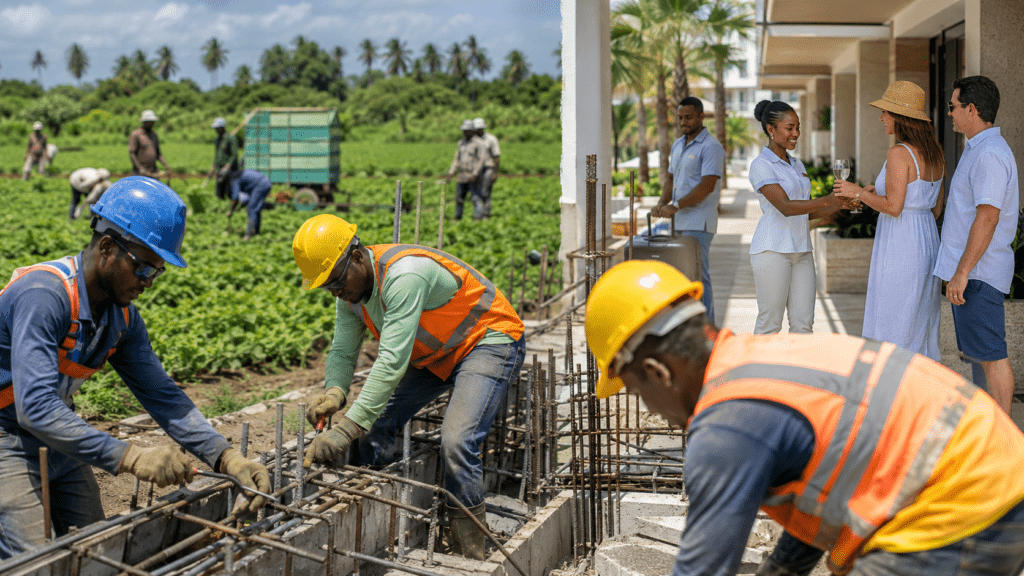
The immigrant workforce has become an essential component of the Dominican Republic’s economy, supplying labor across strategic industries while facing persistent challenges related to informality, legal documentation and access to social protections.
According to data from the Second National Survey of Immigrants (ENI 2017), the Dominican Republic was home to 570,933 foreign-born residents, representing 5.6% of the national population. Haitians accounted for 87.2% of the immigrant population, while migrants from other countries made up the remaining 12.8%, with Venezuelans representing the fastest-growing community.
Growing Venezuelan Community
The survey found that the Venezuelan-born population increased from 3,434 people in 2012 to 25,876 in 2017, a growth of more than 650%. Venezuelan immigrants generally have higher educational attainment, technical or university training, and are concentrated in Greater Santo Domingo, Bávaro and Punta Cana.
Haitian immigrants, meanwhile, remain the country’s largest foreign-born group. The population is predominantly young and male, with nearly 40% between the ages of 20 and 34, reflecting a strong connection to the labor market.
High Labor Force Participation
Nearly 80% of immigrants are between 15 and 45 years old, placing most within the country’s working-age population. Data from the National Continuous Labor Force Survey (ENCFT) 2024 indicate that Haitian immigrants participate in the labor force at a rate of 73.6%, compared with 64.7% for Dominicans. Their employment rate is also approximately nine percentage points higher than that of the native-born population.
Despite strong labor market participation, immigrant workers are disproportionately employed in informal jobs with limited access to social security and labor protections.
Agriculture and Construction Depend on Foreign Labor
The agricultural sector shows one of the highest levels of dependence on immigrant workers. The ENAGROT 2022 Agricultural Survey found that foreign workers represented 66.8% of the workforce interviewed in major crop production, including rice, plantains and beans. Most were Haitian men with an average age of 35, and more than 60% had lived in the Dominican Republic for over a decade.
However, agricultural employment remains largely informal, with daily wage arrangements, limited social protection and low levels of technical training. The survey also found that 66.5% of foreign agricultural workers lacked the skills to operate farming machinery.
The construction industry presents similar characteristics. Approximately 98% of foreign workers in the sector are Haitian nationals, many of whom work without formal labor protections or access to social security. Researchers note that employers recognize the importance of immigrant labor while also identifying a need for greater technical training, workplace safety and improved documentation.
Tourism and Commerce Offer More Diverse Opportunities
Unlike agriculture and construction, the tourism sector employs a more diverse immigrant workforce. Foreign-born workers accounted for approximately 9.6% of employment in hotels, restaurants and bars in 2017, with higher levels of formal employment and stronger technical and language skills, particularly in customer service and administrative positions.
Women play a more visible role in tourism-related informal services and in commerce, where many participate through self-employment, street vending and small businesses. Even so, the lack of legal documentation continues to limit opportunities for many immigrants to transition into formal employment.
Need for Greater Labor Integration
The research concludes that immigrant workers remain indispensable to several sectors of the Dominican economy while highlighting ongoing challenges related to labor informality, unequal access to employment rights and broader social integration.
The findings suggest that policies promoting labor formalization, workforce training and improved integration could strengthen both economic productivity and labor protections while supporting industries that continue to rely heavily on immigrant labor.