 24°C
24°C

How Santo Domingo Influenced Urban Planning in the Americas
Founded at the turn of the 16th century, Santo Domingo became one of the earliest centers of Spanish colonial administration in the Americas. Its streets, central plaza, and institutional buildings helped establish an urban model that influenced later settlements, although historians caution against treating its original layout as a perfectly regular grid or the sole source of colonial planning traditions.


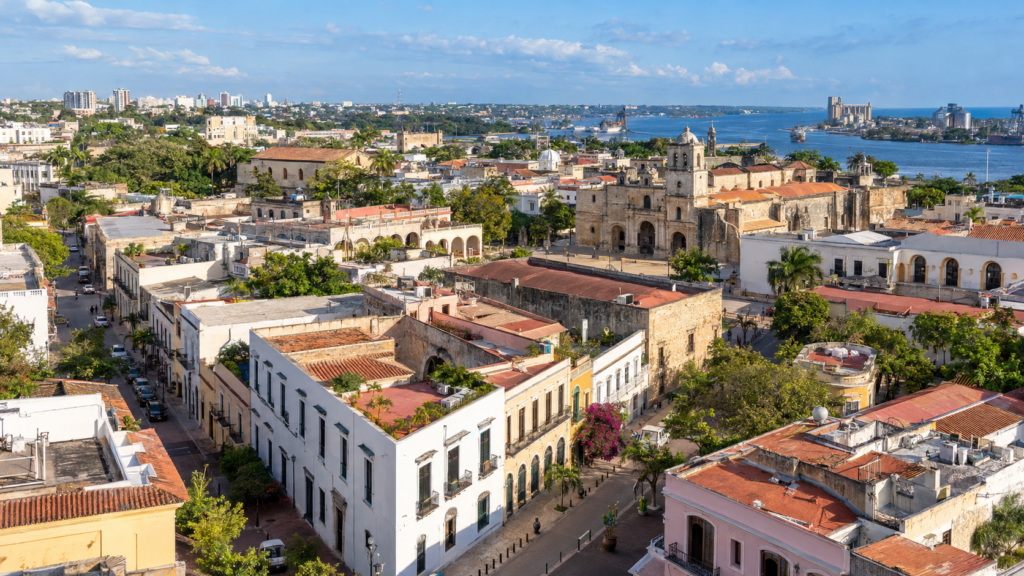
The Colonial City of Santo Domingo, in the capital of the Dominican Republic, preserves an important chapter in the history of urban planning in the Americas. Founded on the island of Hispaniola in the late 15th century, the settlement became a center of Spanish colonial government, religious authority, and commerce. Its street layout and central plaza helped shape the development of later colonial towns, making Santo Domingo an important reference point for understanding how European urban planning traditions spread across the continent.
From an Early Settlement to a Colonial Capital
According to UNESCO, Santo Domingo was initially established on the eastern bank of the Ozama River in 1496. Bartholomew Columbus, brother of Christopher Columbus, founded the settlement in 1498 under the authority of the Spanish Crown. In 1502, Governor Nicolás de Ovando transferred the settlement to the river’s western bank and organized its reconstruction.
The relocation created an opportunity to establish a more orderly urban structure. Rather than allowing the town to develop entirely through unplanned growth, Ovando’s administration organized streets and blocks around a central public square, known as the Plaza Mayor. The square served as a focal point for civic, religious, and administrative life, connecting the physical organization of the settlement with the institutions that governed it.
This arrangement reflected European planning traditions adapted to the circumstances of Spanish expansion in the Caribbean. Santo Domingo became an early example of how urban design could support colonial administration, facilitate the distribution of land, and establish a recognizable center of political authority.
How Santo Domingo’s Urban Layout Influenced Other Cities
The city’s historical importance lies partly in the relationship between its street network and its central plaza. UNESCO identifies the Colonial City of Santo Domingo as an influential example of early urban planning in the Caribbean and the Americas, noting that its layout and Plaza Mayor served as models for subsequent settlements.
The basic principle was straightforward: organize the town around a principal square, connect it to a network of streets, and locate important public institutions within or near the central area. This arrangement provided a recognizable framework for expanding settlements and organizing their civic functions.
However, the historical record requires a qualification. A 2022 academic study published in the journal Land, examining Santo Domingo and Panama Viejo, argues that Santo Domingo’s early street pattern was orderly but did not constitute a perfectly regular grid. The researchers emphasize the influence of local geography and the irregular arrangement of streets and blocks. The city’s importance therefore rests not on a geometrically perfect plan, but on its early contribution to the development of organized colonial urbanism.
Later Spanish colonial settlements adopted related planning principles, although their layouts varied according to terrain, local conditions, and administrative requirements. Santo Domingo should consequently be understood as an influential early example rather than the sole origin of every planned city in the Americas.
The Plaza Mayor and the Institutions of Colonial Government
The Plaza Mayor was more than an open public space. It helped structure the relationship between urban form and political authority. Churches, government offices, and other important buildings established a visible institutional center, while the surrounding streets connected that center to residential areas, commercial activities, and the city’s defensive perimeter.
UNESCO identifies Santo Domingo as the location of several pioneering institutions in the Americas, including its cathedral, hospital, customs house, and university. These institutions developed during different phases of the city’s early colonial history and should not be understood as having all opened simultaneously.
The University of Santo Domingo, the historical predecessor of the present-day Autonomous University of Santo Domingo (UASD), was established by a papal bull issued by Pope Paul III on October 28, 1538. The university’s institutional history records that the Dominican religious community had maintained a center of higher learning in the city since 1518.
The Cathedral of Santa María la Menor, commonly known as the Cathedral of Santo Domingo, is another landmark of the city’s early development. Its construction began in the 16th century, and the building remains one of the most significant surviving monuments of Spanish colonial architecture in the Americas.
A Historic Urban Landscape That Survives Today
The Colonial City preserves substantial evidence of its original urban structure. UNESCO describes the World Heritage property as encompassing 106 hectares, with a historic street network that crosses 116 blocks. Its assessment highlights the survival of the original street widths, plots, and much of the historic architectural fabric.
The area was inscribed on the UNESCO World Heritage List in 1990 under criteria recognizing its influence on urban development, its architectural significance, and its association with major historical events. A boundary modification was subsequently inscribed in 2024.
Walking through the Colonial City today reveals how the relationship between streets, public spaces, religious buildings, and civic institutions shaped the historic center. The surviving layout makes it possible to examine the principles of early colonial planning in a functioning urban environment rather than solely through historical documents or reconstructed models.
Santo Domingo’s legacy is therefore both architectural and urban. Its early settlement helped establish a framework for organizing Spanish colonial towns, while its surviving historic center offers material evidence of the political, religious, and administrative ambitions that shaped the first stages of European urban development in the Americas.
Sources and Further Reading
- UNESCO World Heritage Centre: Colonial City of Santo Domingo — historical chronology, urban layout, institutional heritage, and World Heritage criteria.
- Cubero-Hernández, Silva, and Arroyo Duarte, “Urban Layout of the First Ibero-American Cities on the Continent through Conventual Foundations” (2022) — academic analysis of the early urban layouts of Santo Domingo and Panama Viejo.
- Autonomous University of Santo Domingo: Institutional History — the university’s historical foundation and its origins in the Dominican religious community’s center of higher learning.
- Dominican Republic Heritage Portal: Colonial City of Santo Domingo — national heritage information about the historic site.