 24°C
24°C

Dominican Civil War of 1965: The U.S. Military Intervention
The Dominican Civil War began on April 24, 1965, when Dominican military officers and civilian supporters launched a revolt seeking the restoration of the constitutional government of Juan Bosch, overthrown in 1963. As fighting spread through Santo Domingo, the United States sent troops ashore beginning on April 28. The intervention grew into a major military deployment shaped by Washington’s concerns about political instability, the balance of power in the Caribbean, and the possibility of communist influence during the Cold War.


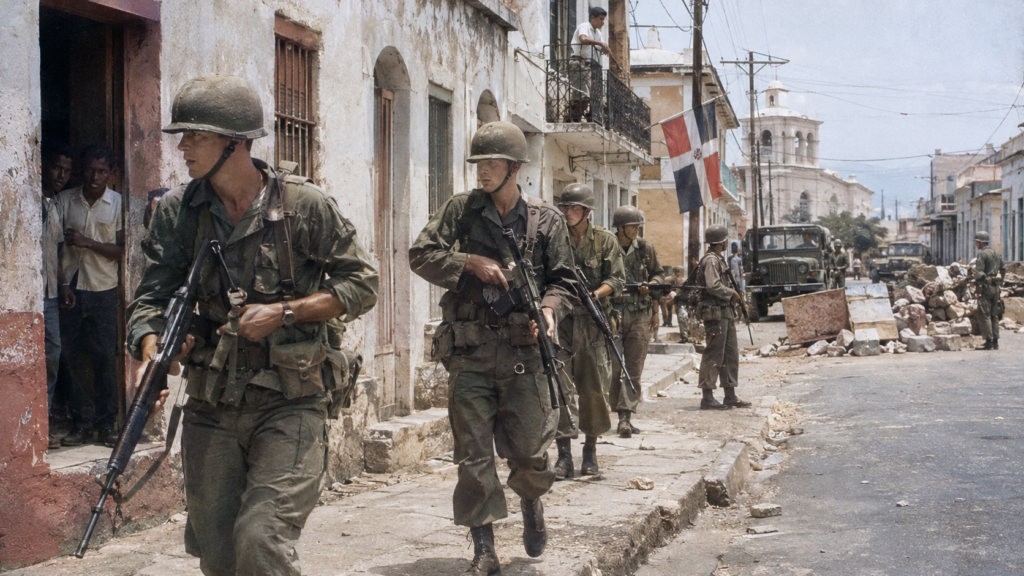
The crisis was not simply a confrontation between communism and anti-communism. It was also a struggle over constitutional legitimacy, military power, and the right of Dominicans to determine their political future. Understanding the events requires examining the divisions within the Dominican military, the objectives of the constitutionalist movement, and the decisions that brought U.S. forces into the conflict.
The Political Crisis After Juan Bosch’s Overthrow
Juan Bosch, a leader of the Dominican Revolutionary Party (PRD), won the country’s presidential election in December 1962 and took office in February 1963. His government introduced a new constitution and pursued reforms that challenged established political and economic interests. On September 25, 1963, military officers overthrew Bosch and removed his government from power.
A civilian-military governing arrangement known as the Triumvirate subsequently took control. Political opposition persisted, however, and dissatisfaction grew among sectors of the armed forces and the population. The constitutional framework introduced under Bosch became a central point of contention, particularly among military officers who opposed the government that had replaced him.
These tensions set the stage for the uprising of April 1965. Although restoring Bosch to the presidency was an important objective for many constitutionalists, the movement also demanded the restoration of constitutional government. Its supporters included military personnel, political activists, and civilians with differing political beliefs.
April 24, 1965: The Constitutionalists’ Uprising
The rebellion began on April 24, 1965, when military officers opposed to the government of Donald Reid Cabral launched an uprising in Santo Domingo. Supporters of the movement took control of strategic locations and called for the restoration of the constitutional order associated with Bosch’s elected government.
The insurgents became known as Constitutionalists because of their commitment to restoring the 1963 Constitution. Their opponents, commonly called Loyalists, included military forces that remained aligned against the rebellion. The conflict rapidly escalated from a political and military revolt into armed confrontations across the capital.
By April 26, fighting had intensified. Loyalist forces bombarded areas held by the rebels, while the competing factions struggled to control military installations, communications, and important routes through Santo Domingo. The breakdown of central authority and the spread of violence created a crisis that soon drew international attention.
The U.S. State Department’s contemporary diplomatic records document how American officials assessed the changing balance between the factions during these first days. A telegram dated April 28, for example, described the military situation as uncertain and recorded discussions about the possible deployment of U.S. Marines. These documents provide direct evidence of Washington’s decision-making as the crisis unfolded.
Why the United States Intervened
The United States initially presented the deployment as a measure to protect American citizens and facilitate the evacuation of foreign nationals. On April 28, U.S. Marines landed in the Dominican Republic. The mission expanded rapidly as Washington became increasingly concerned about the collapse of government authority and the possibility that communist organizations could gain influence over the rebellion.
President Lyndon B. Johnson’s administration viewed the crisis through the strategic concerns of the Cold War. The Cuban Revolution had heightened U.S. sensitivity to the possibility of another government in the Caribbean moving into the Soviet Union’s political orbit. American officials argued that intervention was necessary to prevent a communist takeover, although the extent of communist influence within the constitutionalist movement and the likelihood of such an outcome remain important subjects of historical debate.
The official U.S. documentary record reveals that Washington’s objectives extended beyond evacuation. A telegram sent by the State Department on April 27 identified the restoration of law and order, the prevention of a possible communist takeover, and the protection of American lives as primary objectives. Subsequent military deployments reflected the administration’s increasingly expansive assessment of the crisis.
For Dominicans who supported the constitutionalist cause, the intervention represented a direct foreign intrusion into a struggle over their country’s constitutional and political future. The disagreement over the purpose and legitimacy of the intervention became one of the defining controversies of the conflict.
Operation Power Pack and the Scale of the Intervention
The American intervention, known as Operation Power Pack, grew into one of the largest U.S. military deployments in Latin America during the Cold War. Initial landings were followed by reinforcements from the U.S. Army’s 82nd Airborne Division and additional Marine units.
By mid-May 1965, approximately 23,850 U.S. military personnel were in the Dominican Republic, according to the U.S. Department of Defense’s annual report for fiscal year 1965. This figure represents the peak strength of personnel deployed in the country, not the total number of American service members who participated over the course of the operation. The distinction matters because the intervention involved a continuing rotation and reinforcement of forces.
American troops established positions around strategic infrastructure, secured routes between the capital and the port of Haina, and created an international safety zone in Santo Domingo. U.S. forces also supported the evacuation of foreign nationals and distributed food and medical assistance. At the same time, their military presence altered the balance between the Dominican factions and placed significant limits on the constitutionalists’ freedom of action.
The intervention therefore evolved from an operation presented as protecting civilians and evacuating foreign nationals into a broader military and political effort intended to shape the outcome of the Dominican crisis. The scale of the deployment remains essential to understanding why the episode became such a controversial example of U.S. intervention during the Cold War.
The Organization of American States and the Inter-American Peace Force
The Organization of American States (OAS), a regional organization established to promote cooperation among countries in the Americas, became increasingly involved as the fighting continued. Its diplomatic efforts sought a cease-fire, the protection of civilians, and a political settlement capable of ending the conflict.
On May 6, 1965, the OAS approved a resolution calling for the creation of an inter-American military force. The Inter-American Peace Force was formally established on May 23, with Brazil providing its commander and the United States serving as a major military contributor. Other Latin American countries also supplied personnel.
The force was intended to operate under an inter-American framework, providing a regional structure for security and peacekeeping. However, the United States remained the dominant military participant, and the creation of the multinational force did not erase the controversy surrounding the original unilateral intervention.
For Washington, the OAS framework helped broaden international participation and support diplomatic efforts to restore political stability. For critics, the arrangement raised questions about sovereignty, the legitimacy of collective intervention, and the extent to which regional institutions could operate independently of the interests of the hemisphere’s most powerful country.
From Civil War to a Political Settlement
The fighting and diplomatic negotiations continued through the summer of 1965. The conflict gradually moved toward a political settlement, although the opposing Dominican factions remained deeply divided. The OAS played a role in negotiations intended to establish provisional political arrangements and create conditions for new elections.
In September 1965, a provisional government was established under the terms of the negotiated settlement. The process paved the way for presidential elections in June 1966, which Joaquín Balaguer won. Balaguer had previously served under Rafael Trujillo, the dictator whose rule ended with his assassination in 1961, and his return to the presidency marked a significant development in the country’s post-Trujillo political history.
U.S. forces did not withdraw immediately after the end of the principal fighting. The multinational peacekeeping mission continued while political arrangements were consolidated, and the remaining international forces departed in 1966.
The Lasting Significance of the April Revolution
The Dominican Civil War of 1965 exposed the tension between national sovereignty and the strategic priorities of foreign powers during the Cold War. For constitutionalists, the uprising was a struggle to restore a political order disrupted by the 1963 coup. For the Johnson administration, the collapse of authority and the prospect of communist influence presented a security concern that justified military action.
The intervention also demonstrated how quickly a domestic political crisis could become an international confrontation. Dominican political divisions, U.S. strategic calculations, and the involvement of the OAS combined to shape the course of the conflict and its eventual settlement.
The episode remains central to understanding modern Dominican history because it connected the unfinished struggle for constitutional government with the wider geopolitical competition of the 1960s. Its legacy is not reducible to a single explanation: it involved a genuine domestic conflict, competing visions of political legitimacy, and an intervention whose stated objectives and broader consequences continue to be examined by historians.
Sources and Further Reading
- U.S. Department of State, Foreign Relations of the United States, 1964–1968, Volume XXXII: Dominican Republic; Cuba; Haiti; Guyana — primary diplomatic documents recording U.S. policy decisions and assessments during the crisis.
- U.S. Army Center of Military History: Dominican Republic — an official account of the military deployment and the transition to multinational peacekeeping.
- United Nations: Background on the Dominican Republic Mission — a summary of the intervention, the OAS peace force, and the international response.
- Dominican Heritage Digital Library: Juan Bosch, La República Dominicana: causas de la intervención militar norteamericana de 1965 — a Dominican perspective on the causes and implications of the U.S. intervention.
- Organization of American States: Virtual Library of Inter-American Peace Initiatives — documents on the diplomatic process and establishment of the Inter-American Peace Force.