 24°C
24°C

The Devastations of Osorio: Spain’s Forced Resettlement of Hispaniola
In 1605 and 1606, Spanish colonial authorities forcibly relocated communities from northern and western Hispaniola in an attempt to suppress illegal trade with foreign merchants. Known as the Devastations of Osorio, the operation disrupted local economies, uprooted residents, and left areas of the island more vulnerable to foreign settlement. The policy intended to strengthen Spain's control but had consequences that extended far beyond its original purpose.


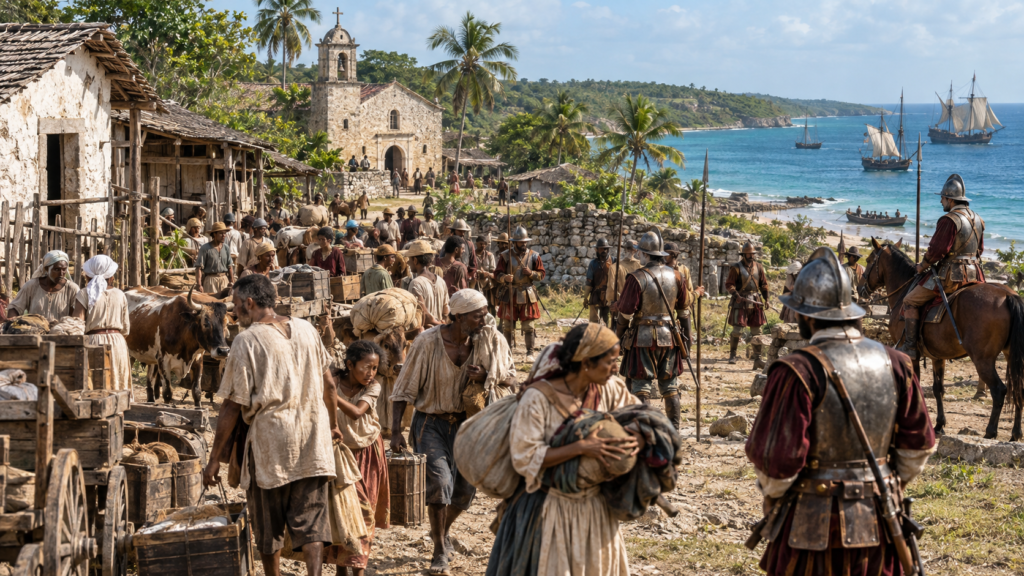
In the early 17th century, the Spanish Crown attempted to tighten its control over Hispaniola, the Caribbean island now shared by the Dominican Republic and Haiti. Its strategy included forcibly relocating communities that traded with foreign merchants outside Spain’s colonial monopoly. The resulting operation, known as the Devastations of Osorio, changed the island’s settlement patterns and created consequences that extended well beyond the immediate suppression of smuggling.
Why Spain Ordered the Depopulation of Hispaniola
Spain sought to control trade between its American colonies and foreign powers. Yet residents of Hispaniola’s northern and western settlements maintained commercial relationships with English, French, and Dutch merchants, exchanging local products for imported goods that were difficult to obtain through Spain’s authorized trading system.
Cattle ranching and the export of hides had become important parts of the island’s economy. For communities far from the colonial capital of Santo Domingo, trading by sea with foreign merchants could be more practical than relying on official commercial channels. These exchanges undermined Spain’s trade restrictions and reduced the Crown’s ability to regulate commerce.
Economic concerns were not the only factor. Spanish officials also feared the spread of Protestant religious ideas and the political influence of rival European powers. Research published by Cambridge University Press describes the proposed depopulation as an effort to impose greater commercial, social, and religious control over a colony that officials in Madrid considered increasingly difficult to govern.
Antonio de Osorio and the Forced Relocations of 1605–1606
The Spanish Crown approved the plan in 1604 and entrusted its implementation to Antonio de Osorio, governor of Hispaniola. The operation became known as the Devastations of Osorio, or Devastaciones de Osorio in Spanish. Between 1605 and 1606, colonial authorities dismantled settlements along the northern and western parts of the island and compelled their inhabitants to move closer to Santo Domingo.
Among the principal settlements affected were Bayahá, La Yaguana, Monte Cristi, and Puerto Plata. The measures also affected communities in the island’s interior, including Santiago, Neiba, and San Juan de la Maguana, although the process unfolded in stages rather than as a single simultaneous evacuation.
The relocation was not simply an administrative transfer. Residents lost access to their homes, land, commercial networks, and established livelihoods. Settlements were dismantled, and the movement of entire communities disrupted local economic and social relationships. Historical research published by the Dominican Republic’s General Archive of the Nation documents the scale of the population reorganization and its effects on the colony.
How the Relocations Changed the Island’s Settlement Patterns
The authorities concentrated displaced residents in settlements nearer to Santo Domingo. The communities of Bayahá and La Yaguana were brought together in Bayaguana, while residents from Monte Cristi and Puerto Plata were relocated to Monte Plata. These new settlement arrangements reflected the Crown’s intention to move populations away from coastal areas where unauthorized trade was difficult to monitor.
The consequences extended beyond the loss of individual towns. Moving communities inland disrupted cattle raising and the trade in hides, while the destruction of established settlements weakened economic activity in the affected regions. The operation also changed how people were distributed across the island, concentrating Spanish colonial settlement more heavily in areas closer to the capital.
The historical record cautions against describing every relocation as the founding of an entirely new town. In some cases, authorities reorganized existing populations and moved them to new locations. The distinction matters because the process involved not only the creation of settlements but also the dismantling of communities with established economic and social structures.
The Unintended Consequences for Spain
The Crown intended to weaken foreign commercial influence, but depopulating the northern and western regions also left areas of the island less effectively occupied by Spanish settlers. Critics of the policy had warned that abandoning these territories could make them more accessible to foreign traders, raiders, and other groups operating beyond Spanish authority.
Academic research on Hispaniola’s colonial history links the depopulations to the subsequent growth of foreign settlement in the island’s western regions. The abandoned territories and nearby islands became increasingly attractive to people involved in maritime trade, privateering, and cattle hunting. Over time, French settlement expanded in the west, contributing to the emergence of the French colony of Saint-Domingue.
The Devastations of Osorio did not, by themselves, create the later division of Hispaniola. French expansion resulted from a longer process involving European rivalries, maritime activity, settlement, and changing colonial power. Nevertheless, the forced relocations weakened Spain’s presence in parts of the island and became an important element in the history of the territorial division that eventually emerged.
Historical Evidence and Further Reading
The Devastations of Osorio are documented in both contemporary colonial records and later historical studies. The Dominican Republic’s General Archive of the Nation preserves and publishes materials that help reconstruct the decisions, protests, and consequences associated with the operation.
- General Archive of the Nation: Las devastaciones de 1605 y 1606 — Manuel Arturo Peña Batlle’s foundational study of the episode, published in 1938.
- General Archive of the Nation: Cartas de la Real Audiencia de Santo Domingo: 1609 — a documentary collection relating to the colonial administration and the period following the relocations.
- Cambridge University Press: “Repressing Smugglers: The Depopulations of Hispaniola, 1604–1606” — an academic analysis of the Crown’s objectives, the forced resettlement, and the wider colonial context.
- “Contested Conquests: African Maroons and the Incomplete Conquest of Hispaniola, 1519–1620” — academic research examining resistance, displacement, and the consequences of Spanish colonial policies.