 22°C
22°C

Santo Domingo’s Malecón Faces Years of Ignored Truck Restrictions
A deadly tanker-truck crash on Santo Domingo’s Malecón has renewed calls to keep heavy vehicles off the coastal avenue, despite restrictions imposed by city and national authorities repeatedly since 2012.


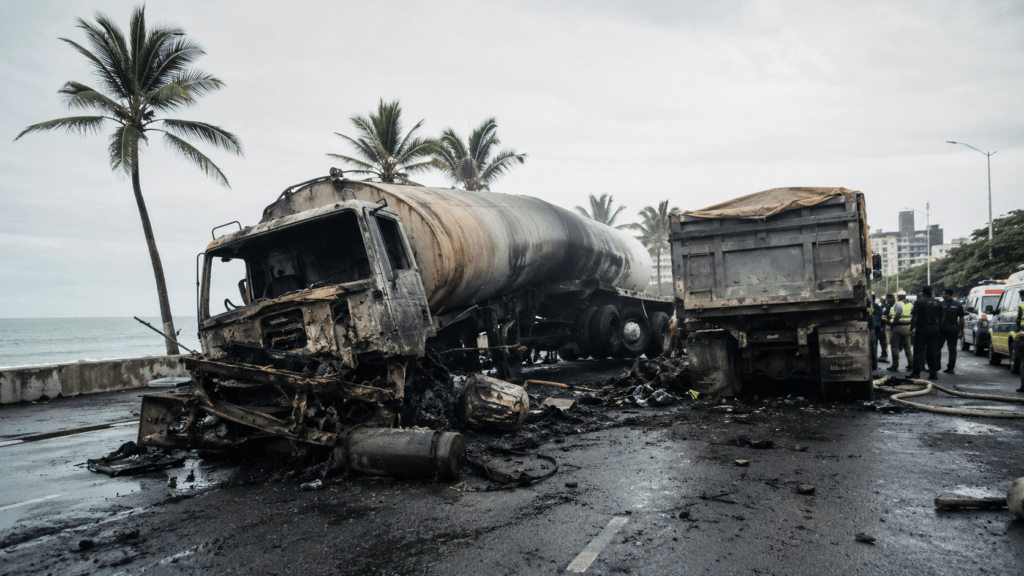
A fuel tanker carrying a load of combustible material caught fire on Monday after colliding with another heavy vehicle on Santo Domingo’s George Washington Avenue, killing two people and sending a large plume of smoke over the capital. The crash has revived a long-standing question over why heavy trucks continue to use the Malecón despite repeated restrictions on their circulation.
The issue is not a lack of regulations. The National Institute of Transit and Land Transportation (INTRANT), the Dominican Republic’s road transport authority, and the District National Council have introduced several measures over the past 14 years to restrict heavy vehicles along the coastal corridor. Their effectiveness, however, has repeatedly depended on enforcement in a busy urban area used by residents, businesses and visitors.
A Restriction That Dates Back to 2012
The District National Council first established restrictions on heavy vehicles along George Washington Avenue through a 2012 regulation. The measure covered the section between Máximo Gómez Avenue and Arzobispo Meriño Street, with exceptions for emergency services and public-service vehicles.
Further restrictions followed in 2017. Resolution 2/2017 allowed heavy vehicles to use part of George Washington Avenue only during specified hours on weekdays and prohibited their circulation on weekends and public holidays. The restricted section extended from Abraham Lincoln Avenue to Fernando Arturo de Meriño Street.
The rules have since been modified and reinforced as authorities attempted to manage freight traffic in central Santo Domingo. The underlying problem has remained the same: large commercial vehicles share an important urban corridor with passenger traffic, pedestrians and recreational activity along the capital’s waterfront.
INTRANT Repeatedly Tightened Enforcement
In December 2022, INTRANT announced that it would begin enforcing restrictions on cargo vehicles traveling along the Malecón between 6 a.m. and 8 p.m. starting in January 2023. The agency later reiterated that heavy vehicles seeking access to the Port of Santo Domingo should enter through designated control points and alternative routes.
In 2024, INTRANT again emphasized restrictions covering heavy cargo vehicles in the capital’s Zona de Acceso Restringida (ZAR), or Restricted Access Zone. The system is designed to control freight traffic in urban areas and concentrate heavy vehicles in permitted routes and periods with lower congestion.
The restrictions became even broader in January 2025, when INTRANT and the District National Council prohibited cargo vehicles with two or more axles from traveling along the Malecón between the Port of Santo Domingo and the Luperón Avenue distributor. The measure was also enforced along the corresponding section of the 30 de Mayo highway.
Traffic officers from the General Directorate of Traffic and Land Transportation Safety (DIGESETT) were deployed at strategic points to prevent restricted vehicles from entering the corridor. Authorities also established alternative routes for trucks heading to the port.
The Challenge Has Been Enforcement
Despite these measures, the restrictions have repeatedly struggled to remain effective over time. Heavy-vehicle drivers have continued entering restricted areas during prohibited hours, while enforcement operations have tended to be concentrated around specific periods rather than maintained continuously.
The pattern is particularly significant because the Malecón is more than a transport corridor. George Washington Avenue runs along Santo Domingo’s waterfront and connects areas used for commuting, recreation, tourism and commercial activity. Heavy trucks moving through the same corridor can create additional safety and congestion concerns in an environment with a high volume of other road users.
The repeated introduction of new restrictions therefore highlights a gap between regulation and implementation. Authorities have established limits, alternative routes and permit systems, but maintaining compliance requires sustained monitoring and enforcement rather than periodic operations alone.
What Dominican Law Says About Freight Traffic
The country’s 2017 Mobility, Transit and Land Transportation Law provides a legal framework for regulating freight movement in urban areas. Article 120 states that cargo transportation may operate in designated zones and during schedules established by INTRANT in coordination with municipal governments, taking into account periods of lower traffic congestion for loading and unloading goods, waste and construction materials.
That framework is the basis for the Restricted Access Zone system used in Santo Domingo. The regulations are intended to organize freight movement while limiting the presence of large commercial vehicles in areas where their circulation can conflict with regular urban traffic.
The latest crash has once again placed enforcement at the center of the discussion. The restrictions themselves are not new, and the authorities have repeatedly announced measures intended to keep heavy vehicles away from the most sensitive sections of the capital’s waterfront.
For residents and visitors using Santo Domingo’s Malecón, the immediate issue is whether those restrictions will be consistently enforced. The history of the past decade shows that the city has repeatedly adopted rules to control heavy-vehicle traffic, but compliance has remained a persistent challenge.