 23°C
23°C

Police Face Coverings Raise Questions Over Accountability in the Dominican Republic
The routine use of face coverings by regular police officers during public operations and demonstrations is prompting questions about how the Dominican Republic can protect officers while preserving identification, transparency and public accountability.


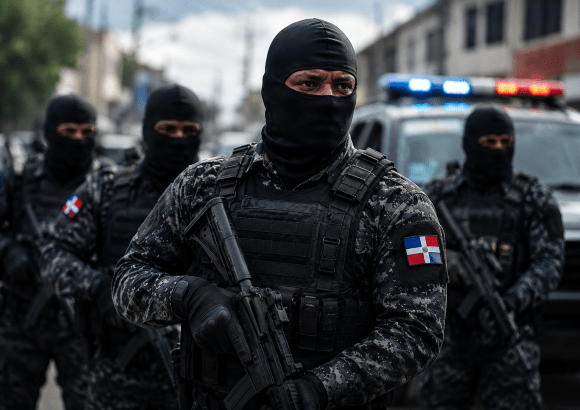
The use of face coverings by police officers during public operations and demonstrations has become a point of debate in the Dominican Republic, where concerns have been raised about the balance between protecting officers and ensuring that citizens can identify those exercising police authority.
Columnist Luis Padilla has questioned whether covering the faces of regular officers should become a common practice when they are interacting directly with members of the public. His concern centers on the difficulty of determining who carried out a particular action if an officer’s face cannot later be identified.
Security Versus Officer Identification
The issue involves two competing considerations. Police officers may require additional protection when participating in operations where their personal safety or identity could be at heightened risk. At the same time, officers who routinely perform public-facing duties exercise authority over citizens and must remain subject to mechanisms that allow their actions to be reviewed.
Padilla distinguished between those circumstances and the broader use of face coverings by regular police personnel. In his view, measures designed for specialized, high-risk operations should not automatically become standard practice for officers whose daily duties include direct contact with the public.
The concern is particularly relevant when questions arise about the conduct of an individual officer. If the officer’s face is concealed and there are insufficient identifying details, establishing who was involved in an encounter could become more difficult. That could complicate subsequent investigations into alleged abuses of authority or other irregular conduct.
Identification As Part of Police Oversight
The debate does not necessarily require choosing between officer safety and public accountability. A more practical approach would involve maintaining clear identification systems even when additional protective equipment is used.
Among the measures raised in the discussion are visible badge numbers, appropriate identification, defined operating protocols and supervisory systems capable of determining which officers participated in a particular operation. Such mechanisms could help protect citizens while also providing safeguards for officers who may later need to demonstrate that they acted within established procedures.
Effective identification can also serve the police institution itself. A system that makes individual officers traceable can help distinguish legitimate police activity from misconduct and provide a clearer basis for reviewing complaints or incidents. It can also reduce uncertainty when officers are involved in crowded demonstrations or other situations where many members of the security forces are operating simultaneously.
The Broader Question for Public Trust
Padilla’s argument does not question the risks faced by police officers or suggest that protective equipment is unnecessary. He acknowledged that many members of the force put their lives at risk while carrying out their duties, underscoring the legitimate need for security measures in dangerous situations.
The central question is instead how far protection of an officer’s identity should extend when that officer is exercising public authority over ordinary citizens. The distinction becomes particularly important in a democratic society, where policing depends not only on maintaining public order but also on mechanisms that allow official conduct to be examined.
For the Dominican Republic, the discussion places transparency and officer safety within the same institutional framework rather than treating them as mutually exclusive objectives. Clear identification, consistent protocols and effective supervision could provide a way to address security concerns without eliminating the ability to determine who was responsible for actions taken during public police operations.
As the debate continues, the question is ultimately how the country’s police institutions can protect personnel in genuinely high-risk situations while preserving the identification and accountability mechanisms that help sustain public confidence in law enforcement.