 24°C


Branches of Government in the Dominican Republic
The Dominican Republic divides state authority among three constitutionally independent branches: the Executive, the Legislative, and the Judicial. Each has distinct responsibilities, but none operates outside the Constitution. Their relationship is designed to distribute public power, establish institutional accountability, and prevent any single branch from exercising authority beyond its legal limits.


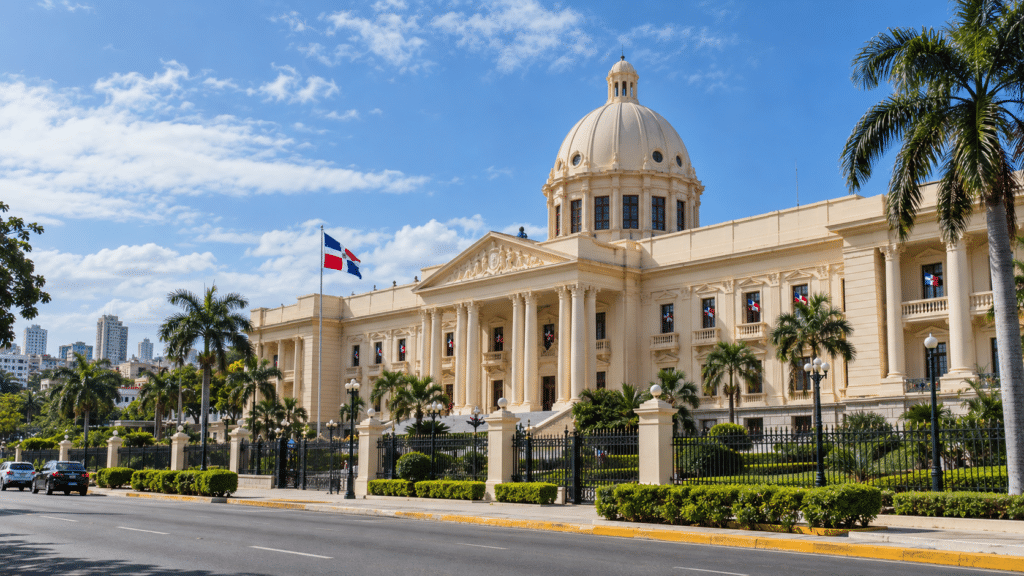
The Dominican Republic’s constitutional system is based on the separation and independence of the three branches of state power. The Executive, Legislative, and Judicial branches have different constitutional mandates, and the Constitution defines the limits within which each must operate. This arrangement combines the authority to govern, the authority to legislate, and the authority to administer justice within a single constitutional order.
The principal legal reference is the Constitution of the Dominican Republic, proclaimed on October 27, 2024. Article 4 establishes the separation of powers and their independence in the exercise of their respective functions, while Article 6 establishes the supremacy of the Constitution. Together, these principles mean that public authority is constitutionally limited and that no branch can claim unrestricted power over the state.
The Three Branches of Government at a Glance
Each branch performs a distinct constitutional function. The Executive leads the state and government within its legal authority, the Legislative exercises lawmaking and oversight powers through the National Congress, and the Judicial exercises judicial authority independently. Their responsibilities sometimes intersect, but those intersections are governed by constitutional rules rather than by a general hierarchy among the branches.
| Branch | Main institution | Core constitutional function |
|---|---|---|
| Executive | President of the Republic | Heads the state and government and exercises executive authority under the Constitution and laws. |
| Legislative | National Congress | Exercises legislative authority, represents the electorate, and performs constitutionally assigned oversight functions. |
| Judicial | Supreme Court of Justice and other courts | Administers justice and resolves disputes through the independent exercise of judicial authority. |
This division provides the foundation for understanding how the Dominican Republic distributes public power. It also establishes the basis for institutional accountability, constitutional review, and the legal limits that apply to public officials.
The Executive Branch: Constitutional Authority and Limits
The Executive Branch is exercised in the name of the people by the president of the Republic, who serves as both head of state and head of government. Article 122 of the Constitution defines this position, while Article 124 establishes direct presidential election for four-year terms and the applicable constitutional rules on reelection.
The president’s constitutional responsibilities include directing the Executive Branch, representing the state in the exercise of executive functions, and exercising the powers specifically assigned by the Constitution and legislation. The Executive also has a role in the relationship between the state and other countries, national defense, public administration, and the implementation of laws and public policy, subject to constitutional and legal limits.
The president does not possess the unrestricted authority to legislate or decide judicial disputes. Executive action must remain within the powers granted by the constitutional framework. Presidential decrees and other executive measures cannot validly override the Constitution or exercise powers reserved to another branch.
The Executive’s relationship with the other branches is therefore defined by both cooperation and limitation. It participates in the constitutional lawmaking framework, is subject to legislative oversight where the Constitution provides for it, and must respect judicial decisions issued within the courts’ jurisdiction. These relationships allow the Executive to exercise leadership without becoming the sole source of public authority.
The Legislative Branch: Representation and Constitutional Oversight
The Legislative Branch is exercised by the National Congress, which consists of two chambers: the Senate and the Chamber of Deputies. Article 76 of the Constitution establishes this structure. Senators and deputies are elected through direct universal suffrage under the electoral framework, giving the legislature a representative basis distinct from the presidential mandate.
The Congress has authority to enact laws and exercise other powers assigned by the Constitution. Its constitutional responsibilities also include decisions on public finance and national matters, as well as oversight of the Executive and public institutions in the circumstances established by law. The legislature is therefore not simply an advisory body to the president; it possesses its own constitutionally defined authority.
The two chambers form part of a bicameral system, meaning that legislative authority is exercised through two separate deliberative bodies rather than a single parliamentary chamber. The Constitution assigns specific responsibilities to each chamber and establishes matters in which they act separately or jointly.
The Congress also provides a formal mechanism for holding public officials accountable. Constitutional oversight powers include summoning or inviting officials to provide information, examining aspects of public administration, investigating matters of public interest, and supervising public policies within the scope established by the Constitution. These powers allow elected representatives to scrutinize executive action without taking over the Executive’s constitutional responsibilities.
Legislative authority is also limited. Congress must act within the Constitution, respect fundamental rights, and comply with the procedures and voting requirements applicable to its decisions. A law enacted by the legislature is not exempt from constitutional scrutiny merely because it has received legislative approval.
The Judicial Branch: Independent Administration of Justice
The Judicial Branch exercises the state’s judicial authority. Article 149 of the Constitution establishes that justice is administered in the name of the Republic through the Judicial Branch and the courts created by the Constitution and laws. Its central constitutional function is to resolve disputes, apply the law to cases within its jurisdiction, and issue decisions through an independent judicial process.
The Constitution recognizes the Judicial Branch’s functional, administrative, and budgetary autonomy. These guarantees are intended to protect the exercise of judicial authority from improper interference by the Executive, the Legislature, or other public actors. Judges must decide cases according to the applicable law rather than instructions from political authorities.
Judicial independence is a structural principle, not a declaration that courts operate outside the law. Courts are bound by the Constitution and legal rules governing their jurisdiction, procedures, and decisions. Their authority is exercised within the judicial system established by the constitutional framework.
The Judicial Branch must also be distinguished from the constitutional review functions assigned to the Constitutional Court. The Dominican Republic has a separate Constitutional Court with specific authority over constitutional matters. Its role is central to the protection of constitutional supremacy, but it should not be treated as simply another administrative department of the Executive or a chamber of Congress.
The judicial framework limits the other branches by requiring public authority to remain subject to the law and by providing mechanisms for resolving disputes in accordance with constitutional and statutory rules. At the same time, courts cannot assume the political or legislative responsibilities assigned to the other branches.
Separation of Powers: What It Means in Practice
Separation of powers means that the Constitution assigns different functions to distinct branches and protects their independence in exercising those functions. It does not mean that each branch can operate without interacting with the others. A constitutional system requires cooperation in certain areas while preserving the boundaries between their respective powers.
For example, the Executive may identify a policy objective and submit a legislative proposal, but the enactment of legislation belongs to the constitutional legislative process. Congress may adopt a law, but it cannot thereby direct judges to decide an individual case in a predetermined way. Courts may determine the legal consequences of a dispute, but they do not acquire a general mandate to formulate government policy.
The distinction between institutional authority and political influence is important. A branch may have considerable political influence because of its electoral support, public standing, or institutional position. That influence does not automatically expand its constitutional powers. Legal authority depends on the Constitution and applicable laws, not solely on political prominence.
Article 4 also establishes that the powers assigned to public officials are those determined by the Constitution and laws and that their responsibilities cannot be freely delegated. This principle reinforces the idea that constitutional offices have defined mandates rather than unlimited authority derived from their officeholders.
Checks and Balances Between the Three Branches
Checks and balances are the mechanisms through which the branches can scrutinize, constrain, or respond to one another within the constitutional framework. They are not designed to make every institution equally powerful in every situation. Instead, they distribute particular forms of authority so that important public decisions remain subject to legal requirements and institutional accountability.
Legislative oversight of the Executive
The Constitution grants the National Congress oversight powers over the Executive and public administration. These include mechanisms for obtaining information from officials, examining public accounts, investigating matters of public interest, and supervising public policies within the applicable constitutional framework. Such powers provide a formal means of scrutinizing how executive authority is exercised.
Oversight does not mean that Congress automatically assumes control of executive decisions. Its role is to exercise the powers assigned to it, require accountability where authorized, and act through the constitutional mechanisms available to the legislature.
Executive participation in the constitutional lawmaking framework
The Executive and Legislature have connected roles in the formation of laws. The president has constitutionally defined responsibilities concerning legislative initiatives, the promulgation of laws, and the exercise of objections where the Constitution permits them. These powers create a structured relationship between the branches rather than placing lawmaking entirely within the control of one institution.
However, the president cannot unilaterally replace Congress as the national legislature. Executive authority to issue decrees or other measures remains subject to the Constitution and laws. The legal effect of a presidential act depends on whether the president possesses the authority to issue it and whether the required constitutional conditions have been met.
Judicial independence and constitutional limits
The independence of the Judicial Branch helps ensure that disputes involving public authorities can be resolved through legal processes rather than political command. Where a case falls within a court’s jurisdiction, the relevant judicial institution must apply the governing law and constitutional rules.
The Constitutional Court has a distinct role in reviewing constitutional questions under its assigned jurisdiction. This function reinforces constitutional supremacy by providing a formal mechanism for examining whether laws and certain public acts comply with the Constitution. It does not give the Court general authority to replace the political judgment of elected institutions on every public question.
Constitutional responsibilities and accountability
Checks and balances also operate through rules governing public office, legal responsibility, and constitutional procedures. Public officials are accountable for exercising their powers within the limits established by law. The Constitution and legislation provide mechanisms for addressing particular violations, resolving institutional disputes, and determining the legal consequences of official conduct.
The exact mechanism depends on the nature of the issue. Political oversight, judicial review, financial scrutiny, and legal accountability are different processes, each with its own authority and requirements. They should not be treated as interchangeable or as powers that any branch can exercise without restriction.
The Constitutional Court and the Supreme Court of Justice
The Constitutional Court and the Supreme Court of Justice occupy different positions within the Dominican Republic’s constitutional framework. Although both are judicial institutions, they do not perform identical functions.
The Constitutional Court is responsible for constitutional matters within the jurisdiction established by the Constitution, including the review of constitutionality and the resolution of certain constitutional disputes. Its function supports the principle that all public authorities, including the three branches of government, are bound by the Constitution.
The Supreme Court of Justice is the highest court within the Judicial Branch’s ordinary judicial structure and exercises the powers assigned to it by the Constitution and law. Its role includes specific jurisdiction over cases and appeals established by the constitutional framework. It should not be confused with the Constitutional Court, whose jurisdiction is specifically focused on constitutional matters.
This distinction matters when considering checks and balances. The Judicial Branch administers justice through the courts, while the Constitutional Court provides a specialized constitutional safeguard. Neither institution functions as a political superior to the president or Congress in every matter; their authority depends on the constitutional jurisdiction assigned to them.
What Happens When Branches Disagree?
Disagreements between branches are a normal possibility in a system that distributes public power. They may arise over the interpretation of constitutional provisions, the scope of a public institution’s authority, the legal effect of an official act, or the boundaries between executive and legislative responsibilities.
The Constitution provides legal mechanisms for addressing these disputes. Depending on the issue, the relevant process may involve the constitutional responsibilities of Congress, judicial proceedings, or the jurisdiction of the Constitutional Court. The applicable procedure and the institution authorized to decide depend on the nature of the dispute and the constitutional provisions involved.
Political disagreement alone does not necessarily constitute a constitutional crisis or a legal violation. The key question is whether an institution has acted within its authority and whether the Constitution provides a mechanism for resolving the disagreement. Institutional independence requires respecting those legal processes, including their limits and outcomes.
Nor does the separation of powers guarantee that disagreements will always be resolved quickly. Constitutional procedures can involve legal interpretation, institutional deliberation, and competing arguments about the scope of authority. The system establishes rules for addressing disputes; it does not eliminate the possibility of political conflict.
The Constitution as the Supreme Legal Authority
The separation of powers ultimately depends on constitutional supremacy. Article 6 establishes that the Constitution is the supreme law and the foundation of the Dominican legal system. Public authorities and institutions exercising state powers are subject to it, and legal or administrative acts contrary to the Constitution are constitutionally invalid.
This principle applies to all three branches. The president cannot lawfully exceed the Executive’s constitutional mandate, Congress cannot enact valid legislation in disregard of constitutional limits, and judicial institutions must exercise their authority within the jurisdiction and rules established by the Constitution and law.
Constitutional supremacy also means that institutional power is not the same as personal authority. Officials exercise powers attached to their offices for constitutionally defined purposes. The legitimacy of public action therefore depends not only on who made a decision, but also on whether the decision was made by the competent institution and in accordance with the applicable legal framework.
The official constitutional text is available through the Dominican government’s Consultoría Jurídica del Poder Ejecutivo. It provides the primary reference for the organization of state power, the constitutional responsibilities of each branch, and the limits governing public authority.
Frequently Asked Questions
What are the three branches of government in the Dominican Republic?
They are the Executive Branch, headed by the president; the Legislative Branch, exercised by the National Congress through the Senate and Chamber of Deputies; and the Judicial Branch, which administers justice through the courts. Each has distinct constitutional responsibilities.
Are the three branches independent?
Yes. Article 4 of the Constitution establishes that the three branches are independent in the exercise of their respective functions. Their independence operates within the Constitution and alongside mechanisms of accountability and institutional cooperation.
Which branch has the most power?
The Constitution does not establish one branch as universally superior to the other two. Each has specific powers and responsibilities, and the limits of those powers depend on the constitutional framework. Political influence may vary, but it does not itself determine the legal scope of an institution’s authority.
Can the president overrule Congress?
The president has specific constitutional powers in relation to legislation, including responsibilities concerning promulgation and objections where applicable. These powers do not allow the president to exercise the legislature’s general lawmaking authority or disregard the constitutional procedures governing legislation.
Can courts review government actions?
Judicial institutions can examine matters within their respective jurisdictions, including disputes involving public authority. The Constitutional Court has a separate role in constitutional review and other matters specifically assigned to it. The availability and scope of review depend on the relevant constitutional and legal provisions.
What is the difference between the Constitutional Court and the Supreme Court of Justice?
The Constitutional Court handles constitutional matters within its assigned jurisdiction, while the Supreme Court of Justice exercises the powers of the highest court in the ordinary judicial structure. Their functions are distinct, even though both are important parts of the country’s judicial framework.
Conclusion
The Dominican Republic’s constitutional system distributes state authority among the Executive, Legislative, and Judicial branches, each with its own mandate and legal limits. The president leads the Executive, Congress exercises legislative and oversight authority, and the courts administer justice independently. Their relationships are governed by constitutional rules that combine institutional independence with accountability.

The essential principle is that no branch possesses unlimited authority. Separation of powers, legislative oversight, judicial independence, constitutional review, and the supremacy of the Constitution work together to define how public power may be exercised. Understanding these relationships provides a foundation for understanding the Dominican Republic’s political institutions without confusing constitutional authority with political influence.