 22°C
22°C
Dominican Republic Calls for Stronger Global Action Against Human Trafficking
The Dominican Republic used the commemoration of the 2026 World Day Against Trafficking in Persons to renew its commitment to combating human trafficking, emphasizing international cooperation, victim protection and coordinated action against transnational organized crime.


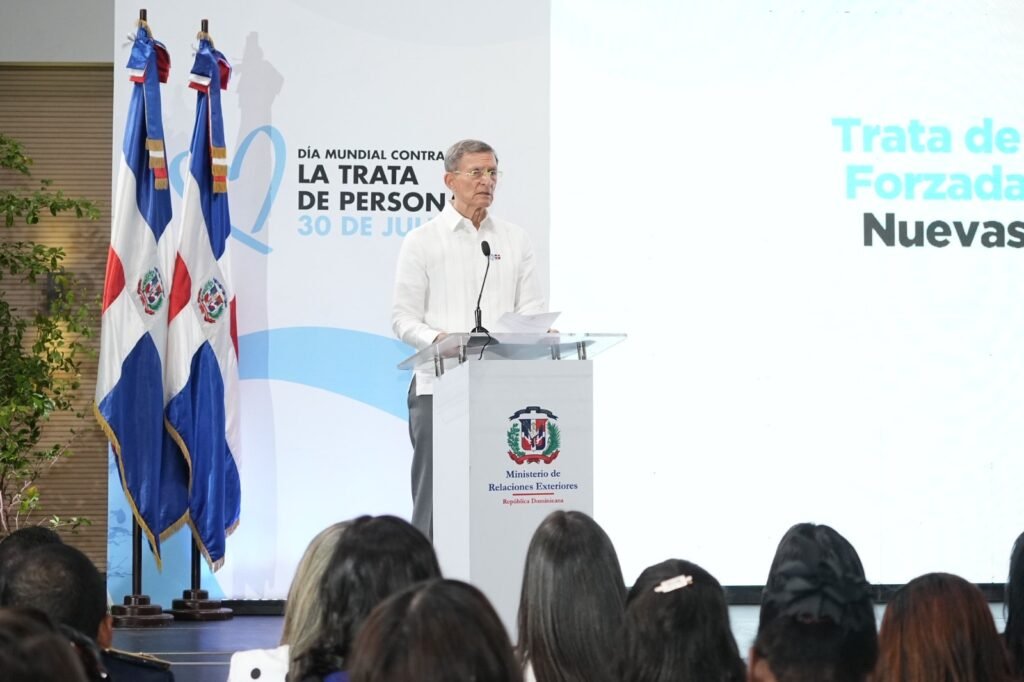
Marking the 2026 World Day Against Trafficking in Persons, the Dominican Republic’s Ministry of Foreign Affairs (MIREX) called for stronger international cooperation to confront human trafficking, describing the crime as one of the most serious violations of human rights and an increasingly significant source of funding for transnational organized crime.
In remarks delivered during the official commemorative ceremony, the ministry stressed that traffickers are increasingly forcing victims to participate in criminal activities such as financial fraud, online scams, cybercrime and money laundering, making them both victims and instruments of organized criminal networks.
Trafficking Continues to Evolve
The address cited the latest United Nations Office on Drugs and Crime (UNODC) Global Report on Trafficking in Persons, which found that the number of detected victims in 2022 exceeded pre-pandemic levels by 25%. The report also highlights how criminal organizations continue adapting their recruitment and exploitation methods in response to changing social, economic, migration and technological conditions.
The speech noted that the 2026 global theme, “Human Trafficking and Forced Criminality: Victims Trapped in Organized Crime,” reflects growing concern over victims being coerced into illegal activities after being recruited through false job offers, promises of better opportunities and digital platforms.
Forced Labor Now Exceeds Sexual Exploitation
According to the UNODC data referenced during the event, 42% of detected trafficking cases worldwide now involve forced labor, surpassing sexual exploitation, which accounts for 36%. Officials said the shift illustrates how criminal organizations continue diversifying exploitation methods to maximize illicit profits.
The ministry also pointed to another UNODC finding showing that 74% of convicted traffickers operated as members of organized criminal networks, underscoring the close relationship between human trafficking and transnational organized crime.
Dominican Republic Highlights International Cooperation
MIREX said combating trafficking requires coordinated judicial, law enforcement and financial investigations across borders, as well as timely information sharing and stronger international partnerships. The ministry reaffirmed the country’s commitment to the principles of the Palermo Protocol, which identifies international cooperation as a cornerstone of preventing trafficking, prosecuting offenders and protecting victims.
The ministry also highlighted the work of the Interinstitutional Commission Against Trafficking in Persons and the Smuggling of Migrants (CITIM), chaired by MIREX, which coordinates national policies on prevention, criminal prosecution and victim assistance.
Regional Leadership Role
The Dominican Republic also emphasized its role as vice president of the Ninth Meeting of National Authorities on Trafficking in Persons of the Organization of American States (OAS) for the 2026–2028 term, alongside Honduras, describing the position as an opportunity to strengthen hemispheric cooperation against trafficking networks.
Closing the ceremony, the ministry announced that commemorative activities would continue with the Third Training Seminar, “Human Trafficking and Forced Criminality: Victims Trapped in Organized Crime,” organized with the support of the United Nations Office on Drugs and Crime (UNODC) and the International Organization for Migration (IOM). The event aims to strengthen institutional capacity to respond to emerging forms of human trafficking while reinforcing international collaboration.