 29°C
A Chronological List of Dominican Republic Presidents: 1844–2026
Since declaring independence on February 27, 1844, the Dominican Republic has experienced more than 180 years of presidential administrations, provisional governments, military coups, foreign occupation and democratic transitions. Its political history includes leaders who governed repeatedly, presidents who served for only a few months and periods in which rival governments claimed executive authority.


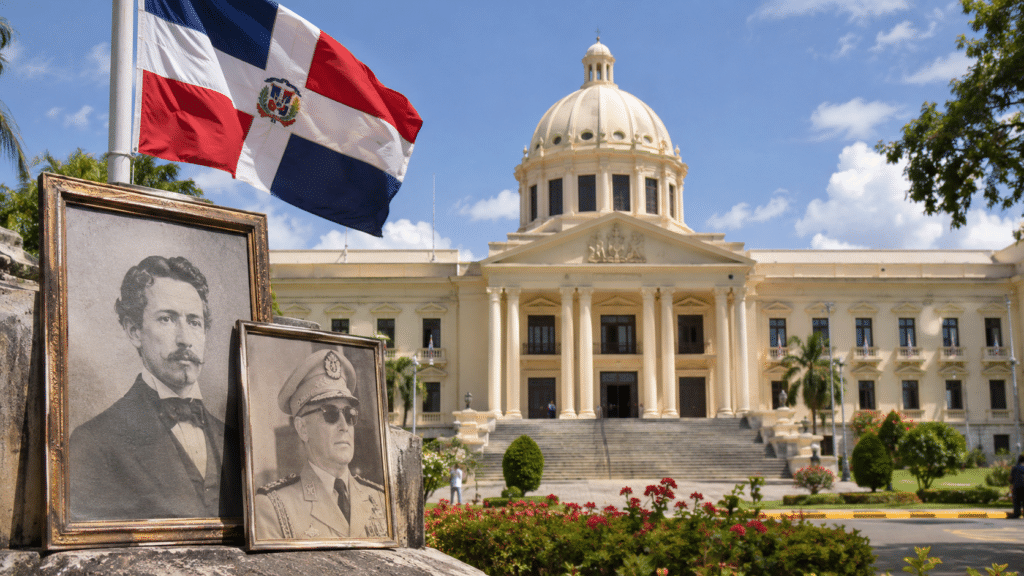
This chronological reference covers the country’s presidents and principal heads of government from independence through November 2026. It includes their periods in office, political affiliations where historically relevant, and the major events associated with their administrations. Luis Abinader, the current president, is included with his two consecutive terms, beginning in 2020.
Political affiliations are identified where they can be established historically. During much of the nineteenth century, political life revolved around military leaders and personal factions rather than modern political parties. The Red and Blue factions, for example, were important political movements during the Second Republic.
1. The First Republic (1844–1861)
The Dominican Republic declared independence from Haiti on February 27, 1844. Its first governments were dominated by military leaders and political factions competing over the organization and future of the new republic.
Francisco del Rosario Sánchez (February–July 1844)
Political affiliation: Independence movement.
Sánchez headed the provisional governing junta immediately after the declaration of independence. He was one of the principal founding fathers of the Dominican Republic and helped establish the first national governing institutions. His leadership preceded Pedro Santana’s assumption of supreme executive authority.
Tomás Bobadilla (1844)
Political affiliation: Conservative independence movement.
Bobadilla became the first president of the Central Governing Junta in March 1844. He played an important role in organizing the new state before being displaced during the political and military consolidation led by Pedro Santana.
Pedro Santana (1844–1848)
Political affiliation: Conservative, Santanista faction.
Pedro Santana became the first constitutional president on November 13, 1844. A leading military figure in the independence movement, he established a centralized government and played a major role in the country’s early political and military organization.
Manuel Jimenes (1848–1849)
Political affiliation: No formal modern political party.
Manuel José Jimenes became president in September 1848. His administration faced military threats and political opposition. Pedro Santana returned to power in May 1849 following a confrontation over the country’s leadership and defense.
Pedro Santana (1849)
Political affiliation: Santanista faction.
Santana briefly returned to executive power in May 1849, exercising authority until September, when Buenaventura Báez assumed the presidency.
Buenaventura Báez (1849–1853)
Political affiliation: Baecista faction.
Báez began his first presidential administration in September 1849. He became one of the country’s most influential nineteenth-century political figures and a persistent rival of Santana.
Pedro Santana (1853–1856)
Political affiliation: Santanista faction.
Santana returned to the presidency in February 1853. His administration continued the centralized political model and the rivalry with Báez. Manuel de Regla Mota temporarily exercised executive authority during some of Santana’s absences.
Manuel de Regla Mota (1856)
Political affiliation: Conservative political leadership.
Manuel de Regla Mota assumed the presidency in May 1856. His administration lasted until October, when Buenaventura Báez returned to power.
Buenaventura Báez (1856–1858)
Political affiliation: Baecista faction.
Báez’s second administration faced an economic and political crisis that triggered the revolution of 1857. Opposition forces established a rival government in Santiago under José Desiderio Valverde.
José Desiderio Valverde (1857–1858)
Political affiliation: Opposition to the Baecista government.
Valverde headed the revolutionary government established in Santiago in 1857. His administration challenged Báez’s authority and played a central role in the political conflict that preceded Santana’s return.
Pedro Santana (1858–1861)
Political affiliation: Santanista faction.
Santana returned to power in 1858. His final administration culminated in the annexation of the Dominican Republic to Spain on March 18, 1861, ending the First Republic and restoring Spanish colonial rule.
2. Spanish Annexation and the Restoration of Independence (1861–1865)
Between 1861 and 1865, the Dominican Republic was incorporated into the Spanish monarchy. Pedro Santana initially served as governor-general, followed by Spanish colonial authorities. There was no independent Dominican presidency during the annexation.
The Dominican Restoration War began in 1863 as an armed movement against Spanish rule. Its leaders established provisional governments that represented the restoration of national sovereignty.
José Antonio Salcedo (1863–1864)
Political affiliation: Restoration movement.
Known as Pepillo Salcedo, he became president of the provisional restoration government in September 1863. His administration directed the independence struggle until he was removed from power in October 1864.
Gaspar Polanco (1864–1865)
Political affiliation: Restoration movement.
Polanco led the provisional government from October 1864 to January 1865. His administration operated during the war against Spain and was marked by internal divisions among restoration leaders.
Benigno Filomeno de Rojas (1865)
Political affiliation: Restoration movement.
Rojas participated in the governing structure established during the final stages of the Restoration War. He held leadership responsibilities within the provisional authorities in early 1865.
Pedro Antonio Pimentel (1865)
Political affiliation: Restoration movement.
Pimentel assumed executive authority in March 1865. His administration coincided with the final withdrawal of Spanish forces and the restoration of Dominican independence.
José María Cabral (1865)
Political affiliation: Blue political movement.
Cabral exercised executive authority as Protector of the Republic from August to November 1865. He subsequently returned to the presidency in 1866.
Pedro Guillermo (1865)
Political affiliation: No established modern party.
Guillermo served as provisional head of the executive between November and December 1865, pending the return of Buenaventura Báez.
Buenaventura Báez (1865–1866)
Political affiliation: Red political faction.
Báez returned to the presidency in December 1865. His government was challenged by the opposition and eventually replaced by a collective governing authority in 1866.
3. Political Instability and the Second Republic (1866–1916)
The Second Republic was characterized by military uprisings, competing political factions and frequent changes of government. The Red faction was associated with Buenaventura Báez, while the Blue movement included important Restoration leaders such as Gregorio Luperón.
Triumvirate (1866)
Leadership: Pedro Antonio Pimentel, Gregorio Luperón and Federico de Jesús García.
This collective government exercised executive authority between May and August 1866. It emerged from the opposition to Báez and prepared the way for José María Cabral’s return.
José María Cabral (1866–1868)
Political affiliation: Blue political movement.
Cabral returned to the presidency in September 1866. His government was overthrown in January 1868 following the return of the Baecista political faction.
Buenaventura Báez (1868–1874)
Political affiliation: Red political faction.
Báez governed from May 1868 until January 1874. His administration became known as the Six Years’ Government. He pursued a proposal to annex the Dominican Republic to the United States, but the plan was rejected by the U.S. Senate.
Ignacio María González (1874–1876)
Political affiliation: Green political movement.
González emerged as president following the fall of Báez. His administration experienced repeated political challenges and changes in executive authority. He governed through several periods between 1874 and 1876 and briefly returned to power in 1878.

Ulises Francisco Espaillat (1876)
Political affiliation: Liberal, associated with the Blue movement.
Espaillat became president in April 1876. His administration promoted institutional reform but faced strong political and military opposition. He resigned in October 1876.
Buenaventura Báez (1876–1878)
Political affiliation: Red political faction.
Báez returned to the presidency for his fifth administration in December 1876. His final government ended in 1878 amid another political crisis.
Ignacio María González (1878)
Political affiliation: Green political movement.
González briefly returned to executive authority in 1878 during the continuing political conflict between rival factions.
Cesáreo Guillermo (1878–1879)
Political affiliation: Associated with the Red political current.
Guillermo led provisional and presidential governments during the turbulent transition of 1878–1879. His administration was challenged by the Blue movement and the Restoration leadership of Gregorio Luperón.
Jacinto de Castro (1878)
Political affiliation: No modern political party.
As president of the Supreme Court, Jacinto de Castro temporarily assumed executive authority in September 1878 under constitutional succession provisions.
Gregorio Luperón (1879–1880)
Political affiliation: Blue political movement.
Luperón headed a provisional government established in Puerto Plata in October 1879. His administration helped restore the political influence of the Blue movement and prepared the country for a new constitutional government.
Fernando Arturo de Meriño (1880–1882)
Political affiliation: Blue political movement.
Meriño became president in September 1880. His government maintained the political order established after the Restoration movement’s return to power, although it also imposed severe measures against armed opposition.
Ulises Heureaux (1882–1884)
Political affiliation: Initially associated with the Blue movement.
Heureaux, widely known as Lilís, began his first presidential administration in 1882. He later consolidated an authoritarian political system that dominated the country for much of the following two decades.
Francisco Gregorio Billini (1884–1885)
Political affiliation: Blue political movement.
Billini assumed the presidency in September 1884. He resigned in May 1885 amid disagreements over the government’s response to political opposition.
Alejandro Woss y Gil (1885–1887)
Political affiliation: Blue political movement.
Woss y Gil became president in May 1885. His administration preceded the consolidation of Ulises Heureaux’s authoritarian rule.
Ulises Heureaux (1887–1899)
Political affiliation: Initially associated with the Blue movement; subsequently personalist authoritarian rule.
Heureaux returned to power in 1887 and remained the country’s dominant political figure until his assassination on July 26, 1899. His government relied on military control, political repression and extensive borrowing. The growing foreign debt contributed to the financial difficulties that followed his death.
Juan Wenceslao Figuereo (1899)
Political affiliation: No established modern political party.
Figuereo briefly assumed the presidency after Heureaux’s assassination. His administration lasted from July to August 1899, during a period of political upheaval.
Horacio Vásquez (1899)
Political affiliation: Horacista movement.
Vásquez headed a provisional government from August to November 1899. He later became president again in the early twentieth century and between 1924 and 1930.
Juan Isidro Jimenes (1899–1902)
Political affiliation: Jimenista movement.
Jimenes became president in November 1899. His administration faced political divisions, financial difficulties and growing foreign involvement in Dominican economic affairs. He was removed from power in 1902.
Horacio Vásquez (1902–1903)
Political affiliation: Horacista movement.
Vásquez returned to executive power in April 1902 following an uprising against Jimenes. His administration ended in 1903 amid another political confrontation.
Alejandro Woss y Gil (1903)
Political affiliation: No firmly established modern party affiliation.
Woss y Gil returned to the presidency in March 1903 and remained in power until November, when his government was overthrown.
Carlos Felipe Morales Languasco (1903–1905)
Political affiliation: Opposition coalition.
Morales Languasco became president in October 1903. His administration operated amid serious financial difficulties and foreign pressure over the country’s outstanding debts.
Ramón Cáceres (1905–1911)
Political affiliation: Horacista political current.
Cáceres assumed the presidency in November 1905. His administration strengthened central government authority and promoted infrastructure and economic development. In 1907, a financial agreement placed Dominican customs revenues under U.S. supervision to secure debt repayment. Cáceres was assassinated in November 1911.
Eladio Victoria (1911–1912)
Political affiliation: No established modern political party.
Victoria assumed executive authority in December 1911, initially as interim president and subsequently as constitutional president. His administration faced armed opposition and political instability.
Adolfo Alejandro Nouel (1912–1913)
Political affiliation: Independent.
Nouel, a Catholic archbishop, became interim president in December 1912. His administration sought to restore political stability but resigned in April 1913.
José Bordas Valdez (1913–1914)
Political affiliation: No established modern political party.
Bordas Valdez became interim constitutional president in April 1913. His government faced military opposition before being replaced in August 1914.
Ramón Báez (1914)
Political affiliation: No established modern political party.
Ramón Báez served as provisional president from August to December 1914 during negotiations intended to resolve the country’s political crisis.
Juan Isidro Jimenes (1914–1916)
Political affiliation: Jimenista movement.
Jimenes returned to the presidency in December 1914. His administration faced mounting tensions with military leaders and the United States. He resigned in May 1916.
Francisco Henríquez y Carvajal (1916)
Political affiliation: Independent.
Henríquez y Carvajal assumed the presidency in July 1916. His government was unable to resolve the confrontation with the United States, whose military forces had already entered the country. The first U.S. occupation began in November 1916.
4. U.S. Military Occupation and the Return to Constitutional Government (1916–1930)
The Dominican Republic was under direct U.S. military administration from 1916 to 1924. During most of this period, there was no independent Dominican president exercising full national executive authority.
Juan Bautista Vicini Burgos (1922–1924)
Political affiliation: Independent; provisional president.
Vicini became provisional president in October 1922 under an agreement designed to facilitate the end of the U.S. occupation. His administration organized the transition to constitutional government and the presidential elections of 1924.
Horacio Vásquez (1924–1930)
Political affiliation: Horacista movement; Dominican National Party.
Vásquez won the 1924 presidential election and returned the country to constitutional government. His administration oversaw infrastructure development and institutional reconstruction. Political tensions surrounding the extension of his presidential term contributed to the crisis that ended with his removal in 1930.
5. The Trujillo Dictatorship (1930–1961)
From 1930 to 1961, the Dominican Republic was dominated by Rafael Leónidas Trujillo. Although other individuals formally occupied the presidency during parts of this period, Trujillo retained decisive political and military authority.
Rafael Estrella Ureña (1930)
Political affiliation: Political movement supporting Trujillo.
Estrella Ureña assumed the presidency in March 1930 after Horacio Vásquez resigned. He played an important role in the political transition that preceded Trujillo’s inauguration in August.
Rafael Leónidas Trujillo (1930–1938)
Political affiliation: Dominican Party.
Trujillo began his first formal presidential administration in August 1930. His dictatorship was characterized by political persecution, censorship, extensive state control and a personality cult. In October 1937, Dominican forces carried out the massacre of Haitians and Haitian-descended people in the border region, an event known as the Parsley Massacre.
Jacinto Bienvenido Peynado (1938–1940)
Political affiliation: Dominican Party.
Peynado became president in August 1938, although Trujillo retained effective political control. His administration coincided with the continuation of the dictatorship and the country’s recovery from the devastating 1930 San Zenón hurricane.
Manuel de Jesús Troncoso de la Concha (1940–1942)
Political affiliation: Dominican Party.
Troncoso assumed the presidency in March 1940. His administration operated under Trujillo’s political dominance. The country also entered the international context of World War II during his period in office.
Rafael Leónidas Trujillo (1942–1952)
Political affiliation: Dominican Party.
Trujillo returned to the presidency in May 1942 and remained formally in office until August 1952. His dictatorship continued to control political life, the armed forces and major economic sectors. Political repression remained a defining feature of the period.
Héctor Bienvenido Trujillo (1952–1960)
Political affiliation: Dominican Party.
Héctor Trujillo, the dictator’s brother, became president in August 1952. Rafael Trujillo remained the country’s dominant political figure. The regime faced growing international isolation, particularly following the assassination attempt against Venezuelan President Rómulo Betancourt in 1960.
Joaquín Balaguer (1960–1962)
Political affiliation: Dominican Party during the dictatorship; later founder of the Reformist Party.
Balaguer assumed the presidency in August 1960 as the Trujillo dictatorship entered its final crisis. Following Trujillo’s assassination on May 30, 1961, he remained in office during the transition away from the dictatorship. Political opposition and demands for democratic change forced his departure in January 1962.
6. Democratic Transition and the 1965 Civil War (1962–1966)
The years following Trujillo’s assassination were marked by attempts to establish democratic institutions, a military coup, competing governments and foreign intervention. The 1965 civil war was a defining event in this transition.
Rafael Filiberto Bonnelly (1962–1963)
Political affiliation: Independent; Council of State.
Bonnelly assumed the presidency in January 1962. His administration oversaw the transition toward democratic elections and the December 1962 vote, which was won by Juan Bosch.
Juan Bosch (1963)
Political affiliation: Dominican Revolutionary Party (PRD).
Bosch took office on February 27, 1963, following the first democratic presidential election after the Trujillo dictatorship. His government introduced constitutional and social reforms aimed at strengthening civil liberties and changing traditional political and economic structures.
On September 25, 1963, Bosch was overthrown in a military coup. His removal initiated another period of political instability.
Emilio de los Santos (1963)
Political affiliation: Military-backed Triumvirate.
De los Santos initially headed the collective government established after Bosch’s overthrow. He resigned in December 1963 following the killing of members of the June 14 Revolutionary Movement.
Donald Reid Cabral (1963–1965)
Political affiliation: Military-backed civilian government.
Reid Cabral became the leading figure of the Triumvirate in December 1963. His government faced increasing opposition from supporters of Bosch and other political groups. The crisis culminated in the April 1965 uprising.
José Rafael Molina Ureña (1965)
Political affiliation: Constitutionalist movement supporting Juan Bosch.
Molina Ureña briefly assumed the provisional presidency on April 25, 1965, during the constitutionalist uprising. His administration sought to restore the constitutional order established under Bosch.
Pedro Bartolomé Benoit (1965)
Political affiliation: Military government opposing the constitutionalist movement.
Benoit headed a military junta from May 1 to May 7, 1965, during the civil conflict.
Francisco Alberto Caamaño (1965)
Political affiliation: Constitutionalist movement.
Caamaño became president of the constitutionalist government in May 1965. His leadership was central to the April Revolution, which sought to restore Bosch’s government. The conflict also led to a U.S. military intervention beginning on April 28, 1965.
Antonio Imbert Barrera (1965)
Political affiliation: Government of National Reconstruction; military leadership.
Imbert headed the opposing Government of National Reconstruction from May to August 1965. His administration operated during the international intervention and negotiations intended to end the civil conflict.
Héctor García Godoy (1965–1966)
Political affiliation: Independent; provisional president.
García Godoy assumed the provisional presidency in September 1965 following the national reconciliation agreement. His main responsibility was to restore political stability and organize new elections. The 1966 election brought Joaquín Balaguer back to power.
7. Joaquín Balaguer and the Return to Electoral Democracy (1966–1996)
Joaquín Balaguer governed for twelve consecutive years between 1966 and 1978, returned to office in 1986 and remained president until 1996. His administrations covered a significant period of Dominican political and economic development.
Joaquín Balaguer (1966–1978)
Political affiliation: Reformist Party, later the Social Christian Reformist Party (PRSC).
Balaguer won the 1966 election and began a twelve-year period in office. His governments promoted infrastructure projects, public works and economic development. The period was also marked by political repression, restrictions on opposition groups and allegations of human rights abuses, particularly during the early years.
In 1978, Antonio Guzmán of the Dominican Revolutionary Party won the presidential election. The transfer of power marked an important moment in the country’s democratic development.
Antonio Guzmán (1978–1982)
Political affiliation: Dominican Revolutionary Party (PRD).
Silvestre Antonio Guzmán Fernández became president in August 1978. His administration was associated with political liberalization, greater respect for civil liberties and the release of political prisoners. The government also faced economic challenges and the effects of Hurricane David in 1979.
Guzmán died by suicide on July 4, 1982, shortly before the end of his presidential term.
Jacobo Majluta (1982)
Political affiliation: Dominican Revolutionary Party (PRD).
As vice president, Majluta assumed the presidency following Guzmán’s death. He served from July 4 to August 16, 1982, completing the constitutional transition until the inauguration of Salvador Jorge Blanco.
Salvador Jorge Blanco (1982–1986)
Political affiliation: Dominican Revolutionary Party (PRD).
Jorge Blanco took office in August 1982. His administration faced a severe economic crisis, rising inflation and negotiations with the International Monetary Fund. In April 1984, economic adjustment measures triggered widespread protests and riots.
Joaquín Balaguer (1986–1996)
Political affiliation: Social Christian Reformist Party (PRSC).
Balaguer returned to the presidency in August 1986 and won re-election in 1990 and 1994. His governments continued major infrastructure and public works projects.
The 1994 presidential election was disputed amid allegations of irregularities. The resulting political crisis led to the Pact for Democracy, which shortened Balaguer’s final term and established early elections for 1996.
8. Modern Dominican Presidents (1996–Present)
Since 1996, the Dominican Republic has experienced successive electoral transitions between the Dominican Liberation Party, the Dominican Revolutionary Party and the Modern Revolutionary Party. This period has been characterized by competitive elections, economic expansion, infrastructure investment and changes to constitutional rules on presidential re-election.
Leonel Fernández (1996–2000)
Political affiliation: Dominican Liberation Party (PLD).
Fernández became president in August 1996 after winning the presidential election against José Francisco Peña Gómez in the second round. His administration promoted economic modernization, foreign investment, infrastructure development and the expansion of telecommunications.
Hipólito Mejía (2000–2004)
Political affiliation: Dominican Revolutionary Party (PRD).
Mejía assumed office in August 2000. His administration faced the consequences of the 2003 banking crisis, one of the most serious financial disruptions in the country’s recent history. The collapse of major financial institutions contributed to economic instability, inflation and a loss of confidence in the financial system.
Leonel Fernández (2004–2012)
Political affiliation: Dominican Liberation Party (PLD).
Fernández returned to the presidency in August 2004 and won re-election in 2008. His administrations emphasized economic growth, infrastructure development, international investment and modernization projects.
The first line of the Santo Domingo Metro began operating in 2009. The 2010 Constitution also introduced significant institutional changes and new rules governing presidential succession and re-election.
Danilo Medina (2012–2020)
Political affiliation: Dominican Liberation Party (PLD).
Medina took office in August 2012 and won a second term in 2016. His administrations were associated with increased public investment in education, including the allocation of 4% of gross domestic product to pre-university education, as well as infrastructure and rural development programs.
His government also faced public controversy over corruption allegations and the Odebrecht bribery scandal, which affected several countries in Latin America and the Caribbean. A constitutional amendment in 2015 allowed Medina to seek re-election in 2016.
Luis Abinader (2020–2024)
Political affiliation: Modern Revolutionary Party (PRM).
Luis Rodolfo Abinader Corona won the July 5, 2020 presidential election and took office on August 16, 2020. He became the first president representing the Modern Revolutionary Party, which had emerged from a division within the Dominican Revolutionary Party.
His first administration coincided with the COVID-19 pandemic and the country’s economic recovery. Major issues included public health, tourism recovery, economic growth, institutional transparency, infrastructure and migration policy.
Luis Abinader (2024–2028)
Political affiliation: Modern Revolutionary Party (PRM).
Abinader won re-election in the May 19, 2024 presidential election and was sworn in for his second consecutive four-year term on August 16, 2024. His administration is scheduled to conclude on August 16, 2028.
His second term continues to address public administration, economic development, infrastructure, education, healthcare, security and institutional reform. Abinader remains the current president of the Dominican Republic as of November 2026.
9. Dominican Presidents by Political Party
Modern political parties did not exist in their present form during much of the nineteenth century. Early Dominican political life was organized around military leaders, personal alliances and factions. The Red and Blue movements were especially influential during the Second Republic.
From the twentieth century onward, formal political parties became increasingly important. The following organizations have been associated with modern Dominican presidents:
Dominican Party
The political organization used by Rafael Trujillo to consolidate and maintain his dictatorship. It also provided the formal political affiliation of presidents who served under his authority.
Dominican Revolutionary Party (PRD)
Associated with Juan Bosch, Antonio Guzmán, Salvador Jorge Blanco and Hipólito Mejía. Founded in 1939, it became one of the principal organizations in Dominican electoral politics.
Social Christian Reformist Party (PRSC)
The political organization associated with Joaquín Balaguer and his return to power in the democratic period after 1966.
Dominican Liberation Party (PLD)
Founded by Juan Bosch in 1973. It became the political organization of Leonel Fernández and Danilo Medina, who governed the country between 1996 and 2000 and again between 2004 and 2020.
Modern Revolutionary Party (PRM)
Founded in 2014 following a division within the PRD. It became the governing party when Luis Abinader won the 2020 presidential election and retained the presidency in 2024.
10. Quick Reference: Dominican Presidents and Their Terms
The following chronological summary identifies the principal national administrations. Where competing or collective governments existed, they are identified separately rather than presented as uninterrupted constitutional presidencies. Dates for provisional and rival administrations may overlap with those of other authorities.
1844–1861: First Republic
February–July 1844: Francisco del Rosario Sánchez, provisional governing junta.
March–June 1844: Tomás Bobadilla, president of the Central Governing Junta.
1844–1848: Pedro Santana.
1848: Council of Secretaries of State, provisional executive authority.
1848–1849: Manuel Jimenes.
1849: Pedro Santana.
1849–1853: Buenaventura Báez.
1853–1856: Pedro Santana.
1856: Manuel de Regla Mota.
1856–1858: Buenaventura Báez.
1857–1858: José Desiderio Valverde, rival government.
1858–1861: Pedro Santana.
1861–1865: Spanish Annexation and Restoration
1861–1862: Pedro Santana, Spanish-appointed governor-general.
1862–1863: Felipe Ribero y Lemoyne, Spanish colonial governor.
1863–1864: Carlos de Vargas y Cerveto, Spanish colonial governor.
1863–1864: José Antonio Salcedo, president of the Restoration government.
1864–1865: Gaspar Polanco, president of the Restoration government.
1864–1865: José de la Gándara y Navarro, Spanish colonial governor.
1865: Benigno Filomeno de Rojas, restoration governing authority.
1865: Pedro Antonio Pimentel.
1865: José María Cabral.
1865: Pedro Guillermo.
1865–1866: Buenaventura Báez.
1866–1916: Second Republic
1866: Triumvirate led by Pedro Antonio Pimentel, Gregorio Luperón and Federico de Jesús García.
1866–1868: José María Cabral.
1868: Manuel Cáceres, brief transitional authority.
1868–1874: Buenaventura Báez.
1874–1876: Ignacio María González.
1876: Ulises Francisco Espaillat.
1876–1878: Buenaventura Báez.
1878: Ignacio María González.
1878–1879: Cesáreo Guillermo.
1878: Jacinto de Castro, interim president.
1879–1880: Gregorio Luperón.
1880–1882: Fernando Arturo de Meriño.
1882–1884: Ulises Heureaux.
1884–1885: Francisco Gregorio Billini.
1885–1887: Alejandro Woss y Gil.
1887–1899: Ulises Heureaux.
1899: Juan Wenceslao Figuereo.
1899: Horacio Vásquez, provisional government.
1899–1902: Juan Isidro Jimenes.
1902–1903: Horacio Vásquez.
1903: Alejandro Woss y Gil.
1903–1905: Carlos Felipe Morales Languasco.
1905–1911: Ramón Cáceres.
1911–1912: Eladio Victoria.
1912–1913: Adolfo Alejandro Nouel.
1913–1914: José Bordas Valdez.
1914: Ramón Báez.
1914–1916: Juan Isidro Jimenes.
1916: Francisco Henríquez y Carvajal.
1916–1966: Occupation, Dictatorship and Democratic Transition
1916–1922: U.S. military occupation; no independent Dominican president.
1922–1924: Juan Bautista Vicini Burgos, provisional president.
1924–1930: Horacio Vásquez.
1930: Rafael Estrella Ureña.
1930–1938: Rafael Leónidas Trujillo.
1938–1940: Jacinto Bienvenido Peynado.
1940–1942: Manuel de Jesús Troncoso de la Concha.
1942–1952: Rafael Leónidas Trujillo.
1952–1960: Héctor Bienvenido Trujillo.
1960–1962: Joaquín Balaguer.
1962–1963: Rafael Filiberto Bonnelly.
1963: Juan Bosch.
1963–1965: Triumvirate, initially headed by Emilio de los Santos and later led by Donald Reid Cabral.
1965: José Rafael Molina Ureña, Pedro Bartolomé Benoit, Francisco Alberto Caamaño and Antonio Imbert Barrera, representing competing or transitional governments.
1965–1966: Héctor García Godoy.
1966–Present: Modern Electoral Period
1966–1978: Joaquín Balaguer.
1978–1982: Antonio Guzmán.
1982: Jacobo Majluta.
1982–1986: Salvador Jorge Blanco.
1986–1996: Joaquín Balaguer.
1996–2000: Leonel Fernández.
2000–2004: Hipólito Mejía.
2004–2012: Leonel Fernández.
2012–2020: Danilo Medina.
2020–2024: Luis Abinader, first term.
2024–2028: Luis Abinader, second term and current administration.