 24°C


Fundamental Principles of the Constitution of the Dominican Republic
The fundamental principles of the Dominican Republic's Constitution establish the legal and political foundations of the state. They define where public authority comes from, how it must be exercised, what limits apply to government institutions and which values guide the interpretation of the constitutional system. The 2024 Constitution places particular emphasis on popular sovereignty, human dignity, the rule of law, democracy and the separation of powers. These principles are distinct from individual rights and from the legal procedures through which people can defend those rights.


What Are the Fundamental Principles of the Dominican Constitution?
The fundamental principles of the Constitution of the Dominican Republic are the basic rules and values that define the nature of the state, establish the source and limits of public authority, and guide the interpretation of the entire legal system. They provide the framework within which government institutions operate and legislation must be adopted and applied.
These principles are set out primarily in the preamble and Title I of the Constitution, particularly Articles 1 through 8. They establish the Dominican Republic as a sovereign, independent, democratic and representative state, organized as a unitary republic and founded on respect for human dignity, fundamental rights, popular sovereignty and the separation of public powers.
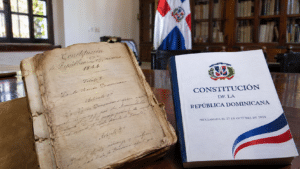
The current constitutional text was proclaimed by the National Revisory Assembly on October 27, 2024. It retains the foundational structure established in the 2010 Constitution while incorporating subsequent amendments. Its opening provisions are therefore essential for understanding the legal identity of the Dominican state and the principles that govern its institutions.
The Constitutional Foundations of the Dominican State
The Constitution does not treat the principles governing the state as isolated declarations. They form a connected system. Popular sovereignty explains the origin of public authority; democracy and representation establish how that authority is exercised; separation of powers prevents its concentration; constitutional supremacy sets its legal limits; and human dignity determines the values that public institutions must respect.
Article 7 brings several of these elements together by defining the Dominican Republic as a social and democratic state governed by the rule of law. It identifies human dignity, fundamental rights, work, popular sovereignty and the separation and independence of public powers as foundations of that model.
1. Popular Sovereignty: All Public Authority Comes from the People
Article 2 establishes that sovereignty resides exclusively in the Dominican people, from whom all public powers originate. The people exercise this sovereignty through their elected representatives or directly, in accordance with the Constitution and the laws.
In constitutional terms, sovereignty means the ultimate authority to determine the political and legal organization of the country. The principle of popular sovereignty rejects the idea that public power belongs inherently to a monarch, a government, a political party, the armed forces or an individual officeholder. Public institutions exercise authority because the constitutional order derives that authority from the people.
How is popular sovereignty exercised?
The Constitution recognizes two broad forms of participation. The first is representative: citizens elect public officials who exercise the responsibilities assigned to their respective offices. The second is direct: citizens can participate in specific public decisions through mechanisms established by the Constitution and legislation.
Article 22 identifies several citizenship rights connected with this principle, including voting, eligibility for elected office, participation in referendums and the exercise of popular legislative and municipal initiative under the applicable rules. These are specific constitutional rights that give practical expression to the broader principle of popular sovereignty.
Popular sovereignty does not mean that every public decision must be submitted to a popular vote. Nor does it allow a temporary majority to disregard constitutional limits. The people exercise sovereignty within the constitutional framework, which protects fundamental rights and establishes procedures for public authority.
2. National Sovereignty and the Principle of Non-Intervention
Article 3 addresses a different dimension of sovereignty: the independence of the Dominican state from foreign powers. It declares national sovereignty inviolable and establishes that public authorities cannot carry out or permit direct or indirect intervention in the country’s internal or external affairs when that intervention undermines the state’s independence, integrity or constitutional attributes.
This principle is closely connected to the historical idea of national independence. It establishes that the Dominican Republic has its own constitutional identity and exercises its public authority without being subject to the political control of another state.
National sovereignty should not be confused with popular sovereignty. Although the concepts are related, they answer different questions:
- Popular sovereignty identifies the people as the source of public authority within the constitutional system.
- National sovereignty protects the independence and integrity of the Dominican state in relation to other countries.
The Constitution also recognizes the country’s participation in the international community. Article 26 provides a framework for international relations based on national interests, cooperation, human rights and international law. Sovereignty therefore does not mean that the Dominican Republic is isolated from international obligations or cooperation.
3. Democracy and Representative Government
Article 4 defines the Dominican government as essentially civil, republican, democratic and representative. These terms establish the political character of the state and distinguish constitutional public authority from systems based on hereditary rule, personal authority or government by unelected institutions.
Democracy means that public power ultimately derives from the people and must be exercised through constitutional institutions and procedures. Representative government provides the institutional structure through which citizens choose officials to act on their behalf.
The democratic principle is broader than the holding of elections. It also requires respect for constitutional rules, political participation, accountability, institutional pluralism and the protection of rights that allow citizens to participate freely in public life.
What does it mean for the state to be a republic?
The republican principle means that public authority is exercised through constitutional offices and institutions rather than being treated as the personal property of a ruler or family. Public officials hold responsibilities defined by law and are accountable for the exercise of their powers.
In the Dominican constitutional system, republican government is connected to the principle that public offices exist to serve the nation and its people. Authority is temporary, regulated and subject to constitutional responsibilities.
Why does the Constitution describe the government as civil?
The reference to a civil government establishes that the country’s political authority must operate through civilian constitutional institutions. The armed forces and security bodies do not possess an independent political mandate to replace elected authorities or determine the constitutional organization of the state.
This principle is reinforced by the constitutional provisions governing the armed forces and the National Police, which define their functions within the constitutional and legal order.
4. Separation and Independence of Public Powers
The separation of powers is another central principle established by Article 4. The Constitution divides the government into three branches: the Legislative, Executive and Judicial powers. Each has constitutionally defined responsibilities and must exercise its functions independently.
The purpose of this arrangement is to prevent the concentration of public authority in a single institution or person. By distributing responsibilities, the Constitution creates a system in which different institutions perform distinct functions and exercise forms of control within the limits established by law.
The three branches of government
The Legislative Branch is responsible for making laws and exercising the constitutional functions assigned to the National Congress. It also performs oversight responsibilities and participates in the constitutional processes defined for the operation of the state.
The Executive Branch is responsible for directing national administration and implementing public policy. It operates under the authority and limits established by the Constitution and legislation.
The Judicial Branch administers justice through the courts. Its independence is essential to ensuring that legal disputes are resolved according to the Constitution and the law rather than political instructions or personal interests.
Separation of powers does not mean institutional isolation
The branches of government are independent in the exercise of their constitutional functions, but they are not entirely disconnected. The Constitution establishes procedures through which they interact, supervise one another and participate in specific decisions.
These arrangements form part of the system of checks and balances. For example, legislation must follow constitutional procedures, administrative decisions may be reviewed by the courts, and certain appointments require participation by more than one institution.
The objective is to combine institutional independence with accountability. No branch is entitled to exercise powers that the Constitution has assigned to another, and no public authority can claim unlimited discretion.
5. Human Dignity as the Foundation of the Constitutional Order
Article 5 establishes that the Constitution is founded on respect for human dignity and the indivisible unity of the Dominican nation. Human dignity is therefore not simply one right among many. It is a foundational value that informs the interpretation of the constitutional system as a whole.
In legal terms, human dignity recognizes the intrinsic worth of every person. It means that individuals cannot be treated merely as instruments of government policy, economic interests or institutional convenience. Public authorities must respect the inherent value of the human person when adopting laws, making administrative decisions and exercising coercive powers.
The principle also influences the interpretation of fundamental rights. Constitutional protections relating to equality, personal integrity, freedom, privacy, due process and social conditions must be understood in a way that respects the dignity of the people to whom they apply.
Human dignity as a constitutional obligation
Article 38 develops this principle by stating that the state is founded on respect for the dignity of the person and is organized to provide real and effective protection for the fundamental rights inherent to every human being. It describes human dignity as sacred, innate and inviolable and makes its respect and protection an essential responsibility of public authorities.
The distinction between Articles 5 and 38 is important. Article 5 establishes human dignity as a foundation of the Constitution, while Article 38 recognizes it explicitly within the catalogue of fundamental rights and defines the responsibility of public institutions to protect it.
6. Constitutional Supremacy and the Rule of Law
Article 6 establishes the supremacy of the Constitution. It declares that every person and every body exercising public authority is subject to the Constitution, which is the supreme rule and foundation of the state’s legal system.
This principle means that the Constitution stands above ordinary laws, decrees, regulations, administrative resolutions and other legal acts. Public institutions cannot validly exercise authority in contradiction with the constitutional framework.
Article 6 also establishes that laws, decrees, resolutions, regulations and acts contrary to the Constitution are null by operation of law. This is a fundamental expression of constitutional control: the validity of public decisions depends on their conformity with the supreme legal norm.
What does the rule of law mean?
The rule of law means that public authority must be exercised according to established legal rules rather than arbitrary decisions. Government officials and institutions are subject to the same constitutional order that defines their powers.
It requires more than the existence of laws. The legal system must provide limits on public authority, legal certainty, procedures for resolving disputes and independent institutions capable of reviewing unlawful conduct.
Article 7 places the rule of law within a broader social and democratic model. This means that legality must operate alongside respect for fundamental rights, democratic legitimacy, human dignity and the independence of public institutions.
Constitutional supremacy applies to everyone
The Constitution is binding not only on the branches of government but also on other public bodies and individuals. Public officials cannot justify an unconstitutional act by claiming that it follows an internal instruction or administrative practice. Similarly, private conduct may be subject to constitutional requirements where the Constitution and applicable law establish that fundamental rights must be respected in relations between individuals.
7. The Dominican Republic as a Social and Democratic State Governed by the Rule of Law
Article 7 brings together several of the Constitution’s central principles by defining the Dominican Republic as a social and democratic state governed by the rule of law, organized as a unitary republic.
This definition combines three dimensions of constitutional government. The democratic dimension identifies the people as the source of public authority and establishes representative political institutions. The rule-of-law dimension subjects public power to the Constitution and legal limits. The social dimension recognizes that the state has responsibilities relating to human dignity, fundamental rights, work and social justice.
The social dimension of the state
A social state is not limited to protecting people against arbitrary government action. It also recognizes that public institutions have responsibilities in creating conditions that allow individuals to exercise their rights and develop their lives with dignity.
This does not mean that the Constitution guarantees identical economic or social outcomes for every person. Rather, it establishes a constitutional commitment to equality, social justice and the effective protection of fundamental rights, within the limits and responsibilities defined by the constitutional and legal system.
The reference to work in Article 7 is particularly relevant. Work is recognized as one of the foundations of the constitutional model, reflecting its connection with human dignity, social participation and the conditions necessary for personal development.
The unitary nature of the Dominican Republic
Article 7 also establishes that the Dominican Republic is organized as a unitary republic. This means that the country has a single national constitutional order and one sovereign state, rather than a federal structure in which constituent states possess their own constitutional sovereignty.
The unitary character of the state does not eliminate local government or administrative decentralization. The Constitution recognizes municipalities and other territorial divisions, assigns responsibilities to local authorities and provides a framework for local administration. These institutions exercise powers within the national constitutional system rather than as sovereign political units.
8. The Essential Function of the State: Protecting Rights and Dignity
Article 8 establishes the essential function of the state: to provide effective protection for individual rights, respect human dignity and obtain the means that allow people to develop in an equal, equitable and progressive manner.
The article connects individual freedom with social justice. It recognizes that constitutional government must protect personal liberty while also considering the general welfare, public order and the rights of others.

This provision gives the social dimension of the state a practical constitutional direction. It requires public authorities to orient their actions toward the effective protection of people rather than treating the exercise of government power as an end in itself.
Article 8 is also an important interpretive reference. When a constitutional provision or public policy raises questions about the responsibilities of the state, its meaning should be considered in light of the constitutional commitment to dignity, rights, equality, freedom and social justice.
9. Other Constitutional Principles That Shape the Organization of the State
The principles established in Articles 1 through 8 provide the central foundations of the Dominican state, but the Constitution develops additional principles throughout its text. These provisions translate the general constitutional model into rules governing territory, public administration, local government and the country’s relationship with the international community.
Territorial integrity and the protection of national resources
Articles 9 through 17 establish rules concerning national territory, border development, political and administrative divisions and natural resources. Article 9 declares the national territory inalienable, while the following provisions regulate the country’s territorial organization and establish constitutional responsibilities concerning water, biodiversity, protected areas and other natural resources.
These provisions reflect the relationship between national sovereignty, territorial integrity and the public interest. They also establish that environmental protection and the sustainable use of natural resources are constitutional concerns, rather than matters left exclusively to ordinary government policy.
International cooperation and respect for international law
Article 26 establishes that the Dominican Republic is a member of the international community, open to cooperation and committed to the rules of international law adopted by the state. It also provides that ratified international treaties, once officially published, form part of the domestic legal framework under the conditions set out in the Constitution.
This principle is important because it demonstrates that national sovereignty and international cooperation are not necessarily contradictory. The Dominican state retains its constitutional independence while accepting international obligations through the procedures recognized by its legal system.
Legality, transparency and accountability in public administration
The Constitution applies the rule-of-law principle to the daily operation of public institutions. Article 138 requires the Public Administration to act according to the principles of effectiveness, hierarchy, objectivity, equality, transparency, economy, publicity and coordination, with full submission to the state’s legal order.
Article 139 assigns the courts responsibility for reviewing the legality of administrative action. Article 146 condemns corruption in state institutions and establishes constitutional provisions intended to prevent the misuse of public office and public resources.
These provisions give practical meaning to the principles of legality and accountability. Public administration must serve the general interest, act within its legal authority and remain subject to judicial and institutional oversight.
Decentralization and local autonomy
The Constitution recognizes a territorial structure that includes the National District, provinces, municipalities and municipal districts. Article 199 identifies the National District, municipalities and municipal districts as the foundation of the local political-administrative system.
Local government allows certain public responsibilities to be exercised closer to the communities affected by them. Municipal authorities operate within the national constitutional framework but have constitutionally recognized responsibilities in local administration, public services and territorial development.
This arrangement shows how a unitary state can also recognize decentralization and local autonomy. National sovereignty remains unified, while administrative responsibilities may be distributed among different levels of government.
10. How Constitutional Principles Guide the Interpretation of the Law
Fundamental principles are not merely political declarations or general statements of national identity. They have legal relevance because they help determine how constitutional provisions, legislation and public decisions should be understood and applied.
Their interpretive function is especially important when a legal provision is ambiguous, when different constitutional interests appear to conflict or when public authorities exercise powers that affect fundamental rights.
They provide a framework for interpreting constitutional provisions
Constitutional provisions must be understood as parts of a coherent legal system. A rule concerning public administration, for example, cannot be interpreted without considering constitutional supremacy, the rule of law, equality and the obligation to respect human dignity.
Likewise, the powers assigned to a public institution must be interpreted in light of the separation of powers and the principle that public authorities may exercise only the functions granted to them by the Constitution and the law.
They limit the exercise of public authority
Constitutional principles help establish whether a public institution has acted within its authority. A decision may be legally questionable if it disregards the constitutional distribution of powers, violates the principle of legality or undermines fundamental rights.
The principle of constitutional supremacy means that ordinary legislation and administrative decisions cannot override the Constitution. If a conflict arises, the relevant constitutional rules and procedures for constitutional review become decisive.
They help resolve conflicts between constitutional interests
Some legal disputes involve more than one legitimate constitutional interest. Freedom of expression, privacy, public order and the rights of other people, for example, may need to be considered together in a particular case.
The Constitution’s principles help guide this analysis. Article 74 establishes specific rules for the interpretation and regulation of fundamental rights, including the requirement to respect their essential content and the principle of reasonableness. It also directs public authorities to interpret and apply rights provisions in the way most favorable to the person who holds the right and to seek to harmonize protected interests when fundamental rights conflict.
They guide the development and application of legislation
The legislature must adopt laws within the limits established by the Constitution. Public authorities responsible for implementing those laws must also interpret them consistently with constitutional requirements.
For example, a law governing public services should be considered in light of the constitutional principles of equality, transparency, effectiveness and service to the general interest. A law regulating administrative powers must remain consistent with legality, due process and the protection of fundamental rights.
11. Fundamental Principles, Individual Rights and Constitutional Guarantees: What Is the Difference?
One of the most important distinctions in constitutional law is the difference between the principles that organize the state, the rights recognized to individuals and the legal mechanisms available to protect those rights. These concepts are closely connected, but they do not perform the same function.
Fundamental principles: the foundations of the system
Fundamental principles define the constitutional identity of the state and establish the values and rules that guide public authority. Popular sovereignty, democracy, human dignity, constitutional supremacy and the separation of powers belong to this category.
They provide a general framework for the entire legal system and help determine how more specific constitutional provisions should be interpreted.
Fundamental rights: specific protections recognized to individuals
Fundamental rights are legal protections recognized by the Constitution to individuals and, where applicable, other rights holders. They include specific guarantees such as the right to life, equality before the law, personal liberty, freedom of expression, privacy, education and health.
The rights are developed primarily in Title II of the Constitution, which addresses fundamental rights, guarantees and duties. While principles such as dignity and equality provide the foundations for these protections, the individual rights provisions define more specific legal entitlements and protections.
Constitutional guarantees: mechanisms for making rights effective
Constitutional guarantees are the procedures and institutional arrangements through which individuals can obtain protection when their rights are threatened or violated. They make constitutional rights enforceable rather than leaving them as abstract declarations.
Title II, particularly Articles 68 through 73, establishes the constitutional framework for the protection of fundamental rights. It recognizes effective judicial protection and specific procedures such as habeas corpus, amparo and habeas data.
The distinction can be summarized as follows:
- Principles establish the foundations and values of the constitutional system.
- Rights recognize specific legal protections and freedoms for individuals.
- Guarantees provide procedures and institutions through which those rights can be defended.
For example, human dignity is a foundational principle. The right to personal integrity is a specific fundamental right. The action of amparo may provide a judicial mechanism to protect that right when the constitutional requirements for its use are met.
12. The Role of the Constitutional Court in Protecting Constitutional Principles
The Constitutional Court plays a central role in ensuring that the Constitution remains the supreme legal framework of the Dominican Republic. Article 184 establishes the Court to guarantee constitutional supremacy, defend the constitutional order and protect fundamental rights.
Its decisions are definitive and irrevocable and constitute binding precedents for public powers and all state bodies. This gives the Court an important role in clarifying the meaning of constitutional provisions and ensuring that public institutions act within constitutional limits.
Article 185 assigns the Court several specific responsibilities, including reviewing direct actions of unconstitutionality against laws, decrees, regulations, resolutions and ordinances. It also has jurisdiction over preventive review of international treaties before ratification and certain conflicts of competence between public powers.
The Constitution also recognizes diffuse constitutional review in Article 188. Under this system, ordinary courts may consider an exception of unconstitutionality in cases before them. This means constitutional control is not confined exclusively to the Constitutional Court.
The Constitutional Court does not replace the other branches of government. Its role is to ensure that the Constitution is respected and that the constitutional distribution of powers, rights and institutional responsibilities is maintained.
13. The Principles That Must Guide the Interpretation of Fundamental Rights
Article 74 contains specific rules for interpreting and regulating fundamental rights and guarantees. These rules are particularly important because they explain how constitutional rights must be understood when legislation, administrative action or judicial decisions affect their exercise.
The article establishes four main interpretive principles:
Rights are not limited to those expressly listed
Article 74 states that the rights and guarantees recognized in the Constitution do not have a limiting character and do not exclude other rights and guarantees of the same nature. This provision prevents the catalogue of fundamental rights from being interpreted as a closed list that automatically excludes other protections of equivalent constitutional character.
Restrictions must respect the essential content of rights
The exercise of fundamental rights may be regulated by law in the cases permitted by the Constitution. However, such regulation must respect the essential content of the right and comply with the principle of reasonableness.
This means that the legislature cannot use ordinary legislation to empty a constitutional right of its substance or impose restrictions that are incompatible with constitutional requirements.
Human rights treaties have constitutional relevance
Article 74 recognizes that international treaties, agreements and conventions on human rights signed and ratified by the Dominican state have constitutional hierarchy and are directly and immediately applicable by courts and other state bodies.
This provision connects the domestic constitutional system with international human rights law. It also means that constitutional interpretation must take account of the relevant international instruments accepted by the Dominican Republic.
Interpretation should favor the person holding the right
Public authorities must interpret and apply provisions concerning fundamental rights and guarantees in the sense most favorable to the person who holds the right. When fundamental rights conflict, the relevant authorities should seek to harmonize the protected interests.
This approach is commonly associated with the principle of favorability. It does not mean that every claim automatically prevails, but it establishes a constitutional direction for interpreting rights provisions and resolving conflicts consistently with human dignity and the protection of fundamental rights.
Frequently Asked Questions About the Fundamental Principles of the Dominican Constitution
What are the main principles of the Dominican Constitution?
The central principles include popular sovereignty, national sovereignty, democracy, representative government, the separation and independence of public powers, human dignity, constitutional supremacy and the rule of law. Article 7 brings several of these together by defining the Dominican Republic as a social and democratic state governed by the rule of law.
Which constitutional articles establish the fundamental principles?
Articles 1 through 8 of the 2024 Constitution contain the main foundational provisions. They address the organization of the state, popular and national sovereignty, non-intervention, the form of government, human dignity, constitutional supremacy, the social and democratic state governed by the rule of law and the essential function of the state.
What is the difference between popular sovereignty and national sovereignty?
Popular sovereignty means that public authority originates in the Dominican people, as established in Article 2. National sovereignty refers to the independence and integrity of the Dominican state in relation to foreign powers, as protected by Article 3.
What does it mean that the Dominican Republic is a social and democratic state governed by the rule of law?
It means that the state combines democratic political authority with legal limits on government power and constitutional responsibilities relating to human dignity, fundamental rights, work and social justice. Public institutions must act under the Constitution while protecting the rights of individuals.
Is human dignity a fundamental right or a constitutional principle?
It has both dimensions. Article 5 establishes human dignity as a foundation of the Constitution, while Article 38 recognizes it explicitly as a fundamental right and makes its protection an essential responsibility of public authorities.
Are constitutional principles the same as fundamental rights?
No. Principles provide the foundations and interpretive framework of the constitutional system. Fundamental rights are more specific legal protections recognized to individuals. For example, human dignity is a foundational principle, while equality before the law and freedom of expression are specific fundamental rights.
What happens if a law contradicts the Constitution?
Article 6 establishes that legal acts contrary to the Constitution are null by operation of law. The constitutional system provides procedures for reviewing the validity of laws and other public acts, including direct actions of unconstitutionality before the Constitutional Court and diffuse review by ordinary courts.
Who ensures that constitutional principles are respected?
All public authorities are bound by the Constitution and must act within its limits. The courts review the legality and constitutionality of public action, while the Constitutional Court has a specific mandate to guarantee constitutional supremacy, defend the constitutional order and protect fundamental rights.
Conclusion
The fundamental principles of the Dominican Constitution define the legal identity of the state and establish the limits and responsibilities of public authority. Popular sovereignty identifies the people as the source of government power; democracy and representation determine how that power is exercised; separation of powers prevents its concentration; and constitutional supremacy ensures that every institution remains subject to the highest legal norm.
Human dignity and the social and democratic rule-of-law model give these institutional principles their broader purpose: the effective protection of people and their fundamental rights. Understanding the distinction between principles, rights and constitutional guarantees is essential to understanding how the Dominican constitutional system operates. Together, they form the framework through which the Constitution organizes the state, guides legal interpretation and protects the constitutional order.
Official Constitutional Reference
The complete text of the current Constitution and earlier constitutional versions can be consulted through the Constitutional Collection of the Legal Consultancy of the Executive Branch. The 2024 Constitution is also available through the Constitutional Court’s official publication.