 24°C


History of the Constitution of the Dominican Republic
The Constitution of the Dominican Republic has been rewritten and amended repeatedly since it was first proclaimed on November 6, 1844. Its evolution reflects the country's changing political circumstances, from the concentration of executive power in the nineteenth century to the expansion of fundamental rights, the development of constitutional courts and the introduction of stronger institutional safeguards. The current text, proclaimed on October 27, 2024, is the latest stage in that long process.


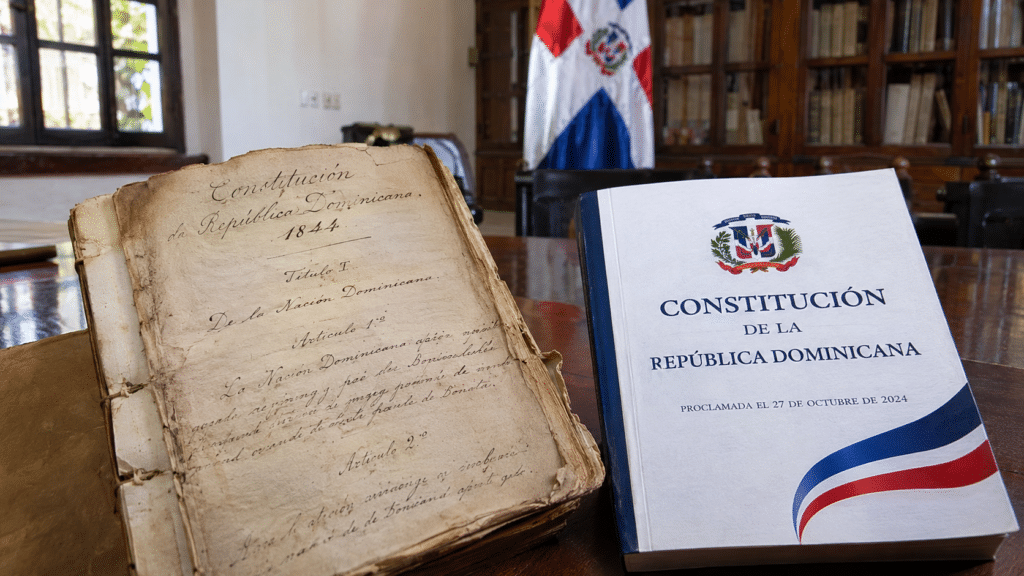
The First Dominican Constitution: November 6, 1844
The Dominican Republic adopted its first Constitution on November 6, 1844, in the city of San Cristóbal, less than nine months after the proclamation of independence from Haiti. Known as the Constitution of San Cristóbal, it established the legal foundations of the new state and defined the principles on which its institutions would operate.
The document described the country as a free, independent and sovereign nation organized as a civil, republican, popular, representative, elective and responsible government. It recognized the principle of national sovereignty and established the separation of public authority among three branches: executive, legislative and judicial. Its institutional design drew on several constitutional traditions, including those of the United States, France, Spain and Haiti.
The legislature was bicameral, consisting of the Tribunado and the Consejo Conservador. The Constitution also established a framework of individual rights and freedoms, although the practical protection of those rights was limited by the political and military conditions of the new republic.
Article 210 and the concentration of executive power
One of the most consequential provisions was Article 210, included in the transitional provisions. It granted the president exceptional authority to take measures considered necessary for national security during the ongoing conflict with Haiti, without being held responsible for their exercise in the same way as under ordinary constitutional rules.
The article became a defining feature of the early constitutional system because it weakened the limits imposed on the executive branch. Although the Constitution formally established separation of powers, Article 210 created an exception that could be used to justify extraordinary presidential authority. Its significance would become especially clear during the first constitutional crisis of 1854.
The Constitutional Revisions of 1854
The first decade of Dominican constitutional history was marked by political rivalry, military insecurity and disagreements over the balance of power. These circumstances produced two major constitutional revisions in 1854, which moved in different directions.
The February 1854 Constitution
The revision of February 1854 sought to reduce some of the exceptional powers granted to the executive under the original Constitution. It removed Article 210 and adjusted the distribution of authority among state institutions. The legislative branch retained a bicameral structure, with a Chamber of Representatives and a Senate, while the revised text also introduced changes to the organization of the executive and municipal institutions.
The revision did not eliminate the possibility of extraordinary presidential powers altogether. It provided for exceptional authority in circumstances such as foreign invasion or serious disturbances, subject to constitutional conditions. Nevertheless, the February text represented an attempt to establish a more balanced institutional arrangement than the one created in 1844.
The December 1854 Constitution
The political balance shifted again before the end of the year. A second revision, proclaimed in December 1854, restored a more centralized model of government. The bicameral legislature was replaced by a single body known as the Senado Consultor, and the executive recovered extensive authority over central and provincial administration.
The new text also restored an exceptional provision comparable to the original Article 210. This reversal illustrated a recurring pattern in Dominican constitutional history: constitutional changes were often driven not only by institutional debate but also by the immediate interests of political factions and the authorities in power.
The Constitution of Moca of 1858
The Constitution of Moca, proclaimed on February 19, 1858, emerged from a political movement against the government of Buenaventura Báez. It is widely recognized as one of the most liberal constitutional texts of the nineteenth century because it sought to restrict presidential authority and strengthen representative institutions.
Among its most important provisions were the restoration of a bicameral legislature, the establishment of four-year presidential terms without immediate reelection and the limitation of the executive’s influence over judicial appointments. It also introduced direct presidential voting, an important change in the relationship between citizens and the selection of the head of state.
The Constitution restricted the use of extraordinary presidential powers and strengthened legal protections. It abolished the death penalty for political offenses and affirmed equality before the law for people within Dominican territory, including foreigners. Another distinctive provision designated Santiago de los Caballeros as the country’s capital, reflecting the political importance of the Cibao region during the movement that produced the new text.
Its practical influence was limited by the political crisis that followed. The government established under the Constitution of Moca was overthrown in 1858, and the previous constitutional framework was restored. Even so, the document remained an important reference in later debates about constitutional limits, political representation and civil liberties.
Constitutional Changes After the Restoration of Independence, 1865–1907
The annexation of the Dominican Republic to Spain in 1861 interrupted the country’s constitutional development as an independent state. The Restoration War, which began in 1863, ended with the reestablishment of Dominican sovereignty in 1865. The return to independence required a new constitutional framework, leading to the Constitution of November 14, 1865.
The Constitutions of 1865 and 1866
The 1865 Constitution restored republican institutions after the end of Spanish rule. It expanded political participation by recognizing the right of men to vote and stand for election under the rules established by the constitutional system. However, the new arrangement did not bring lasting institutional stability.
A further revision followed in 1866. Subsequent changes in 1868 and 1872 reflected continuing disputes over the organization of the state, the powers of the executive and the relationship between public authority and individual freedoms. These revisions were part of a broader period in which constitutional rules changed frequently as governments and political coalitions competed for control.
The revisions of 1872 and 1874
The Constitution of September 14, 1872, restored provisions favorable to presidential reelection and established the Catholic Church as the official religion, restricting the constitutional position of non-Catholic religious communities. These changes demonstrated that constitutional reform could affect not only the distribution of political power but also the relationship between the state, religion and civil liberties.
The Constitution of March 24, 1874, introduced another institutional reorganization. It removed literacy as a voting requirement, abolished the municipal power as a separate constitutional institution and established a unicameral legislature. Further revisions followed in 1875, 1876, 1877, 1878, 1879, 1880, 1881, 1887 and 1896.
These successive texts repeatedly adjusted presidential terms, legislative organization, electoral rules and the distribution of authority. Their frequency is significant: during much of the nineteenth century, the Constitution did not function as a stable framework above political competition. Instead, it was repeatedly modified in response to changing governments and disputes over the exercise of power.
The constitutional reforms of 1907 and 1908
The reforms of 1907 and 1908 marked another stage in the gradual consolidation of the republican institutional structure. The Constitution of 1908 restored a bicameral National Congress, ending a long period in which several constitutional texts had used a single legislative chamber. This change established a legislative structure that would remain an important feature of the Dominican constitutional system.
The 1908 text also reorganized aspects of the public administration and the relationship between national and local institutions. It provided a more developed framework for the operation of the state, although constitutional rules continued to be influenced by political instability and disputes over presidential authority.
The 1924 Constitution and the Trujillo Era
The Constitution of 1924
The Constitution proclaimed on June 13, 1924, followed the end of the United States military occupation, which had lasted from 1916 to 1924. The restoration of Dominican constitutional government required a new institutional settlement and a reorganization of the legal framework governing the republic.
The 1924 text restored constitutional institutions and addressed the organization of public authority, electoral arrangements and the relationship between the state and its citizens. It became the basis for later revisions in 1927 and 1929. The reforms of those years included changes to the constitutional provisions governing presidential succession, terms and the organization of public institutions.
Constitutional revisions under Rafael Trujillo
During the dictatorship of Rafael Trujillo, the Constitution was repeatedly revised. Changes in 1934, 1942, 1947, 1955 and the revisions of 1959 and 1960 altered provisions relating to the organization of the state, presidential authority, citizenship and other constitutional matters.
The 1942 Constitution is particularly important in the history of citizenship and political rights because it recognized women’s suffrage at the national level. Dominican women had participated in a restricted electoral process in 1934, but the 1942 reform established constitutional recognition of their right to vote in national elections. This represented a major change in the formal definition of political citizenship.
However, the expansion of rights in the constitutional text did not mean that political freedoms were effectively protected under the dictatorship. The existence of constitutional guarantees must be distinguished from their enforcement in practice. Under an authoritarian system, institutions responsible for protecting those guarantees lacked the independence necessary to provide effective limits on the government.
The Constitutional Reforms of 1961 and 1962
The end of the Trujillo dictatorship in 1961 opened a period of political transition and constitutional reorganization. The revisions of December 29, 1961, and September 16, 1962, sought to adapt the institutional framework to a political environment in which the country was moving away from authoritarian rule.
These changes addressed the organization of public institutions, the restoration of political freedoms and the redefinition of the relationship between state authority and citizens. They also prepared the ground for the constitutional project adopted in 1963, which would introduce a much broader conception of social and economic rights.
The Constitution of 1963: A Broader Vision of Rights
Proclaimed on April 29, 1963, the Constitution associated with the government of Juan Bosch represented a significant change in Dominican constitutional thinking. It moved beyond a framework focused primarily on the formal structure of government and individual civil liberties, giving greater constitutional recognition to social and economic rights.
The text placed greater emphasis on human dignity, social justice, the rights of workers and the social responsibilities associated with property. It addressed labor protections, education, housing and the economic conditions necessary for a more equal society. It also sought to strengthen the independence and responsibilities of public institutions.
One of its central principles was that property should serve a social function. This approach did not abolish private property, but it placed its exercise within a broader framework of public interest and social responsibility. The Constitution also recognized the importance of labor rights and sought to expand the state’s role in protecting workers and improving social conditions.
The 1963 text was short-lived. The government was overthrown in September of that year, and the Constitution was subsequently displaced. Nevertheless, its provisions remained influential in later Dominican constitutional debates, particularly those concerning social rights, the role of the state and the relationship between economic activity and human dignity.
The 1965 Crisis and the Constitution of 1966
The political and military crisis of 1965 produced an exceptional constitutional situation. During the conflict, the Act of Reconciliation and the Institutional Act of September 3, 1965, served as important legal and political instruments for the transition toward a new constitutional settlement. Although these documents were not ordinary constitutional revisions adopted through the standard process, they formed part of the country’s constitutional history.
The Constitution proclaimed on November 28, 1966, established the framework that would remain in force, with amendments, for more than four decades. It restored a more traditional institutional structure and gave the executive branch extensive authority. It also replaced many of the social and economic provisions introduced by the 1963 Constitution with a more limited constitutional approach.
The 1966 text allowed presidential reelection without a consecutive-term limit. It also strengthened the president’s authority over public administration and maintained a centralized relationship between the national government and local authorities. The armed forces were assigned a constitutional role in maintaining public order, a provision that reflected the security concerns of the period.
Although the Constitution recognized individual rights and the separation of powers, the institutional balance established in 1966 gave the executive considerable influence. This framework remained the basis of the Dominican constitutional system until the major reform of 1994.
The 1994 Constitutional Reform
The reform of August 14, 1994, was adopted during a political crisis following the disputed presidential election of that year. The resulting political agreement, commonly known as the Pact for Democracy, sought to address the electoral dispute and introduce safeguards intended to improve the credibility of the political system.
The reform introduced several changes with lasting institutional consequences. It prohibited immediate presidential reelection, shortened the presidential term then in progress and separated presidential elections from congressional and municipal elections. It also introduced a two-round presidential election system, under which a second round is held if no candidate obtains the required majority in the first round.
Another major innovation was the creation of the National Council of the Magistracy (Consejo Nacional de la Magistratura), a constitutional body responsible for appointing members of the Supreme Court of Justice. The reform also strengthened the institutional position of the judiciary by granting it greater administrative and financial autonomy.
The 1994 reform changed the constitutional system of judicial review as well. It recognized the authority of judges to assess the constitutionality of laws in cases before them, establishing a system of decentralized or diffuse constitutional review. The reform also recognized dual nationality, allowing Dominicans who acquired another nationality to retain Dominican citizenship under the conditions established by the Constitution.
These changes marked a turning point in the relationship between electoral rules, judicial independence and constitutional oversight. Unlike many earlier revisions, the 1994 reform was closely associated with an effort to address a crisis of democratic legitimacy through institutional changes.
The 2002 Reform: Presidential Reelection Returns
The Constitution was amended again on July 25, 2002. The most prominent change concerned presidential reelection. The reform restored the possibility of one consecutive reelection, reversing the prohibition introduced in 1994.
The change demonstrated how presidential eligibility continued to be one of the most frequently contested subjects in Dominican constitutional reform. Although the 2002 amendment did not replace the broader institutional framework established in 1966 and modified in 1994, it reinforced the recurring pattern of changing constitutional rules in response to political debates over the presidency.
The 2010 Constitution: A New Model of the State
The Constitution proclaimed on January 26, 2010, was a comprehensive constitutional transformation rather than a limited amendment. It reorganized the structure of the state, expanded the catalogue of rights and introduced new institutions designed to strengthen constitutional oversight and the protection of fundamental rights.
The Dominican Republic as a social and democratic state governed by the rule of law
One of the most important changes was the definition of the Dominican Republic as a social and democratic state governed by the rule of law. This formulation expanded the constitutional responsibilities of the state beyond maintaining public order and protecting traditional individual liberties.
Article 8 established the effective protection of individual rights, respect for human dignity and the creation of conditions that allow people to develop on an equal and progressive basis as essential functions of the state. The new framework placed individual freedom and social justice within the same constitutional model.
The expansion of fundamental rights
The 2010 Constitution reorganized and expanded the rights recognized in the constitutional text. It included more detailed provisions concerning civil and political rights, economic and social rights, cultural rights and collective rights. Environmental protection received explicit constitutional recognition, reflecting the growing importance of sustainable development and the protection of natural resources.
The text also strengthened protections relating to equality, personal integrity, privacy, freedom of expression, access to information and due process. It recognized additional mechanisms through which individuals could defend their constitutional rights, including the constitutional recognition of amparo and habeas data.
Amparo provides a judicial mechanism for protecting fundamental rights when they are threatened or violated. Habeas data allows individuals to access information held about them and seek the correction or protection of personal data under the conditions established by law. These mechanisms gave constitutional rights a more direct procedural dimension.

New constitutional institutions
The 2010 Constitution introduced several institutions that changed the organization of the state and the mechanisms available to protect the constitutional order.
The most significant was the Constitutional Court, established to guarantee constitutional supremacy, defend the constitutional order and protect fundamental rights. Its creation gave constitutional review a specialized institutional body rather than leaving the system dependent solely on the ordinary courts and the Supreme Court of Justice.
The Constitution also established the Superior Electoral Tribunal to resolve electoral disputes and created the constitutional basis for the Office of the Ombudsman (Defensor del Pueblo), intended to safeguard citizens’ rights in their dealings with public administration and other areas defined by law.
These institutions formed part of a broader reorganization of the constitutional system. The reform also strengthened the National Council of the Magistracy and clarified the constitutional position of different public bodies.
New forms of citizen participation
The 2010 text expanded the constitutional framework for direct citizen participation. It incorporated mechanisms such as referendums and popular legislative initiative, allowing citizens to participate in certain public decisions and legislative processes beyond periodic elections.
The reform also gave constitutional recognition to the Economic and Social Council, a consultative body intended to facilitate dialogue among social, economic and institutional sectors. Together, these provisions reflected a broader conception of democratic participation.
The 2015 Reform: Presidential Reelection and the Return to a Two-Term Rule
The Constitution was amended on June 13, 2015, primarily to change the rules governing presidential reelection. The 2010 Constitution had prohibited immediate reelection, but the 2015 amendment allowed a president to seek one consecutive term.
The revised rule permitted a president to serve two consecutive four-year terms but prohibited another presidential candidacy after completing the second term. This represented a change from the 2010 framework while retaining a constitutional limit on the number of consecutive terms.
The 2015 amendment did not replace the institutional model introduced in 2010. The Constitutional Court, the Superior Electoral Tribunal, the expanded catalogue of rights and the definition of the country as a social and democratic state governed by the rule of law remained central features of the constitutional framework.
The 2024 Constitutional Reform: The Current Constitution
The latest major revision was proclaimed by the National Revisory Assembly on October 27, 2024, and published in Official Gazette No. 11170 on October 31, 2024. It amended several provisions of the 2015 text and added a new general provision, Article 278, together with transitional rules.
The reform addressed presidential term limits, the composition of the Chamber of Deputies, the organization of the National Council of the Magistracy, the appointment of the attorney general and the timing of national elections. The result is the constitutional text currently in force.
A stronger restriction on presidential reelection
One of the central objectives of the 2024 reform was to make the existing presidential term limit more difficult to change. The constitutional framework maintains the rule that a president may serve no more than two consecutive four-year terms and may not seek another presidential term after completing them.
The reform also introduced a new safeguard through Article 278. Under this provision, no elected official may benefit during their own term from a constitutional amendment that changes the rules governing their nomination, election or continuation in the office they hold. The provision is designed to prevent officeholders from using constitutional changes to alter the rules applicable to their own tenure.
The transitional provisions also established a specific restriction for the president elected in May 2024: that officeholder may not run again for president or vice president. This rule is distinct from the general two-consecutive-term provision and forms part of the transitional framework accompanying the 2024 reform.
Reduction in the number of deputies
The 2024 reform amended Article 81 and reduced the membership of the Chamber of Deputies from 190 to 170. The revised structure includes territorial representatives, national representatives and representatives elected by Dominicans living abroad.
The change modifies the composition of the legislative branch without replacing the country’s bicameral system. The National Congress continues to consist of the Senate and the Chamber of Deputies.
Changes to the National Council of the Magistracy
The reform modified Articles 178 and 179, which regulate the composition and functions of the National Council of the Magistracy. Among the institutional changes was the inclusion of the president of the Constitutional Court in the Council’s composition.
The Council plays a central role in the appointment of senior judicial officials and, under the 2024 framework, participates in the appointment of the attorney general. The changes therefore affect the constitutional relationship between the executive branch, the judiciary and the institutions responsible for selecting key legal authorities.
A revised appointment process for the attorney general
Articles 169, 170 and 171 address the constitutional position and autonomy of the Public Ministry. The 2024 reform reinforced the institution’s constitutional autonomy and changed the appointment procedure for the attorney general of the Republic.
Under Article 171, the president must propose a candidate to the National Council of the Magistracy within the first 100 days of the presidential term. The Council appoints the attorney general and half of the deputy attorneys general covered by the provision. Those appointed by the Council have a period of inamovability of two years and may be confirmed under the constitutional and legal rules in force, subject to the applicable exceptions.
The reform also reaffirmed the Public Ministry’s functional, administrative and budgetary autonomy. Its constitutional responsibilities include directing criminal investigations, exercising public prosecution and protecting the fundamental rights of citizens, victims and witnesses.
Unification of national elections
The 2024 reform amended Article 209 to establish the unification of presidential, congressional and municipal elections. The transition is scheduled for the 2032 electoral cycle, following transitional arrangements for the terms of municipal authorities elected in 2028.
Before this change, presidential and congressional elections were held separately from municipal elections. The new arrangement is intended to bring the different electoral processes into a single national cycle, changing the constitutional timetable for the renewal of elected authorities.
How the Dominican Constitution Has Changed Over Time
The evolution of the Constitution can be understood through several major shifts in the way the state is organized and the rights it recognizes. The following table summarizes the most consequential stages rather than listing every amendment adopted since 1844.
| Period or constitutional text | Main institutional changes | Significance for rights and constitutional principles |
|---|---|---|
| 1844 | Established the republic, separation of powers and a bicameral legislature; Article 210 granted exceptional executive powers. | Recognized sovereignty and individual rights within a framework that allowed substantial presidential authority. |
| 1854 | Two revisions altered the balance between the executive and legislature; the December text introduced a unicameral Senate Consultor. | Illustrated the conflict between limits on executive power and the restoration of exceptional presidential authority. |
| 1858 | The Constitution of Moca restored bicameralism, restricted immediate reelection and limited executive influence over judicial appointments. | Expanded political participation and strengthened legal equality and protections against abuses of power. |
| 1865–1908 | Repeated revisions changed legislative organization, presidential terms, electoral rules and municipal institutions. | Political participation and religious freedoms varied considerably between constitutional texts. |
| 1924–1960 | Constitutional rules were repeatedly revised, including during the Trujillo dictatorship. | The 1942 reform recognized women’s right to vote in national elections, although political freedoms remained restricted in practice under dictatorship. |
| 1963 | Introduced a broader social and economic conception of the state. | Expanded constitutional attention to labor, social justice, human dignity and the social function of property. |
| 1966 | Restored a centralized institutional framework and extensive executive authority. | Recognized individual rights but did not retain the full social-rights framework of 1963. |
| 1994 | Created the National Council of the Magistracy, introduced a two-round presidential election system and strengthened judicial autonomy. | Strengthened electoral safeguards, judicial independence and constitutional review. |
| 2002 | Restored the possibility of one consecutive presidential reelection. | Changed the constitutional rules governing presidential eligibility. |
| 2010 | Established the Constitutional Court, Superior Electoral Tribunal and constitutional basis for the Ombudsman. | Expanded fundamental, social, economic, cultural and environmental rights and recognized amparo and habeas data. |
| 2015 | Allowed one consecutive presidential reelection, followed by a prohibition on another term. | Maintained a two-consecutive-term limit while changing the rule introduced in 2010. |
| 2024 | Reduced the Chamber of Deputies to 170 members, changed the National Council of the Magistracy and revised the appointment process for the attorney general. | Strengthened the constitutional rules on presidential term limits and introduced a restriction preventing elected officials from benefiting from changes to their own tenure rules. |
The Main Trends in the Evolution of Constitutional Rights
The history of the Dominican Constitution is not simply a succession of institutional arrangements. It also shows how the legal definition of citizenship, equality and the responsibilities of the state has changed over time.
From formal liberties to broader social rights
The 1844 Constitution established the foundations of republican government and recognized individual rights, but it did not develop a comprehensive system of social and economic guarantees. The Constitution of 1963 marked an important change by placing labor protections, social justice and the social function of property at the center of constitutional debate.
The 2010 Constitution developed this approach further by defining the country as a social and democratic state governed by the rule of law. It included a wider range of rights and established constitutional mechanisms intended to make those rights enforceable.
The expansion of political citizenship
Political participation also changed significantly. The constitutional texts of the nineteenth century used different voting arrangements and eligibility requirements. The 1865 Constitution expanded male political participation, while the 1942 reform recognized women’s suffrage at the national level.
Later reforms addressed the organization of elections, the possibility of a second presidential round, the separation or unification of electoral cycles and the constitutional rules governing elected office. These changes reflect the evolving relationship between citizenship, representation and the electoral system.
Religious freedom and equality before the law
Religious rights were not treated consistently across the nineteenth-century constitutions. The 1872 text established Catholicism as the official religion and restricted the constitutional position of Protestant worship. Other constitutional texts recognized different approaches to religious liberty and equality.
The modern constitutional framework places greater emphasis on individual freedom, equality and protection against discrimination. These principles are part of the broader rights-based structure established in 2010 and retained in the current Constitution.
Environmental and collective rights
The 2010 Constitution expanded the scope of constitutional protection beyond individual civil and political liberties. It recognized environmental protection and collective interests as constitutional concerns, reflecting the relationship between natural resources, public health, sustainable development and the rights of present and future generations.
What Makes the 2024 Constitution Different from Earlier Texts?
The 2024 Constitution did not replace the entire constitutional model established in 2010. Instead, it amended selected provisions while retaining the central framework of the social and democratic state governed by the rule of law, the expanded catalogue of rights and the institutions created in the earlier reform.
Its most distinctive contribution lies in the rules governing elected office and institutional appointments. The new Article 278 establishes that an elected official cannot benefit from a constitutional amendment affecting the rules of the office held during their term. The reform also changes the composition of the National Council of the Magistracy and the process for appointing the attorney general.
Other changes concern the number of deputies and the electoral calendar. These provisions modify the operation of representative institutions and the timing of elections, but they do not remove the constitutional structure of a bicameral Congress or the system of independent constitutional bodies established in 2010.
Where to Consult the Dominican Constitution and Its Historical Versions
Readers who want to examine the evolution of specific articles should consult the original constitutional texts rather than relying exclusively on summaries. Comparing successive versions is particularly useful for understanding how provisions on presidential terms, citizenship, judicial organization and fundamental rights have changed.
The Constitutional Collection of the Legal Consultancy of the Executive Branch provides access to the official texts of the Constitution, including the versions promulgated in 1844, 1854, 1858, 1963, 1966, 1994, 2002, 2010, 2015 and 2024.
The Constitutional Court has also published La Constitución Dominicana y Sus Reformas (1844–2015), a historical compilation that reproduces successive constitutional texts and provides a valuable documentary basis for comparative research. The publication is available through the Constitutional Court’s collection of constitutional publications.
Frequently Asked Questions About the History of the Dominican Constitution
When was the first Constitution of the Dominican Republic adopted?
The first Constitution was proclaimed on November 6, 1844, in San Cristóbal. It established the Dominican Republic as an independent, sovereign and representative republic and defined the separation of powers among the executive, legislative and judicial branches.
How many times has the Dominican Constitution been amended?
The number depends on how constitutional revisions and new constitutional texts are counted. The official collection maintained by the Legal Consultancy of the Executive Branch lists 32 constitutional texts, from 1844 through 2024. Historical references that count individual amendment processes may produce a different total because they use a different method of classification.
What was the Constitution of Moca of 1858?
The Constitution of Moca was proclaimed on February 19, 1858. It was a liberal constitutional text that restored a bicameral legislature, restricted immediate presidential reelection, strengthened political participation and limited the executive’s influence over judicial appointments. Its period of application was brief because of the political upheaval that followed.
Why was the Constitution of 1963 important?
The 1963 Constitution expanded the constitutional role of the state in social and economic matters. It emphasized labor protections, social justice, human dignity and the social function of property. Although it was short-lived, it influenced later constitutional discussions about social rights and the responsibilities of public institutions.
What changed in the 1994 constitutional reform?
The 1994 reform prohibited immediate presidential reelection, introduced a two-round presidential election system, separated presidential elections from congressional and municipal elections and created the National Council of the Magistracy. It also strengthened judicial autonomy, introduced diffuse constitutional review and recognized dual nationality.
What were the most important changes introduced in 2010?
The 2010 Constitution defined the Dominican Republic as a social and democratic state governed by the rule of law, expanded fundamental and social rights, recognized environmental rights and established the Constitutional Court and Superior Electoral Tribunal. It also provided constitutional recognition for amparo and habeas data as mechanisms for protecting rights.
What is the current Constitution of the Dominican Republic?
The current Constitution is the text proclaimed on October 27, 2024, and published in Official Gazette No. 11170 on October 31, 2024. It amended selected provisions of the 2015 Constitution, including those concerning presidential term limits, the Chamber of Deputies, the National Council of the Magistracy, the Public Ministry and the electoral calendar.
Conclusion
Since 1844, the Constitution of the Dominican Republic has evolved from a foundational document establishing the institutions of a newly independent state into a more extensive legal framework for democratic government, fundamental rights and constitutional oversight. Its history includes periods of institutional instability, authoritarian rule, liberal reform and major changes in the relationship between citizens and public authority.
The Constitution of 2024 retains the rights-based and institutional framework developed in 2010 while introducing new rules on presidential tenure, public appointments and elections. Understanding this evolution requires looking beyond the dates of individual reforms to examine how each constitutional text changed the organization of the state, the limits on public power and the rights recognized for the Dominican people.