 26°C


Powers and Responsibilities of the President of the Dominican Republic
The President of the Dominican Republic holds the country’s highest executive office, combining the roles of head of state and head of government. The Constitution grants the President broad authority over domestic policy, foreign relations, public administration, national defense, and senior government appointments. These powers, however, are not unlimited: they operate within a constitutional system that gives the National Congress, the courts, and independent institutions specific oversight and control responsibilities.


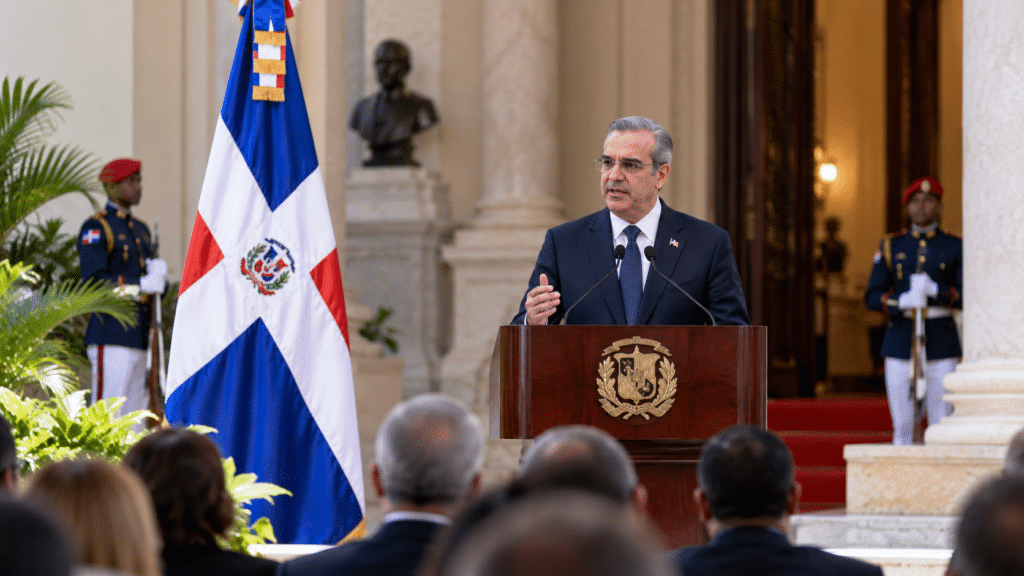
The constitutional position of the President is defined primarily by Articles 122 and 128 of the Constitution of the Dominican Republic, proclaimed on October 27, 2024. Article 122 establishes that the President exercises executive power on behalf of the people as both head of state and head of government. Article 128 sets out the principal responsibilities attached to those roles, including the direction of domestic and foreign policy, civil and military administration, and supreme command of the country’s security forces.
This combination makes the presidency the central institution of the Executive Branch. It does not, however, make the President the supreme authority over every institution in the Dominican state. The Constitution establishes separate powers, independent institutions, legal procedures, and accountability mechanisms that restrict how presidential authority can be exercised.
The President’s constitutional position
The Dominican Republic is a unitary, democratic, and representative state organized around three independent branches of government: the Executive, the Legislature, and the Judiciary. Article 4 establishes that these branches exercise their respective functions independently, while Article 6 makes the Constitution the supreme law of the country. Every public authority, including the President, is subject to its provisions.
The President therefore exercises executive authority within a system of divided constitutional responsibilities. The National Congress adopts legislation and exercises political and financial oversight. The courts review the legality of public administration and resolve legal disputes. Constitutional institutions also perform specific functions that cannot simply be absorbed into the President’s personal authority.
Article 127 reinforces this constitutional responsibility through the presidential oath. Before taking office, the President and Vice President must pledge before the National Assembly to uphold the Constitution and laws, defend the country’s independence, respect citizens’ rights and freedoms, and faithfully perform the duties of their offices.
Domestic policy and executive leadership
Article 128 establishes that the President directs the country’s domestic policy and civil administration. This gives the office responsibility for setting the government’s general direction, defining executive priorities, coordinating public policy, and ensuring that the institutions under the Executive Branch carry out their legally assigned responsibilities.
In practical terms, the President can establish national policy priorities, issue executive instructions, coordinate government action, and require public officials within the Executive Branch to implement decisions that fall within their legal authority. The President also presides over the Council of Ministers, which Article 137 defines as the body responsible for coordinating general government affairs.
Presidential leadership does not eliminate the legal responsibilities of individual ministers or public institutions. Article 136 provides that the powers of ministers and deputy ministers are determined by law. The President may direct the government’s general policy, but executive officials must still act within their respective legal competencies and comply with constitutional and statutory requirements.
The distinction between political direction and legal authority
The President’s ability to establish government priorities should not be confused with an unrestricted power to decide any matter. Public administration is governed by Article 138, which requires government action to observe principles including effectiveness, hierarchy, objectivity, equality, transparency, economy, publicity, and coordination. It also requires full compliance with the country’s legal system.
These principles apply to executive decisions even when they reflect the President’s political program. A government instruction cannot lawfully authorize conduct prohibited by legislation, disregard the rights of individuals, or transfer powers that the Constitution assigns to another institution.
Promulgating laws and issuing executive regulations
One of the President’s most important constitutional responsibilities is ensuring that legislation adopted by the National Congress is formally promulgated, published, and faithfully executed. Article 128 authorizes the President to issue decrees, regulations, and instructions when necessary to implement the law.
This authority gives the Executive an essential role in putting legislation into practice. Laws frequently establish general rules and policy objectives, while regulations specify procedures, administrative requirements, and technical details needed for their implementation. Presidential decrees may also formalize appointments and other decisions that fall within executive competence.
However, the power to issue regulations is not equivalent to the legislative authority of Congress. A presidential decree or regulation cannot lawfully contradict a statute, amend a law without the required legislative procedure, or create powers that the Constitution has reserved for another branch of government.
The President’s power to observe legislation
The Constitution also gives the Executive a limited role in the legislative process through the power to observe, or return, a law approved by Congress. Under Article 102, the President may return a bill to the chamber from which it originated, explaining the objections. The ordinary period for doing so is ten days after receipt, reduced to five days when the matter has been declared urgent.
The President does not have an absolute veto. If the chamber reconsidering the bill approves it again by the constitutionally required two-thirds majority of members present, it is sent to the other chamber for the corresponding decision. If the required majorities are obtained, the legislative process can proceed despite the President’s objections.
This mechanism allows the Executive to raise constitutional, legal, or policy concerns about legislation without giving the President the final word on what becomes law. Legislative authority remains with the National Congress.
Foreign policy and international relations
The President directs the Dominican Republic’s foreign policy and represents the country in its official relations with other states. Article 128 recognizes the President’s authority to conduct diplomatic negotiations and receive foreign heads of state and their representatives.
This role allows the Executive to establish diplomatic priorities, negotiate international agreements, represent national interests in bilateral and multilateral discussions, and coordinate the country’s external relations. The President is also responsible for signing treaties and conventions on behalf of the Dominican Republic.
International treaties require congressional approval
The President cannot independently make every international agreement binding on the Dominican Republic. Article 128 requires treaties and international conventions signed by the Executive to be submitted to the National Congress for approval. Without that approval, they do not have validity or bind the Republic under the constitutional procedure.
Article 93 also assigns Congress the authority to approve or reject international treaties and conventions signed by the Executive. This creates a constitutional division of responsibility: the President conducts negotiations and signs agreements, while the Legislature exercises the approval function assigned to it.
Once an international convention has been ratified and officially published, Article 26 establishes the conditions under which its provisions apply within the domestic legal system. The President’s diplomatic authority must therefore be exercised consistently with the Constitution, applicable legislation, and the country’s international obligations.
Appointment of ambassadors and diplomatic representatives
The President appoints ambassadors accredited abroad and heads of permanent missions to international organizations, but these appointments require the approval of the Senate. The President appoints other members of the diplomatic corps in accordance with the Foreign Service Law and may accept their resignations or remove them under the applicable legal framework.
The Senate’s approval requirement is an important institutional limit. It means that the President cannot independently complete every senior diplomatic appointment covered by Article 128. The Constitution gives the Executive the initiative while reserving a specific confirmation role for the Legislature.
National defense, the Armed Forces, and public security
Article 128 identifies the President as the supreme authority of the Armed Forces, the National Police, and the other state security bodies. The President directs civil and military administration and retains supreme command of the country’s military and police forces.
Within the limits established by law, the President may determine matters concerning the Armed Forces and National Police, exercise command personally or through the relevant ministry, determine their personnel strength, and deploy them for public-service purposes. The President also has authority to appoint or dismiss members of the military and police jurisdictions, as provided by the Constitution.
This constitutional arrangement places the country’s security institutions under civilian executive authority. It does not establish an independent military power or authorize security forces to operate outside the legal framework governing their activities.
National defense in the event of an external attack
The Constitution grants the President specific responsibilities when the Dominican Republic faces an actual or imminent armed attack by a foreign nation or external power. The President may take measures necessary to provide for and guarantee the legitimate defense of the country.
This authority is accompanied by an obligation to inform the National Congress about the measures adopted and to request the declaration of a State of Defense when appropriate. The provision recognizes the need for executive action in urgent security circumstances while preserving the Legislature’s constitutional role in decisions concerning exceptional national defense arrangements.
Police and security measures in exceptional circumstances
Article 128 also allows the President to adopt provisional police and security measures when conduct described in Article 62, paragraph 6, threatens public order, state security, the regular operation of public services, or economic activity. This provision concerns circumstances that do not amount to the exceptional situations regulated under Articles 262 to 266.
The distinction matters. Ordinary constitutional powers may permit temporary measures to address certain disruptions, but they do not give the President an unrestricted ability to suspend constitutional rights or govern indefinitely through emergency decrees. Measures must remain within the legal conditions and purposes established by the Constitution.
States of exception and emergency powers
The Dominican Constitution recognizes three types of states of exception: the State of Defense, the State of Internal Disturbance, and the State of Emergency. Article 262 provides that these exceptional regimes are intended for extraordinary situations that seriously affect national security, public institutions, or individuals and cannot be adequately addressed through ordinary powers.
The President may declare a state of exception with authorization from the National Congress. Article 128 also addresses the situation in which Congress is not in session, allowing the President to declare the relevant state of exception in accordance with the constitutional provisions. This exceptional procedure does not remove the requirement to operate within the framework established by Articles 262 to 266.
The three regimes have different constitutional grounds and purposes:
- State of Defense: Applies when national sovereignty or territorial integrity faces a serious and imminent threat from external armed aggression.
- State of Internal Disturbance: Applies when serious public disorder imminently threatens institutional stability, state security, or civic coexistence and cannot be resolved through ordinary powers.
- State of Emergency: Addresses serious circumstances affecting the country or a part of its territory that cannot be adequately managed through ordinary government authority.
Emergency powers are not unlimited. The Constitution identifies fundamental rights and judicial guarantees that cannot be suspended under the applicable regimes. It also establishes procedural requirements governing their declaration, duration, territorial application, and termination.
The National Congress therefore remains central to the constitutional control of exceptional powers. The President cannot treat an emergency declaration as a permanent transfer of legislative or judicial authority to the Executive.
Presidential powers concerning migration and foreign nationals
Article 128 grants the President authority to take certain measures concerning foreign nationals when their activities are, or may be, detrimental to public order or national security. These include ordering their arrest or expulsion in accordance with the law and prohibiting the entry of foreign nationals when considered appropriate in the public interest.
These provisions must be interpreted together with the Constitution’s guarantees of personal liberty, due process, equality, and judicial protection. Presidential authority in migration and security matters does not create an unrestricted power to detain or expel individuals without legal grounds or applicable procedures.
Article 40 establishes constitutional protections relating to personal liberty and security, including safeguards against detention without the required legal authorization. Article 69 guarantees due process and effective judicial protection. The exercise of executive authority over foreign nationals must therefore comply with the applicable legislation and constitutional safeguards.
Appointments and authority over public administration
The President has substantial appointment powers within the Executive Branch. Article 128 authorizes the appointment of ministers, deputy ministers, and other public officials occupying positions of free appointment or positions whose designation has not been assigned by the Constitution or legislation to another state institution.
The President may also accept resignations and remove officials from positions falling within this constitutional authority. In addition, the President may designate the heads of autonomous and decentralized state bodies, and accept their resignations or remove them, in accordance with the law.
The phrase “in accordance with the law” is essential. Not every public appointment belongs to the President. The Constitution and legislation assign certain appointments to Congress, the National Council of the Magistracy, the Judiciary, or other institutions. Where another body has constitutional appointment authority, the President cannot replace that procedure with a unilateral decree.
The appointment of the Attorney General
The appointment of the Attorney General illustrates how the 2024 Constitution changed the relationship between presidential authority and an institution with functional autonomy. Under Article 170, the Public Prosecutor’s Office enjoys functional, administrative, and budgetary autonomy. It is therefore not simply another administrative department under direct presidential control.
Article 171 establishes a specific appointment procedure. Within the first 100 days of the presidential term, the President must propose to the National Council of the Magistracy a candidate for Attorney General and candidates representing half of the deputy prosecutors subject to this procedure. The Council of the Magistracy is responsible for making the appointments under the constitutional and legal framework.
The Attorney General and the deputy prosecutors appointed through this mechanism have a two-year period of tenure protection. At the end of that period, the National Council of the Magistracy may confirm them under the same appointment rules. The Constitution also provides for replacement appointments when a definitive vacancy occurs and establishes that their tenure cannot exceed the presidential constitutional period in which they were appointed unless they are confirmed for a new period, subject to the applicable transitional provisions.
This arrangement gives the President a formal role in proposing candidates but does not leave the final appointment entirely to the President. It also provides institutional protections intended to distinguish the Public Prosecutor’s Office from ordinary political appointments.
Public finances, contracts, and the national budget
The President has important responsibilities concerning public revenue, expenditure, government contracts, and national budgeting. Article 128 requires the President to safeguard the proper collection and faithful investment of national revenues. These duties operate within a system in which Congress approves the budget and several institutions exercise financial oversight.
Submitting the national budget
The President must submit the proposed General State Budget Law to the National Congress no later than October 1 of each year for the following fiscal year. The proposal sets out the government’s expected revenues, planned expenditures, and financial priorities.
Submitting the proposal does not mean that the President can approve the budget unilaterally. The National Congress has constitutional authority to examine and approve the budget and may modify the proposal under the applicable voting requirements. The Executive is responsible for implementing the approved budget, not for replacing the legislative approval process.
Article 236 establishes an additional restriction: public expenditure is not valid unless it is authorized by law and ordered by a competent official. The President cannot lawfully use public funds simply because an expenditure is considered politically desirable or administratively convenient.
Government contracts requiring congressional approval
The President may enter into contracts on behalf of the state, but Article 128 identifies categories that require approval by the National Congress. These include contracts involving the allocation or commitment of national revenues, the transfer of state property, the raising of loans, and general tax exemptions.

The Constitution establishes a maximum threshold of 200 public-sector minimum wages for the relevant contracts and exemptions that the President may enter into without congressional approval. Arrangements exceeding the constitutional threshold or falling within the specified categories must follow the required legislative approval procedure.
This limitation is particularly important for public borrowing, the disposal of state assets, and agreements that affect public revenue. It prevents the Executive from using contractual powers to bypass the constitutional rules governing public finances.
Annual reports and presidential accountability
The President must deposit the reports of the ministries before the National Congress when the first ordinary legislative session begins on February 27 each year. Article 128 also requires the President to report on the administration of the previous year.
Article 114 expands this obligation by requiring an annual account of the previous year’s budgetary, financial, and administrative performance. The report must include an explanatory message addressing macroeconomic and fiscal projections, expected economic, financial, and social results, and the government’s main priorities within the approved budget.
These requirements make presidential accountability a constitutional duty rather than a voluntary political practice. The Executive must explain how public resources were administered and provide Congress with information that allows it to examine government performance.
Other constitutional responsibilities of the President
Article 128 includes several additional responsibilities that are distinct from the President’s general role in directing government policy. They include specific powers concerning national institutions, diplomatic matters, public security, and the exercise of certain legal prerogatives.
Granting presidential pardons
The President may grant pardons on February 27, August 16, and December 23 of each year, in accordance with the law and applicable international conventions. This is a constitutionally defined power rather than an unrestricted authority to disregard judicial decisions or criminal legislation.
Approving certain municipal transactions
The President has authority to authorize or refuse authorization for municipal councils to dispose of real estate and to approve or reject certain municipal contracts when municipal property or revenues are used as security. This power is limited to the circumstances specified in Article 128 and must be exercised under the relevant legal framework.
Authorizing certain activities involving foreign governments
The President may authorize or refuse authorization for Dominican citizens to hold public positions or perform functions for foreign governments or international organizations within Dominican territory. The President also has authority to decide whether Dominican citizens may accept and use decorations or titles granted by foreign governments.
What the President cannot do
The breadth of presidential authority can create the impression that the President controls every aspect of national government. The constitutional structure establishes otherwise. Executive powers are extensive, but they are limited by the division of state functions, the supremacy of the Constitution, statutory requirements, and the oversight powers of other institutions.
The most important limits can be understood through several constitutional principles.
- The President cannot legislate alone. The power to enact laws belongs to the National Congress. Presidential regulations and decrees must remain within the Constitution and existing legislation.
- The President cannot make treaties binding without the required congressional approval. The Executive negotiates and signs international agreements, but Congress has the constitutional power to approve or reject them.
- The President cannot spend public money without legal authorization. Public expenditure must be authorized by law and ordered by a competent official.
- The President cannot disregard judicial independence. Judges are constitutionally independent and subject to the Constitution and laws, not to presidential instructions in the exercise of judicial functions.
- The President cannot take over the powers of autonomous institutions. Where the Constitution or legislation assigns a responsibility to another institution, the Executive must respect that allocation.
- The President cannot exercise emergency powers without constitutional conditions. States of exception are subject to specific grounds, procedures, legislative authorization, and protections for fundamental rights.
- The President cannot remove every public official at will. Appointment and removal powers depend on the position involved and any constitutional or statutory protections that apply.
These restrictions are not merely procedural details. They define the constitutional boundaries of the presidency and prevent the concentration of all public authority in a single office.
Institutional checks on presidential power
The Constitution establishes several mechanisms through which other state institutions can review, supervise, or challenge executive decisions. These controls operate in different ways: some are political, others are judicial, and others concern public finances or institutional independence.
National Congress: legislative and political oversight
The National Congress is one of the principal checks on presidential authority. Under Article 93, it exercises legislative and oversight functions on behalf of the people. These include examining executive acts, supervising public policies, investigating matters of public interest, and reviewing the government’s administration of public resources.
Congress can summon ministers, deputy ministers, and the directors or administrators of autonomous and decentralized state institutions to provide information about their responsibilities and administrative decisions. It may also interpellate certain senior officials, including the Governor of the Central Bank, under the conditions established by Article 95.
The Constitution further requires Congress to examine the acts of the Executive and determine whether they comply with the Constitution and the laws. This creates a formal mechanism for legislative scrutiny beyond the approval of bills and the annual budget.
Impeachment and removal from office
The Constitution provides for political accountability through impeachment. Under Article 83, the Chamber of Deputies has the exclusive authority to bring charges before the Senate against specified public officials for serious misconduct in the performance of their duties.
When the President or Vice President is the subject of an impeachment charge, the Chamber of Deputies must obtain the support of three-quarters of its full membership. The person charged is suspended from office once the Chamber determines that there are grounds to proceed.
The Senate then considers the accusation under Article 80. A declaration of guilt requires the support of two-thirds of the Senate’s full membership. A guilty decision results in removal from office and disqualification from holding public office for ten years. The individual may also face ordinary judicial proceedings where applicable.
This procedure establishes a constitutional route for addressing serious misconduct by the highest executive officials. It is separate from ordinary political disagreement or criticism of government policy.
The Judiciary: review of executive legality
The courts provide another essential limit on presidential power. Article 139 expressly establishes that the courts control the legality of public administration and that citizens may request this review through the procedures provided by law.
This means that executive decisions, administrative acts, and government actions can be challenged when they violate legal requirements or exceed the authority granted to the administration. Presidential involvement does not place an administrative decision beyond judicial scrutiny.
Article 151 protects the independence of judges. They are independent, impartial, and subject to the Constitution and laws. They cannot be removed, separated, suspended, transferred, or retired except for legally established reasons and through the required guarantees.
The Constitutional Court
The Constitutional Court has a distinct role in safeguarding constitutional supremacy. It exercises the powers assigned to it by the Constitution, including jurisdiction over constitutional challenges and conflicts of competence between public powers.
This role is particularly relevant when a dispute concerns the boundaries between the Executive and another branch or constitutional institution. The Court is not subordinate to the President and does not act as an advisory department of the government.
Article 188 also recognizes diffuse constitutional review: courts throughout the country may consider an exception of unconstitutionality in cases brought before them. This means constitutional control is not confined exclusively to the Constitutional Court.
Financial oversight: the Comptroller General and Chamber of Accounts
The Constitution establishes a system of public financial control involving Congress, the Comptroller General of the Republic, the Chamber of Accounts, and society through mechanisms established by law.
The Comptroller General is the Executive Branch’s internal control authority under Article 247. Its responsibilities include internal auditing and evaluating the collection, management, use, and investment of public resources within its legal scope. Because it is part of the Executive, it should be distinguished from the independent external audit function.
The Chamber of Accounts performs external fiscal oversight under Article 248. It is a technical institution with legal personality and administrative, operational, and budgetary autonomy. Its constitutional responsibilities include examining public accounts and reporting to Congress on the oversight of state assets.
This distinction matters when assessing presidential accountability. Internal control operates within the Executive’s administrative structure, while the Chamber of Accounts provides an external institutional mechanism for reviewing the use of public resources.
Independent institutions and constitutional autonomy
Not every public institution is under the President’s direct authority. The Constitution recognizes bodies with their own legally defined powers, autonomy, or appointment procedures. Their independence varies according to their constitutional foundation and the legislation governing them.
The Public Prosecutor’s Office, for example, enjoys functional, administrative, and budgetary autonomy under Article 170. The President participates in the appointment process for the Attorney General and certain deputy prosecutors, but the National Council of the Magistracy makes the appointments under Article 171.
Other constitutional institutions, including the Chamber of Accounts and the Ombudsman, have their own appointment arrangements and autonomy guarantees. Their constitutional responsibilities cannot be replaced by ordinary presidential instructions simply because they form part of the broader state structure.
Presidential tenure, travel, and succession
The Constitution also establishes rules governing the exercise and continuity of the presidency. Under Article 124, the presidential term lasts four years. The President may seek one consecutive constitutional term but may never again run for the presidency or vice presidency after that consecutive term limit has been reached.
Article 131 places a specific restriction on international travel: the President cannot travel abroad for more than fifteen days without authorization from the National Congress. This is a direct example of a constitutional requirement that applies to the President personally.
Article 129 establishes the rules of presidential succession. The Vice President assumes executive authority during a temporary presidential absence and succeeds to the presidency in the event of a definitive vacancy. If both offices become vacant, the President of the Supreme Court of Justice temporarily assumes executive power and must convene the National Assembly to elect replacements under the constitutional procedure.
The President and Vice President may resign only before the National Assembly, as provided by Article 132. Article 133 establishes that the President and Vice President, whether elected or in office, cannot be deprived of their liberty, subject to the constitutional provision referenced in that article. This specific protection should not be confused with an exemption from constitutional accountability or the impeachment procedure.
How presidential authority works in practice
The constitutional design combines strong executive leadership with a system of institutional limits. The President can direct government policy, command the security forces, negotiate international agreements, appoint many senior officials, and issue regulations needed to implement legislation. These powers allow the Executive to coordinate national government and respond to public needs.
At the same time, the President must work within a framework in which other institutions retain their own constitutional responsibilities. Congress approves legislation, treaties, the national budget, and certain contracts. Courts review administrative legality and protect judicial independence. The Chamber of Accounts exercises external financial control, while autonomous institutions perform functions assigned to them by the Constitution and laws.
Understanding this distinction is essential when interpreting the role of the Dominican presidency. The President is the country’s principal executive authority, but the office does not embody the entirety of state power. Its legitimacy and effectiveness depend on exercising constitutional powers while respecting the institutions that provide oversight, legal review, and independent public authority.
Frequently asked questions about the President’s powers
Is the President of the Dominican Republic both head of state and head of government?
Yes. Article 122 expressly establishes that the President exercises executive power in both capacities. As head of state, the President represents the country, conducts diplomatic relations, and exercises constitutional responsibilities concerning national defense. As head of government, the President directs domestic policy and leads the Executive Branch.
Can the President of the Dominican Republic pass laws by decree?
No. Legislative authority belongs to the National Congress. The President can issue decrees, regulations, and instructions when necessary to implement the law, but these instruments cannot replace legislation or contradict the Constitution and statutes.
Can the President appoint all government officials?
No. The President appoints ministers, deputy ministers, and many other officials whose positions are subject to free appointment or whose designation has not been assigned to another institution. Other appointments are reserved for bodies such as the Senate or the National Council of the Magistracy, depending on the office involved.
Can the President declare a state of emergency without Congress?
The general constitutional rule is that states of exception require authorization from the National Congress. Article 128 addresses the situation in which Congress is not in session, allowing the President to declare a state of exception under the conditions established by the Constitution. The declaration remains subject to the constitutional framework governing exceptional powers.
Can Congress remove the President from office?
Yes. The Constitution provides for impeachment in cases of serious misconduct in the exercise of official duties. The Chamber of Deputies must approve the charge against the President by a three-quarters vote of its full membership. The Senate then decides the case, and a declaration of guilt requires a two-thirds vote of its full membership.
Can the President sign international treaties without Congress?
The President can negotiate and sign treaties or international conventions, but they do not become valid or binding on the Dominican Republic without approval from the National Congress, as required by Article 128.
Is the Public Prosecutor’s Office directly controlled by the President?
No. Article 170 grants the Public Prosecutor’s Office functional, administrative, and budgetary autonomy. The President proposes candidates for Attorney General and certain deputy prosecutors, but the National Council of the Magistracy makes the appointments under Article 171.
Conclusion
The President of the Dominican Republic occupies a central position in the country’s constitutional system, with authority over domestic and foreign policy, public administration, national defense, diplomatic relations, and a broad range of executive appointments. These responsibilities make the presidency the principal institution responsible for directing the work of the national government.
That authority is nevertheless bounded by the Constitution. Legislative approval, judicial review, financial oversight, independent institutions, and impeachment procedures ensure that presidential decisions remain subject to legal and institutional control. The Dominican constitutional model therefore combines executive leadership with the principle that public power is divided, limited, and accountable.
For readers seeking to understand the country’s political system, this distinction is fundamental: the President leads the Executive Branch, but the Constitution—not the presidency—remains the highest authority in the Dominican Republic.