 24°C
24°C

U.S. Launches Immigrant Visa Bond Pilot in Dominican Republic
The United States has selected the Dominican Republic for a pilot program that could require certain immigrant visa applicants to post a financial bond if consular officials determine they may become a public charge.


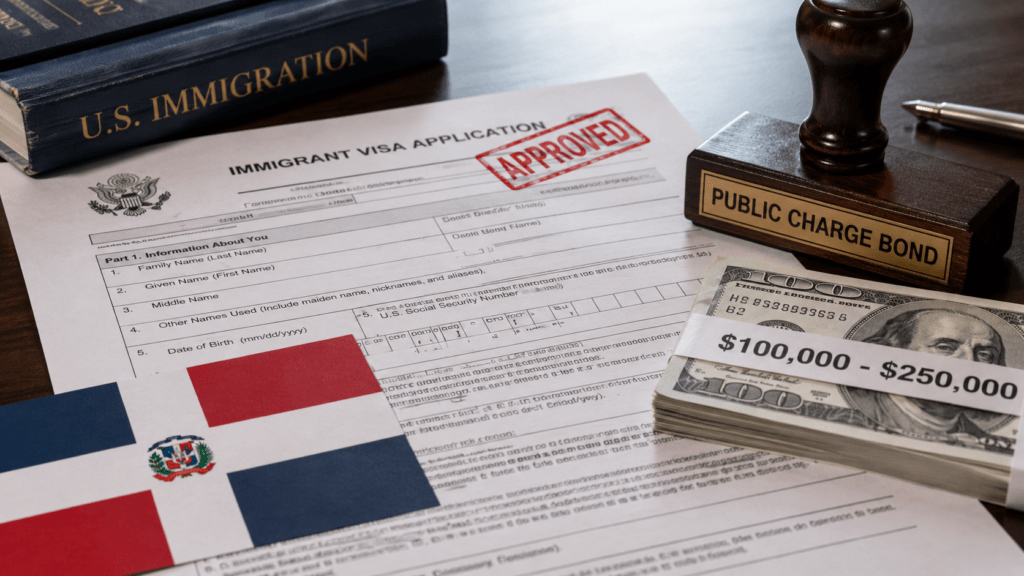
The U.S. Department of State has begun a pilot program in the Dominican Republic allowing consular officers to require certain immigrant visa applicants to post a public charge bond. The measure is aimed at applicants whose financial circumstances raise concerns that they could become primarily dependent on government assistance after moving to the United States.
The Dominican Republic is the first country selected for the pilot, which the State Department says will be evaluated before potentially being expanded to other countries. The program adds a financial guarantee to the existing review of an immigrant’s ability to support themselves and is separate from the visa bond program already applied to certain nonimmigrant applicants from designated countries.
Bond Amounts Will Be Determined Case by Case
Reports cited in connection with the program have placed potential guarantees at between $100,000 and $250,000. However, State Department spokesperson Natalia Molano said there is no fixed amount under the pilot. Instead, the consular officer will determine the amount individually based on the circumstances of each case.
The process begins after the U.S. Citizenship and Immigration Services (USCIS), the federal agency responsible for administering many immigration benefits, approves the underlying immigrant petition and the case is forwarded for consular processing. The consular officer then reviews the applicant’s financial circumstances and the sponsor’s documentation.
For many family-based immigrants and some employment-based applicants, that review includes Form I-864, the Affidavit of Support. The document is intended to demonstrate that the immigrant has adequate financial support and is not likely to become a public charge.
Dominican Republic Chosen for the Initial Pilot
The State Department said the Dominican Republic was selected because of the volume and scale of immigrant visa operations handled by the U.S. Embassy in Santo Domingo. The pilot is intended to provide the government with experience administering public charge bonds before any broader implementation is considered.
The program does not mean every Dominican applicant for an immigrant visa will have to post a bond. The requirement is directed at individual cases in which the consular officer determines that additional financial assurance is warranted.
The distinction is important for applicants and their U.S.-based sponsors because the bond is not presented as a standard visa fee. It is a financial guarantee tied to the government’s assessment of whether the prospective immigrant could become a public charge.
Bond Can Be Canceled Under Certain Conditions
The bond is administered through USCIS rather than the U.S. consulate. Under the existing public charge bond framework, a bond can be canceled under specified circumstances, including after the immigrant’s fifth anniversary as a lawful permanent resident if the applicable requirements are met. Other circumstances can also lead to cancellation, including permanent departure, naturalization or a determination that the immigrant is not likely to become a public charge.
The public charge assessment is part of U.S. immigration law and considers whether an applicant is likely to become primarily dependent on the government for subsistence. Financial resources, family circumstances, assets and the required Affidavit of Support can form part of that assessment.
For Dominican families pursuing permanent immigration to the United States, the pilot introduces another potential financial hurdle into the consular stage of the process. The precise criteria and amounts applicable to individual cases will depend on the consular officer’s determination, while the State Department evaluates how the program operates in Santo Domingo.