 22°C
22°C
U.S. Immigrant Visa Pause for Dominicans: What Travelers and Applicants Should Know
The U.S. decision to temporarily adjust immigrant visa appointments worldwide has particular significance for the Dominican Republic, one of the largest U.S. immigrant-visa processing posts in the world. The immediate effect is uncertainty for Dominicans seeking permanent residence through family or employment, while the broader policy direction points toward more intensive financial screening and potentially higher costs for some applicants. The U.S. State Department has not announced a definitive date for the resumption of normal appointment scheduling.


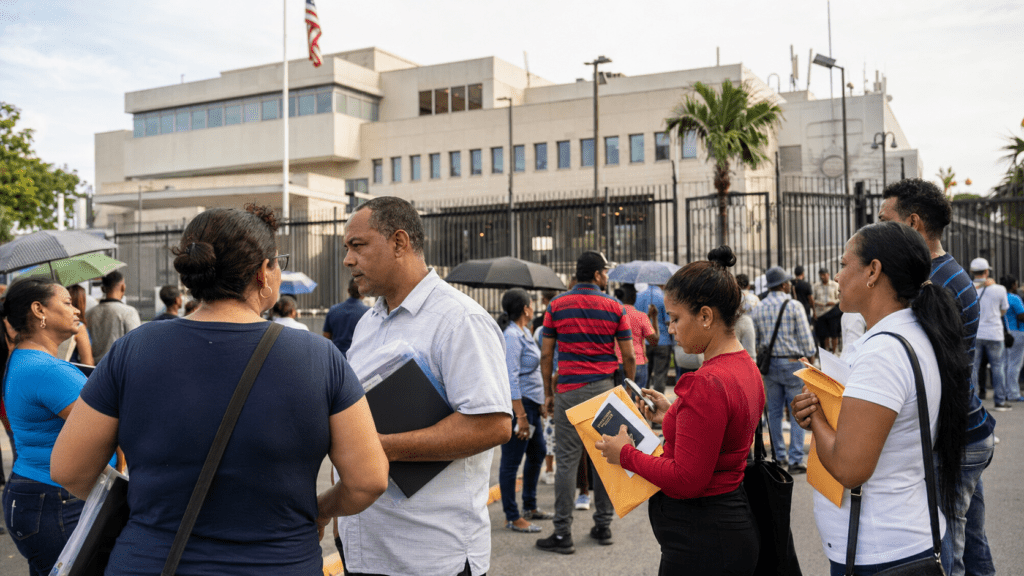
The temporary U.S. pause affecting immigrant visa appointments is not simply another change in the American visa system for the Dominican Republic. Because Santo Domingo handles an exceptionally large volume of immigrant visa cases, any disruption in scheduling can have consequences for thousands of Dominican families and applicants waiting to establish permanent residence in the United States.
The U.S. Department of State says the adjustment is connected to a global training initiative for consular officers. The objective is to prepare officers to apply stricter guidance when evaluating whether applicants could become a public charge — broadly, a person considered likely to depend on certain U.S. public benefits. The department has not announced a firm date for the restoration of normal immigrant visa appointment scheduling.
Why the Pause Matters More to the Dominican Republic
The Dominican Republic has an unusually important position in the U.S. immigrant visa system. The U.S. Embassy in Santo Domingo reported in May 2026 that it had processed more than 54,000 immigrant visas, making the Dominican Republic the second-largest country worldwide for U.S. immigrant visa issuance after Mexico. The figure illustrates the scale of the family and migration relationship between the two countries.
That volume means a temporary interruption can have a larger practical effect in the Dominican Republic than in countries where immigrant visa demand is much smaller. A postponed interview is not necessarily a denied visa, but it can delay a family’s plans to move, reunite in the United States, begin employment or arrange housing and schooling.
The distinction is important. The current measure concerns immigrant visa appointments and processing; it is not a blanket suspension of every U.S. visa service. Nonimmigrant categories such as tourist and business visas are not covered by the immigrant visa pause.
The Immediate Effect: More Uncertainty for Families
For many Dominicans, the most important consequence is uncertainty rather than an outright refusal. Applicants who have spent months or years moving through petitions, National Visa Center processing, document collection and medical examinations may now face changes to their interview schedule.
The U.S. Embassy’s Santo Domingo instructions already warn applicants that missing or improperly preparing for an immigrant visa interview can lead to additional delays. The embassy also notes that there can be a significant wait for another appointment when an applicant has to reschedule.
A broader scheduling disruption therefore has the potential to compound an existing problem: every postponed appointment can contribute to pressure on future appointment capacity. The precise size of any additional backlog cannot yet be established because the State Department has not published a timetable for how quickly postponed appointments will be restored.
Family Reunification Is Likely to Be the Most Visible Impact
The Dominican-American relationship is heavily shaped by family migration. Immigrant visas allow eligible foreign nationals to enter the United States with the intention of becoming permanent residents, including beneficiaries of qualifying family-sponsored petitions.
For a Dominican family, the consequences of a delayed interview can extend well beyond the applicant. A spouse may remain separated from a U.S. citizen or permanent-resident partner. Parents and children may have to postpone reunification. Families may also delay decisions involving employment, housing, education and travel.
These consequences should not be confused with a permanent change in eligibility. A postponed appointment does not by itself establish that an applicant will ultimately be denied a visa. The immediate issue is timing and the additional scrutiny that applicants may face once their cases are reviewed under the updated guidance.
Financial Screening Is Becoming More Important
The central policy issue behind the new training initiative is the U.S. government’s renewed emphasis on whether immigrants are likely to become dependent on public benefits. The State Department says its officers are being trained to evaluate applicants comprehensively and consistently under the public-charge framework.
This matters in the Dominican Republic because financial documentation is already an important part of many family-sponsored immigrant visa cases. The U.S. Embassy in Santo Domingo instructs family-based applicants to provide the appropriate Form I-864 Affidavit of Support and supporting financial evidence from the sponsor.
The new environment places greater importance on presenting a complete and internally consistent financial record. Applicants and sponsors should not assume that completing the standard affidavit alone eliminates every possible public-charge concern. The State Department’s new bond procedure demonstrates that consular officers may apply additional scrutiny in selected cases.
Dominican Applicants Face a Separate Public Charge Bond Pilot
The Dominican Republic is also directly connected to another significant change in U.S. immigration policy. On August 5, 2026, the State Department announced a pilot procedure allowing consular officers to require certain immigrant visa applicants to seek a Public Charge Bond through U.S. Citizenship and Immigration Services (USCIS).
The measure is not an automatic requirement for all Dominican applicants. According to the State Department, it is being used on a case-by-case basis. An applicant must first be directed into the process by a consular officer; applicants are not supposed to independently apply for a bond simply because they are seeking an immigrant visa.
The State Department’s official announcement does not publish a single standard bond amount. Reports describing the pilot have cited amounts as high as $250,000, but the amount is determined according to the circumstances of the individual case rather than through a universal fee applicable to every Dominican immigrant visa applicant.
This distinction is particularly important because the bond should not be confused with the separate visa-bond programs that apply to some nonimmigrant applicants. The immigrant public-charge bond is a different mechanism with a different legal purpose.
Why the Bond Pilot Is Especially Significant for Santo Domingo
The selection of the Dominican Republic for the initial immigrant public-charge bond pilot is closely connected to the volume of immigrant visa processing at the U.S. Embassy in Santo Domingo. The embassy has described its consular section as one of the world’s largest immigrant visa posts, and the more than 54,000 immigrant visas processed there in the reported period demonstrate why changes introduced there can have substantial practical significance.
For applicants, the financial implications can be considerable. A bond is not simply another routine application fee that every family should budget for. It becomes relevant only when a consular officer determines that the case falls within the applicable public-charge process.
That means Dominican families should avoid assuming either that every immigrant visa applicant will have to post a large bond or that the possibility can be ignored entirely. The correct approach is to prepare the financial documentation required for the underlying immigrant visa case and follow official instructions if a consular officer subsequently requires additional action.
The Pause Comes After an Earlier 75-Country Policy Was Challenged
The global appointment pause also comes against the backdrop of an earlier U.S. policy that suspended immigrant visa issuance for nationals of 75 countries. A federal judge in New York recently ruled that policy unlawful, concluding that the secretary of state had exceeded his statutory authority by imposing a categorical restriction based on nationality.
The earlier policy and the current appointment pause are not identical. The January measure targeted visa issuance for nationals of specified countries, while the new initiative is described by the State Department as a worldwide adjustment of immigrant visa appointments connected to consular training.
That distinction matters for Dominicans. The Dominican Republic was not included in the 75-country list published by the State Department in January. The current worldwide appointment adjustment therefore represents a different type of disruption: it is not a nationality-based suspension specifically directed at Dominican citizens.
What Happens to Applicants Who Already Have a Case?
The effect depends on where the applicant is in the process. A person who has only submitted a petition is in a different position from someone whose case is documentarily complete and awaiting an interview, while someone who already has a valid immigrant visa occupies another category entirely.
The State Department maintains an immigrant visa scheduling-status tool that shows the approximate cases being scheduled by individual posts. It explains that interviews are generally scheduled according to when the National Visa Center determines that a case is documentarily complete and when a visa is available.
The department has not published a general promise that every postponed interview will be rescheduled within a particular number of days. Applicants should therefore avoid making irreversible travel or relocation arrangements based solely on an expected interview date until they receive updated instructions from the relevant U.S. authorities.
Medical Exams Could Become a Practical Concern
Medical examinations are another area where delays can create practical complications. Immigrant visa applicants in Santo Domingo must complete specific medical procedures as part of the consular process, and the embassy provides detailed instructions about the documents that must be available for the interview.
If an interview is postponed, applicants may need to pay close attention to the timing and validity of medical documentation rather than assuming that every part of the preparation remains valid indefinitely. The safest course is to follow the latest instructions from the embassy and the designated medical provider before repeating an examination or incurring another expense.
The Economic Impact on the Dominican Republic
The immigration relationship between the Dominican Republic and the United States has economic consequences that extend beyond individual families. Delays in permanent migration can affect when workers move, when households consolidate in the United States and when family members make related financial decisions in the Dominican Republic.
It would be premature, however, to assign a specific economic cost to the current pause. There is not yet enough official information to calculate how many Dominican applicants will be affected, how long the disruption will last or how many interviews will ultimately be rescheduled.
The most defensible conclusion is narrower: because Santo Domingo handles such a large volume of immigrant visa cases, prolonged disruption would have a meaningful effect on Dominican households even if the U.S. government ultimately describes the measure as temporary.
Could the Pause Increase the Dominican Visa Backlog?
Potentially, yes, although the eventual size of any backlog will depend on how long the adjustment lasts and how quickly the embassy can absorb postponed appointments.
Santo Domingo already has substantial demand across immigrant visa categories. The State Department’s scheduling tool has shown cases at the post being scheduled according to different priority dates depending on whether they involve employment, family preference or immediate relatives.
A temporary pause does not automatically create a permanent backlog. If appointments resume quickly and the embassy increases scheduling capacity to compensate, some of the lost time could be recovered. If the disruption continues for an extended period, however, the accumulated cases could take longer to clear.
What Dominican Applicants Should Do Now
Applicants should focus on preparation rather than speculation. The most useful steps are practical and relatively straightforward:
- Monitor official communications. Applicants should check messages from the U.S. Embassy and the National Visa Center rather than relying on social media posts or informal reports.
- Keep financial documents current. Sponsors and applicants should ensure that required affidavits and supporting financial evidence remain accurate and complete.
- Do not pay a supposed bond without official instructions. The State Department says the public-charge bond process begins only when a consular officer directs an eligible applicant into it.
- Do not assume a delay means a denial. A postponed appointment and a refusal on eligibility grounds are different outcomes.
- Check medical-examination instructions before repeating an exam. Applicants should confirm what is required after any rescheduling rather than automatically paying for another examination.
- Keep the case information accessible. Applicants should retain copies of petitions, civil records, financial documents and correspondence so they can respond quickly when a new appointment is assigned.
These precautions are particularly important in Santo Domingo because the embassy’s own guidance warns that incomplete preparation can result in additional delays and that rescheduling may involve a significant wait.
What the Pause Does Not Mean
Several conclusions should not be drawn from the announcement.
First, the measure does not mean that the United States has abolished immigrant visas. The State Department continues to maintain immigrant visa categories and publishes visa availability and scheduling information.
Second, it does not mean that every Dominican applicant will have to post a public-charge bond. The bond pilot applies only to selected cases after a consular determination, according to the State Department.
Third, it does not suspend ordinary tourist or business visas as part of this particular appointment pause. The current initiative concerns immigrant visa appointments.
Finally, the existence of a stricter screening policy does not mean that every applicant with modest income will automatically be denied. Public-charge determinations involve an assessment of the individual circumstances and the evidence presented in the case.
A More Selective U.S. Immigration Environment
The importance of the Dominican case extends beyond the immediate scheduling disruption. Taken together, the worldwide appointment pause, the public-charge bond pilot and the administration’s broader immigration policies indicate a U.S. system placing greater emphasis on financial self-sufficiency and more intensive screening.
For the Dominican Republic, that shift is especially relevant because migration to the United States occurs at a scale that makes consular policy a major family and economic issue. The country is one of the largest sources of immigrant visa applicants handled by the U.S. government, while the two countries maintain extensive family, commercial and travel ties.
The immediate question for Dominican applicants is therefore not whether immigration to the United States has ended. It has not. The more important question is how long the scheduling disruption will last and how the revised screening standards will affect individual cases once normal interviews resume.
Frequently Asked Questions
Does the U.S. immigrant visa pause affect Dominican citizens?
Yes. The measure is described as a worldwide adjustment of immigrant visa appointments, so Dominican applicants can be affected. The Dominican Republic is particularly significant because Santo Domingo processes a very high volume of immigrant visas.
Does the pause affect tourist visas?
No. The current worldwide pause concerns immigrant visa appointments. Nonimmigrant categories such as tourism and business visas are not included in this particular measure.
Will every Dominican immigrant visa applicant have to pay a bond?
No. The State Department says the public-charge bond procedure is being used for certain applicants on a case-by-case basis. Applicants should not assume that the bond applies to every immigrant visa case.
How much is the immigrant visa public-charge bond?
The State Department has not established one universal amount for every applicant. The bond is determined according to the circumstances of the individual case. Reports about the pilot have cited amounts reaching $250,000, but that figure should not be interpreted as a mandatory charge for all Dominican applicants.
Does an interview delay mean the visa has been denied?
No. A postponed or rescheduled appointment is not the same as a visa refusal. The applicant’s eligibility is ultimately determined through the applicable immigrant visa process.

Should applicants cancel their medical examination?
Applicants should not make assumptions about whether a medical examination must be repeated or rescheduled. They should follow the latest instructions provided by the U.S. Embassy and the designated medical provider after receiving an updated interview date.
What should Dominican applicants do while waiting?
They should keep their case information and financial documentation current, monitor official communications and avoid relying on unofficial claims about appointment dates or bond requirements. The State Department’s official scheduling and embassy pages remain the most reliable sources for case-specific instructions.
The Bottom Line for the Dominican Republic
The U.S. immigrant visa pause creates a particularly important problem for the Dominican Republic because Santo Domingo is one of the world’s busiest immigrant visa posts. The immediate consequence is greater uncertainty and the possibility of additional delays for families seeking permanent residence in the United States. The longer-term significance may be even greater: Dominican applicants are entering a U.S. immigration system where financial self-sufficiency and public-charge considerations are receiving greater attention.
For now, the most important distinction is between delay and denial. The current pause does not eliminate immigrant visas for Dominicans, nor does the public-charge bond apply automatically to everyone. But applicants should expect a more demanding review environment and should treat official instructions, complete documentation and timely responses as increasingly important parts of the process. The ultimate impact on the Dominican Republic will depend heavily on how long the appointment disruption lasts and how the new screening policies are applied once normal scheduling resumes.