 26°C
26°C

How Deep Learning Could Change Crop Disease Detection
Artificial intelligence is increasingly being tested as a tool for identifying crop diseases and insect pests from photographs, but promising laboratory-style results do not automatically translate into reliable field diagnosis. A study published in Scientific Programming developed an improved AlexNet-based deep-learning system for identifying diseases and pests from crop images, reporting an average recognition rate of 96.26% for three fragrant-pear pest categories and testing the model on images of rice, corn, potato and yellow peach leaves. The research is not a Dominican deployment or a study of Dominican farms, but its findings are relevant to the country because the Dominican Republic has a large agricultural sector and an established plant-health surveillance system in which faster image-based screening could, in principle, complement—not replace—expert diagnosis.


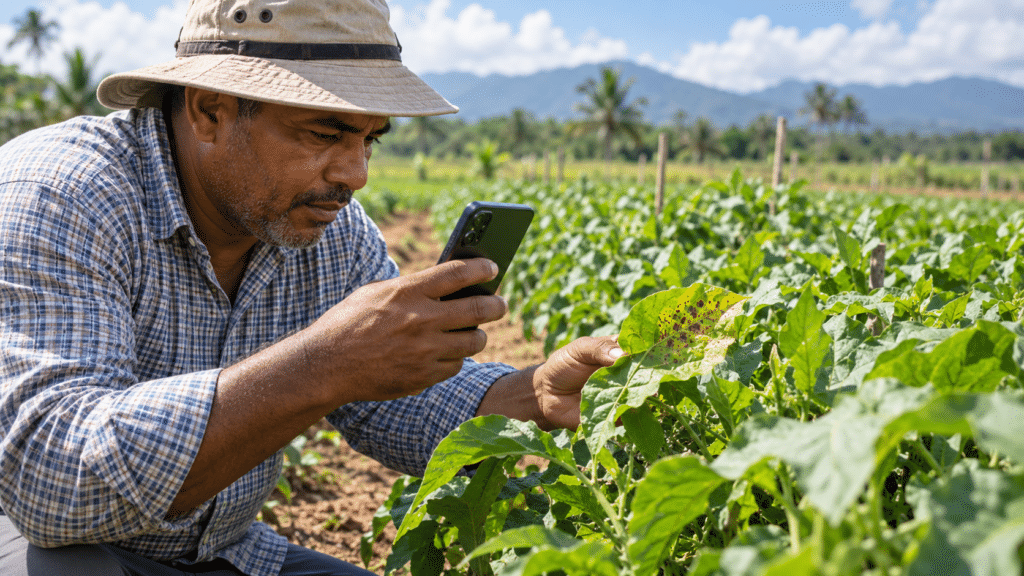
The promise of artificial intelligence in agriculture is straightforward: instead of relying entirely on a farmer or technician to recognize a disease or insect pest by sight, a camera could capture an image and a trained computer model could identify the visual pattern in seconds. The technology is usually based on deep learning, a branch of machine learning that allows neural networks to learn visual features from large collections of labeled images.
A research study published in Scientific Programming tested that idea with an image-recognition system based on an improved version of the AlexNet convolutional neural network. The researchers designed the system to identify crop diseases and insect pests, using image preprocessing and modifications to the original network architecture. Their main experiment focused on fragrant-pear leaves and three pest categories, where the proposed model achieved an average recognition rate of 96.26% and an average recognition time of 321 milliseconds.
The result is technically significant, but it needs to be read carefully. The study did not test the system on Dominican farms, did not use a Dominican agricultural image dataset and did not demonstrate that the technology is ready for widespread use by farmers. Its value for the Dominican Republic is therefore indirect: it illustrates what image-based agricultural diagnostics can achieve under defined experimental conditions, while also highlighting the data and field-validation challenges that would have to be addressed before similar systems could become dependable tools in Dominican agriculture.
What the Researchers Built
The study addressed a practical problem in agriculture: diseases and insect pests can spread quickly, while conventional identification depends heavily on human observation and specialist knowledge. The researchers proposed a deep-learning system intended to automate part of that visual identification process.
The core of the system was an improved AlexNet model. AlexNet is a convolutional neural network, or CNN, an architecture designed to recognize patterns in images. Rather than being explicitly programmed with rules such as “look for a brown spot of a certain shape,” a CNN learns combinations of visual features from examples during training.
The researchers modified the original AlexNet structure. According to the study, they retained its first five convolutional layers but removed the fully connected layers, while adjusting other network parameters. The stated objective was to improve recognition efficiency and reduce the risk of overfitting associated with the network’s original fully connected structure.
The image-processing stage was also part of the approach. The researchers collected crop images through field sampling and used nearest-neighbor interpolation during preprocessing. In practical terms, preprocessing standardizes images before they are presented to the neural network, helping the model work with inputs in a consistent format.
The Main Test Focused on Fragrant Pear
The principal experiment centered on images of fragrant pear affected by three pest categories: scarab, pear gall midge and pear leaf sucker. The researchers compared their improved AlexNet system with several other approaches.
| Model or reference | Scarab | Pear gall midge | Pear leaf sucker | Average recognition rate |
|---|---|---|---|---|
| Reference model 1 | 91.28% | 89.72% | 86.58% | 89.19% |
| Reference model 2 | 92.63% | 90.35% | 87.01% | 90.00% |
| Reference model 3 | 94.18% | 92.54% | 89.96% | 92.23% |
| Proposed improved AlexNet | 98.25% | 95.81% | 94.73% | 96.26% |
The proposed model produced the highest result among the approaches compared in the experiment. Its average recognition rate was 96.26%, while its reported recognition time was 321 milliseconds. The study calculated that this average recognition rate was 7.93, 6.96 and 4.37 percentage points higher than the respective comparison methods.
Those numbers describe the performance of this particular experiment. They should not be interpreted as meaning that artificial intelligence can identify 96.26% of all crop diseases and pests in real-world agriculture. The model was trained and evaluated within a defined research dataset and focused primarily on a limited set of categories.
The Model Was Also Tested on Other Crops
One of the more interesting parts of the research was an additional evaluation using other leaf datasets. The researchers tested the proposed model on rice, corn, potato and yellow-peach leaf datasets.
| Dataset | Recognition accuracy |
|---|---|
| Rice leaf | 96.75% |
| Corn leaf | 91.88% |
| Potato leaves | 95.31% |
| Yellow peach leaves | 92.64% |
The authors interpreted these results as evidence that the model had some ability to transfer to related fine-grained leaf-classification tasks. Importantly, the researchers noted that the model was trained without using the maize and yellow-peach datasets and nevertheless achieved recognition rates above 90% on those tests.
That finding is useful, but it should not be confused with broad proof of generalization across agriculture. A model can perform well on a separate dataset and still struggle when confronted with a new crop variety, unfamiliar disease, different camera, different lighting or a background that was absent from the training images.
Why Image Recognition Is Attractive for Agriculture
Plant diseases and insect pests are visual problems. Symptoms may appear as discoloration, spots, lesions, leaf deformation, insect presence or other patterns that can sometimes be detected from photographs.
Deep-learning systems attempt to turn those visual patterns into numerical features that can be classified. During training, the model receives labeled examples and adjusts its internal parameters to distinguish among categories. Once trained, it can process a new image and produce a classification based on patterns it has learned.
The appeal is speed and scalability. A human expert can examine only a limited number of plants at a time. An automated system could potentially screen large numbers of images, including photographs taken with smartphones, fixed cameras, drones or other agricultural monitoring equipment.
That potential is why researchers have increasingly focused on larger and more realistic agricultural image datasets. A major challenge in the field is that many early datasets contained leaves photographed under controlled conditions, often against relatively simple backgrounds. A model can therefore learn visual cues that are easier to recognize in a laboratory-style image than in an actual farm.
The Biggest Challenge Is Not Just the Neural Network
The research highlights an important principle in agricultural artificial intelligence: model architecture is only one part of the system. The quality, diversity and relevance of the training data can be just as important.
A 2021 review of deep-learning research on crop disease and pest detection noted that there was no single large, unified dataset covering the field and that researchers commonly relied on combinations of self-collected and public datasets. The review also emphasized the greater practical value of images captured under natural conditions, where backgrounds, lighting and other variables are more difficult to control.
More recent research has reinforced that point. A 2024 study comparing plant-disease recognition under laboratory, mixed and field conditions found average accuracy falling from 98.22% in laboratory conditions to 91.76% in mixed conditions and 71.55% in field conditions. The result came from experiments involving diseases affecting apple, potato and tomato and several different neural-network architectures.
This difference is crucial when interpreting high accuracy figures. A system can be highly accurate on a benchmark and still require substantial additional development before it can be trusted in uncontrolled agricultural environments.
Why the Dominican Republic Is a Relevant Context
The study itself is not about the Dominican Republic. Its crops, datasets and experimental environment cannot be presented as representative of Dominican agriculture.
But the technology addresses a problem that exists in the Dominican agricultural sector: plant-health monitoring. The country’s Ministry of Agriculture maintains a Department of Plant Health and a broader phytosanitary system responsible for preventing, monitoring and responding to agricultural pests and diseases.
Dominican official documents identify a wide range of crop-health threats. A Ministry of Agriculture risk-reduction plan lists diseases and pests affecting different regions and crops, including black and yellow Sigatoka in bananas and plantains, anthracnose, Botrytis, fall armyworm, coffee berry borer and coffee rust, among others. The document also identifies different pest and disease profiles across the country’s agricultural regions.
This is where image-based AI could become relevant in principle. A farmer or technician could potentially photograph a symptomatic plant, use a trained model to screen the image and obtain a preliminary classification. Such a system could help prioritize cases for human inspection, especially where agricultural specialists cannot examine every field immediately.
That is a possible application, not a finding of the study. The research does not establish that the Dominican Republic currently operates such a system at scale.
Dominican Agriculture Already Has a Significant Plant-Health Infrastructure
Artificial intelligence would also enter an existing institutional system rather than replace it. In December 2025, the Dominican Ministry of Agriculture reported that its Plant Health and Food Safety departments had strengthened phytosanitary surveillance and that the country had recorded no entry of quarantine pests during that year, according to the ministry. It attributed the result to measures including controls at airports, ports and border areas.
The ministry also works with the Organismo Internacional Regional de Sanidad Agropecuaria, or OIRSA, on agricultural health and quarantine issues. The ministry said in 2025 that OIRSA had been working in the Dominican Republic for two decades on areas including plant health, agricultural quarantine and the prevention, control and eradication of pests and diseases.
That context matters because an AI image classifier would be most useful as part of a broader surveillance chain. Detection is only the first step. A suspected disease may require laboratory confirmation, field inspection, containment measures or another official response.
The Crops in the Research Are Relevant—but Not All Equally So
The model was tested on rice, corn, potato and yellow peach leaves in addition to its main fragrant-pear experiment. Some of these crops have direct relevance to the Dominican Republic, while others are less central to the country’s agricultural profile.
Official Dominican statistics show that rice is one of the country’s major crops. The National Statistics Office, or ONE, reported 187,682 hectares of rice harvested in 2024. It also reported 47,716 hectares of corn harvested that year and 4,299 hectares of potatoes.
The broader agricultural picture is even more diverse. ONE’s agricultural statistics include crops such as plantains, bananas, cassava, beans, sweet potatoes, coconut, avocado and other fruits and vegetables. In the first quarter of 2025, rice accounted for 48.7% of the recorded area planted among the major crops in the statistical bulletin, while plantains accounted for 11.1%, corn 6.4% and cassava 4.5%.
These figures illustrate both the opportunity and the limitation. A technology demonstrated on rice or potato leaves could be relevant to Dominican agriculture, but a useful Dominican system would ultimately need data from the crops, varieties, diseases, pests and environmental conditions actually encountered in the country.
What Would Have to Change for a Dominican Application?
A Dominican agricultural AI system would need its own representative image data. That means photographs collected under Dominican field conditions rather than relying exclusively on datasets created elsewhere.
The dataset would ideally need to capture variation in:
- crop species and local varieties;
- diseases and insect pests found in the Dominican Republic;
- different stages of infection or infestation;
- healthy plants and visually similar conditions;
- lighting, weather and camera differences;
- soil, foliage and farm backgrounds;
- different geographic and production environments.
The reason is straightforward: a disease symptom does not appear in isolation. A photograph taken in a commercial field can contain leaves, stems, soil, weeds, shadows, irrigation equipment and other visual information that was not present in a controlled dataset.
Models therefore need to learn the disease or pest rather than accidentally learning the background associated with a particular class. This is one reason field-specific datasets are increasingly important in agricultural computer vision.
Accuracy Alone Is Not Enough
The study emphasizes recognition accuracy and recognition time, but an operational agricultural diagnostic system would need a wider set of performance measures.
Accuracy tells us the proportion of predictions that are correct overall. It can be useful when classes are balanced, but it can become misleading when some diseases or pests appear much more frequently than others.
Precision asks how many of the cases the model labels as a particular condition are actually that condition. Recall asks how many of the true cases the model successfully identifies. In agricultural surveillance, both can matter. Missing a serious pest can have different consequences from incorrectly flagging a healthy plant.
A real system would also need to deal with images in which the relevant symptom is too small, partially hidden or ambiguous. It would need a way to indicate uncertainty rather than forcing every image into a category it may not recognize.
These considerations become particularly important when moving from a research benchmark to a decision-support tool. A model should not be treated as an expert simply because its test-set accuracy is high.
One of the Study’s Most Important Limitations
The authors themselves identify limitations in the proposed approach. Most importantly, they note that the model is focused on specific crops, diseases or pests and that performance is less satisfactory when dealing with a broader variety of diseases and pests.
That limitation goes to the heart of agricultural diagnosis. Farms do not present one disease at a time in perfectly labeled images. A single plant may show several symptoms, multiple stresses can occur simultaneously, and visual damage can result from causes that look similar.
A model trained to distinguish three pear pests is therefore not equivalent to a general agricultural doctor. Expanding the number of classes requires more representative images, reliable labeling and testing across independent field conditions.
The research also does not demonstrate the model’s performance in the full range of uncontrolled environments that a commercial agricultural tool would encounter. The distinction between benchmark performance and field performance is well documented in the wider literature.
What the Research Means for Farmers and Agricultural Technicians
The most realistic near-term interpretation is that deep learning could become a screening and decision-support technology, rather than an autonomous replacement for agricultural expertise.
A possible workflow would be simple: a farmer or field technician photographs a suspicious plant; an AI system compares the image with a validated reference model; the system returns one or more likely categories together with a confidence estimate; and a trained professional determines whether further inspection or laboratory testing is necessary.
Such a system could potentially reduce the time required to identify cases worth investigating. It could also create standardized digital records that help agricultural authorities understand where particular symptoms are being reported.
But none of those operational benefits were demonstrated in the study itself. They are potential applications inferred from the type of technology investigated and should not be presented as proven outcomes of the experiment.

The Technology Could Fit Into a Larger Surveillance Network
The Dominican Republic already maintains agricultural surveillance mechanisms, including phytosanitary controls at points of entry and field-level monitoring. In 2026, the Ministry of Agriculture announced additional measures in the border province of Elías Piña, including strengthened surveillance of border plots and inspections intended to prevent the movement of prohibited agricultural products and the introduction of pests and diseases.
That makes the concept of automated image screening potentially relevant beyond individual farms. If sufficiently accurate and locally trained, image-based systems could eventually contribute data to a wider monitoring network.
But integration would require institutional standards. Authorities would need to establish how images are collected, how diagnoses are validated, how false positives and false negatives are handled, who can access the data and when an AI-generated alert triggers an official investigation.
Those are implementation questions that the pear-focused research does not answer.
Why Local Data Would Matter in the Dominican Republic
The strongest lesson for the Dominican Republic is therefore not that it should simply adopt the model described in the study. It is that local agricultural data would be essential if the country wanted to build or validate a comparable system.
The country’s agricultural environment is distinct from the environments represented in the research. Different varieties, weather patterns, management practices, pests, diseases and image-capture conditions can all affect model performance.
Training with local images would also allow researchers to address diseases and pests that matter specifically to Dominican producers. A national dataset could be organized by crop, geographic area, symptom, confirmed diagnosis and stage of infestation, provided the necessary expert validation and data-management standards were in place.
That kind of dataset could have value beyond a single AI model. It could support research, extension services, early-warning systems and digital agricultural tools, while also providing a structured record of plant-health observations.
AI Does Not Eliminate the Need for Plant Experts
One of the easiest mistakes in interpreting agricultural AI research is to confuse visual classification with diagnosis in the broader scientific sense.
A photograph can contain clues, but some diseases require laboratory analysis to confirm the causal organism. Nutrient deficiencies, environmental stress, pesticide injury and infectious diseases can sometimes produce overlapping visual symptoms. An image model may identify a pattern without establishing the underlying cause.
For that reason, an AI system should be understood as a tool that produces a classification or probability based on its training—not as independent proof of a biological diagnosis.
This distinction is particularly important for official plant-health decisions, where misidentification can have consequences for containment, trade and agricultural production.
What the Research Says About Speed
The reported 321-millisecond recognition time is one of the study’s notable technical results. It suggests that the modified model was designed not only for accuracy but also for computational efficiency.
Fast inference could be valuable in applications where many images need to be screened. But processing time measured in a research environment is not the same as end-to-end response time for a farmer. A practical service would also involve taking the photograph, uploading or processing it, running the model, communicating the result and, when necessary, obtaining expert confirmation.
Hardware requirements, internet connectivity and software integration would also influence real-world performance. The study does not establish the cost or infrastructure requirements of deploying the system at Dominican farms.
The Bigger Shift in Agricultural AI
The research belongs to a broader movement toward computer vision in agriculture. Earlier work demonstrated that convolutional neural networks could classify plant diseases from large collections of leaf images. One widely cited 2016 study trained a deep CNN on more than 54,000 images covering 14 crop species and 26 disease or healthy categories and reported 99.35% accuracy on its held-out test set.
More recent work has increasingly focused on the harder problem of recognizing disease and pests under realistic conditions. A 2025 benchmark called DLCPD-25 assembled 221,943 images across 23 crop types and 203 categories of pests, diseases and healthy states, deliberately incorporating field images and the uneven class distributions found in natural agricultural environments. The best self-supervised model in that study reached 72.1% accuracy and a 71.3% macro F1 score in the reported downstream task.
The contrast is instructive. A very high score on a carefully controlled dataset and a lower score on a much larger, more diverse field-oriented benchmark are not necessarily contradictory. They illustrate how much harder the recognition problem becomes as the data more closely resemble real farming conditions.
What Should Be Taken From This Study?
The study provides evidence that an appropriately modified deep-learning architecture can recognize certain crop pests from images with high accuracy within the experimental setting. It also shows that the approach can produce useful results on several additional leaf datasets, including rice, corn, potato and yellow peach.
But the research does not demonstrate a universal crop-disease detector, nor does it establish deployment in the Dominican Republic. Its most useful lesson for the country is methodological: agricultural AI needs representative data, careful validation and integration with existing expert and institutional systems.
That lesson is particularly relevant to the Dominican Republic because agriculture spans a wide range of crops and production environments. ONE’s agricultural statistics show substantial areas devoted to rice, corn and other crops, while the Ministry of Agriculture documents a broad range of existing pest and disease threats.
If AI-based plant-health tools are eventually developed for Dominican conditions, the decisive question will not simply be whether a neural network can achieve a high percentage on a test set. It will be whether the system remains reliable when confronted with the plants, pests, diseases, weather, cameras and field conditions that Dominican farmers and agricultural technicians actually encounter.