 25°C
25°C

Major Agricultural Products of the Dominican Republic
The Dominican Republic produces a diverse range of agricultural commodities, from rice, plantains, bananas, sugarcane and cacao to coffee, tobacco, avocados, mangoes, coconuts, pineapples, vegetables, roots and legumes. Agriculture serves both the domestic market and international buyers, making the location of production as important as export performance. Official statistics show particularly strong concentrations of rice in the northern and northeastern agricultural regions, cacao in the Northeast and East, tobacco around Santiago, bananas in the Northwest and other irrigated zones, and fruit and vegetable production across several regions with different climates and irrigation systems.


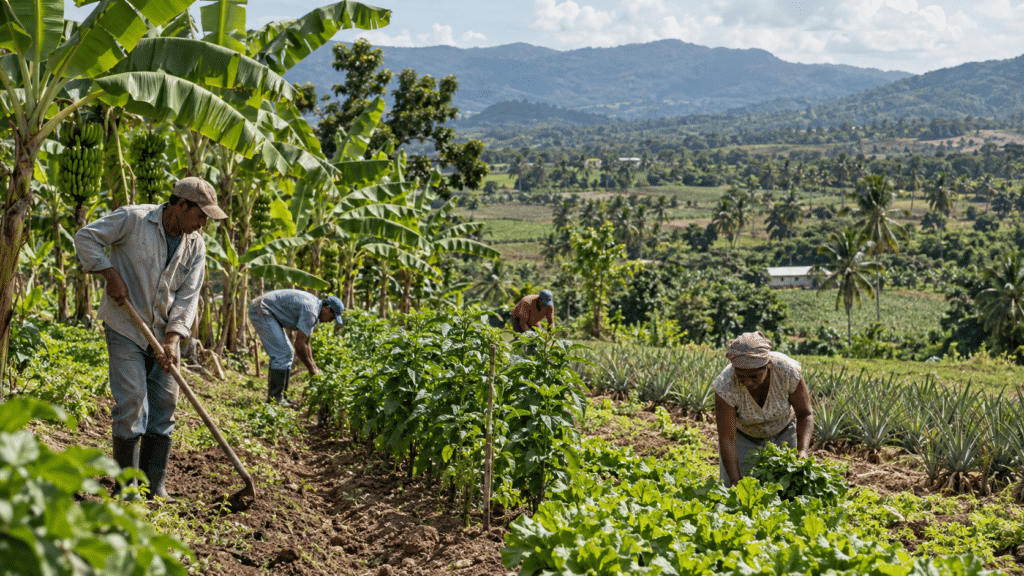
The Dominican Republic has one of the most diversified agricultural systems in the Caribbean. Its combination of tropical and subtropical climates, irrigated plains, mountain environments and fertile valleys allows farmers to produce cereals, tropical fruits, musaceae, roots and tubers, legumes, vegetables, tree crops and traditional commercial crops. The result is an agricultural economy that serves several markets at once: domestic households, food processors, hotels and restaurants, livestock producers and international buyers.
The scale of production varies substantially from one crop to another. Rice is primarily associated with food security and the domestic market, while cacao, tobacco, bananas, coffee, mangoes and avocados have important commercial and export components. Other crops, including plantains, cassava, sweet potatoes, beans, vegetables and many fruits, are consumed predominantly within the country, although some also enter regional and international trade. The Ministry of Agriculture and the National Statistics Office (ONE) maintain annual and monthly datasets covering production, harvested area, yields and prices for the principal crops. ONE agricultural statistics and the Ministry of Agriculture’s agricultural statistics are the principal national references for these measurements.
Rice: The Dominican Republic’s Main Staple Crop
Rice occupies a distinctive position in Dominican agriculture because of its importance to domestic food consumption. It is cultivated in numerous provinces, but production is concentrated in the irrigated agricultural regions of the Northeast, Northwest and North-Central areas. Ministry of Agriculture data have historically identified the Northeast as the largest producing region, followed by the Northwest and North-Central regions. The province of Duarte, in particular, is a major rice-producing area, while La Vega, Monseñor Nouel and other northern provinces also have extensive production.
The country’s rice industry operates around two main planting seasons and depends heavily on irrigation infrastructure. A 2025 national water-planning document describes rice as the agricultural crop with the greatest water demand and reports that the country has been self-sufficient in rice production. It also places average production during 2018–2020 at about 13.5 million quintals and notes per-capita consumption of roughly 127 pounds.
Production has continued to expand. The Ministry of Agriculture reported 14.78 million quintals of national rice production in 2025, equivalent to more than one million metric tons of paddy rice. That figure followed 13.73 million quintals recorded for 2024 in an official agricultural report.
Most rice is destined for domestic consumption rather than export. It is processed through local rice mills and distributed through supermarkets, wholesalers, traditional markets and food-service businesses. Rice also illustrates why agricultural importance cannot be measured only by export earnings: its principal economic role is supplying a basic food consumed on a very large scale, supporting thousands of farmers, millers, transport operators and other participants in the domestic food chain.
Plantains and Bananas
Plantains and bananas are among the most widely cultivated crops in the Dominican Republic. They belong to the musaceae group but serve different commercial roles. Plantains are overwhelmingly associated with the domestic food market, while bananas, particularly organic bananas, have a much stronger export orientation.
Plantain production is spread across several agricultural zones. Important production areas include La Vega, Hermanas Mirabal, Espaillat, Santiago and Duarte in the Cibao, as well as irrigated areas of Azua, Peravia, Barahona, Bahoruco, Valverde and Montecristi. Earlier Ministry of Agriculture production assessments identified the Cibao’s agricultural triangle around La Vega, Hermanas Mirabal and Espaillat as a particularly important concentration.
The domestic market absorbs most plantain production. It is used for mangú, tostones, boiled plantains and numerous other dishes, making the crop an important component of household food consumption and restaurant demand. The Ministry of Agriculture has previously estimated domestic consumption at millions of plantains per day, illustrating the scale of the internal market.
Banana production has a different market structure. The principal producing areas include Montecristi, Valverde, Santiago and Azua. The Dominican Republic has developed a substantial organic banana industry, with production concentrated particularly in the Northwest. Bananas are sold domestically but are also packed and shipped to international markets, where organic certification has become an important commercial characteristic.
Recent Ministry of Agriculture statistics show the scale of both crops. During January–June 2025, national production reached approximately 947,260 metric tons of guineo, the Dominican term commonly used for bananas, and 777,659 metric tons of plantains. These were among the largest volumes recorded for individual agricultural products during the first half of that year.
Cacao: A Major Agroforestry and Export Crop
Cacao is one of the Dominican Republic’s most internationally recognized agricultural products. It is particularly important in the Northeast, where the Ministry of Agriculture has identified the region as the country’s largest producing area, accounting for about 61 percent of national production in one official assessment. Duarte, Sánchez Ramírez, Hato Mayor and other provinces also have substantial cacao-growing areas.
The crop is commonly grown under agroforestry systems, combining cacao trees with shade trees and other vegetation. This production model is especially significant in humid areas and contributes to the economic role of cacao beyond the value of the beans themselves. The Ministry of Agriculture reported in 2025 that approximately 2.75 million tareas were under cacao agroforestry systems and that around 42,000 producers were registered in the sector.
Cacao serves several commercial markets. Beans can be fermented, dried and sold to processors and exporters, while processed cacao enters the chocolate, cocoa powder, cocoa butter and confectionery industries. The Dominican Republic has developed a particularly strong position in organic cacao. ProDominicana lists organic cacao among the country’s principal agricultural export offerings.
The 2024–2025 cacao year illustrates the crop’s economic scale. The Ministry of Agriculture reported approximately 85,000 metric tons of cacao production and 78,000 tons exported, with export revenues of about US$700 million. These figures refer specifically to the cacao year and export performance, rather than the total economic value generated by the entire domestic cacao chain.
Coffee: Mountain Agriculture With a Domestic Market
Coffee has historically been one of the Dominican Republic’s traditional agricultural crops and remains important in mountain and highland communities. Production is associated with several mountainous regions, including areas of the South, Southwest, Central and northern highlands. Coffee cultivation is particularly relevant to smallholder agriculture because plantations can be located on terrain less suitable for large-scale mechanized crops.
The crop has faced production challenges, including plant diseases, aging plantations, hurricanes and other extreme weather events. Government agricultural programs have consequently focused on rehabilitation, replanting and technical assistance. In December 2025, the Ministry of Agriculture reported a program supporting 18,000 tareas of coffee and musaceae plantations in La Vega, Santiago, Valverde and Santiago Rodríguez.
Coffee has an important domestic market because roasted and ground coffee is widely consumed in the Dominican Republic. It is also processed by local roasters and food businesses. The country does not produce enough coffee to satisfy all domestic requirements, meaning the crop’s significance should not be judged solely by its export volume. Government agricultural programs have explicitly discussed increasing domestic production partly to reduce reliance on imported coffee.
Production performance has fluctuated considerably. The Ministry of Agriculture’s 2020–2024 sector review reported strong growth in coffee production in 2021 and 2023, but the Central Bank reported a 10 percent decline in coffee production in 2025. This illustrates the difference between a crop’s long-term agricultural importance and its performance in any individual year.
Sugarcane: A Large-Scale Industrial Crop
Sugarcane is one of the Dominican Republic’s historic commercial crops and differs from rice, plantains and most fruits because its production is closely linked to large industrial operations and sugar processing. Sugarcane is concentrated primarily in the eastern and southeastern parts of the country, where large plantations supply sugar mills.
The crop is harvested for industrial processing rather than being sold primarily as a fresh food. Its principal commercial products include raw and refined sugar, molasses and related by-products. Sugarcane also supports employment and services associated with harvesting, transportation, milling, refining and industrial processing.
The scale of cane production is substantially larger when measured by raw agricultural weight than many fruit and food crops. Historical ONE statistics recorded several million metric tons of sugarcane production annually, reflecting the high weight of the harvested stalks. The relevant economic comparison therefore needs to distinguish between farm-level cane output and the value of processed sugar and related products.
Sugarcane remains economically relevant even though the structure of the Dominican agricultural economy has diversified considerably. The Central Bank reported that sugarcane production increased by 10.3 percent in 2025, placing it among the crops that contributed positively to agricultural value-added growth that year.
Tobacco: Concentrated Production and High-Value Processing
Tobacco occupies a smaller physical area than rice or sugarcane but has an unusually important processing and manufacturing component. The crop is particularly associated with the Cibao, with Santiago serving as the country’s principal production area. The Ministry of Agriculture has reported that approximately 51 percent of tobacco cultivation is concentrated in Santiago, while additional production takes place in about a dozen other provinces.
Dominican tobacco is primarily associated with cigar manufacturing. The commercial chain extends from farmers producing tobacco leaves to curing facilities, processors, cigar factories, exporters, distributors and specialized retailers. This means the economic value of tobacco cannot be measured only by the value of unprocessed leaf production.
The crop also has an important international market. Dominican cigars are sold in North America, Europe and other markets, while domestic cigar production supports a specialized manufacturing industry. The Ministry of Agriculture identifies tobacco among the country’s most important agricultural export sectors.
Production itself can fluctuate from year to year. The Central Bank reported a 0.9 percent decline in raw tobacco production in 2025, even as several other major crops expanded.
Avocados
Avocado production has become increasingly important within the Dominican fruit sector. It is cultivated in several regions, including the South, Southwest, Central and eastern agricultural zones. The crop benefits from the country’s varied elevations and microclimates, which allow different production areas to supply markets at different times.
Avocados serve both domestic consumers and export markets. They are sold fresh through traditional markets, supermarkets, restaurants and food-service channels, while export-oriented farms and packing operations supply international buyers. Monte Plata, for example, is among the provinces producing avocado alongside pineapple, peppers, squash and other commercial crops.
Official agricultural data show the crop’s recent expansion. The Ministry of Agriculture reported production of approximately 2.179 million units in 2024, compared with 1.808 million in 2023, although the unit-based measurement used in that particular series should not be confused with metric-ton production statistics from other agricultural datasets. The same report estimated US$90.98 million in foreign-exchange earnings from avocado exports in 2024.
Mangoes
Mango is another important Dominican fruit with a dual domestic and export market. Production is particularly associated with the southern province of Peravia, especially the area around Baní, although mango is cultivated elsewhere in the country. Baní has become a major center for mango production, commercialization and agricultural events.
The country grows hundreds of mango varieties, with Keitt among the varieties particularly important for international trade. Dominican mangoes are consumed fresh domestically and are also shipped to the United States, the European Union and the United Kingdom. In 2024, the Ministry of Agriculture reported expectations of more than nine million export boxes, equivalent to about 32 million kilograms, with the European Union accounting for approximately 47 percent of shipments, the United States 28 percent and the United Kingdom about 22 percent.
Mango also demonstrates the importance of agricultural processing and logistics. Export-oriented production requires grading, packing, traceability, phytosanitary controls and, for certain markets, specialized treatment. These activities create economic value beyond the farm itself.
Coconut and Other Tropical Tree Crops
Coconut is widely grown in humid and coastal areas and is used for fresh consumption, cooking, beverages, confectionery, oil and other processed products. It is particularly associated with the Northeast and eastern parts of the country, although production is distributed across several regions.
In the first half of 2025, the Dominican Republic produced approximately 309,644 metric tons of coconut, compared with 284,075 tons during the corresponding period of 2024, according to the agricultural statistics bulletin prepared by ONE using Ministry of Agriculture data. Coconut production was therefore among the significant contributors to the country’s tropical fruit and oil-bearing crop base.
Other tree crops include papaya, citrus, guava, soursop and sapote. Their economic importance varies according to region and season, with much of the production entering domestic fresh-food markets while selected crops and varieties are increasingly connected to processing and export chains.
Pineapple and Other Commercial Fruits
Pineapple is cultivated in several areas, including Monte Plata and other regions with suitable soils and rainfall conditions. It is sold fresh and can also supply juice, food processing and hospitality businesses. Monte Plata agriculture includes pineapple alongside avocado, peppers, squash and sweet potatoes, illustrating how individual provinces often maintain diversified crop portfolios rather than specializing in only one commodity.
Official production statistics show the scale of the fruit sector as a whole. During January–June 2025, fruit crops accounted for approximately 2.85 million metric tons of production, making fruit the largest agricultural product group by volume among the categories reported in the national statistical bulletin. Musaceae followed with about 1.72 million tons, while vegetables accounted for about 884,074 tons.
Among individual fruits, the same six-month dataset recorded approximately 990,942 tons of papaya, 947,260 tons of bananas, 777,659 tons of plantains, 550,372 tons of pineapple and 524,471 tons of avocado. These figures demonstrate that the Dominican agricultural economy is much broader than its best-known export crops.
Roots, Tubers and Legumes
Roots and tubers are central to the domestic food system. Cassava, sweet potatoes and other root crops are cultivated in different regions and are sold primarily through domestic markets. They are consumed boiled, fried or processed into traditional foods and are also used as ingredients in food manufacturing.
Yuca, or cassava, has a particularly broad production footprint because it can be grown under conditions that are less suitable for some higher-value commercial crops. Sweet potatoes are similarly important in household consumption and local food markets. During January–June 2025, official statistics recorded approximately 125,709 metric tons of yuca and 53,957 tons of sweet potatoes.
Legumes are another important part of the agricultural system. Red and black beans and pigeon peas, known locally as habichuelas and guandules, are widely consumed in Dominican cuisine. Production is concentrated in several regions, including the Southwest, South, East and North-Central areas depending on the crop and production cycle. Ministry of Agriculture planning documents identify the Southwest and other southern regions as important areas for several major legumes.
Vegetables and Protected Agriculture
Vegetable production is more geographically diverse than the large plantation crops. Tomatoes, onions, peppers, squash, carrots, cabbage and other vegetables are cultivated in open fields, while high-value vegetables are also produced under protected agriculture, particularly in greenhouses.
The Dominican Republic has developed a substantial protected-agriculture sector that allows producers to control growing conditions more closely and supply markets with vegetables that require greater consistency in quality and appearance. ONE maintains separate statistics for vegetable and fruit production under greenhouse conditions, while the Ministry of Agriculture publishes annual information on protected agriculture infrastructure and production.
During January–June 2025, vegetable production totaled approximately 884,074 metric tons across the main categories reported by ONE. The largest individual volumes included tayota at about 374,504 tons, industrial tomato at 137,409 tons, onions at 84,369 tons, peppers at 44,741 tons and carrots at 38,167 tons.
Vegetables serve several markets simultaneously. Domestic households and restaurants are major buyers, while hotels and tourism businesses create substantial demand for consistent supplies. Selected vegetables, including Asian vegetables and greenhouse crops, also have established export channels. ProDominicana identifies greenhouse vegetables, Asian vegetables and aromatic herbs among the country’s agricultural export offerings.
Where the Main Agricultural Products Are Produced
Dominican agriculture is organized around distinct agricultural regions rather than a single production zone. The Cibao Valley and northern regions are particularly important for rice, tobacco, plantains and other crops. The Northeast is a major center for rice and cacao. The Northwest, especially the area around Valverde and Montecristi, is important for bananas and irrigated agriculture. The South and Southwest produce plantains, coffee, avocado, vegetables, roots and other crops, while the East has important cacao, sugarcane, coconut and fruit production.
| Crop or group | Main production areas | Principal commercial uses | Main market orientation |
|---|---|---|---|
| Rice | Northeast, Northwest, North-Central, Southwest | Rice for household consumption, food service and processing | Primarily domestic |
| Cacao | Northeast, East, Duarte, Sánchez Ramírez and other humid zones | Cocoa beans, chocolate, cocoa butter and powder | Domestic processing and export |
| Plantains | Cibao, South, Southwest and irrigated areas of the Northwest | Mangú, tostones, cooking and food processing | Primarily domestic |
| Bananas | Montecristi, Valverde, Santiago, Azua and other production zones | Fresh fruit and processed food | Domestic and export |
| Tobacco | Santiago and other Cibao provinces | Cigars and tobacco products | Domestic processing and export |
| Coffee | Mountain areas in the North, Central, South and Southwest | Roasted and ground coffee | Primarily domestic, with export trade |
| Sugarcane | East and Southeast | Sugar, molasses and industrial by-products | Domestic processing and export |
| Avocado | South, Southwest, Central and other suitable zones | Fresh consumption and food service | Domestic and export |
| Mango | Peravia and other southern and central areas | Fresh fruit, juice and processing | Domestic and export |
| Coconut | Northeast, East and coastal areas | Fresh coconut, oil, beverages and food products | Domestic and export |
Domestic Consumption Is as Important as Exports
It is misleading to view Dominican agriculture primarily through its export crops. A substantial share of agricultural production exists to supply the country’s population, tourism industry, restaurants, food processors and other domestic buyers. Rice and plantains are particularly clear examples, while cassava, sweet potatoes, beans, vegetables, bananas and many fruits also have large domestic markets.
The importance of domestic consumption is reflected in the composition of national production. During January–June 2025, the agricultural groups recorded by ONE produced more than 6.5 million metric tons across cereals, oleaginous crops, legumes, roots and tubers, musaceae, vegetables and fruits. Fruits alone represented about 2.85 million tons, while musaceae contributed approximately 1.72 million tons.
The domestic market also connects agriculture with tourism. Hotels, restaurants and institutional food services require continuous supplies of rice, plantains, vegetables, fruits, roots and other products. Consequently, improvements in agricultural production can affect not only farm incomes but also food distribution, retail, hospitality and food processing.

Major Agricultural Products and International Markets
Export markets are especially significant for crops capable of generating higher value per unit or for which the Dominican Republic has developed specialized production and processing capabilities. Cacao, tobacco, bananas, mangoes, avocados, sugar and selected vegetables are among the products with established international demand.
The United States and European markets are particularly important for several Dominican agricultural products, although destination patterns vary by commodity. Mango exports, for example, have significant exposure to the European Union, United States and United Kingdom, while specialized Dominican cigar products have a broader international distribution. Organic cacao and bananas also have established international markets.
Official customs data provide detailed information on agricultural trade by product, tariff classification and destination. The General Directorate of Customs maintains export statistics covering individual tariff lines and trading partners, while ONE publishes broader foreign-trade statistical reports. Dominican Customs export statistics and ONE Foreign Trade Yearbook are useful references when examining agricultural trade by commodity.
The Economic Role of Agriculture
Agriculture contributes to the Dominican economy through several channels: direct farm production, food processing, rural employment, domestic food supply, tourism supply chains and exports. The economic impact of a crop therefore extends beyond its farm-gate price.
The Central Bank reported that agricultural value added increased by 5.4 percent in 2025. The strongest positive contributors included coconut, cacao, sugarcane, avocado, plantain, banana, pigeon peas, beans, rice and cassava. Coffee and raw tobacco were among the products that recorded declines that year.
Financing is another measure of agricultural economic activity. In 2025, the Agricultural Bank disbursed RD$25.9 billion across agricultural, livestock and related activities, of which RD$18.35 billion, or 70.9 percent, went to agriculture. The figure covers financing rather than production value, but it illustrates the scale of financial resources circulating through the agricultural sector.
How the Crop Structure Is Changing
The Dominican agricultural system combines long-established crops with expanding commercial fruit, vegetable and protected-agriculture activities. Rice, sugarcane, tobacco, coffee and cacao remain important traditional products, while avocado, mango, pineapple, greenhouse vegetables and other higher-value crops have expanded their commercial importance.
Recent production data show that this diversification is not merely an export phenomenon. During the first half of 2025, production increased across cereals, oleaginous crops, legumes, roots and tubers, musaceae and vegetables compared with the corresponding period of 2024. Fruit production also increased slightly, although individual crops experienced very different changes.
The result is an agricultural economy with several distinct layers: large-scale industrial crops such as sugarcane; highly organized staple-food production such as rice; smallholder and agroforestry systems such as cacao and coffee; specialized export agriculture such as bananas, mangoes and avocados; and broad domestic production of plantains, roots, legumes, vegetables and fruit.
The Main Agricultural Products in Perspective
No single crop defines Dominican agriculture. Rice is central to food security and domestic consumption; plantains, roots, tubers, legumes and vegetables supply everyday food markets; cacao and tobacco connect farming to sophisticated international processing industries; sugarcane supports a large industrial chain; coffee remains important to mountain communities and domestic consumption; and fruits such as bananas, avocados, mangoes, pineapple and coconut combine local demand with opportunities in international markets.
The latest national statistics reinforce the breadth of this production base. ONE maintains annual series covering production, yields and harvested areas through 2025, while the Ministry of Agriculture publishes more detailed monthly and regional agricultural data. FAOSTAT provides internationally harmonized production and trade series that can be used alongside Dominican national statistics when comparisons with other countries are required.
For readers assessing the Dominican agricultural economy, the most useful distinction is therefore between crops according to their role rather than simply their export value. Some products are principally food-security crops, some are major domestic commercial commodities, some support specialized processing industries, and others generate substantial foreign-exchange earnings. Together, these categories explain the economic importance and geographic diversity of agriculture in the Dominican Republic.