 28°C
28°C

INTEC Researchers Study Borophene Graphyne For Next-Gen Chips
Researchers at the Instituto Tecnológico de Santo Domingo (INTEC) are studying a two-dimensional borophene-graphyne material that could eventually support smaller and more efficient electronic devices beyond conventional silicon-based CMOS technology.


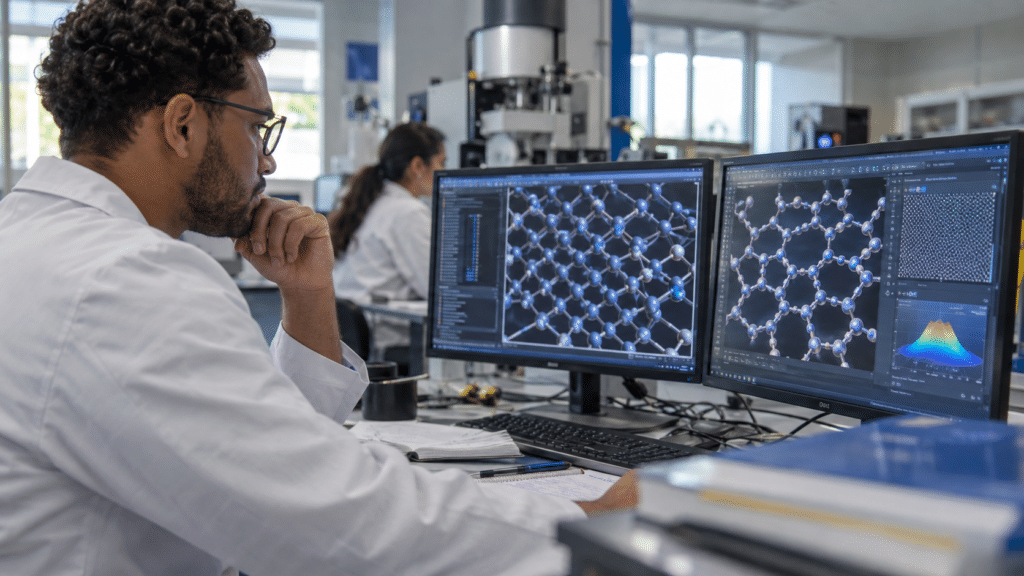
Researchers at the Instituto Tecnológico de Santo Domingo (INTEC) are studying a combination of borophene and graphyne at the atomic scale as part of research into technologies that could help advance semiconductors beyond conventional silicon-based CMOS systems.
The theoretical study examines whether the proposed borophene-graphyne compound can control electrical current at extremely small scales. If its predicted properties are confirmed through experimental research, the material could potentially become a candidate for future electronic components operating at dimensions approaching the atomic scale.
Research Explores Alternatives to Conventional Silicon
The study addresses one of the major challenges in semiconductor research: developing increasingly smaller electronic components while maintaining control over voltage, current and energy consumption. Silicon remains the foundation of modern semiconductor technology, but continued miniaturization is encouraging researchers to investigate new materials and device architectures.
This challenge is at the center of the Beyond-CMOS field, which explores alternatives to conventional complementary metal-oxide-semiconductor technology. The INTEC research examines whether atomically thin materials could offer properties suitable for future generations of electronic devices.
Borophene is a two-dimensional material composed of boron atoms, while graphyne is a carbon-based two-dimensional material. The INTEC study combines the two within a theoretical framework to investigate their structural, electronic and transport properties.
A Potential New Direction in Dominican Republic Inventions
The research is also part of a broader body of scientific and technological work emerging from the Dominican Republic. Within the context of Dominican Republic inventions, the study illustrates how researchers at Dominican universities are investigating advanced materials and technologies with potential applications beyond the country’s traditional industrial sectors.
However, the research remains at a theoretical stage. The findings do not demonstrate that the proposed material can currently be used in commercial semiconductor devices or replace silicon-based chips. Instead, the study evaluates whether its predicted characteristics warrant further investigation and eventual experimental testing.
Potential Applications in Advanced Electronics
The study, titled “Borophene-Graphyne Compound (BGC) for Beyond-CMOS Electronics: A First-Principles, Phonon, Molecular Dynamics and Quantum Transport Falsifiable Framework,” evaluates whether the material could provide the characteristics required to control electrical transport at atomic dimensions.
One of the device concepts examined is the tunneling field-effect transistor (TFET), which uses quantum tunneling to regulate electrical current. The researchers also identify possible applications in transistors, quantum capacitance devices, plasmonics and tunneling diodes, depending on whether the material’s predicted properties can eventually be validated experimentally.
The research combines first-principles calculations, phonon analysis, molecular dynamics and quantum transport methods. These computational approaches allow scientists to examine the potential behavior of the proposed material before moving toward device fabrication and experimental validation.
INTEC Researchers Behind the Study
Baldo Alberto Luigi Dalporto, a faculty member and researcher in INTEC’s engineering area, is the lead author of the study. His research focuses on electronics applied to physics, and his contributions included conceptualization, methodology, project administration, visualization and preparation of the study.
Sabine Mary, an INTEC researcher and co-author, contributed to the methodology, validation and scientific supervision. Santiago Gallur, also an INTEC researcher and co-author, worked on conceptualization, formal analysis, methodology and validation, as well as the scientific review of the research.
What the Research Could Mean for Future Electronics
The work places INTEC within a broader international scientific effort to investigate atomically thin materials and alternative mechanisms for future semiconductor technologies. Research into materials such as borophene and graphyne could become increasingly relevant as scientists explore ways to overcome some of the physical and engineering limitations associated with continued semiconductor miniaturization.
For the Dominican Republic, the study also highlights the growing role of university-based research in advanced science and technology. While the borophene-graphyne compound is not yet a demonstrated commercial technology, the research provides a theoretical basis for further investigation into materials that could eventually contribute to next-generation electronic devices.